Who Ate the Cheese


Who Ate the Cheese?!
Introduction:

DNA isolation from blood, hair, skin cells, or other genetic evidence left at the scene of a crime can be compared with the DNA of a criminal suspect to determine guilt or innocence. This is due to the fact that every person has a different sequence. Scientists use a small number of sequences of DNA that are known to vary among individuals, and analyze those to get a possibility of a match.  DNA is isolated, cut using restriction enzymes and sorted by size by gel electrophoresis. DNA is placed in a gel and an electrical charge is applied to the gel. The positive charge is at the top and the negative charge is at the bottom. Because DNA has a slightly negative charge, the pieces of DNA will be attracted to the bottom. The smaller pieces move more quickly towards the bottom than the larger pieces. The DNA can then be analyzed.

Objectives:

In this simulation you will examine crime scene evidence to determine who is responsible for eating the Queen’s special imported Lindbergher Cheese (yes, the stinky cheese). You will model the process of electrophoresis and DNA fingerprinting.

ROYAL GUARD INCIDENT REPORT

Incident Data

Incident Type: Theft Complaint Status Pending DNA results
Processed by: Chief Wiggam Other Officers: Officer Li Gase

Property

Property Code: Rare cheese Owner’s Name Queen Elizabeth
Name: Lindbergher Value: $12,000

Burglary Data

Method of Entry: Unknown, no evidence of force on doors or windows.

Narrative: The cheese was allegedly stolen from the Queen’s sitting room the night before the grand ball. The cheese was listed as a gift from the Manchurian diplomat. Officer Li Gase dusted for fingerprints and found none on the table or doors, the maid claimed that they had been wiped clean earlier. The wheel of cheese was on a platform in the sitting room, and half of it had been eaten. We took pictures of the half eaten cheese and sent it to the lab for further tests. Edna N. Zime, the lab technician said that saliva samples could be taken from the teeth imprints of the cheese that was left behind.

Suspect Data

Suspect Number: 1
Name: Princess Dubbah Elix
Description of Suspicion: The princess was seen entering the sitting room earlier in the evening. She is well known for her love of cheese.

Suspect Number 2
Name: Electra Foresis
Description of Suspicion: Electra was recently involved in a relationship with the Manchurian diplomat that sources say ended badly. Her motive may have been to sabotage the diplomat’s gift to the Queen.

Suspect Number 3
Name: Ada Nine
Description of Suspicion: Ada was the maid in charge of cleaning the sitting room. She had access to the cheese.

Suspect Number 4
Name: Gene Tics
Description of Suspicion: Gene is the leader of the local Cheese-Makers Guild, he may not have wished for Queen Elizabeth to have cheese from anywhere but his own guild.

Crime Lab Data

Crime Lab Investigator R. Renee Lab Technician Edna N. Zime
List of Evidence Received Plastic bag with cheese crumbs List of Procedures Used DNA extraction
Polymerase Chain Reaction
DNA restriction Analysis

Narrative: After receiving the package with the plastic bag marked Crime Scene, the DNA was extracted. Because the sample was so mall, the DNA was amplified using the polymerase chain reaction. We isolated the DNA from the four suspects and compared them to the crime scene DNA using DNA restriction analysis.

Results: See attached DNA Results

DNA Evidence Evaluation:

1. Turn your paper strips (DNA sequences) so that the side with the bases is facing you. The restriction enzyme cuts at every point it finds C C G G, always cutting between the C and the G. Label the back of the slips with the suspect number so that you don’t get them confused after cutting. Use scissors to cut the DNA sequence at the C C G G points.

2. Count the number of base pairs (bp) in each piece of DNA that you created. Record the base pair number on the back side of the DNA fragment.

3. Make an enlarged chart like the one shown. Your teacher will give you paper for this. Use a ruler to ensure that the lengths are uniform.

4. Tape your DNA fragments to the chart, using the base pair numbers as a guideline for fragment placement.

5. Compare the crime scene DNA to the suspects and indicate on your chart, which suspect is guilty of eating the cheese.


ANALYSIS:

1. On your chart, label the positive (+) and the negative (-) ends. Circle the suspect’s DNA who matches the DNA at the crime scene and write the name of the suspect.

2. For each of the following tasks performed in the activity, describe what they are actually simulating.

Cutting the DNA into fragments:


Taping the DNA onto the large paper:


3. For each word below, describe how it relates to DNA Fingerprinting:

Polymerase Chain Reaction:


Gel Electrophoresis:


Restriction Enzyme:


BACK

Why Boats Float

How does a heavy boat float?


A boat, or any other object designed to float, is based on a theory by a very old guy, even older than Capt. Matt. Though he is old and, by the way, dead, he was really a cool guy and his name was Archimedes (Ark-i’-meed-eez). His principle, cleverly named the Archimedes’ Principle, explains how things float.

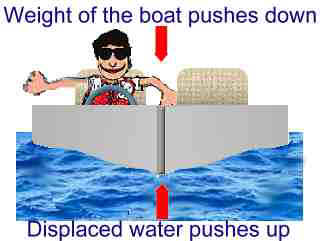
If you fill your bathtub with water, what happens when you get in? The water rises, right? (And sometimes goes over the side.) That is because you “displaced” some of the water with your body and it had to go somewhere. The key to floating is that the object must displace an amount of water which is equal to its own weight.

For example, suppose you had a block of wood that was 1 foot square. Let’s say that this block of wood weighs about 50 pounds. Now say we lower that wood into the water. The wood will move down into the water until it has displaced 50 pounds of water. That means that fifty pounds of water are pushing back up on the block and making it float.

The principle of floating is pretty easy, however, if you want to remain inside the boat and actually get where you want to go, your boat must have “stability” as well as being able to float. Stability means that it is designed not to tip over easily. That doesn’t mean it won’t ever tip over.


stability1.jpg (8249 bytes)


On a large ship like an ocean liner or tanker, the movement of one person doesn’t affect the stability of the ship because it was designed to safely carry lots of weight. But on a small boat, like a fishing boat, your weight and the weight of your gear (and where you put it) has an effect on the stability of the boat.


stability2.jpg (11938 bytes)


A boat is said to “heel” (no not the one on your foot) when it leans over to one side. This is why you never want to sit or step onto the side of a boat. Your weight could make it “heel” too much and it may tip over. You should also balance the weight of all the stuff you bring with you. In a small boat, you and your gear should always stay low and to the center of the boat. When getting into a small boat, always try to step into the center and keep “one hand for yourself and one for the boat.”


stability3.jpg (11482 bytes)


Of course, because you have on your PFD and are displacing enough water to float, you would be okay, just a little wet and cold. If this should ever happen to you and you can’t right the boat (turn it back over), stay with the boat, blow your whistle or yell for help.

So . . . the next time someone says “Whatever floats your boat” tell them about Archimedes and stability and why it’s a very good idea to always wear your life jacket!


Wise Owl

The Wise Owl          

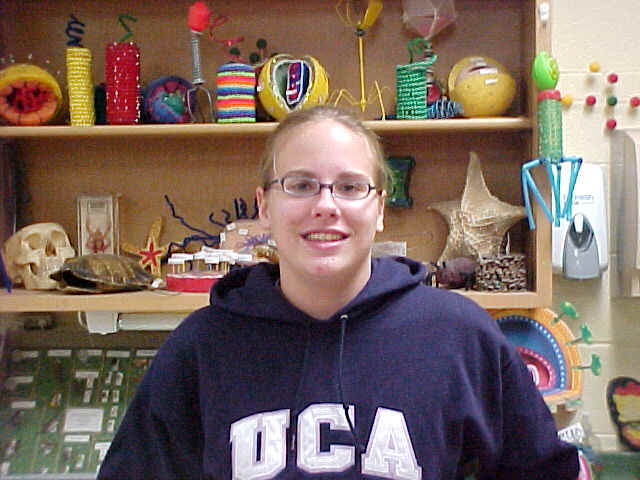
Students who are showing academic excellence in their science class will have their name and picture  on
this web page each week.

2012-13
AP Biology Pre AP Biology   Biology I
Kayla Bass Alice Bewley Tony Jones
Brynn Thomas Jocelyn Brown Siddhi Patel
Mariah Campbell Kayla Hankins Cicily Ashcraft
Are You the next Wise Owl?

Wise Owl Archive


Wiseowl Archive


2008-09
 Chase – AP Biology Ivy – PreAP Biology Hoda – PreAP Biology
Rachael – AP Biology Taylor – Biology I Jacob – PreAP Biology
Koreena – Pre AP Biology Zach – Pre AP Biology Gracen – Pre AP Biology
Amanda – Pre AP Biology Shelby – Pre AP Biology Ashley – AP Biology
Valorie – Biology I Katie – Pre AP Biology Regan – AP Biology
Gabrielle – Biology I John – Pre AP Biology Are You the next Wise Owl?


2007-08
Michael – AP Biology Elizabeth – AP Biology Laura – PreAP Biology
Rachael – Pre AP Biology Ashley – Pre AP Nolan – AP Biology
Julia – Pre AP Biology Josh – Biology I Samantha – Pre AP Biology
Steven – AP Biology Alex – AP Biology Lydia – AP Biology
Amber – AP Biology Are You the next Wise Owl?
2006-07
Chase Charlene Blake
Elizabeth Michael Nolan
Harrison Sijia
Lauren Amber
Steven Joseph Megan
Nenteza Lauren Are You the next Wise Owl?