Graphing Practice

Graphing Practice

Introduction

  • Graphing is an important procedure used by scientists to display the data that is collected during a controlled experiment
  • Line graphs must be constructed correctly to accurately portray the data collected
  • Many times the wrong construction of a graph detracts from the acceptance of an individual’s hypothesis
  • A graph contains five major parts:
    a. Title
    b. The independent variable
    c. The dependent variable
    d. The scales for each variable
    e. A legend
  • The title: depicts what the graph is about. By reading the title, the reader should get an idea about the graph. It should be a concise statement placed above the graph.
  • The Independent Variable: is the variable that can be controlled by the experimenter. It usually includes time (dates, minutes, hours), depth (feet, meters), temperature (Celsius). This variable is placed on the X axis (horizontal axis).
  • The Dependent Variable: is the variable that is directly affected by the independent variable. It is the result of what happens because of the independent variable. Example: How many oxygen bubbles are produced by a plant located five meters below the surface of the water? The oxygen bubbles are dependent on the depth of the water. This variable is placed on the Y-axis or vertical axis.
  • The Scales for each Variable: In constructing a graph one needs to know where to plot the points representing the data. In order to do this a scale must be employed to include all the data points. This must also take up a conservative amount of space. It is not suggested to have a run on scale making the graph too hard to manage. The scales should start with 0 and climb based on intervals such as: multiples of 2, 5, 10, 20, 25, 50, or 100. The scale of numbers will be dictated by your data values.
  • The Legend: is a short descriptive narrative concerning the graph’s data. It should be short and concise and placed under the graph.
  • The Mean for a group of variables: To determine the mean for a group of variables, divide the sum of the variables by the total number of variables to get an average.
  • The median for a group of variables: To determine median or “middle” for an even number of values, put the values in ascending order and take the average of the two middle values.    e.g.    2, 3, 4, 5, 9, 10     Add 4+5 (2 middle values) and divide by 2 to get 4.5
  • The mode for a group of variables: The mode for a group of values is the number that occurs most frequently.     e.g.   2, 5,  8, 2,  6,  11    The number 2 is the mode because it occurred most often (twice)  

Procedure 1:
Using the following data, answer the questions below and then construct a line graph.


Depth in meters Number of Bubbles / minute Plant A Number of Bubbles / minute Plant B
2 29 21
5 36 27
10 45 40
16 32 50
25 20 34
30 10 20


1. What is the dependent variable and why?  

2. What is the independent variable and why?

3. What title would you give the graph? .

4. What are the mean, median, and mode of all 3 columns of data? 

a). Depth :                      Mean____________Median__________Mode________ 

b). Bubble Plant A.:        Mean ____________Median_________Mode________ 

c). Bubbles Plant B:        Mean ____________Median_________Mode________

Graph Title: _________________________________________________________

Legend: ______________________________________________________________ 

Procedure 2:
Diabetes is a disease affecting the insulin producing glands of the pancreas. If there is not enough insulin being produced by these cells, the amount of glucose in the blood will remain high. A blood glucose level above 140 for an extended period of time is not considered normal. This disease, if not brought under control, can lead to severe complications and even death. 

Answer the following questions concerning the data below and then graph it.  


Time After Eating hours Glucose mg /dL of Blood Person A Glucose mg /dL of Blood Person B
0.5 170 180
1 155 195
1.5 140 230
2 135 245
2.5 140 235
3 135 225
4 130 200


 1. What is the dependent variable and why?

2. What is the independent variable and why?

3. What title would you give the graph?

4. Which, if any, of the above individuals (A or B) has diabetes? 

5. What data do you have to support your hypothesis? 

6. If the time period were extended to 6 hours, what would the expected blood glucose level for Person B? 

Title: ________________________________________________________________

Legend: ______________________________________________________________

Summary:
1. What conclusions can be determined from the data in graph 1?

2. What conclusions can be determined from the data in graph 2?

3. Can the data in each of these graphs be used to construct other types of graphs?

4. If so, what other graph types can be constructed?


BACK


Click Here for Notebook Copy

Heart Dissection Questions

Name___________________________ Date__________ Period___________

Heart Dissection

1. Why are pig hearts used to study the anatomy of the human heart?

2. How can you tell which side of the heart is the ventral surface?

3. How many chambers are found in the mammalian heart? What other group of organisms would have this same number of chambers?

4. What is the advantage in having this number of chambers compared to organisms with fewer number of chambers?

5. Which chambers are the pumping chambers of the heart?

6. Which chambers are the receiving chambers of the heart?

7. How do the walls of the atria compare with the walls of the ventricles and why are they different?

8. What is the purpose of heart valves?

9. Name & compare the heart valves found between the upper & lower chambers of the right and left sides of the heart.

10. Vessels that carry blood away from the heart are called __________, while __________ carry blood toward the heart.

11. Which artery is the largest and why?

12. What is the purpose of the coronary artery and what results if there is blockage in this vessel?

13. Use the diagram of the heart below to trace blood flow through the heart:

  BACK

Frog Dissection Worksheet


Frog Dissection Worksheet
    1. What do you think is the function of the nictitating membrane, and why?
    2. A frog does not chew its food. What do the positions of its teeth suggest about how the frog uses them?
    3. Trace the path of food through the digestive tract.
    4. Trace the path of blood through the circulatory system, starting at the right atrium.
    5. Trace the path of air through the respiratory system.
    6. Trace the paths of sperm in a male and eggs in a female.
    7. Trace the path of urine in both sexes.
    8. Which parts of the frog’s nervous system can be observed in its abdominal cavity and hind leg?
    9. Suppose in a living frog the spinal nerve extending to the leg muscle were cut. What ability would the frog lose? Why?
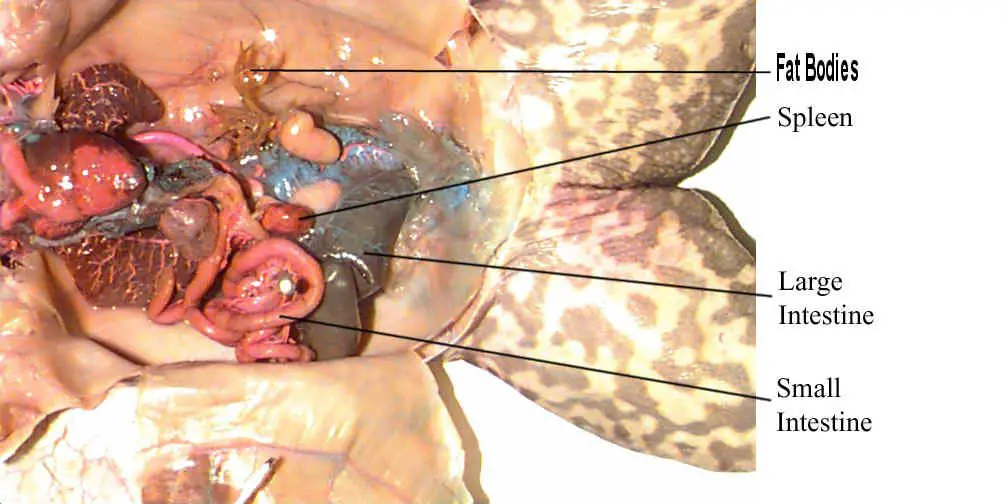
    10. The abdominal cavity of a frog at the end of hibernation season would contain very small fat bodies or none at all. What is the function of the fat bodies?


  1.  Structures of an animal’s body that fit it for its environment are adaptations. How do the frog’s powerful hind legs help it to fit into a life both in water and on land?
  2. During one mating of frogs, the female lays some 2,000 to 3,000 eggs in water as the male sheds millions of sperm over them. How do these large numbers relate to the frog’s fitness for life in water?
BACK

Frog Dissection

Frog Dissection
Pictures:  Modern Biology, Holt

Background:
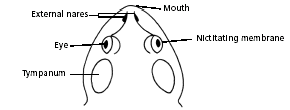
As members of the class Amphibia, frogs may live some of their adult lives on land, but they must return to water to reproduce. Eggs are laid and fertilized in water. On the outside of the frog’s head are two external nares, or nostrils; two tympani, or eardrums; and two eyes, each of which has three lids. The third lid, called the nictitating membrane, is transparent. Inside the mouth are two internal nares, or openings into the nostrils; two vomerine teeth in the middle of the roof of the mouth; and two maxillary teeth at the sides of the mouth. Also inside the mouth behind the tongue is the pharynx, or throat.

In the pharynx, there are several openings: one into the esophagus, the tube into which food is swallowed; one into the glottis, through which air enters the larynx, or voice box; and two into the Eustachian tubes, which connect the pharynx to the ear. The digestive system consists of the organs of the digestive tract, or food tube, and the digestive glands. From the esophagus, swallowed food moves into the stomach and then into the small intestine. Bile is a digestive juice made by the liver and stored in the gallbladder. Bile flows into a tube called the common bile duct, into which pancreatic juice, a digestive juice from the pancreas, also flows. The contents of the common bile duct flow into the small intestine, where most of the digestion and absorption of food into the bloodstream takes place.

Indigestible materials pass through the large intestine and then into the cloaca, the common exit chamber of the digestive, excretory, and reproductive systems. The respiratory system consists of the nostrils and the larynx, which opens into two lungs, hollow sacs with thin walls. The walls of the lungs are filled with capillaries, which are microscopic blood vessels through which materials pass into and out of the blood. The circulatory system consists of the heart, blood vessels, and blood. The heart has two receiving chambers, or atria, and one sending chamber, or ventricle. Blood is carried to the heart in vessels called veins. Veins from different parts of the body enter the right and left atria. Blood from both atria goes into the ventricle and then is pumped into the arteries, which are blood vessels that carry blood away from the heart.

The urinary system consists of the frog’s kidneys, ureters, bladder, and cloaca. The kidneys are organs that excrete urine. Connected to each kidney is a ureter, a tube through which urine passes into the urinary bladder, a sac that stores urine until it passes out of the body through the cloaca. The organs of the male reproductive system are the testes, sperm ducts, and cloaca. Those of the female system are the ovaries, oviducts, uteri, and cloaca. The testes produce sperm, or male sex cells, which move through sperm ducts, tubes that carry sperm into the cloaca, from which the sperm move outside the body. The ovaries produce eggs, or female sex cells, which move through oviducts into the uteri, then through the cloaca outside the body.

The central nervous system of the frog consists of  the brain, which is enclosed in the skull, and the spinal cord, which is enclosed in the backbone. Nerves branch out from the spinal cord. The frog’s skeletal and muscular systems consist of its framework of bones and joints, to which nearly all the voluntary muscles of the body  are attached. Voluntary muscles, which are those over which the frog has control, occur in pairs of flexors and extensors. When a flexor of a leg or other body part contracts, that  part is bent. When the extensor of that body part contracts, the part straightens.

Objectives:
Describe the appearance of various organs found in the frog.
Name the organs that make up various systems of the frog.

Purpose:
In this lab, you will dissect a frog in order to observe the external and internal structures of frog anatomy.

Materials:
• safety goggles, gloves, and a lab apron
forceps
preserved frog
dissecting pins (6–10)
dissecting tray and paper towels
plastic storage bag and twist tie
scissors
marking pen
dissecting needle

Procedure:

  1. Put on safety goggles, gloves, and a lab apron.
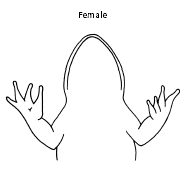
  2. Place a frog on a dissection tray. To determine the frog’s sex, look at the hand digits, or fingers, on its forelegs. A male frog usually has thick pads on its “thumbs,” which is one external difference between the sexes, as shown in the diagram below. Male frogs are also usually smaller than female frogs. Observe several frogs to see the difference between males and females.
  1.  Use the diagram below to locate and identify the external features of the head. Find the mouth, external nares, tympani, eyes, and nictitating membranes.
  1. Turn the frog on its back and pin down the legs. Cut the hinges of the mouth and open it wide. Use the diagram below to locate and identify the structures inside the mouth. Use a probe to help find each part: the vomerine teeth, the maxillary teeth, the internal nares, the tongue, the openings to the Eustachian tubes, the esophagus, the pharynx, and the slit-like glottis.

  1. Look for the opening to the frog’s cloaca, located between the hind legs. Use forceps to lift the skin and use scissors to cut along the center of the body from the cloaca to the lip. Turn back the skin, cut toward the side at each leg, and pin the skin flat. The diagram above shows how to make these cuts
  2. Lift and cut through the muscles and breast bone to open up the body cavity. If your frog is a female, the abdominal cavity may be filled with dark-colored eggs. If so, remove the eggs on one side so you can see the organs underlying them.
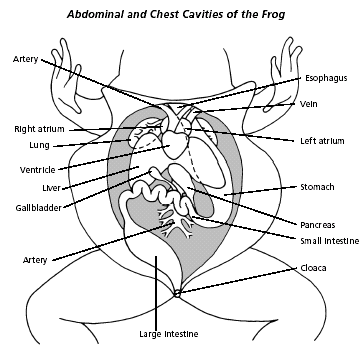
  3. Use the diagram below to locate and identify the organs of the digestive system: esophagus, stomach, small intestine, large intestine, cloaca, liver, gallbladder, and pancreas.

  1. Again refer to the diagram below to identify the parts of the circulatory and respiratory systems that are in the chest cavity. Find the left atrium, right atrium, and ventricle of the heart. Find an artery attached to the heart and another artery near the backbone. Find a vein near one of the shoulders. Find the two lungs.
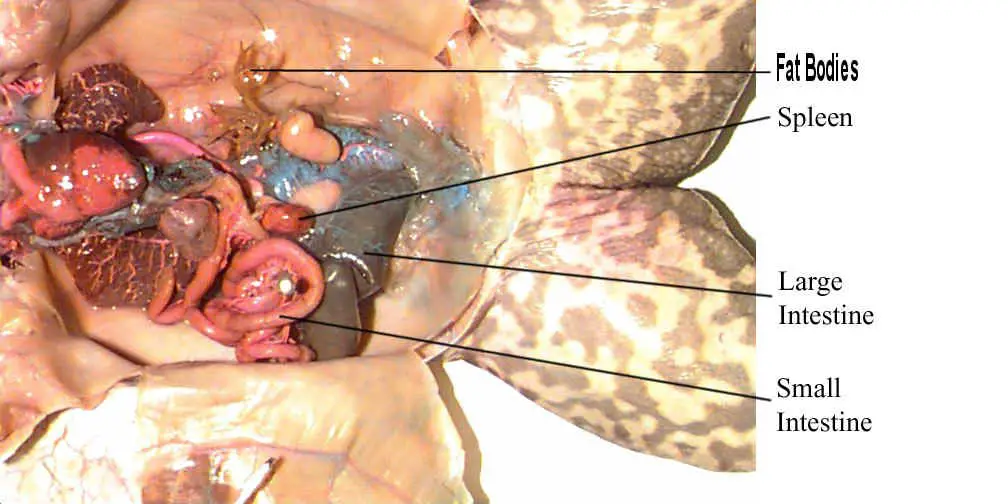
  1. Use a probe and scissors to lift and remove the intestines and liver. Use the diagram on the next page to identify the parts of the urinary and reproductive systems. Remove the peritoneal membrane, which is connective tissue that lies on top of the red kidneys. Observe the yellow fat bodies that are attached to the kidneys. Find the ureters; the urinary bladder; the testes and sperm ducts in the male; and the ovaries, oviducts, and uteri in the female.

  1. Remove the kidneys and look for threadlike spinal nerves that extend from the spinal cord. Dissect a thigh, and trace one nerve into a leg muscle. Note the size and texture of the leg muscles.
  2. Dispose of your materials according to the directions from your teacher.
  3. Clean up your work area and wash your hands before leaving the lab.
Click here for worksheet

BACK

Freshman Biology I Stuttgart Cam


General Biology I
Stuttgart Campus
Syllabus
Cheryl Massengale – Instructor
Monday, Tuesday, Wednesday – Lecture Room 109
Thursday – Lab Room C105
Class Time – 5:00 to 7:50


Assignments on this site may change so check the site often!


TOP


WEEK TOPIC LECTURE MATERIALS
B109 MON/TUES/THURS
LAB ASSIGNMENTS
C105 WEDNESDAY
1 BIOCHEMISTRY Identifying Controls & Variables with Homer ACTIVITY

VIRTUAL LAB – Dependent and Independent Variables

ANIMATIONS
Practice Tests:  Chemistry   Biochemistry
Biochemistry Practice Test (hardest)
Online Biochemistry Test
2 CELLS Osmosis & Diffusion in an Egg LAB


LAB – Vitruvian Man and
Printable Metric Meter

ANIMATIONS
Practice Tests:  Cells   Membranes
Cell Practice Test (Hardest)
Online Test
3
and
4
METABOLISM MICROSCOPY LAB
ANIMATIONS
VIRTUAL LAB – ENZYME-CONTROLLED REACTIONS

Enzyme Foldable ACTIVITY

Lab: Spinach Chromatography

Lab: Stored Energy in Foods

Practice Tests:  Metabolism   Photosynthesis
Cell Respiration
Metabolism Practice Test (Hardest)
Online Test
5 GENETICS & EVOLUTION Sponge Bob Genetics   1  2  3  4   5

Smith-Magenis Syndrome

Lab: Karyotyping & Genetic Disorders

6 NUCLEIC ACIDS Strawberry DNA  LAB


VIRTUAL LAB – Knocking Out Genes

LAB – What’s the Point?
DNA Template
Mutation Sequence Table

ANIMATION – Additions and Deletions

ANIMATIONS
Practice Tests:  Genetics   Nucleic Acids
Nucleic Acid & Genetics Practice Test (Hardest)
Online Test
FINAL EXAM – July 13 Online Test


BACK