Chromatography Plant Pigments


Chromatography of Plant Pigments

INTRODUCTION:

Chlorophyll often hides the other pigments present in leaves. In Autumn, chlorophyll breaks down, allowing xanthophyll and carotene, and newly made anthocyanin, to show their colors.
The mix of pigments in a leaf may be separated into bands of color by the technique of paper chromatography. Chromatography involves the separation of mixtures into individual components. Chromatography means “color writing.” With this technique the components of a mixture in a liquid medium are separated. The separation takes place by absorption and capillarity. The paper holds the substances by absorption; capillarity pulls the substances up the paper at different rates. Pigments are separated on the paper and show up as colored streaks. The pattern of separated components on the paper is called a chromatogram.

PRELAB PREPARATION:

Gather leaves from several different plants. CAUTION: Avoid poisonous plants. Autumn leaves from deciduous trees are especially interesting. Sort the leaves by kind (maple, etc.) and color. Review a diagram of a plant cell . Find the grana and the chloroplasts of the cell.

MATERIALS:

Safety goggles
Chromatography solvent (92 parts Petroleum ether to 8 parts acetone)
Chromatography paper (or filter paper) about 1 cm x 15 cm
Ethyl alcohol
Fresh spinach
Test tube
Test tube rack
Scissors and Ruler
Fresh leaves of plants
Glass stirring rod
Paper clip
Cork (to fit test tube)
Mortar and pestle
Sand (optional)
10-ml Graduated cylinder

PROCEDURE:

Leaves should be grouped by kind (maple, etc.) and color. Work with a spinach leaf and with one or more other types. CAUTION: Chromatography solvents are flammable and toxic. Have no open flames; maintain good ventilation; avoid inhaling fumes.

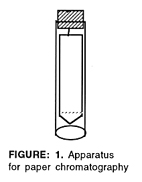
1. Cut a strip of filter paper or chromatography paper so that it just fits inside a 15-cm (or larger) test tube. Cut a point at one end. Draw a faint pencil line as shown in figure 1. Bend a paper clip and attach it to a cork stopper. Attach the paper strip so that it hangs inside the tube, as shown. The sides of the strip should not touch the glass.

2. Tear a spinach leaf into pieces about the size of a postage stamp. Put them into a mortar along with a pinch or two of sand to help with grinding. Add about 5 ml ethyl alcohol to the leaf pieces. Crush leaves with the pestle, using a circular motion, until the mixture is finely ground. The liquid in which the leaf pigments are now for paper chromatography dissolved is called the pigment extract.

3. Use a glass rod to touch a drop of the pigment extract to the center of the pencil line on the paper strip. Let it dry. Repeat as many as 20 times, to build up the pigment spot. NOTE: You must let the dot dry after each drop is added. The drying keeps the pigment dot from spreading out too much.

4. Pour 5 ml chromatography solvent into the test tube. Fit the paper and cork assembly inside. Adjust it so that the paper point just touches the solvent (but not the sides of the tube). The pigment dot must be above the level of the solvent. Watch the solvent rise up the paper, carrying and separating the pigments as it goes. At the instant the solvent reaches the top, remove the paper and let it dry. Observe the bands of pigment. The order, from the top, should be carotenes (orange), xanthophylls (yellow), chlorophyll a (yellow-green), chlorophyll b (blue-green), and anthocyanin (red). Identify and label the pigment bands on the dry strip. Write the species of leaf on the strip as well.
Record the species, external color, and chromatogram pigments in the DATA TABLE of your report sheet.

5. Each pigment has an Rf value, the speed at which it moves over the paper compared with the speed of the solvent.

Rf = Distance moved by the pigment / Distance moved by the solvent

Measure the distance in cm from the starting point (pencil line) to the center of each pigment band. Then measure the entire distance traveled by the solvent. Remember, the starting point for the solvent is also the pencil line and the ending point for the solvent is the top edge of the paper. Do the required divisions and record your Rf values in the DATA TABLE of your report sheet.

6. Wash the mortar and pestle thoroughly, using a little alcohol to remove any remaining pigment.

7. Repeat steps 1 through 6 for each species.

DATA TABLE:

Chromatography Data

Leaf Type (species) External color Chromatogram Pigments
Colors from the Top Pigment Names Rf Values


Chapter 7 – Membrane Structure and Function Lecture Outline

Chapter 7    Membrane Structure and Function    Lecture Outline

Overview

  • The plasma membrane separates the living cell from its nonliving surroundings.
  • This thin barrier, 8 nm thick, controls traffic into and out of the cell.
  •  Like all biological membranes, the plasma membrane is selectively permeable, allowing some substances to cross more easily than others.

A. Membrane Structure

  • The main macromolecules in membranes are lipids and proteins, but carbohydrates are also important.
  • The most abundant lipids are phospholipids.
  •  Phospholipids and most other membrane constituents are amphipathic molecules.
  •  Amphipathic molecules have both hydrophobic regions and hydrophilic regions.
  • The arrangement of phospholipids and proteins in bi   ological membranes is described by the fluid mosaic model.

1. Membrane models have evolved to fit new data.

  •  Models of membranes were developed long before membranes were first seen with electron microscopes in the 1950s.
  •  In 1915, membranes isolated from red blood cells were chemically analyzed and found to be composed of lipids and proteins.
  •  In 1925, E. Gorter and F. Grendel reasoned that cell membranes must be a phospholipid bilayer two molecules thick.
  • The molecules in the bilayer are arranged such that the hydrophobic fatty acid tails are sheltered from water while the hydrophilic phosphate groups interact with water.
  •  Actual membranes adhere more strongly to water than do artificial membranes composed only of phospholipids.
  • One suggestion was that proteins on the surface of the membrane increased adhesion.
  •  In 1935, H. Davson and J. Danielli proposed a sandwich model in which the phospholipid bilayer lies between two layers of globular proteins.
  • Early images from electron microscopes seemed to support the Davson-Danielli model, and until the 1960s, it was widely accepted as the structure of the plasma membrane and internal membranes.
  • Further investigation revealed two problems.
  • First, not all membranes were alike. Membranes differ in thickness, appearance when stained, and percentage of proteins.
  • Membranes with different functions differ in chemical composition and structure.
  • Second, measurements showed that membrane proteins are not very soluble in water.
  • Membrane proteins are amphipathic, with hydrophobic and hydrophilic regions.
  • If membrane proteins were at the membrane surface, their hydrophobic regions would be in contact with water.
  • In 1972, S. J. Singer and G. Nicolson presented a revised model that proposed that the membrane proteins are dispersed and individually inserted into the phospholipid bilayer.
  • In this fluid mosaic model, the hydrophilic regions of proteins and phospholipids are in maximum contact with water, and the hydrophobic regions are in a nonaqueous environment within the membrane.
  • A specialized preparation technique, freeze-fracture, splits a membrane along the middle of the phospholipid bilayer.
  • When a freeze-fracture preparation is viewed with an electron microscope, protein particles are interspersed in a smooth matrix, supporting the fluid mosaic model.

2. Membranes are fluid.

  •  Membrane molecules are held in place by relatively weak hydrophobic interactions.
  • Most of the lipids and some proteins drift laterally in the plane of the membrane, but rarely flip-flop from one phospholipid layer to the other.
  • The lateral movements of phospholipids are rapid, about 2 microns per second. A phospholipid can travel the length of a typical bacterial cell in 1 second.
  • Many larger membrane proteins drift within the phospholipid bilayer, although they move more slowly than the phospholipids.
  • Some proteins move in a very directed manner, perhaps guided or driven by motor proteins attached to the cytoskeleton.
  • Other proteins never move and are anchored to the cytoskeleton.
  • Membrane fluidity is influenced by temperature. As temperatures cool, membranes switch from a fluid state to a solid state as the phospholipids pack more closely.
  • Membrane fluidity is also influenced by its components. Membranes rich in unsaturated fatty acids are more fluid that those dominated by saturated fatty acids because the kinks in the unsaturated fatty acid tails at the locations of the double bonds prevent tight packing.
  • The steroid cholesterol is wedged between phospholipid molecules in the plasma membrane of animal cells.
  • At warm temperatures (such as 37°C), cholesterol restrains the movement of phospholipids and reduces fluidity.
  • At cool temperatures, it maintains fluidity by preventing tight packing.
  • Thus, cholesterol acts as a “temperature buffer” for the membrane, resisting changes in membrane fluidity as temperature changes.
  • To work properly with active enzymes and appropriate permeability, membranes must be about as fluid as salad oil.
  • Cells can alter the lipid composition of membranes to compensate for changes in fluidity caused by changing temperatures.
  • For example, cold-adapted organisms such as winter wheat increase the percentage of unsaturated phospholipids in their membranes in the autumn.
  • This prevents membranes from solidifying during winter.

3. Membranes are mosaics of structure and function.

  • A membrane is a collage of different proteins embedded in the fluid matrix of the lipid bilayer.
  • Proteins determine most of the membrane’s specific functions.
  • The plasma membrane and the membranes of the various organelles each have unique collections of proteins.
  • There are two major populations of membrane proteins.
  • Peripheral proteins are not embedded in the lipid bilayer at all.
  • Instead, they are loosely bound to the surface of the protein, often connected to integral proteins.
  • Integral proteins penetrate the hydrophobic core of the lipid bilayer, often completely spanning the membrane (as transmembrane proteins).
  • The hydrophobic regions embedded in the membrane’s core consist of stretches of nonpolar amino acids, often coiled into alpha helices.
  • Where integral proteins are in contact with the aqueous environment, they have hydrophilic regions of amino acids.
  • On the cytoplasmic side of the membrane, some membrane proteins connect to the cytoskeleton.
  • On the exterior side of the membrane, some membrane proteins attach to the fibers of the extracellular matrix.
  • The proteins of the plasma membrane have six major functions:

1.       Transport of specific solutes into or out of cells.
2.       Enzymatic activity, sometimes catalyzing one of a number of steps of a metabolic pathway.
3.       Signal transduction, relaying hormonal messages to the cell.
4.       Cell-cell recognition, allowing other proteins to attach two adjacent cells together.
5.       Intercellular joining of adjacent cells with gap or tight junctions.
6.       Attachment to the cytoskeleton and extracellular matrix, maintaining cell shape and stabilizing the location of certain membrane proteins.

4. Membrane carbohydrates are important for cell-cell recognition.

  • The plasma membrane plays the key role in cell-cell recognition.
  •  Cell-cell recognition, the ability of a cell to distinguish one type of neighboring cell from another, is crucial to the functioning of an organism.
  • This attribute is important in the sorting and organization of cells into tissues and organs during development.
  • It is also the basis for rejection of foreign cells by the immune system.
  •  Cells recognize other cells by binding to surface molecules, often carbohydrates, on the plasma membrane.
  • Membrane carbohydrates are usually branched oligosaccharides with fewer than 15 sugar units.
  • They may be covalently bonded to lipids, forming glycolipids, or more commonly to proteins, forming glycoproteins.
  • The oligosaccharides on the external side of the plasma membrane vary from species to species, from individual to individual, and even from cell type to cell type within the same individual.
  • This variation distinguishes each cell type.
  • The four human blood groups (A, B, AB, and O) differ in the external carbohydrates on red blood cells.

5. Membranes have distinctive inside and outside faces.

  • Membranes have distinct inside and outside faces. The two layers may differ in lipid composition. Each protein in the membrane has a directional orientation in the membrane.
  • The asymmetrical orientation of proteins, lipids and associated carbohydrates begins during the synthesis of membrane in the ER and Golgi apparatus.
  • Membrane lipids and proteins are synthesized in the endoplasmic reticulum. Carbohydrates are added to proteins in the ER, and the resulting glycoproteins are further modified in the Golgi apparatus. Glycolipids are also produced in the Golgi apparatus.
  • When a vesicle fuses with the plasma membrane, the outside layer of the vesicle becomes continuous with the inside layer of the plasma membrane. In that way, molecules that originate on the inside face of the ER end up on the outside face of the plasma membrane.

B. Traffic across Membranes

1. A membrane’s molecular organization results in selective permeability.

  • A steady traffic of small molecules and ions moves across the plasma membrane in both directions.
  • For example, sugars, amino acids, and other nutrients enter a muscle cell, and metabolic waste products leave.
  • The cell absorbs oxygen and expels carbon dioxide.
  • It also regulates concentrations of inorganic ions, such as Na+, K+, Ca2+, and Cl−, by shuttling them across the membrane.
  • However, substances do not move across the barrier indiscriminately; membranes are selectively permeable.
  • The plasma membrane allows the cell to take up many varieties of small molecules and ions and exclude others. Substances that move through the membrane do so at different rates.
  • Movement of a molecule through a membrane depends on the interaction of the molecule with the hydrophobic core of the membrane.
  • Hydrophobic molecules, such as hydrocarbons, CO2, and O2, can dissolve in the lipid bilayer and cross easily.
  • The hydrophobic core of the membrane impedes the direct passage of ions and polar molecules, which cross the membrane with difficulty.
  • This includes small molecules, such as water, and larger molecules, such as glucose and other sugars.
  • An ion, whether a charged atom or molecule, and its surrounding shell of water also has difficulty penetrating the hydrophobic core.
  • Proteins assist and regulate the transport of ions and polar molecules.
  • Specific ions and polar molecules can cross the lipid bilayer by passing through transport proteins that span the membrane.
  • Some transport proteins, called channel proteins, have a hydrophilic channel that certain molecules or ions can use as a tunnel through the membrane.
  • For example, the passage of water through the membrane can be greatly facilitated by channel proteins known as aquaporins.
  • Other transport proteins, called carrier proteins, bind to molecules and change shape to shuttle them across the membrane.
  • Each transport protein is specific as to the substances that it will translocate.
  • For example, the glucose transport protein in the liver will carry glucose into the cell but will not transport fructose, its structural isomer.

2. Passive transport is diffusion across a membrane with no energy expenditure.

  • Diffusion is the tendency of molecules of any substance to spread out in the available space.
  • Diffusion is driven by the intrinsic kinetic energy (thermal motion or heat) of molecules.
  •  Movements of individual molecules are random.
  • However, movement of a population of molecules may be directional.
  • Imagine a permeable membrane separating a solution with dye molecules from pure water. If the membrane has microscopic pores that are large enough, dye molecules will cross the barrier randomly.
  • The net movement of dye molecules across the membrane will continue until both sides have equal concentrations of the dye.
  • At this dynamic equilibrium, as many molecules cross one way as cross in the other direction.
  • In the absence of other forces, a substance will diffuse from where it is more concentrated to where it is less concentrated, down its concentration gradient.
  • No work must be done to move substances down the concentration gradient.
  • Diffusion is a spontaneous process that decreases free energy and increases entropy by creating a randomized mixture.
  • Each substance diffuses down its own concentration gradient, independent of the concentration gradients of other substances.
  • The diffusion of a substance across a biological membrane is passive transport because it requires no energy from the cell to make it happen.
  • The concentration gradient itself represents potential energy and drives diffusion.
  • Because membranes are selectively permeable, the interactions of the molecules with the membrane play a role in the diffusion rate.
  • Diffusion of molecules of limited permeability through the lipid bilayer may be assisted by transport proteins.

3. Osmosis is the passive transport of water.

  • Differences in the relative concentration of dissolved materials in two solutions can lead to the movement of ions from one to the other.
  • The solution with the higher concentration of solutes is hypertonic relative to the other solution.
  • The solution with the lower concentration of solutes is hypotonic relative to the other solution.
  • These are comparative terms.
  • Tap water is hypertonic compared to distilled water but hypotonic compared to seawater.
  • Solutions with equal solute concentrations are isotonic.
  • Imagine that two sugar solutions differing in concentration are separated by a membrane that will allow water through, but not sugar.
  • The hypertonic solution has a lower water concentration than the hypotonic solution.
  • More of the water molecules in the hypertonic solution are bound up in hydration shells around the sugar molecules, leaving fewer unbound water molecules.
  • Unbound water molecules will move from the hypotonic solution, where they are abundant, to the hypertonic solution, where they are rarer. Net movement of water continues until the solutions are isotonic.
  • The diffusion of water across a selectively permeable membrane is called osmosis.
  • The direction of osmosis is determined only by a difference in total solute concentration.
  • The kinds of solutes in the solutions do not matter.
  • This makes sense because the total solute concentration is an indicator of the abundance of bound water molecules (and, therefore, of free water molecules).
  • When two solutions are isotonic, water molecules move at equal rates from one to the other, with no net osmosis.
  • The movement of water by osmosis is crucial to living organisms.

4. Cell survival depends on balancing water uptake and loss.

  • An animal cell (or other cell without a cell wall) immersed in an isotonic environment experiences no net movement of water across its plasma membrane.
  • Water molecules move across the membrane but at the same rate in both directions.
  • The volume of the cell is stable.
  • The same cell in a hypertonic environment will lose water, shrivel, and probably die.
  • A cell in a hypotonic solution will gain water, swell, and burst.
  • For organisms living in an isotonic environment (for example, many marine invertebrates), osmosis is not a problem.
  • The cells of most land animals are bathed in extracellular fluid that is isotonic to the cells.
  • Organisms without rigid walls have osmotic problems in either a hypertonic or hypotonic environment and must have adaptations for osmoregulation, the control of water balance, to maintain their internal environment.
  • For example, Paramecium, a protist, is hypertonic to the pond water in which it lives.
  • In spite of a cell membrane that is less permeable to water than other cells, water still continually enters the Paramecium cell.
  • To solve this problem, Paramecium cells have a specialized organelle, the contractile vacuole, which functions as a bilge pump to force water out of the cell.
  • The cells of plants, prokaryotes, fungi, and some protists have walls that contribute to the cell’s water balance.
  • A plant cell in a hypotonic solution will swell until the elastic cell wall opposes further uptake.
  • At this point the cell is turgid (very firm), a healthy state for most plant cells.
  • Turgid cells contribute to the mechanical support of the plant.
  • If a plant cell and its surroundings are isotonic, there is no movement of water into the cell. The cell becomes flaccid (limp), and the plant may wilt.
  • The cell wall provides no advantages when a plant cell is immersed in a hypertonic solution. As the plant cell loses water, its volume shrinks. Eventually, the plasma membrane pulls away from the wall. This plasmolysis is usually lethal.

5. Specific proteins facilitate passive transport of water and selected solutes.

  •  Many polar molecules and ions that are normally impeded by the lipid bilayer of the membrane diffuse passively with the help of transport proteins that span the membrane.
  • The passive movement of molecules down their concentration gradient via transport proteins is called facilitated diffusion.
  • Two types of transport proteins facilitate the movement of molecules or ions across membranes: channel proteins and carrier proteins.
  • Some channel proteins simply provide hydrophilic corridors for the passage of specific molecules or ions.
  • For example, water channel proteins, aquaporins, greatly facilitate the diffusion of water.
  • Many ion channels function as gated channels. These channels open or close depending on the presence or absence of a chemical or physical stimulus.
  • If chemical, the stimulus is a substance other than the one to be transported.
  • For example, stimulation of a receiving neuron by specific neurotransmitters opens gated channels to allow sodium ions into the cell.
  • When the neurotransmitters are not present, the channels are closed.
  • Some transport proteins do not provide channels but appear to actually translocate the solute-binding site and solute across the membrane as the transport protein changes shape.
  • These shape changes may be triggered by the binding and release of the transported molecule.
  • In certain inherited diseases, specific transport systems may be defective or absent.
  • Cystinuria is a human disease characterized by the absence of a protein that transports cysteine and other amino acids across the membranes of kidney cells.
  • An individual with cystinuria develops painful kidney stones as amino acids accumulate and crystallize in the kidneys.

6. Active transport uses energy to move solutes against their gradients.

  • Some transport proteins can move solutes across membranes against their concentration gradient, from the side where they are less concentrated to the side where they are more concentrated.
  • This active transport requires the cell to expend metabolic energy.
  •  Active transport enables a cell to maintain its internal concentrations of small molecules that would otherwise diffuse across the membrane.
  • Active transport is performed by specific proteins embedded in the membranes.
  • ATP supplies the energy for most active transport.
  •  ATP can power active transport by transferring a phosphate group from ATP (forming ADP) to the transport protein.
  • This may induce a conformational change in the transport protein, translocating the solute across the membrane.
  • The sodium-potassium pump actively maintains the gradient of sodium ions (Na+) and potassium ions (K+) across the plasma membrane of animal cells.
  • Typically, K+ concentration is low outside an animal cell and high inside the cell, while Na+ concentration is high outside an animal cell and low inside the cell.
  • he sodium-potassium pump maintains these concentration gradients, using the energy of one ATP to pump three Na+ out and two K+ in.

7. Some ion pumps generate voltage across membranes.

  •  All cells maintain a voltage across their plasma membranes.
  • Voltage is electrical potential energy due to the separation of opposite charges.
  • The cytoplasm of a cell is negative in charge compared to the extracellular fluid because of an unequal distribution of cations and anions on opposite sides of the membrane.
  • The voltage across a membrane is called a membrane potential, and ranges from −50 to −200 millivolts (mV). The inside of the cell is negative compared to the outside.
  • The membrane potential acts like a battery.
  • The membrane potential favors the passive transport of cations into the cell and anions out of the cell.
  • Two combined forces, collectively called the electrochemical gradient, drive the diffusion of ions across a membrane.
  • One is a chemical force based on an ion’s concentration gradient.
  • The other is ann electrical force based on the effect of the membrane potential on the ion’s movement.
  • An ion does not simply diffuse down its concentration gradient but diffuses down its electrochemical gradient.
  •  For example, there is a higher concentration of Na+ outside a resting nerve cell than inside.
  • When the neuron is stimulated, a gated channel opens and Na+ diffuse into the cell down their electrochemical gradient. The diffusion of Na+ is driven by their concentration gradient and by the attraction of cations to the negative side of the membrane.
  • Special transport proteins, electrogenic pumps, generate the voltage gradient across a membrane.
  • The sodium-potassium pump in animals restores the electrochemical gradient not only by the active transport of Na+ and K+, setting up a concentration gradient, but because it pumps two K+ inside for every three Na+ that it moves out, setting up a voltage across the membrane.
  • The sodium-potassium pump is the major electrogenic pump of animal cells.
  • In plants, bacteria, and fungi, a proton pump is the major electrogenic pump, actively transporting H+ out of the cell.
  • Proton pumps in the cristae of mitochondria and the thylakoids of chloroplasts concentrate H+ behind membranes.
  • These electrogenic pumps store energy that can be accessed for cellular work.

8. In cotransport, a membrane protein couples the transport of two solutes.

  • A single ATP-powered pump that transports one solute can indirectly drive the active transport of several other solutes in a mechanism called cotransport.
  •  As the solute that has been actively transported diffuses back passively through a transport protein, its movement can be coupled with the active transport of another substance against its concentration gradient.
  • Plants commonly use the gradient of hydrogen ions generated by proton pumps to drive the active transport of amino acids, sugars, and other nutrients into the cell.
  • One specific transport protein couples the diffusion of protons out of the cell and the transport of sucrose into the cell. Plants use the mechanism of sucrose-proton cotransport to load sucrose into specialized cells in the veins of leaves for distribution to nonphotosynthetic organs such as roots.

9. Exocytosis and endocytosis transport large molecules across membranes.

  • Small molecules and water enter or leave the cell through the lipid bilayer or by transport proteins.
  • Large molecules, such as polysaccharides and proteins, cross the membrane via vesicles.
  • During exocytosis, a transport vesicle budded from the Golgi apparatus is moved by the cytoskeleton to the plasma membrane.
  • When the two membranes come in contact, the bilayers fuse and spill the contents to the outside.
  • Many secretory cells use exocytosis to export their products.
  • During endocytosis, a cell brings in macromolecules and particulate matter by forming new vesicles from the plasma membrane.
  • Endocytosis is a reversal of exocytosis, although different proteins are involved in the two processes.
  • A small area of the plasma membrane sinks inward to form a pocket.
  • As the pocket deepens, it pinches in to form a vesicle containing the material that had been outside the cell.
  • There are three types of endocytosis: phagocytosis (“cellular eating”), pinocytosis (“cellular drinking”), and receptor-mediated endocytosis.
  • In phagocytosis, the cell engulfs a particle by extending pseudopodia around it and packaging it in a large vacuole.
  • The contents of the vacuole are digested when the vacuole fuses with a lysosome.
  •  In pinocytosis, a cell creates a vesicle around a droplet of extracellular fluid. All included solutes are taken into the cell in this nonspecific process.
  • Receptor-mediated endocytosis allows greater specificity, transporting only certain substances.
  • This process is triggered when extracellular substances, or ligands, bind to special receptors on the membrane surface. The receptor proteins are clustered in regions of the membrane called coated pits, which are lined on their cytoplasmic side by a layer of coat proteins.
  • Binding of ligands to receptors triggers the formation of a vesicle by the coated pit, bringing the bound substances into the cell.
  • Receptor-mediated endocytosis enables a cell to acquire bulk quantities of specific materials that may be in low concentrations in the environment.
  • Human cells use this process to take in cholesterol for use in the synthesis of membranes and as a precursor for the synthesis of steroids.
  • Cholesterol travels in the blood in low-density lipoproteins (LDL), complexes of protein and lipid.
  • These lipoproteins act as ligands to bind to LDL receptors and enter the cell by endocytosis.
  • In an inherited disease called familial hypercholesterolemia, the LDL receptors are defective, leading to an accumulation of LDL and cholesterol in the blood.
  • This contributes to early atherosclerosis.


Chapter 7 – A Tour of the Cell Objectives


Chapter 7   Membrane Structure & Function
Objectives
Membrane Structure

1.  Explain why phospholipids are amphipathic molecules.

2.  Explain what freeze-fracture techniques reveal about the arrangement of proteins in membranes.

3.  Describe the fluidity of the components of a cell membrane and explain how membrane fluidity is influenced by temperature and membrane composition.

4.  Explain how cholesterol resists changes in membrane fluidity with temperature change.

Traffic Across Membranes

5.  Distinguish between peripheral and integral membrane proteins.

6.  List six major functions of membrane proteins.

7.  Explain the role of membrane carbohydrates in cell-cell recognition.

8.  Explain how hydrophobic molecules cross cell membranes.

9.  Distinguish between channel proteins and carrier proteins.

10. Define diffusion. Explain why diffusion is a spontaneous process.

11. Explain why a concentration gradient of a substance across a membrane represents potential energy.

12. Distinguish among hypertonic, hypotonic, and isotonic solutions.

13. Define osmosis and predict the direction of water movement based on differences in solute concentrations.

14. Describe how living cells with and without cell walls regulate water balance.

15. Explain how transport proteins facilitate diffusion.

16. Distinguish among osmosis, facilitated diffusion, and active transport.

17. Describe the two forces that combine to produce an electrochemical gradient.

18. Explain how an electrogenic pump creates voltage across a membrane.

19. Describe the process of cotransport.

20. Explain how large molecules are transported across a cell membrane.

21.       Distinguish between pinocytosis and receptor-mediated endocytosis.


BACK


Chapter 8 – An Introduction to Metabolism Lecture Outline

Chapter 8    An Introduction to Metabolism    Lecture Outline

Overview

A. Metabolism, Energy, and Life

1. The chemistry of life is organized into metabolic pathways.

·         The totality of an organism’s chemical reactions is called metabolism.

·         Metabolism is an emergent property of life that arises from interactions between molecules within the orderly environment of the cell.

·         Metabolic pathways begin with a specific molecule, which is then altered in a series of defined steps to form a specific product.

·         A specific enzyme catalyzes each step of the pathway.

·         Catabolic pathways release energy by breaking down complex molecules to simpler compounds.

°         A major pathway of catabolism is cellular respiration, in which the sugar glucose is broken down in the presence of oxygen to carbon dioxide and water.

·         Anabolic pathways consume energy to build complicated molecules from simpler compounds. They are also called biosynthetic pathways.

°         The synthesis of protein from amino acids is an example of anabolism.

·         The energy released by catabolic pathways can be stored and then used to drive anabolic pathways.

·         Energy is fundamental to all metabolic processes, and therefore an understanding of energy is key to understanding how the living cell works.

°         Bioenergetics is the study of how organisms manage their energy resources.

2. Organisms transform energy.

·         Energy is the capacity to do work.

°         Energy exists in various forms, and cells transform energy from one type into another.

·         Kinetic energy is the energy associated with the relative motion of objects.

°         Objects in motion can perform work by imparting motion to other matter.

°         Photons of light can be captured and their energy harnessed to power photosynthesis in green plants.

°         Heat or thermal energy is kinetic energy associated with the random movement of atoms or molecules.

·         Potential energy is the energy that matter possesses because of its location or structure.

°         Chemical energy is a form of potential energy stored in molecules because of the arrangement of their atoms.

·         Energy can be converted from one form to another.

°         For example, as a boy climbs stairs to a diving platform, he is releasing chemical energy stored in his cells from the food he ate for lunch.

°         The kinetic energy of his muscle movement is converted into potential energy as he climbs higher.

°         As he dives, the potential energy is converted back to kinetic energy.

°         Kinetic energy is transferred to the water as he enters it.

°         Some energy is converted to heat due to friction.

3. The energy transformations of life are subject to two laws of thermodynamics.

·         Thermodynamics is the study of energy transformations.

·         In this field, the term system refers to the matter under study and the surroundings include everything outside the system.

·         A closed system, approximated by liquid in a thermos, is isolated from its surroundings.

·         In an open system, energy and matter can be transferred between the system and its surroundings.

·         Organisms are open systems.

°         They absorb energy—light or chemical energy in the form of organic molecules—and release heat and metabolic waste products such as urea or CO2 to their surroundings.

·         The first law of thermodynamics states that energy can be transferred and transformed, but it cannot be created or destroyed.

°         The first law is also known as the principle of conservation of energy.

°         Plants do not produce energy; they transform light energy to chemical energy.

·         During every transfer or transformation of energy, some energy is converted to heat, which is the energy associated with the random movement of atoms and molecules.

·         A system can use heat to do work only when there is a temperature difference that results in heat flowing from a warmer location to a cooler one.

°         If temperature is uniform, as in a living cell, heat can only be used to warm the organism.

·         Energy transfers and transformations make the universe more disordered due to this loss of usable energy.

·         Entropy is a quantity used as a measure of disorder or randomness.

°         The more random a collection of matter, the greater its entropy.

·         The second law of thermodynamics states that every energy transfer or transformation increases the entropy of the universe.

°         While order can increase locally, there is an unstoppable trend toward randomization of the universe.

°         Much of the increased entropy of the universe takes the form of increasing heat, which is the energy of random molecular motion.

·         In most energy transformations, ordered forms of energy are converted at least partly to heat.

°         Automobiles convert only 25% of the energy in gasoline into motion; the rest is lost as heat.

°         Living cells unavoidably convert organized forms of energy to heat.

·         For a process to occur on its own, without outside help in the form of energy input, it must increase the entropy of the universe.

·         The word spontaneous describes a process that can occur without an input of energy.

°         Spontaneous processes need not occur quickly.

°         Some spontaneous processes are instantaneous, such as an explosion. Some are very slow, such as the rusting of an old car.

·         Another way to state the second law of thermodynamics is for a process to occur spontaneously, it must increase the entropy of the universe.

·         Living systems create ordered structures from less ordered starting materials.

°         For example, amino acids are ordered into polypeptide chains.

°         The structure of a multicellular body is organized and complex.

·         However, an organism also takes in organized forms of matter and energy from its surroundings and replaces them with less ordered forms.

°         For example, an animal consumes organic molecules as food and catabolizes them to low-energy carbon dioxide and water.

·         Over evolutionary time, complex organisms have evolved from simpler ones.

°         This increase in organization does not violate the second law of thermodynamics.

°         The entropy of a particular system, such as an organism, may decrease as long as the total entropy of the universe—the system plus its surroundings—increases.

°         Organisms are islands of low entropy in an increasingly random universe.

°         The evolution of biological order is perfectly consistent with the laws of thermodynamics.

4. The free energy change of a reaction tells us whether it is spontaneous.

·         How can we determine which reactions occur spontaneously and which ones require an input of energy?

·         The concept of free energy provides a useful function for measuring spontaneity of a system.

·         Free energy is the portion of a system’s energy that is able to perform work when temperature and pressure is uniform throughout the system, as in a living cell.

·         The free energy (G) in a system is related to the total enthalpy (in biological systems, equivalent to energy) (H) and the entropy (S) by this relationship:

°         G = H − TS, where T is temperature in Kelvin units.

°         Increases in temperature amplify the entropy term.

°         Not all the energy in a system is available for work because the entropy component must be subtracted from the enthalpy component.

°         What remains is the free energy that is available for work.

·         Free energy can be thought of as a measure of the stability of a system.

°         Systems that are high in free energy—compressed springs, separated charges, organic polymers—are unstable and tend to move toward a more stable state, one with less free energy.

°         Systems that tend to change spontaneously are those that have high enthalpy, low entropy, or both.

·         In any spontaneous process, the free energy of a system decreases.

·         We can represent this change in free energy from the start of a process until its finish by:

°         DG = Gfinal state − Gstarting state

°         Or DG = DH − TDS

·         For a process to be spontaneous, the system must either give up enthalpy (decrease in H), give up order (increase in S), or both.

°         DG must be negative for a process to be spontaneous.

§         Every spontaneous process is characterized by a decrease in the free energy of the system.

§         Processes that have a positive or zero DG are never spontaneous.

°         The greater the decrease in free energy, the more work a spontaneous process can perform.

°         Nature runs “downhill.”

·         A system at equilibrium is at maximum stability.

°         In a chemical reaction at equilibrium, the rates of forward and backward reactions are equal, and there is no change in the concentration of products or reactants.

°         At equilibrium DG = 0, and the system can do no work.

°         A process is spontaneous and can perform work only when it is moving toward equilibrium.

°         Movements away from equilibrium are nonspontaneous and require the addition of energy from an outside energy source (the surroundings).

·         Chemical reactions can be classified as either exergonic or endergonic based on free energy.

·         An exergonic reaction proceeds with a net release of free energy; DG is negative.

·         The magnitude of DG for an exergonic reaction is the maximum amount of work the reaction can perform.

·         The greater the decrease in free energy, the greater the amount of work that can be done.

°         For the overall reaction of cellular respiration: C6H12O6 + 6O2 -> 6CO2 + 6H2O

§         DG = −686 kcal/mol

°         For each mole (180 g) of glucose broken down by respiration, 686 kcal of energy are made available to do work in the cell.

§         The products have 686 kcal less free energy than the reactants.

·         An endergonic reaction is one that absorbs free energy from its surroundings.

°         Endergonic reactions store energy in molecules; DG is positive.

°         Endergonic reactions are nonspontaneous, and the magnitude of DG is the quantity of energy required to drive the reaction.

·         If cellular respiration releases 686 kcal, then photosynthesis, the reverse reaction, must require an equivalent investment of energy.

°         For the conversion of carbon dioxide and water to sugar, DG = +686 kcal/mol.

·         Photosynthesis is strongly endergonic, powered by the absorption of light energy.

·         Reactions in a closed system eventually reach equilibrium and can do no work.

°         A cell that has reached metabolic equilibrium has a DG = 0 and is dead!

·         Metabolic disequilibrium is one of the defining features of life.

·         Cells maintain disequilibrium because they are open systems. The constant flow of materials into and out of the cell keeps metabolic pathways from ever reaching equilibrium.

°         A cell continues to do work throughout its life.

·         A catabolic process in a cell releases free energy in a series of reactions, not in a single step.

·         Some reversible reactions of respiration are constantly “pulled” in one direction, as the product of one reaction does not accumulate but becomes the reactant in the next step.

·         Sunlight provides a daily source of free energy for photosynthetic organisms.

·         Nonphotosynthetic organisms depend on a transfer of free energy from photosynthetic organisms in the form of organic molecules.

5. ATP powers cellular work by coupling exergonic reactions to endergonic reactions.

·         A cell does three main kinds of work:

1.       Mechanical work, such as the beating of cilia, contraction of muscle cells, and movement of chromosomes during cellular reproduction.

2.       Transport work, the pumping of substances across membranes against the direction of spontaneous movement.

3.       Chemical work, driving endergonic reactions such as the synthesis of polymers from monomers.

·         Cells manage their energy resources to do this work by energy coupling, the use of an exergonic process to drive an endergonic one.

·         In most cases, the immediate source of energy to power cellular work is ATP.

·         ATP (adenosine triphosphate) is a type of nucleotide consisting of the nitrogenous base adenine, the sugar ribose, and a chain of three phosphate groups.

·         The bonds between phosphate groups can be broken by hydrolysis.

°         Hydrolysis of the end phosphate group forms adenosine diphosphate.

§         ATP -> ADP + Pi

§         This reaction releases 7.3 kcal of energy per mole of ATP under standard conditions (1 M of each reactant and product, 25°C, pH 7).

°         In the cell, DG for hydrolysis of ATP is about −13 kcal/mol.

·         While the phosphate bonds of ATP are sometimes referred to as high-energy phosphate bonds, these are actually fairly weak covalent bonds.

°         However, they are unstable, and their hydrolysis yields energy because the products are more stable.

·         The release of energy during the hydrolysis of ATP comes from the chemical change to a state of lower free energy, not from the phosphate bonds themselves.

·         Why does the hydrolysis of ATP yield so much energy?

°         Each of the three phosphate groups has a negative charge.

°         These three like charges are crowded together, and their mutual repulsion contributes to the instability of this region of the ATP molecule.

·         In the cell, the energy from the hydrolysis of ATP is directly coupled to endergonic processes by the transfer of the phosphate group to another molecule.

°         This recipient molecule is now phosphorylated.

°         This molecule is now more reactive (less stable) than the original unphosphorylated molecules.

·         Mechanical, transport, and chemical work in the cell are nearly always powered by the hydrolysis of ATP.

°         In each case, a phosphate group is transferred from ATP to another molecule and the phosphorylated molecule undergoes a change that performs work.

·         ATP is a renewable resource that can be regenerated by the addition of a phosphate group to ADP.

°         The energy to phosphorylate ADP comes from catabolic reactions in the cell.

°         A working muscle cell recycles its entire pool of ATP once each minute.

°         More than 10 million ATP molecules are consumed and regenerated per second per cell.

·         Regeneration of ATP is an endergonic process, requiring an investment of energy.

°         DG = 7.3 kcal/mol.

·         Catabolic (exergonic) pathways, especially cellular respiration, provide the energy for the exergonic regeneration of ATP.

·         The chemical potential energy temporarily stored in ATP drives most cellular work.

B. Enzymes Are Catalytic Proteins

1. Enzymes speed up metabolic reactions by lowering energy barriers.

·         Spontaneous chemical reactions may occur so slowly as to be imperceptible.

°         The hydrolysis of table sugar (sucrose) to glucose and fructose is exergonic.

§         DG = −7 kcal/mol

°         Despite this, your sugar sits in its bowl with no observable hydrolysis.

°         If we add a small amount of the enzyme catalyst sucrase to a solution of sugar, all the sucrose will be hydrolyzed within seconds.

·         A catalyst is a chemical agent that speeds up the rate of a reaction without being consumed by the reaction.

°         An enzyme is a catalytic protein.

·         Enzymes regulate metabolic pathways.

·         Every chemical reaction involves bond breaking and bond forming.

°         To hydrolyze sucrose, the bond between glucose and fructose must be broken and new bonds must form with hydrogen and hydroxyl ions from water.

·         To reach a state where bonds can break and reform, reactant molecules must absorb energy from their surroundings. When the new bonds of the product molecules form, energy is released as heat as the molecules assume stable shapes with lower energy.

·         The initial investment of energy for starting a reaction is the free energy of activation or activation energy (EA).

·         Activation energy is the amount of energy necessary to push the reactants over an energy barrier so that the reaction can proceed.

°         At the summit, the molecules are in an unstable condition, the transition state.

°         Activation energy may be supplied in the form of heat that the reactant molecules absorb from the surroundings.

°         The bonds of the reactants break only when the molecules have absorbed enough energy to become unstable and, therefore, more reactive.

°         The absorption of thermal energy increases the speed of the reactant molecules, so they collide more often and more forcefully.

°         Thermal agitation of the atoms in the molecules makes bonds more likely to break.

°         As the molecules settle into new, stable bonding arrangements, energy is released to the surroundings.

°         In exergonic reactions, the activation energy is released back to the surroundings, and additional energy is released with the formation of new bonds.

·         For some processes, EA is not high, and the thermal energy provided by room temperature is sufficient for many reactants to reach the transition state.

·         In many cases, EA is high enough that the transition state is rarely reached and that the reaction hardly proceeds at all. In these cases, the reaction will only occur at a noticeable rate if the reactants are heated.

°         A spark plug provides the energy to energize a gasoline-oxygen mixture and cause combustion.

°         Without that activation energy, the hydrocarbons of gasoline are too stable to react with oxygen.

·         Proteins, DNA, and other complex organic molecules are rich in free energy. Their hydrolysis is spontaneous, with the release of large amounts of energy.

°         However, there is not enough energy at the temperatures typical of the cell for the vast majority of organic molecules to make it over the hump of activation energy.

·         How are the barriers for selected reactions surmounted to allow cells to carry out the processes of life?

°         Heat would speed up reactions, but it would also denature proteins and kill cells.

·         Enzymes speed reactions by lowering EA.

°         The transition state can then be reached even at moderate temperatures.

·         Enzymes do not change DG.

°         They hasten reactions that would occur eventually.

°         Because enzymes are so selective, they determine which chemical processes will occur at any time.

2. Enzymes are substrate specific.

·         The reactant that an enzyme acts on is the substrate.

·         The enzyme binds to a substrate, or substrates, forming an enzyme-substrate complex.

·         While the enzyme and substrate are bound, the catalytic action of the enzyme converts the substrate to the product or products.

·         The reaction catalyzed by each enzyme is very specific.

·         What accounts for this molecular recognition?

°         The specificity of an enzyme results from its three-dimensional shape.

·         Only a portion of the enzyme binds to the substrate.

°         The active site of an enzyme is typically a pocket or groove on the surface of the protein into which the substrate fits.

°         The active site is usually formed by only a few amino acids.

·         The specificity of an enzyme is due to the fit between the active site and the substrate.

·         As the substrate enters the active site, interactions between the substrate and the amino acids of the protein causes the enzyme to change shape slightly, leading to a tighter induced fit that brings chemical groups in position to catalyze the reaction.

3. The active site is an enzyme’s catalytic center.

·         In most cases, substrates are held in the active site by weak interactions, such as hydrogen bonds and ionic bonds.

°         R groups of a few amino acids on the active site catalyze the conversion of substrate to product.

°         The product then leaves the active site.

·         A single enzyme molecule can catalyze thousands of reactions a second.

·         Enzymes are unaffected by the reaction and are reusable.

·         Most metabolic enzymes can catalyze a reaction in both the forward and reverse directions.

°         The actual direction depends on the relative concentrations of products and reactants.

°         Enzymes catalyze reactions in the direction of equilibrium.

·         Enzymes use a variety of mechanisms to lower activation energy and speed up a reaction.

°         In reactions involving more than one reactant, the active site brings substrates together in the correct orientation for the reaction to proceed.

°         As the active site binds the substrate, it may put stress on bonds that must be broken, making it easier for the reactants to reach the transition state.

°         R groups at the active site may create a microenvironment that is conducive to a specific reaction.

§         An active site may be a pocket of low pH, facilitating H+ transfer to the substrate as a key step in catalyzing the reaction.

°         Enzymes may briefly bind covalently to substrates.

§         Subsequent steps of the reaction restore the R groups within the active site to their original state.

·         The rate that a specific number of enzymes convert substrates to products depends in part on substrate concentrations.

°         At low substrate concentrations, an increase in substrate concentration speeds binding to available active sites.

°         However, there is a limit to how fast a reaction can occur.

°         At high substrate concentrations, the active sites on all enzymes are engaged.

§         The enzyme is saturated.

§         The rate of the reaction is determined by the speed at which the active site can convert substrate to product.

·         The only way to increase productivity at this point is to add more enzyme molecules.

4. A cell’s physical and chemical environment affects enzyme activity.

·         The activity of an enzyme is affected by general environmental conditions, such as temperature and pH.

·         Each enzyme works best at certain optimal conditions, which favor the most active conformation for the enzyme molecule.

·         Temperature has a major impact on reaction rate.

°         As temperature increases, collisions between substrates and active sites occur more frequently as molecules move more rapidly.

°         As temperature increases further, thermal agitation begins to disrupt the weak bonds that stabilize the protein’s active conformation, and the protein denatures.

°         Each enzyme has an optimal temperature.

§         Most human enzymes have optimal temperatures of about 35–40°C.

§         Bacteria that live in hot springs contain enzymes with optimal temperatures of 70°C or above.

·         Each enzyme also has an optimal pH.

·         Maintenance of the active conformation of the enzyme requires a particular pH.

°         This falls between pH 6 and 8 for most enzymes.

°         However, digestive enzymes in the stomach are designed to work best at pH 2, while those in the intestine have an optimum of pH 8.

·         Many enzymes require nonprotein helpers, called cofactors, for catalytic activity.

°         Cofactors bind permanently or reversibly to the enzyme.

°         Some inorganic cofactors include zinc, iron, and copper.

·         Organic cofactors are called coenzymes.

°         Many vitamins are coenzymes.

·         Binding by inhibitors prevents enzymes from catalyzing reactions.

°         If inhibitors attach to the enzyme by covalent bonds, inhibition may be irreversible.

°         If inhibitors bind by weak bonds, inhibition may be reversible.

·         Some reversible inhibitors resemble the substrate and compete for binding to the active site.

°         These molecules are called competitive inhibitors.

°         Competitive inhibition can be overcome by increasing the concentration of the substrate.

·         Noncompetitive inhibitors impede enzymatic reactions by binding to another part of the molecule.

°         Binding by the inhibitor causes the enzyme to change shape, rendering the active site less effective at catalyzing the reaction.

·         Toxins and poisons are often irreversible enzyme inhibitors.

·         Sarin is the nerve gas that was released by terrorists in the Tokyo subway in 1995.

°         Sarin binds covalently to the R group on the amino acid serine.

°         Serine is found in the active site of acetylcholinesterase, an important nervous system enzyme.

C. The Control of Metabolism

1. Metabolic control often depends on allosteric regulation.

·         In many cases, the molecules that naturally regulate enzyme activity behave like reversible noncompetitive inhibitors.

·         Regulatory molecules often bind weakly to an allosteric site, a specific receptor on the enzyme away from the active site.

°         Binding by these molecules can either inhibit or stimulate enzyme activity.

·         Most allosterically regulated enzymes are constructed of two or more polypeptide chains.

°         Each subunit has its own active site.

°         Allosteric sites are often located where subunits join.

·         The binding of an activator stabilizes the conformation that has functional active sites, while the binding of an inhibitor stabilizes the inactive form of the enzyme.

·         As the chemical conditions in the cell shift, the pattern of allosteric regulation may shift as well.

·         By binding to key enzymes, reactants and products of ATP hydrolysis may play a major role in balancing the flow of traffic between anabolic and catabolic pathways.

°         For example, ATP binds to several catabolic enzymes allosterically, inhibiting their activity by lowering their affinity for substrate.

°         ADP functions as an activator of the same enzymes.

°         ATP and ADP also affect key enzymes in anabolic pathways.

°         In this way, allosteric enzymes control the rates of key reactions in metabolic pathways.

·         In enzymes with multiple catalytic subunits, binding by a substrate to one active site stabilizes favorable conformational changes at all other subunits, a process called cooperativity.

°         This mechanism amplifies the response of enzymes to substrates, priming the enzyme to accept additional substrates.

·         A common method of metabolic control is feedback inhibition in which an early step in a metabolic pathway is switched off by the pathway’s final product.

°         The product acts as an inhibitor of an enzyme in the pathway.

·         Feedback inhibition prevents a cell from wasting chemical resources by synthesizing more product than is needed.

2. The localization of enzymes within a cell helps order metabolism.

·         Structures within the cell help bring order to metabolic pathways.

·         A team of enzymes for several steps of a metabolic pathway may be assembled as a multienzyme complex.

·         The product from the first reaction can then pass quickly to the next enzyme until the final product is released.

·         Some enzymes and enzyme complexes have fixed locations within the cells as structural components of particular membranes.

°         Others are confined within membrane-enclosed eukaryotic organelles.

·         Metabolism, the intersecting set of chemical pathways characteristic of life, is a choreographed interplay of thousands of different kinds of cellular molecules.

 

Chapter 8 Membrane Structure Objectives


Chapter 8   Introduction to Metabolism
Objectives
Metabolism, Energy, and Life

1.        Explain the role of catabolic and anabolic pathways in cellular metabolism.

2.        Distinguish between kinetic and potential energy.

3.        Explain why an organism is considered an open system.

4.        Explain the first and second laws of thermodynamics in your own words.

5.        Explain why highly ordered living organisms do not violate the second law of thermodynamics.

6.        Write and define each component of the equation for free-energy change.

7.        Distinguish between exergonic and endergonic reactions in terms of free energy change.

8.        Explain why metabolic disequilibrium is one of the defining features of life.

9.        List the three main kinds of cellular work. Explain in general terms how cells obtain the energy to do cellular work.

10.       Describe the structure of ATP and identify the major class of macromolecules to which ATP belongs.

11.       Explain how ATP performs cellular work.

Enzymes Are Catalytic Proteins

12. Describe the function of enzymes in biological systems.

13. Explain why an investment of activation energy is necessary to initiate a spontaneous reaction.

14. Explain how enzyme structure determines enzyme specificity.

15. Explain the induced-fit model of enzyme function.

16. Describe the mechanisms by which enzymes lower activation energy.

17. Explain how substrate concentration affects the rate of an enzyme-catalyzed reaction.

18. Explain how temperature, pH, cofactors, and enzyme inhibitors can affect enzyme activity.

The Control of Metabolism

19. Explain how metabolic pathways are regulated.

20. Explain how the location of enzymes in a cell may help order metabolism


BACK