Protist Unrevised Notes B1


Algae and Fungal-like Protists


Characteristics:

  •  Algae are autotrophic protists that have chloroplasts and produce their own carbohydrates by photosynthesis
  • In the past, algae was classified in the plant Kingdom, however, algae lack tissue differentiation and have no true roots, stems, or leaves
  • The reproductive structures of algae also differ from those of plants, because they form gametes in single-celled gametangia, or gamete chambers
  • Often times, algal cells contain pyrenoids, organelles that synthesize and store starch.

Structure:

  • The body portion of an alga is called a thallus; the thallus is usually haploid
  • Four types of algae are recognized: unicellular, colonial, filamentous, and multicellular
    ·        Unicellular algae have a structure that consists of a single cell; most unicellular algae are aquatic organisms that compose the phytoplankton, a population of photosynthetic organisms that forms the foundation of aquatic food chains.
    ·        Colonial algae, such as Volvox, have a structure that consists of groups of cells acting in a coordinated manner.
    ·        Some of the cells in colonial algae become specialized; this allows them to move, feed, and reproduce efficiently.
    ·        Filamentous algae, such as Spirogyra, have a slender, rod-shaped thallus composed of rows of cells joined end to end; other species of filamentous algae have specialized structures that anchor the thallus to the ocean bottom.
    ·        Multinuclear algae often have a large, complex thallus; Macrocystis is among the largest multicellular algae.

Classification
·        Algae are classified into 7 phyla, based on color, type of chlorophyll, form of food-storage substance, and cell wall composition.

Reproduction
·        Many species of algae reproduce sexually and asexually
·    Sexual reproduction in algae is often triggered by environmental stress
·        During asexual reproduction, the algae first absorbs its flagellum, then the haploid cell divides mitotically up to three times, and from two to eight haploid flagellated cells called zoospores develop within the parent cell, lastly, the asexual reproductive cells break out of the parent cell, disperse, and eventually grow to full size.
·        Sexual reproduction begins by haploid cells dividing mitotically to produce either “plus” or “minus” gametes.
·        A plus gamete and a minus gamete come into contact with one another and shed their cell walls, then they fuse and form a diploid zygote, which develops a thick protective wall; this resting stage of a zygote is called a zygospore.
·        A zygospore can withstand bad environmental conditions; during the bad environmental condition, the thick wall opens and the living zoospore emerges.

Reproduction in Multicellular Algae
·        The male unicellular gametangium, called an antheridium, produces sperm and the female unicellular gametangium, called an oogonium, produces an egg.
·        The antheridium releases sperm into the surrounding water, where they swim to the female egg and enter through small spores.
·        After fertilization, the resulting zygote is released from the female egg and forms a thick-walled, resting spore; the diploid undergoes meiosis, forming zoospores that are released into the water; the zoospore settles and divides to form a rootlike holdfast, and the others divide and form a new filament.
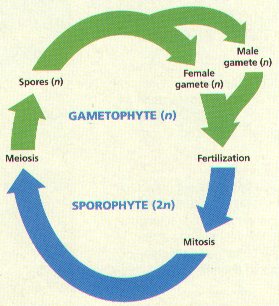
·        The leaflike algae Ulva has a sexual reproductive cycle that is characterized by a pattern called alternation of generations; a life cycle that exhibits alternation of generations has two distinct multicellular phases- a haploid, gamete-producing phase called a gametophyte and a diploid, spore-producing phase called a sporophyte.
·        The adult sporophyte has reproductive cells called sporangia, which produce haploid zoospore by meiosis.

Algal-Like Protists

Phylum Chlorophyta
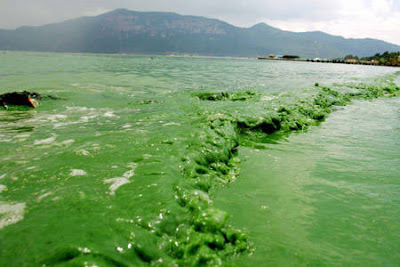
·        The phylum Chlorophyta contains more than 7,000 identified species of organisms called green algae and members of this phylum have an amazing number of forms and reproductive methods and their body structures range from single cells and colonial forms to multicellular filaments and sheets.

Phylum Phaeophyta
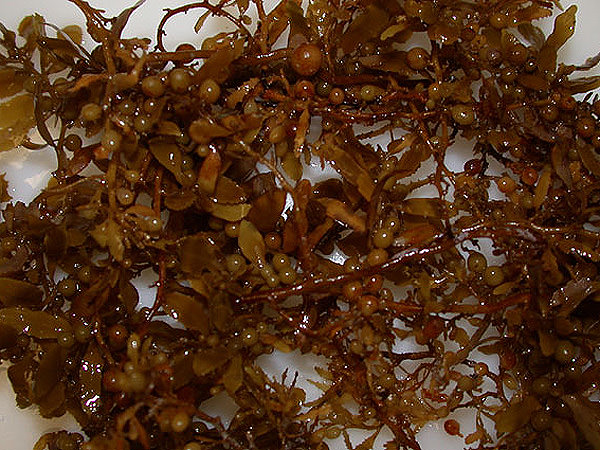
·        The phylum Phaeophyta contains 1,500 species of organisms called brown algae; brown algae is mostly marine and plantlike organisms called seaweed’s and kelps, they are common along rocky coasts where ocean water is cool.
·        The brown algae contain chlorophylls a and c and a large amount of pigment called fucoxanthin, which give the algae its brown color.
·        The food brown algae produces are stored as laminarin, a carbohydrate with glucose units that are linked differently than those in starch.
·        All brown algae are multicellular; the largest brown alga is the Macrocystis.
·        The thallus is anchored to the ocean bottom by a rootlike holdfast; the stemlike portion of the alga is called the stipe and the leaflike region, modified to capture sunlight for photosynthesis is called the blade.
·        The cell walls of the Macrocystis contain alginate, an alginic acid that is used in cosmetics and various drugs, as food, and as a stabilizer in most ice creams.

Phylum Rhodophyta
·        The phylum Rhodophyta contains 4,000 species of organisms called red algae.
·        Red algae contain chlorophyll a and pigments called phycobilins, which play an important role in absorbing light for photosynthesis.
·        Phycobilins can absorb the wavelengths of light that penetrate deep into the water; they make it possible for red algae to live in depths where alga pigments cannot survive.
·        Certain species of red algae have cell walls that are coated with a sticky substance called carageenan, which is a polysaccharide.
·        Agar, which is used as a gel-forming base for culturing microbes, is also extracted from the cell wall of red algae.

Bacillariophyta
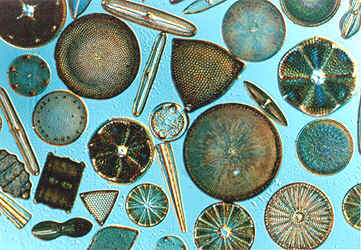
·        The phylum Bacillariophyta contains 11,500 species of organisms called diatoms.
·        Diatoms are abundant in both freshwater and marine environments; the cell wall, called shells, of the diatoms contains two pieces that fit together like a box; each half is called a valve.
·        Centric diatoms have circular or triangular shells and are most abundant in marine environments.
·        Pennate diatoms have rectangular shells and are most abundant in freshwater ponds and lakes; some pennate diatoms by secreting threads that attach to the surface of the water.
·        Diatoms are an abundant component of phytoplankton and are important producers in freshwater and marine food webs, along with being an essential source of nutrients for microscopic heterotrophs, and they release an abundance of oxygen.
·        When diatoms die their shells sink and accumulate in large numbers, forming a layer of material called diatomaceous earth.

Phylum Dinoflagellata
·      The phylum Dinoflagellata contains 1,100 species of organisms called dinoflagellates.
·        Dinoflagellates are small, usually unicellular organisms, photosynthetic, but a few are colorless and heterotrophic, and they are the major producers of organic matter in marine environments.
·      Photosynthetic dinoflagellates usually have a yellowish green to brown color due to large amounts of pigments called carotenoids and chlorophylls a and c.
·      Some species of dinoflagellates, such as Noctiluca, can produce bioluminescence, a display of sparkling light often seen in the ocean water at night.
·      When other species produce toxins and red pigments that explode, a resulting phenomenon is the red tide.

Phylum Chrysophyta
·        The phylum Chrysophyta contains about 850 species of organisms called golden algae, which live in freshwater, but few are found in marine environments.
·        Most of the species placed in this phylum are some shade of yellow or brown due to the presence of large amounts of carotenoids.
·        Golden algae store much of their surplus energy as oil and are important in the formation of petroleum deposits.

Phylum Euglenophyta
·        The phylum Euglenophyta contains 1,000 species of flagellated unicellular algae called euglenoids.
·        Euglenoids show both plantlike and animal-like characteristics; they are plantlike in that they have chlorophyll and are photosynthetic and they are animal-like in that they lack a cell wall and are highly motile.
·        Euglena is abundant in freshwater, especially in water polluted by excess nutrients.
·        Euglena lacks a cell wall and therefore is able to change its shape as it swims about.

Fungal-like Protists

Slime Molds
·        Slime molds spend half their life in a mobile, amoeba-like feeding form, engulfing organic matter and bacteria, like protozoa.
·        Slime molds produce funguslike reproductive structures, which is why they were once classified as fungi.
·        Slime molds are typically found growing on damp soil, rotting logs, decaying leaves, or other decomposing organic matter in moist areas.
·        During reproduction, slime molds produce a spore-bearing structure called a fruiting body.

Phylum Acrasiomycota
·        The phylum Acrasiomycota comprises about 65 species of cellular slime molds.
·        Cellular slime molds live as individual haploid cells that move about like amoebas; each cell moves as an independent organism, creeping over rotting logs and soil or swimming in fresh water, ingesting bacteria and other food.
·        A pseudoplasmodium is a coordinated colony of individual cells that resembles a slug, and it leaves a slimy trail as it crawls over decaying logs, leaves, and twigs.
·        Eventually a pseudoplasmodium will settle and form a fruiting body where spore will develop, then once the fruiting body breaks open, and the wind disperses the spores to new locations.

Phylum Myxomycota
·        450 species of plasmodial slime molds compose the phylum Myxomycota.
·        During the feeding stage of its life cycle, a plasmodial slime mold is a mass of cytoplasm called a plasmodium, and it may be as large as several square meters.
·        Each plasmodium is multinucleate or it contains thousands of nuclei.
·        The spores of a plasmodium are resistant to adverse conditions; in favorable conditions, they crack open and give rise to haploid reproductive cells.

Water Molds
·        A water mold is a funguslike organism composed of branched filaments of cells.
·        Water molds are aquatic and are commonly found in bodies of freshwater.

Phylum Oomycota
·        The phylum Oomycota includes a number of organisms that are pathogenic to plants.
·        Blight is a disease of plants characterized by quickly developing decay and discoloring leaves, stems, and flowers.
·        Water molds reproduce asexually and sexually.
·        During asexual reproduction, they produce motile, flagellated reproductive zoospores, which accumulate to form a matlike mass.
·        During sexual reproduction, the cells of the water mold develops egg-containing and sperm-containing structures, then tubes grow between the two types of structures letting the sperm cells to fertilize haploid egg cells to form diploid zygotes.

Phylum Chytridiomycota
·        It is approximately 750 protists species in the phylum Chytridiomycota.
·        The chytrids are primarily aquatic protists characterized by gametes and zoospores with a single, posterior flagellum.

Back


Protists

NAME/PERIOD:

If you type answers onto this page, they won’t be saved so be sure to PRINT this page!  Answer sheet to download.

  Exploring Protists


Domain Eukarya; Kingdom Protista

There are many types of protists, but organisms in this kingdom only have a few things in common:

They are eukaryotes – organisms that have cells with a nucleus and membrane-bound organelles.  They typically live in aquatic or moist environments. Most protists are unicellular (made of only one cell) but they may live in colonies.  But there are some protists are are multicellular (containing more than one cell) 

1. Are protists prokaryotes or eukaryotes?


2. What is a eukaryote?


3. What type of environment would you typically find protists living?


4. Are all protists unicellular? yes or no

5. What are unicellular protists that live together in clusters called?

Obtaining Food / Nutrition / Energy

Protists have a few different methods of obtaining nutrition (food):

  • Some contain chloroplasts (green pigments) like plants, and are autotrophsAutotrophs can use photosynthesis to make their own food, for example Algae.
  • Then there are others that are heterotrophs and obtain their food by absorbing it from their surroundings, for example Paramecium.
  • But there are some that can do both autotrophic and heterotrophic methods of obtaining food, for example Euglena.


6. How do the heterotroph protists obtain their food?


7. How do the autotroph protists get their food? Name the process.


8. What is an example of a protist that can do both autotrophic and heterotrophic methods of obtaining food?


9. What is an example of a protist that absorbs their food?


10. What is an example of a protist that makes their own food?


Classifying Protists

Protists are classified by how they obtain food.  Protists are organized into three main groups:

  • Animal – like protists  (heterotrophs)
  • Plant/Algal – like protists  (autotrophs)
  • Fungal – like protists  (heterotroph decomposers)

11. How are protists classified?


Animal – Like Protists – Protozoa

Animal – like protists are often called Protozoa.  Scientists classify them by the way they move around.

  • Most are unicellular and microscopic.  You can see them using a compound light microscope.
  • They are classified as heterotrophs because they absorb their food using vacuoles for digestion.
  • These are typically found in freshwater, marine, and moist land habitats.

12. What are the animal-like protists often called?

13. How do they obtain their food / energy?

14. How are they classified?

15. Go to http://blog.microscopeworld.com/2012/04/amoeba-under-microscope.html and DRAW and LABEL an amoeba.


Methods of Protozoa movement:

Cilia small hair-like projections all around the organism
Flagella long, thin, whip-like structure
Pseudopodia “false feet” – temporary extensions of a cell’s cytoplasm that help them move around and change their shapes to absorb their food
Parasites move along with the host they invaded


16. What is the method of movement that uses a long, whip-like tail?

17. What is the method of movement that uses “false feet”?

18. What are cilia?

19. Go to http://www.eastcentral.edu/common/depts/bi/protistans.php and DRAW and LABEL the paramecium.

paramecium

Types of Protozoa:

Phylum Sarcodina Phylum Ciliophora Phylum Zoomastingina Phylum Sporozoa
Common Name – Sarcodines Common Name – Ciliates Common Name – Zooflagellates Common Name – Sporozoan
Move by using Pseudopodia Move by using Cilia Move by using Flagella Adults do not move
Example:  Amebas    Example: Paramecium Example: Trypanosoma
(causes African Sleeping Sickness)
Example: Plasmodium (causes Malaria)


20. What is an example of a protozoa that uses a flagella for movement?

21. What type of protist phylum uses cilia?


Plant/Algal – Like Protists 

Plant/Algal-like protists are eukaryotes that are similar to plants.  Scientists classify these protists by the color of their pigments.

  • They are autotrophic and use chlorophyll and other pigments to harvest and use energy from sunlight.  They produce oxygen for our environment.
  • They are not considered plants because they do not have true roots, stems or leaves and most have flagella for movement at some time in their life cycles.
  • The Giant Kelp or seaweed are also in this group of algae.
Green Algae Brown Algae Red Algae Diatoms Dinoflagellates Golden Algae Euglena

22. What are plant/algal-like protists similar to?

23. How are they classified?

24. How do they obtain food/energy?  autotroph or heterotroph?

25. What do they do for the environment?

26. Why are they not plants?

27. Why are diatoms and dinoflagellates so important? (Use the web to research this question)

28. Giant kelp are called what?

29. Red algae produce what substance used as a culture media in lab? (Use the web to research this question)


Fungal – Like Protists 


Fungal-like protists are multicellular eukaryotes that are absorptive heterotrophs.

  • The job of fungal-like protists are decomposers breaking down dead organic matter.  They improve the quality of dirt by putting nutrients back into the ground.
  • They are most commonly known as the slime molds or water molds.  Do not confuse these with the mold you see growing on food or bread.

30. Are fungal-like protists unicellular OR multicellular?

31. How do they obtain their food?

32. What is the job of the fungal-like protists?

33. Give two examples of a fungal-like protist.


Protists – Review

Click on the box you choose for the correct answer for each question.

34. Protists are

Prokaryote, water based organisms
Eukaryote, water based organisms
Prokaryote, land based organisms
Eukaryote, land based organisms


35. Animal-like protists are often called

Algae
Decomposers
Molds
Protozoa


36. Animal-like protists are classified by

The way they move.
What they eat.
Pigments
Flagella


37. Plant/Algal-like protists are

Heterotrophic
Chemotrophic
Autotrophic
Phototrophic


38. Plant/Algal-like protists are classified by

Movement
Size
Color of Pigments
Nutrition


39. Fungal-like protists help the environment by

Decomposing organic matter
Producing oxygen
Producing carbon dioxide
Producing spores


Protozoan


Protozoa
Animal like Protists

All Materials © Cmassengale

Characteristics:

  • Eukaryotes
  • Found in kingdom Protista
  • Most are unicellular
  • Heterotrophs that ingest small food particles & digest it inside food vacuoles containing digestive enzymes
  • Classified by the way they move (cilia, flagella, pseudopodia…)

  • Microscopic in size
  • 65,000 identified species with almost half extinct
  • Found in freshwater, marine, and moist terrestrial habitats
  • Make up part of the zooplankton & serve as food for animals in marine & freshwater systems
  • First seen by Leeuwenhoek in 1675
  • Many species are free living
  • Some species are parasitic living in the bloodstream of their host & cause malaria, amebic dysentery, or giardiasis
  • Many serve as food for other organisms in aquatic habitats; called zooplankton

Reproduction:

  • All reproduce asexually by binary fission (single protozoan divides into two individuals)
  • Some species reproduce by multiple fission producing more than two individuals
  • Some species reproduce sexually by conjugation (opposite mating strains join & exchange genetic material)

Adaptations:

  • Eyespots in some protozoans can detect changes in light

  • Many can form harden covering called cyst when conditions become unfavorable (no water, pH or temperature changes, nutrient deficiency, decreased oxygen supplies…)
  • Metabolic activity of protozoans resumes when conditions become favorable again
  • Some protozoans can detect & avoid obstacles and harmful chemicals in their environment
  • Freshwater protozoa have contractile vacuoles to pump out excess water

Classification:

  • Divided into 4 phyla based on their method of movement — Sarcodina, Ciliophora, Zoomastigina, & Sporozoa
  • Found in the kingdom Protista along with algae, slime molds, & water molds
  • Sarcodinians move by extending their cytoplasm or pseudopodia (fingerlike projections of the cytoplasm)
  • Zooflagellates move by whip like flagella
  • Ciliophorans or ciliates move by hair like cilia move
  • Sporozoans are nonmotile


Phylum Common Name Locomotion Type of Nutrition Examples
Sarcodina sarcodines pseudopodia heterotrophic;
some parasitic
Amoeba
Radiolaria
Naegleria
Ciliophora ciliates cilia heterotrophic;
some parasitic
Paramecium
Tetrahymena
Balantidium
Zoomastigina zooflagellates flagella heterotrophic;
some parasitic
Trypanosoma
Leishmania
Giardia
Trichonympha
Sporozoa sporozoans (None in Adults) heterotrophic;
some parasitic
Plasmodium
Toxoplasma


Protozoan Evolution:

  • First eukaryotic organism thought to have evolved about 1.5 billion years ago
  • Protozoans possible evolved from the 1st eukaryotes by Endosymbiosis 
  •  Endosymbiosis – process where one prokaryote lives inside another becoming dependent upon each other

Phylum Sarcodina:

  • Includes hundreds of species of amebas
  • Found in freshwater, marine, & moist soil habitats
  •  Usually reproduce asexually
  • Their cytoplasm consists of clear, outer ectoplasm and granular, inner endoplasm
  • Move by extending cytoplasm (cytoplasmic streaming)
  • Cytoplasm extensions are called “false foot” or pseudopods
  • Pseudopods form when the inner cytoplasm or endoplasm pushes the outer cytoplasm or ectoplasm forward to make a blunt, armlike extension
  • Ameba move by cytoplasmic streaming to produce pseudopods; process called ameboid movement

  • Sarcodines also use their pseudopods for feeding by surrounding & engulfing food particles & other protists; called phagocytosis
  • Food is surrounded by a pseudopod & then this part of the cell membrane pinches together forming a food vacuole; called endocytosis
  • Cytoplasmic enzymes enter the food vacuole & digest the food
  • Undigested food & wastes leave by exocytosis

  • Most Sarcodinians have contractile vacuoles to pump out excess water

  • Oxygen & carbon dioxide diffuse through the cell membrane
  • Sarcodinians may form hard, protective, inactive cysts when conditions become unfavorable (drought, lack of nutrients, heat…)
  • React to stimuli such as light
  •  Some Sarcodinians have hard shells called the test made of silica or calcium carbonate
  • Radiolarians found in warm, marine waters have a test made of silica & have sticky pseudopodia to trap food

  • Marine Foraminiferans have a test made of calcium carbonate with holes through which pseudopodia extend

  • Foraminiferan tests build up and form limestone or chalk (e.g. White Cliffs of Dover)
  • Important food source in marine habitats
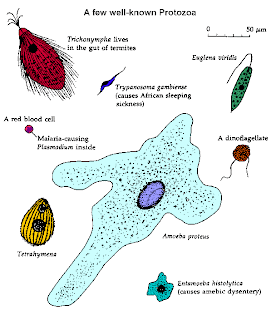
  • Entameba histolytica cysts in untreated water supplies cause amebic dysentery which can be fatal

Phylum Ciliophora:

  • Called ciliates because they move by short, hairlike cilia lining the cell membrane
  • Cilia may be modified into teeth, paddles, or feet

  • Largest group of protozoans
  • Most found in freshwater, but some are marine
  •  Called plankton & serve as a food source
  •  Form protective cysts to survive unfavorable conditions
  • Members include the Paramecium, Vorticella,  & Stentor
  • Have 2 types of nuclei — smaller micronuclei & larger macronuclei
  • Macronucleus controls asexual reproduction by mitosis
  • Can reproduce sexually by conjugation (two paramecia join together & exchange DNA)
  • Gases diffuse across cell membrane

Stentor:

  • Trumpet shaped protozoan with cilia around the top
  • Attaches to feed & then detaches to swim around

Vorticella:

  • Cup shaped protozoan with cilia at the top
  •   Has a coiled stalk to raise & lower the organism
  • Can attach to surfaces

Paramecium caudatum:

  •  Slipper shaped protozoan found in freshwater

  • Clear, elastic covering of cell membrane called pellicle
  • Pellicle made of protein for protection
  • Use cilia to swim & obtain food (algae & bacteria)
  • Have 2 contractile vacuoles to pump out excess water
  •  Cilia sweep food into oral groove where mouth located at the bottom
  •  Food enters short tube called gullet into food vacuoles where it’s digested
  • Wastes leave through anal pore

  • Have trichocysts (tiny, toxic darts to help capture prey or anchor to a surface)
  •  Respond to light & learn by trial & error
  • Reproduce asexually by mitosis & sexually by conjugation

Phylum Zoomastigina:

  • Called Zooflagellates because have one or more whiplike flagella to move
  • Flagella made of bundles of microtubules

  • May be freshwater or marine
  • Some are parasites such as Trypanosoma that destroy red blood cells & causes fatal African sleeping sickness

  • Trichonympha lives symbiotically inside termites & digests cellulose

Phylum Sporozoa:

  • Adult sporozoans have no structures for movement
  • Form spores

  • Most are parasitic using one or more hosts
  • Immature sporozoans are called sporozoites & live in body fluids of hosts
  • Plasmodium is transmitted by mosquitoes & causes malaria
  • Plasmodium sporozoites enter the bloodstream, travel to the liver, divide & form spores called merozoites
  • Merozoites attack red blood cells & later form eggs & sperm that fertilize
  •  New sporozoites migrate to the salivary glands of mosquitoes where they can be passed on to another person
  • Malaria can be controlled by controlling mosquito populations & it is treated with a drug called quinine derived from the Cinchona Tree


Plant Analytical Questions

Plant Analytical Questions

Plant Structures and Function

Part 1: Use the following diagram of a seedling to answer these questions.

  1. What tropisms are being exhibited by the various parts of this seedling?


  1. What hormones are involved in these responses?


Part 2: Use the diagram below to complete lines a – f.

The diagrams represent three conditions of day & night length. A short-day plant, with a critical night length of 14 hours, and a long-day plant, with a critical night length of 8 hours, are grown under each condition. On lines a – f, indicate whether each plant will flower under each condition.


Plant Pigments and Photosynthesis


Plant Pigments and Photosynthesis


Introduction:
In this laboratory you will separate plant pigments using chromatography. You will also measure the rate of photosynthesis in isolated chloroplasts. The measurement technique involves the reduction of the dye DPIP. The transfer of electrons during the light-dependent reactions of photosynthesis reduces DPIP, changing it from blue to colorless.

Exercise 4A: Plant Pigment Chromatography:
Paper chromatography is a useful technique for separating and identifying pigment and other molecules from cell extracts that contain a complex mixture of molecules. The solvent moves up the paper by capillary action, which occurs as a result of the attraction of solvent molecules to the paper and the attraction of the solvent molecules to one another. As the solvent moves up the paper, it carries along any substances dissolved in it. The pigments are carried along at different rates because they are not equally soluble in the solvent and because they are attracted, to different degrees, to the fibers of the paper through the formation of intermolecular bonds, such as hydrogen bonds.

Beta carotene, the most abundant carotene in plants, is carried along near the solvent front because it is very soluble in the solvent being used and because it forms no hydrogen bonds with cellulose. Another pigment , Xanthophyll differs from carotene in that it contains oxygen. Xanthophyll is found further from the solvent font because it is less soluble in the solvent and has been slowed down by hydrogen bonding to the cellulose. Chlorophyll’s contain oxygen and nitrogen and are bound more tightly to the paper than the other pigments. Chlorophyll a is the primary photosynthetic pigment in plants. A molecule of chlorophyll a is located at the reaction center of the photo systems. The pigments collect light energy and send it to the reaction center. Carotenoids also protect the photosynthetic systems from damaging effects of ultraviolet light.

Procedure:
1. Obtain a 250 mL beaker which has about 2 cm of solvent at the bottom. Cover the beaker with aluminum foil to prevent the vapors from spreading. It is also suggested this work be done under a fume hood.

2. Cut a piece of filter paper which will be long enough to reach the solvent. Draw a line about 1.0 cm from the bottom of the paper. See Figure 4.1 below.

Figure 4.1

3. Use a quarter to extract the pigments from spinach leaf cells. Place a small section of leaf on the top of the pencil line. Use the ribbed edge of the coin to to crush the leaf cells. Be sure the pigment line is on top of the pencil line. Use a back and forth movement exerting firm pressure through out.

4. Place the chromatography paper in the cylinder. See Figure 4.2 below. Do not allow the pigment to touch the solvent.

Figure 4.2


5. Cover the beaker. When the solvent is about 1 cm from the top of the paper, remove the paper and immediately mark the location of the solvent front before it evaporates.

6. Mark the bottom of each pigment band. Measure the distance each pigment migrated from the bottom of the pigment origin to the bottom of the separated pigment band. Record the distance that each front, including the solvent front, moved in Table 4.1 Depending on the species of plant used, you may be able to observe 4 or 5 pigment bands.

Table 4.1

Distance moved by Pigment Band (millimeters)

Band Number Distance (mm) Band Color
1
2
3
4
5

Distance Solvent Front Moved _________________

Analysis of Results:
The relationship of the distance moved by a pigment to the distance moved by the solvent is a constant called Rf . It can be calculated for each of the four pigments using the formula:


Rf = distance pigment migrated (mm)_____
distance solvent front migrated (mm)

Record your Rf values in Table 4.2

Table 4.2

___________________________ = Rf for carotene (yellow to yellow -orange)
___________________________ = Rf for xanthophyll (yellow)
___________________________ = Rf for Chlorophyll a (bright green to blue green)
___________________________ = Rf for Chlorophyll b (yellow green to olive green)

Topics for Discussion:
1. What factors are involved in the separation of the pigments?

_______________________________________________________________________________

_______________________________________________________________________________

_______________________________________________________________________________

_______________________________________________________________________________

_______________________________________________________________________________

2. Would you expect the Rf value of a pigment to be the same if a different solvent were used? Explain.

_______________________________________________________________________________

_______________________________________________________________________________

_______________________________________________________________________________

_______________________________________________________________________________

_______________________________________________________________________________

3. What type of chlorophyll does the reaction center contain? What are the roles of the other pigments?

_______________________________________________________________________________

_______________________________________________________________________________

_______________________________________________________________________________

_______________________________________________________________________________

_______________________________________________________________________________

Exercise 4B: Photosynthesis / The Light Reaction:
Light is a part of a continuum of radiation or energy waves. Shorter wavelengths of energy have a greater amounts of energy. For example, high-energy ultraviolet rays can harm living things. Wavelengths of light within the visible spectrum of light power photosynthesis. when light is absorbed by leaf pigments, electrons within each photosystem are boosted to a higher energy level and this energy level is used to produce ATP and to reduce NADP to NADPH. ATP and NADPH are then used to incorporate CO2 into organic molecules, a process called carbon fixation.

Design of the Exercise:
Photosynthesis may be studied in a number of ways. For this experiment, a dye-reduction technique will be used. The dye-reduction experiment tests the hypothesis that light and chloroplasts are required for the light reactions to occur. In place of the electron accepter, NADP, the compound DPIP ( 2.6-dichlorophenol-indophenol), will be substituted. When light strikes the chloroplasts, electrons boosted to high energy levels will reduce DPIP. It will change from blue to colorless.

In this experiment, chloroplasts are extracted from spinach leaves and incubated with DPIP in the presence of light. As the DPIP is reduced and becomes colorless, the resultant increase in light transmittance is measured over a period of time using a spectrophotometer. The experimental design matrix is presented in Table 4.3.

Table 4.3: Photosynthesis Setup

Cuvettes

1

Blank


2

Unboiled Chloroplasts Dark

3

Unboiled Chloroplasts Light

4

Boiled Chloroplasts Light

5

No
Chloroplasts

Phosphate Buffer 1 ml. 1 ml. 1 ml. 1 ml. 1 ml.
Distilled Water 4 ml. 3 ml. 3 ml. 3 ml. 3 ml + 3 drops
DPIP —- 1 ml. 1 ml. 1 ml. 1 ml.
Unboiled Chloroplasts 3 drops 3 drops 3 drops —- —-
Boiled Chloroplasts —- —- —- 3 drops —-

Procedure:
1. Turn on the spectrophotometer to warm up the instrument and set the wavelength to 605 nm by adjusting the wavelength control knob.

2. While the spectrophotometer is warming up, your teacher may demonstrate how to prepare a chloroplast suspension from spinach leaves.

3. Set up an incubation area that includes a light, water flask, and test tube rack. The water in the flask acts as a heat sink by absorbing most of the light’s infrared radiation while having little effect on the light’s visible radiation.

Figure 4.2: Incubation Setup

Flood Light ——-Water Heat Sink——-Cuvettes


4. Your teacher will provide you with two beakers, one containing unboiled chloroplasts. Be sure to keep these on ice at all times.

5. At the top rim, label the cuvettes 1,2,3,4, and 5, respectively. Using lens tissue, wipe the outside walls of each cuvette ( Remember: handle cuvettes only near the top). Using foil paper, cover the walls and bottom of cuvette 2. Light should not be permitted inside cuvette 2 because it is a control for this experiment.

6. Refer to Table 4.3 to prepare each cuvette. Do not add unboiled or boiled chloroplasts yet. To each cuvette, add 1 ml of phosphate buffer.

7. Bring the spectrophotometer to zero by adjusting the amplifier control knob until the meter reads 0% transmittance. Cover the top of cuvette 1 with Parafilm@ and invert to mix. Insert cuvette 1 into the sample holder and adjust the instrument to 100% transmittance by adjusting the light -control knob. Cuvette 1 is the blank to be used to recalibrate the instrument between readings. For each reading, make sure that the cuvettes are inserted into the sample holder so that they face the same way as in the previous reading.

8. Obtain the unboiled chloroplast suspension, stir to mix, and transfer three drops to cuvette 2. Immediately cover and mix cuvette 2. Then remove it from the foil sleeve and insert it into the spectrophotometer’s sample holder, read the % transmittance, and record it as the time 0 reading in Table 4.4 . Replace cuvette 2 into the foil sleeve, and place it into the incubation test tube rack. Turn on the flood light. Take and record additional readings at 5,10,and 15 minutes. Mix the cuvette’s contents just prior to each readings. Remember to use cuvette 1 occasionally to check and adjust the spectrophotometer to 100% transmittance.

9. Obtain the unboiled chloroplast suspension, mix, and transfer three drops to cuvette 3. Immediately cover and mix cuvette 3. Insert it into the spectrophotometer’s sample holder, read the % transmittance, and record it in Table 4.4 . Replace cuvette 3 into the incubation test tube rack. Take and record additional readings at 5,10,and 15 minutes. Mix the cuvette’s contents just prior to each readings. Remember to use cuvette 1 occasionally to check and adjust the spectrophotometer to 100% transmittance.

10. Obtain the boiled chloroplast suspension, mix, and transfer three drops to cuvette 4. Immediately cover and mix cuvette 4. Insert it into the spectrophotometer’s sample holder, read the % transmittance, and record it in Table 4.4 . Replace cuvette 4 into the incubation test tube rack. Take and record additional readings at 5,10,and 15 minutes. Mix the cuvette’s contents just prior to each readings. Remember to use cuvette 1 occasionally to check and adjust the spectrophotometer to 100% transmittance.

11. Cover and mix the contents of cuvette 5. Insert it into the spectrophotometer’s sample holder, read the % transmittance, and record it in Table 4.4 . Replace cuvette 5 into the incubation test tube rack. Take and record additional readings at 5,10,and 15 minutes. Mix the cuvette’s contents just prior to each readings. Remember to use cuvette 1 occasionally to check and adjust the spectrophotometer to 100% transmittance.

Table 4.4: Transmittance (%)

Time (minutes)

Cuvette 0 5 10 15
2 Unboiled /Dark
3 Unboiled/ Light
4 Boiled / Light
5 No Chloroplasts

Analysis of Results:
Plot the percent transmittance from the four cuvettes on the graph below
.

a. What is the dependent variable? ____________________________________________

b. What is the independent variable? __________________________________________

Graph Title: __________________________________________________________________

Graph 4.1

Topics for Discussion:
1. What is the purpose of DPIP in this experiment?

___________________________________________________________________________

___________________________________________________________________________

___________________________________________________________________________

2. What molecule found in chloroplasts does DPIP “replace” in this experiment? _________________

3. What is the source of the electrons that will reduce DPIP? _________________________________

4. What was measured with the spectrophotometer in this experiment? ____________________________________________________________________________

____________________________________________________________________________

____________________________________________________________________________

____________________________________________________________________________

5. What is the effect of darkness on the reduction of DPIP? Explain.

____________________________________________________________________________

____________________________________________________________________________

____________________________________________________________________________

____________________________________________________________________________

6. What is the effect of boiling the chloroplasts on the subsequent reduction of DPIP? Explain.

____________________________________________________________________________

____________________________________________________________________________

____________________________________________________________________________

____________________________________________________________________________

7. What reasons can you give for the difference in the percent transmittance between the live chloroplasts that were incubated in the light and those that were kept in the dark?

_____________________________________________________________________________

_____________________________________________________________________________

_____________________________________________________________________________

_____________________________________________________________________________