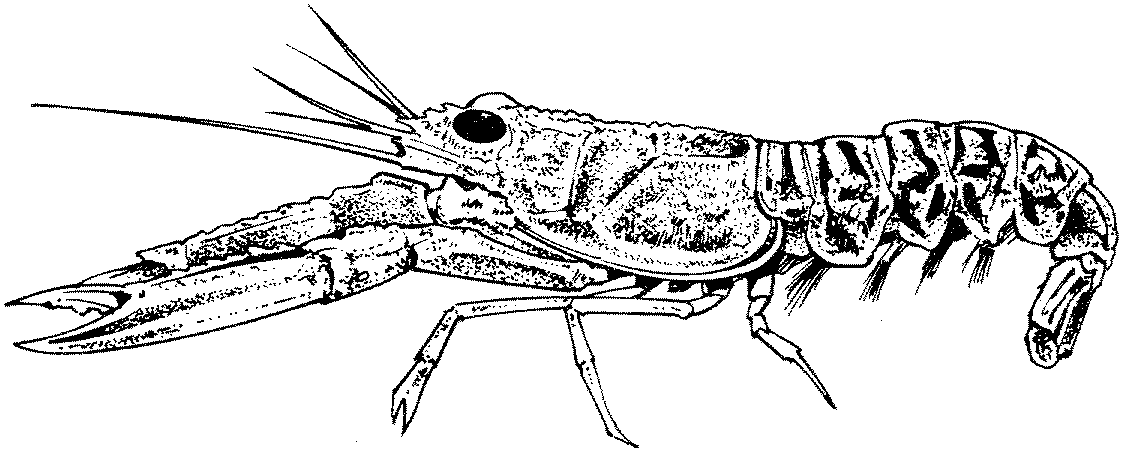
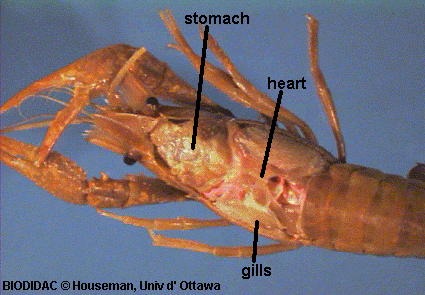
Crayfish Worksheet

Name(s)__________________________________ Group______ Date ________ Period_____

Crayfish Dissection Worksheet

1. What structures are used for capturing prey and securing and eating food?


2. How are the antennae, chelipeds, other walking legs, and swimmerets related?


3. What are the main structures you could have observed when you removed the exoskeleton of the abdomen and tell the function of each?


4. Is the crayfish most vulnerable to its enemies from the dorsal or ventral side? Why?


5. The crayfish usually molts, or sheds its exoskeleton, twice a year. Why does the crayfish “hide” after it molts?


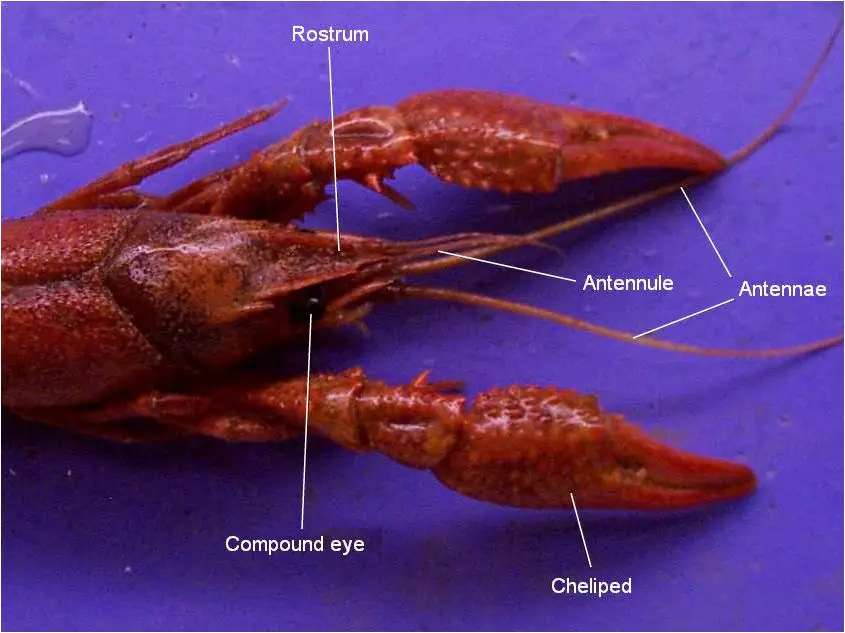
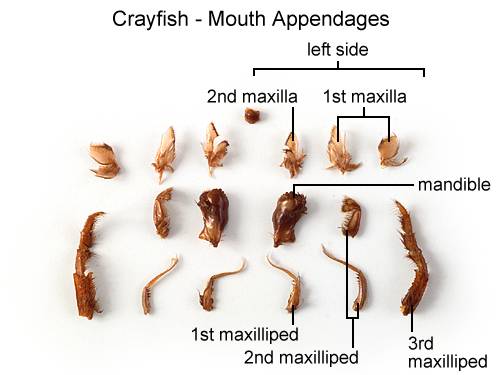
6. Name the appendages found on the head of a crayfish & tell the function of each.


.


7. Of the systems studied, which two are most unlike the related human system? Why?


8. Although the crayfish has an inflexible cephalothorax, the crayfish is classified as a segmented animal. Why?


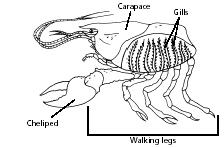
9. Name the appendages found on the thorax of the crayfish and tell the function of each.


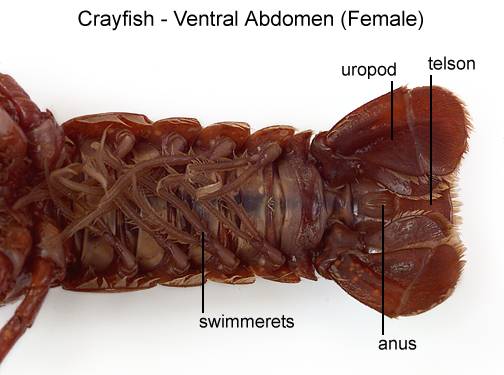
10. Name the appendages on the abdomen of the thorax and tell the function of each.


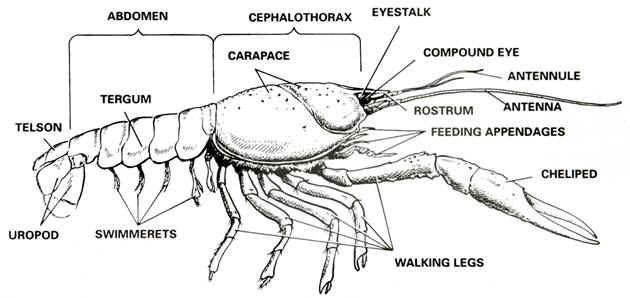
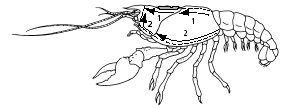
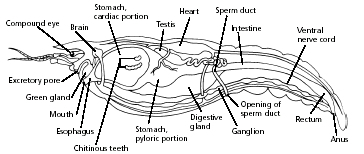
11. Label the drawing of the crayfish.

BACK


Dichotomous Key

Dichotomous Key

The identification of biological organisms can be greatly simplified using tools such as dichotomous keys.  A dichotomous key is an organized set of couplets of mutually exclusive characteristics of biological organisms.  You simply compare the characteristics of an unknown organism against an appropriate dichotomous key.  These keys will begin with general characteristics and lead to couplets indicating progressively specific characteristics. If the organism falls into one category, you go to the next indicated couplet.  By following the key and making the correct choices, you should be able to identify your specimen to the indicated taxonomic level.

Sample key to some common beans used in the kitchen:


Pinto


1a. Bean round Garbanzo bean
1b. Bean elliptical or oblong Go to 2
2a. Bean white White northern
2b. Bean has dark pigments Go to 3
3a. Bean evenly pigmented Go to 4
3b. Bean pigmentation mottled Pinto bean
4a. Bean black Black bean
4b. Bean reddish-brown Kidney bean

Click here for correct answers


Chromatography of Plant Pigments Sample 2 PreAP


Chromatography of Plant  Pigments


Introduction

Chromatography is a way of separating a mixture using differences in the abilities of the components to move through a material. All chromatography involves two phases – a stationary phase and a mobile phase. The movement of the mobile phase through the stationary phase allows separation to take place. Because the components of a mixture move at different rates, they eventually separate.

Paper chromatography is a common way to separate various components of a mixture. The components of the mixture separate because different substances are selectively absorbed by paper due to differences in polarity. A solution can be separated by allowing it to flow along a stationary substance. Water or some other solvent is used as the mobile phase. The solvent moves upward along the paper because of capillary action. As it reaches the spot, the mixture dissolves in the solvent. For instance, the pigments in an ink solution can be separated by passing the ink through a piece of paper. The pigments respond differently to the paper. The differences in the migration rates result in differences in the distances the separated components travel, some pigments are held back while other moves ahead. Eventually, a pattern of colors results that shows the separated pigments.

Hypothesis

Paper can be used to separate mixed chemicals.

Materials

The materials used for this lab are paper, pencil, scissors, eraser, filter paper, test tube, cork, paper clip, metric ruler, black felt-tip pen, and a calculator.

Methods

The first step to this experiment was to bend a paper clip so that it is straight with a hook at one end. Push the straight end of the paper clip into the bottom of a cork stopper. Next, hang a thin strip of filter paper on the hooked end of the paper clip. Insert the paper strip into the test tube so it does not touch the sides, but almost the bottom of the test tube. Next, remove the paper strip from the test tube and draw a solid 5 mm wide band about 25 mm from the bottom of the paper, using a black felt tip pen. Use a pencil to draw a line across the top of the paper strip 10 cm from the top.

Pour about 2 mL of water into the test tube with the bottom of the paper in the water and the black band above the water. Observe what happens as the liquid travels up the paper. Record the changes you see. When the solvent has reached the pencil line, remove the paper from the test tube. Let the paper dry on the desk. With a metric ruler, measure the distances form the starting point to the top edge of each color. Record the data in a data table. Calculate a ration for each color by dividing the distance the color traveled by the distance the solvent traveled.

Results

The results of the experiment are shown in a chart and a graph.

Distance color traveled and Rf value.


Color of ink (list in order Distance traveled by each color (mm) Distance solvent traveled (mm) Ration traveled =
Distance color moved /Distance water moved
Yellow 50 120 5/12
Orange 85 120 17/24
Pink 100 120 5/6
Red 105 120 7/8
Blue 115 120 23/24
Violet 120 120 1


Questions

1. How many colors separated from the black ink? Six colors separated from the black ink: yellow, orange, pink, red, blue, violet.

2. What served as the solvent for the ink? Water served as the solvent because it is the universal solvent.

3. As the solvent travel up the paper, what color appeared first? Orange appeared first as the solvent traveled up the paper.

4. List the colors in order from top to bottom that separated from the black ink? The colors that separated from top to bottom: violet, blue, red, pink, orange, and yellow.

5. In millimeters, how far did the solvent travel. The solvent traveled 120mm.

6. From your results, what can you conclude is true about black ink. That black ink is a combination of several colors and that can be separated by water.

7. Why did the inks separate? The ink separated because each pigment has its own characteristics and molecular structure.

8. Why did some inks move a greater distance? Different pigments were absorbed at different rates.

Error analysis

There could be an error by the way the ink was distributed on the paper or by the amount of water put in the test tube.

Conclusion

The hypothesis was correct. This experiment showed the way black ink could be separated. Black ink is made from a various colors— yellow, orange, pink, red, blue, and violet. The colors separate because of the differences in their molecular characteristics, their solubility in water and their rate of absorption by the paper.

BACK


Dichotomous Key Activity


Dichotomous Key Activity


Directions: Give each of the following creatures a name. You may want to print this out before you proceed.


1. ________________

5. _________________

8. ___________________

2. ________________

4. __________________

6. __________________

9. ___________________

3. __________________

7. _________________

10. __________________


Darwin & Natural Selection


Charles Robert Darwin
Darwin and Evolution

All Materials © Cmassengale


History of Evolution:

  • Plato & Aristotle believed species were fixed & could be arranged according to their complexity
  • In the mid eighteenth century, Carolus Linnaeus developed a system of classification that called binomial nomenclature
  • George Cuvier, in the eighteenth century, explained changes in the fossil record by proposing that a whole series of catastrophes (extinctions) and re-populations from other regions had occurred giving the appearance of change over time
  • Prior to Darwin, it was thought that the world was young & species did not change
  • Lamarck (1744-1829) was first to state that descent with modification occurs and that organisms become adapted to their environments
  • Inheritance of acquired characteristics was the Lamarckian belief that organisms become adapted to their environment during their lifetime and pass on these adaptations to their offspring
  • Lamarck believed that the long necks of giraffes evolved as generations of giraffes reached for ever higher leaves; known as the Law of Use & Disuse

Giraffe neck extension

  • Because it is supported by so many lines of evidence, evolution is no longer considered a hypothesis
  • Evolution is one of the great unifying theories of biology

Darwin’s Background & Voyage:

  • His nature was too sensitive to become a doctor like his father so he studied divinity
  • He attended biology and geology lectures and was tutored by the Reverend John Henslow who arranged his trip on the HMS Beagle
  • In 1831, at the age of 22, Charles Darwin accepted a naturalist position aboard the ship HMS Beagle & began a five-year voyage around the world

Map showing Darwin's voyage on the Beagle

  • He read Principles of Geology by Charles Lyell that stated that the observed massive geological changes were caused by slow, continuous processes (erosion, uplifting…)
  • Darwin carried this book with him on his voyage as he witnessed Argentina coast earthquakes raising the earth several feet, & marine shells occurring far inland and at great heights in the Andes
  • Darwin’s many observations led him to the idea that species slowly change over time
  • Darwin’s comparison of the animals of South America and the Galapagos Islands caused him to conclude that adaptation to the environment can cause diversification, including origin of new species
    Examples: Patagonian hares replaced rabbits in the South American grasslands

The Galapagos Islands:

  • Volcanic islands off the South American coast
  • Island species varied from the mainland species, and from island-to-island
  • Each island had either long or short necked tortoises depending on the island’s vegetation

  • Finches on the Galapagos Islands resembled a mainland finch, but there were more types
  • Bill shapes are adaptations to different means of gathering food. Diversity of bill shape in the Hawaiian honey creeper
  • Galapagos finch species varied by nesting site, beak size, and eating habits


Darwin’s Theory of Evolution:

  • An adaptation is a trait that helps an organism be more suited to its environment
  • Darwin decided adaptations develop over time
  • Natural selection was proposed by both Alfred Russell Wallace and Darwin as a driving mechanism of evolution
  • Darwin and Wallace both read an essay by Thomas Malthus that proposed that human populations outgrow resources so there is a constant struggle for existence

mathusianpopulation.gif (10181 bytes)

  • Fitness is a measure of an organism’s reproductive success
  • Organisms most fit to reproduce are selected by environment which results in adaptation of the population
  • Natural selection is also called “survival of the fittest”
  • Conditions for natural selection include:
    a. Variations exist among members of a population
    b. Many more individuals are produced each generation than will survive
    c. Some individuals are better adapted so they survive & reproduce
    d. Members of a population compete for food, space, mates…
  • Variations that make adaptation possible are those that are passed on generation to generation
  • Extinction occurs when previous adaptations are no longer suitable to a changed environment

On the Origin of Species by Darwin:

  • After the HMS Beagle returned to England in 1836, Darwin waited over 20 years to publish
  • Darwin was forced to publish Origin of Species after reading a similar hypothesis by Alfred Russell Wallace
  • Both men concluded that life forms arose by descent from a common ancestor, and       that natural selection is the mechanism by which species change and new species arise

Fossil Evidence:

  • Fossils are relics or impressions of ancient organisms
  • Most fossils are found in layers (strata) of sedimentary rock

  • The fossil record traces history of life and allows us to study history of particular organisms
  • Through radioactive dating, geologists estimate the age of the earth at about 4.6 billion years


ERA PERIOD EPOCH DATES
MYA
AGE of Notes
Cenozoic Quaternary Holocene 0-2 Mammals Humans
Pleistocene  Other Mammal Species
Tertiary Pliocene 2-5
Miocene 5-24
Oligocene 24-37
Eocene 37-58
Paleocene 58-66 Extinction of dinosaurs
Mesozoic Cretaceous 66-144 Reptiles Flowering plants
Jurassic 144-208 1st birds & mammals
Triassic 208-245 First Dinosaurs
Paleozoic Permian 245-286 Amphibians End of trilobites
Carboniferous Pennsylvanian 286-320 First reptiles
Mississippian 320-360 Large primitive trees
Devonian 360-408 Fishes First amphibians
Silurian 408-438 First land plant fossils
Ordovician 438-505 Invertebrates First Fish
Cambrian 505-570 1st shells, trilobites dominant

Precambrian

570-2,500 1st Multi-celled organisms
2,500-3,800 1st one-celled organisms
3,800-4,600


  • Fossils are at least 10,000 years old and include skeletons, shells, seeds, insects trapped in amber, imprints of organisms, organisms frozen in ice (wooly mammoth),  or trapped in tar pits (saber-toothed tiger)
  • Transitional forms reveal links between groups (Example: Therapsids were mammal-like reptiles and Pterosaurs were bird like reptiles)

pterosaur_flying.gif (50359 bytes)
PTEROSAURS

Biogeographical Evidence:

  • Biogeography is the study of the geographic distribution of life forms on earth
  • Physical factors, such as the location of continents, determine where a population can spread
  • Example: Placental mammals arose after Australia separated from the other continents, so only marsupials diversified in Australia


KOALA KANGAROO


Anatomical Evidence:

  • Organisms have anatomical similarities when they are closely related because of common descent
  • Homologous structures in different organisms are inherited from a common ancestor have have similar structures
  • Example : Vertebrate forelimbs contain the same sets of bones organized in similar ways, despite their dissimilar functions

  • Analogous structures are inherited from different ancestors and have come to resemble each other because they serve a similar function
  • Example: Bird wing & bat wing are both for flight but they are structurally different
  • Vestigial Structures are remains of a structure that is no longer functional but show common ancestry
  • Example: Humans have a tailbone but no tail

Embryological Evidence:

  • During development, all vertebrates have a post-anal tail and paired pharyngeal pouches
  • Organisms that show similarities in their embryonic development may have a common ancestry

Biochemical Evidence:

  • Almost all living organisms use the same basic biochemical molecules, e.g., DNA, ATP, enzymes …
  • Similarities in amino acid sequences, DNA codes, etc. can be explained by descent from a common ancestor

Examples of Evolution in Modern Times:

  • Peppered moth — light colored vs. dark colored (industrialization influence) Manchester, England
  • Insect resistance to insecticides
  • Bacterial resistance to antibiotics