Classification Bi Worksheet


Classification


Section 18-1            History of Taxonomy 

1. Define taxonomy. 

2. Who was first to classify organisms? 

3. Explain Aristotle’s taxonomy of organisms. 

4. Why are common names not good to use when classifying organisms? Give an example. 

5. Describe Carolus Linnaeus’s system of classification. 

6. Linnaeus used ____________________ or form & structure to classify organisms. 

7. List Linnaeus’s levels of organization in order starting with the broadest classification level. 

8. Name Linnaeus’s two kingdoms. 

9. What is the difference between phylum & division? How are they alike?

10. What classification level contains only a single type of organism? 

11. Give the taxonomy for a lion. 

12. In Linnaeus’s naming system, ___________________ words are used as the name. 

13. Explain Linnaeus’s 2-word naming system. 

14. What is Linnaeus’s naming system called? 

15. Write the scientific name for man. 

16. The ___________ name is written first and must always be __________________. 

17. The ____________ name is written second and should _____________ be capitalized. 

18. Name 2 things a species name may do. 

19. What are varieties? 

20. What are subspecies? 

21. Write a scientific name that includes a subspecies. 

22. What do modern taxonomist use to classify organisms? 

23. What is phylogeny? 

Section 18-2            Modern Phylogenetic Taxonomy 

24. Name 6 things used by modern taxonomists to classify organisms. 

25. Classification of an organism should reflect its __________ or ___________ history.

26. What is systematics?

27. Name a tool used by systematic taxonomists.

28. What is a phylogenetic tree? 

29. Draw a phylogenetic tree showing the possible relationships among animal phyla. 

30. Do phylogenetic trees ever change?  Explain. 

31. What complex animal group is located at the top of your phylogenetic tree? 

32. Do all organisms have complete fossil records? Explain. 

33. Which structures show that organisms are more closely related, homologous or analogous? 

34. Features similar in structure but with different functions are called _______________ structures.

35. Early patterns of similar ______________________ development show relationships. 

36. The fertilized egg or _______________ divides by mitosis. 

37. What is the blastula & make a sketch? 

38. What is the blastopore, & what does it become? 

39. The blastopore becomes the mouth in many animals except in ________ where it becomes their ______________.

40. What invertebrate group is most closely related to the vertebrates? 

41. Taxonomists compare macromolecules such as ____________, ____________, & ____________ to show similarities among species. 

42. If two organisms have similar banding patterns on their chromosomes then they are _______________ related.

43. What is used in cladistics to show evolutionary relationships? 

44. What is a derived character & give an example? 

45. Do shared derived characters show common ancestry?

46. What is a cladogram? 

47. Sketch a cladogram for vertebrates. 

Section 18-3            Modern Systems of Classification 

48. The discovery of 2 broad types of bacteria led taxonomists to develop what type of classification system? 

49. Name the 6 kingdoms & tell which are prokaryotes & which are eukaryotes. 

50. Describe members of the kingdom Archaebacteria. 

51. In what type of environment are Archaebacteria found? 

52. Did Archaebacteria carry on photosynthesis? 

53. What kingdom contains true bacteria? 

54. Name 4 things Eubacteria do that affect your life.

55. Do all true bacteria use oxygen? Explain. 

56. How do all bacteria reproduce? 

57. Why are bacteria able to evolve so quickly? Give an example. 

58. Most protists are ______ organisms, but some like the giant kelp are _________ without __________. 

59. Since protists are eukaryotes, what special structures do they contain? 

60. Some protists like ________________ feed on other organisms, while __________ have chloroplasts & make their own food.

61. Describe the characteristics of fungi. 

62. How do fungi get food? 

64. Multicellular plants are in the ____________________ kingdom. 

65. Most plants are ________________ and make food energy by ________________. 

66. Most plants live on ________________. 

67. Name 4 examples of major plant groups. 

68. Describe the characteristics of the animal kingdom. 

69. Most animals have _______________ body organization. 

70. Both plants & animals reproduce ________________. 

71. Using information about __________ RNA, __________ developed the three _______ classification system. 

72. Name the 3 domains. 

73. Domain ___________ contains the same organisms as the kingdom Archaebacteria. 

74. Domain ________________ contains the same organisms as kingdom Eubacteria. 

75. What is included in domain Eukarya? 

76. What characteristic do all members of the domain Eukarya have in common with each other

BACK


Crayfish Worksheet

Name(s)__________________________________ Group______ Date ________ Period_____

Crayfish Dissection Worksheet

1. What structures are used for capturing prey and securing and eating food?


2. How are the antennae, chelipeds, other walking legs, and swimmerets related?


3. What are the main structures you could have observed when you removed the exoskeleton of the abdomen and tell the function of each?


4. Is the crayfish most vulnerable to its enemies from the dorsal or ventral side? Why?


5. The crayfish usually molts, or sheds its exoskeleton, twice a year. Why does the crayfish “hide” after it molts?


6. Name the appendages found on the head of a crayfish & tell the function of each.


.


7. Of the systems studied, which two are most unlike the related human system? Why?


8. Although the crayfish has an inflexible cephalothorax, the crayfish is classified as a segmented animal. Why?


9. Name the appendages found on the thorax of the crayfish and tell the function of each.


10. Name the appendages on the abdomen of the thorax and tell the function of each.


11. Label the drawing of the crayfish.

BACK


Dichotomous Key

Dichotomous Key

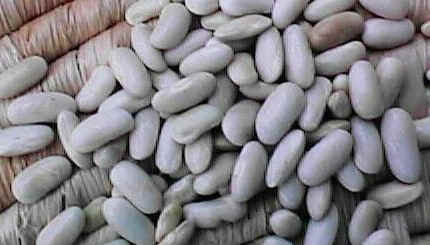
The identification of biological organisms can be greatly simplified using tools such as dichotomous keys.  A dichotomous key is an organized set of couplets of mutually exclusive characteristics of biological organisms.  You simply compare the characteristics of an unknown organism against an appropriate dichotomous key.  These keys will begin with general characteristics and lead to couplets indicating progressively specific characteristics. If the organism falls into one category, you go to the next indicated couplet.  By following the key and making the correct choices, you should be able to identify your specimen to the indicated taxonomic level.

Sample key to some common beans used in the kitchen:


Pinto


1a. Bean round Garbanzo bean
1b. Bean elliptical or oblong Go to 2
2a. Bean white White northern
2b. Bean has dark pigments Go to 3
3a. Bean evenly pigmented Go to 4
3b. Bean pigmentation mottled Pinto bean
4a. Bean black Black bean
4b. Bean reddish-brown Kidney bean

Click here for correct answers


Chromatography of Plant Pigments Sample 2 PreAP


Chromatography of Plant  Pigments


Introduction

Chromatography is a way of separating a mixture using differences in the abilities of the components to move through a material. All chromatography involves two phases – a stationary phase and a mobile phase. The movement of the mobile phase through the stationary phase allows separation to take place. Because the components of a mixture move at different rates, they eventually separate.

Paper chromatography is a common way to separate various components of a mixture. The components of the mixture separate because different substances are selectively absorbed by paper due to differences in polarity. A solution can be separated by allowing it to flow along a stationary substance. Water or some other solvent is used as the mobile phase. The solvent moves upward along the paper because of capillary action. As it reaches the spot, the mixture dissolves in the solvent. For instance, the pigments in an ink solution can be separated by passing the ink through a piece of paper. The pigments respond differently to the paper. The differences in the migration rates result in differences in the distances the separated components travel, some pigments are held back while other moves ahead. Eventually, a pattern of colors results that shows the separated pigments.

Hypothesis

Paper can be used to separate mixed chemicals.

Materials

The materials used for this lab are paper, pencil, scissors, eraser, filter paper, test tube, cork, paper clip, metric ruler, black felt-tip pen, and a calculator.

Methods

The first step to this experiment was to bend a paper clip so that it is straight with a hook at one end. Push the straight end of the paper clip into the bottom of a cork stopper. Next, hang a thin strip of filter paper on the hooked end of the paper clip. Insert the paper strip into the test tube so it does not touch the sides, but almost the bottom of the test tube. Next, remove the paper strip from the test tube and draw a solid 5 mm wide band about 25 mm from the bottom of the paper, using a black felt tip pen. Use a pencil to draw a line across the top of the paper strip 10 cm from the top.

Pour about 2 mL of water into the test tube with the bottom of the paper in the water and the black band above the water. Observe what happens as the liquid travels up the paper. Record the changes you see. When the solvent has reached the pencil line, remove the paper from the test tube. Let the paper dry on the desk. With a metric ruler, measure the distances form the starting point to the top edge of each color. Record the data in a data table. Calculate a ration for each color by dividing the distance the color traveled by the distance the solvent traveled.

Results

The results of the experiment are shown in a chart and a graph.

Distance color traveled and Rf value.


Color of ink (list in order Distance traveled by each color (mm) Distance solvent traveled (mm) Ration traveled =
Distance color moved /Distance water moved
Yellow 50 120 5/12
Orange 85 120 17/24
Pink 100 120 5/6
Red 105 120 7/8
Blue 115 120 23/24
Violet 120 120 1


Questions

1. How many colors separated from the black ink? Six colors separated from the black ink: yellow, orange, pink, red, blue, violet.

2. What served as the solvent for the ink? Water served as the solvent because it is the universal solvent.

3. As the solvent travel up the paper, what color appeared first? Orange appeared first as the solvent traveled up the paper.

4. List the colors in order from top to bottom that separated from the black ink? The colors that separated from top to bottom: violet, blue, red, pink, orange, and yellow.

5. In millimeters, how far did the solvent travel. The solvent traveled 120mm.

6. From your results, what can you conclude is true about black ink. That black ink is a combination of several colors and that can be separated by water.

7. Why did the inks separate? The ink separated because each pigment has its own characteristics and molecular structure.

8. Why did some inks move a greater distance? Different pigments were absorbed at different rates.

Error analysis

There could be an error by the way the ink was distributed on the paper or by the amount of water put in the test tube.

Conclusion

The hypothesis was correct. This experiment showed the way black ink could be separated. Black ink is made from a various colors— yellow, orange, pink, red, blue, and violet. The colors separate because of the differences in their molecular characteristics, their solubility in water and their rate of absorption by the paper.

BACK


Dichotomous Key Activity


Dichotomous Key Activity


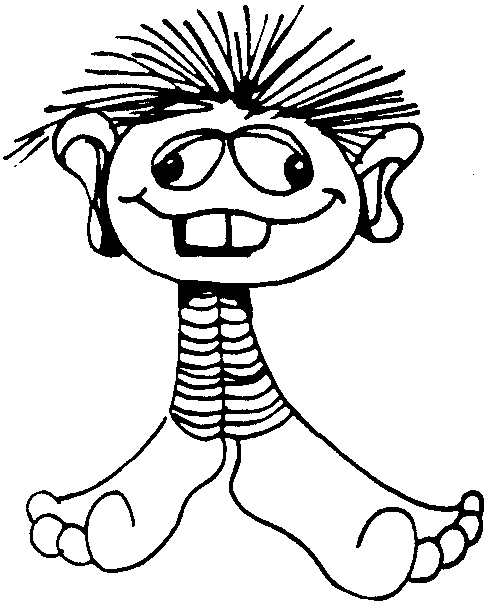
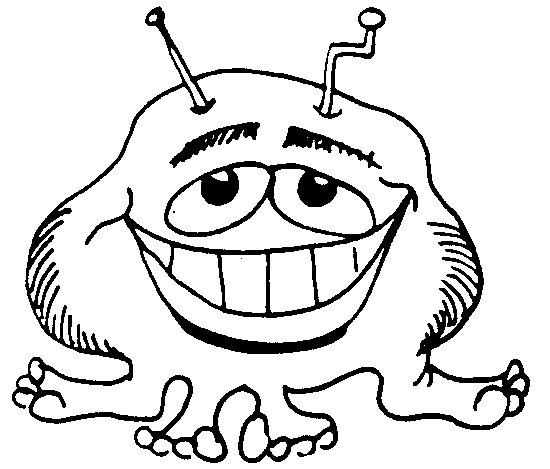
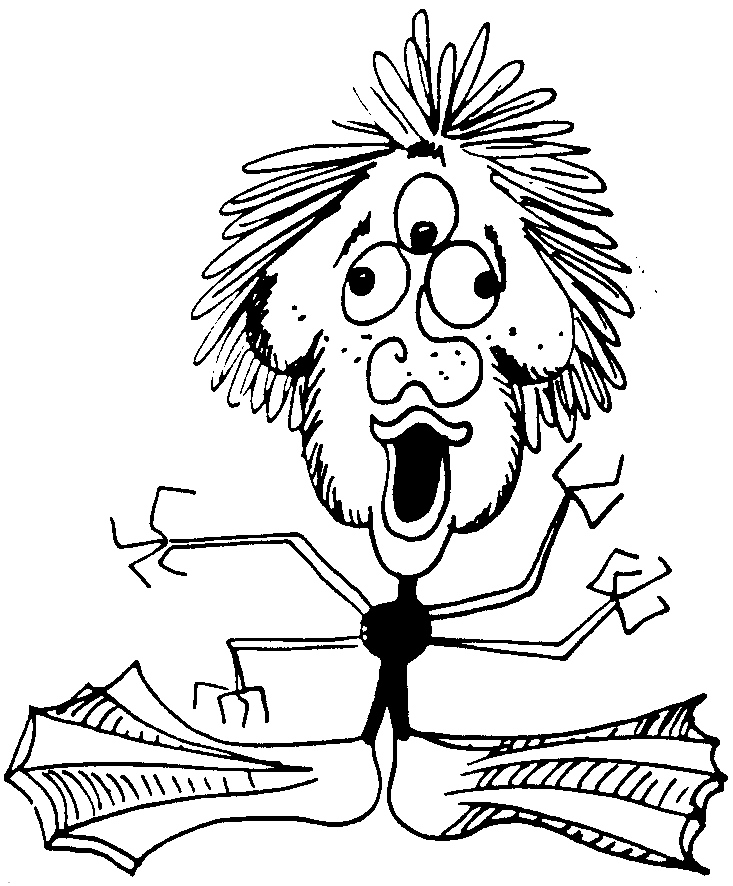
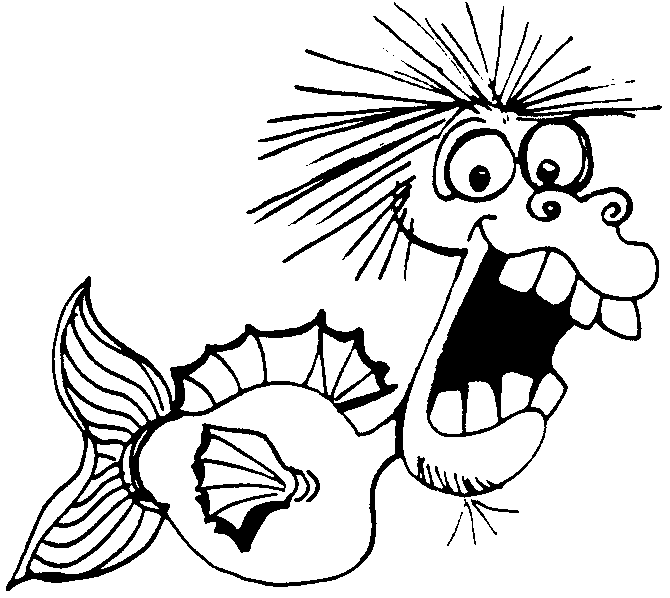
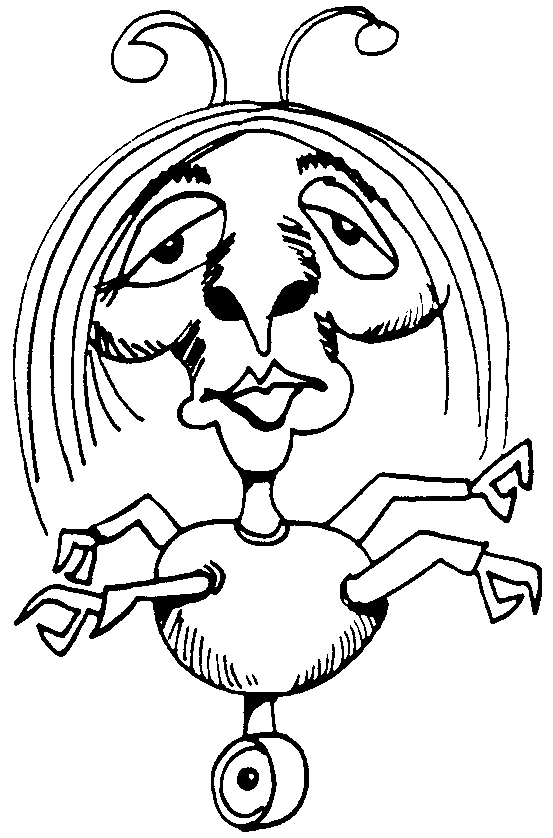
Directions: Give each of the following creatures a name. You may want to print this out before you proceed.


1. ________________

5. _________________

8. ___________________

2. ________________

4. __________________

6. __________________

9. ___________________

3. __________________

7. _________________

10. __________________