Plant Reproduction


PLANT REPRODUCTION
All Materials © Cmassengale


PLANT LIFE CYCLES: 

  • A life cycle includes all of the stages of an organism’s growth and development
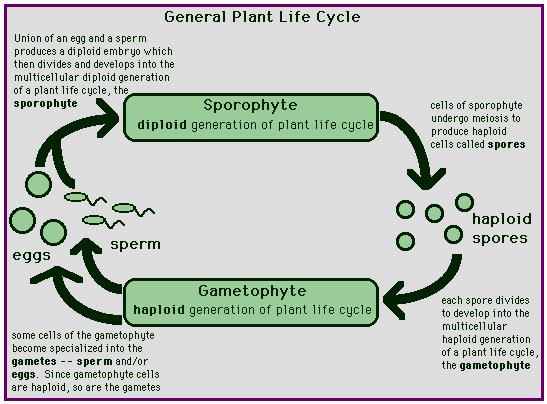
  • A plant’s life cycle involves two alternating multicellular stages – a Diploid (2n) sporophyte stage and a Haploid (1n) gametophyte stage
  • This type of life cycle is called Alternation of Generations

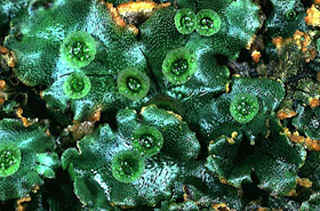
Moss Characteristics: 

  • Nonvascular (pass water cell-to-cell)
  • Seedless (reproduce by spores)
  • Low growing
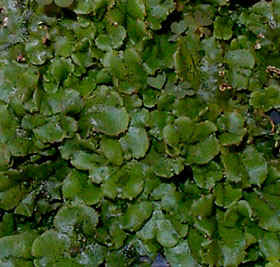
  • Phylum Bryophyta (also includes liverworts & hornworts)
  • Grow on moist brick walls, in sidewalks, as thick mats on forest floors, and on the shaded side of trees

  • Can survive periodic dry spells, reviving when water becomes available
  • Require water for fertilization so sperm can swim to egg
  • Rhizoids (root like structures) anchor mosses
  • Have waxy covering called cuticle on aerial parts to prevent desiccation 

 Moss Life Cycle:

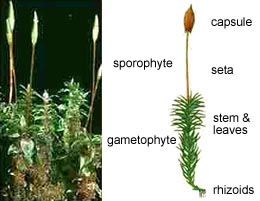
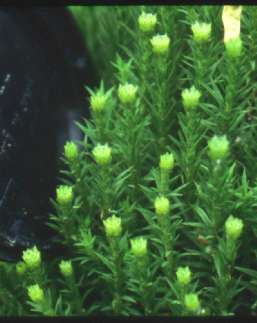
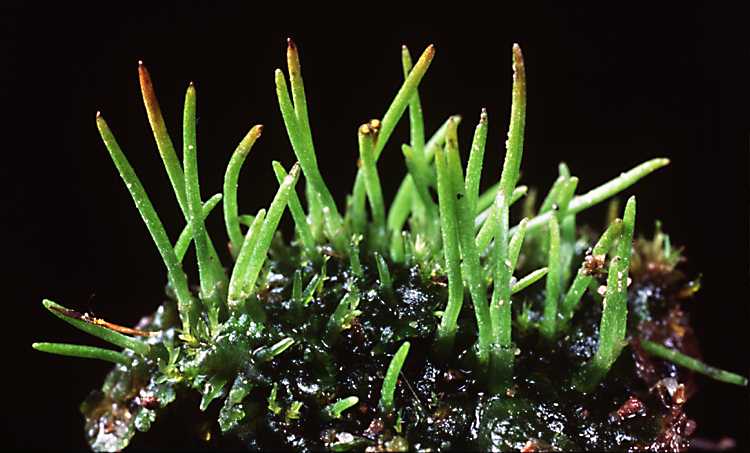
  •  Dominant form of a moss is a clump of leafy green gametophytes (photosynthetic)
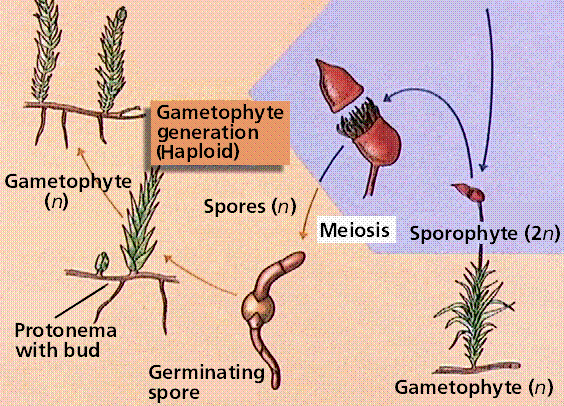
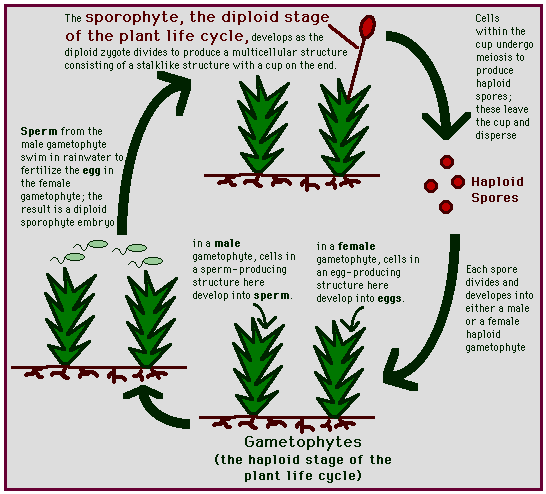
  •  Moss alternates between a haploid (1n) gametophyte and diploid (2n) sporophyte
  • Gametophyte generation produces gametes (eggs & Sperm)
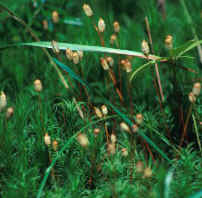
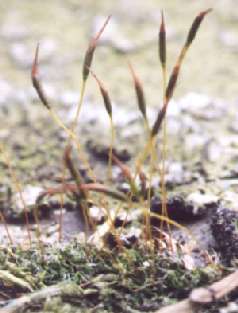
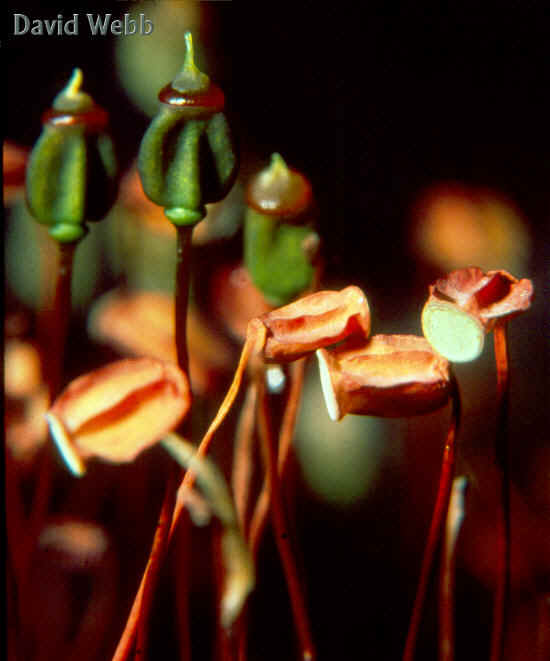
  • Sporophyte generation forms at the top of the gametophytes and produces spores 
  • Stalk-like sporophytes lack chlorophyll
  • Capsule at the top of the sporophyte forms haploid (1n) spores

Sexual reproduction in Moss:

  • Moss produce 2 kinds of jacketed gametes — eggs & sperm
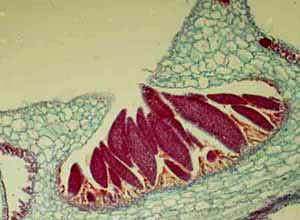
  • Egg producing organ is called the archegonium
  • Eggs are larger and nonmotile
  • Sperm producing organ is called the antheridium
  • Sperm are smaller, flagellated cells
  • Antheridia & archegonia are both part of the gametophyte plant
  • Fertilization can occur only during or soon after RAIN  when the gametophyte is covered with Water
  • Sperm swim to the egg by following a trail of chemicals released by the egg in the water
  • Fertilization produces a zygote that becomes a sporophyte
  • Mature sporophytes produce homosporous spores (all the same type)
  • Mature capsules open & release spores spread by wind
  • Spores landing on moist places germinate into protonema that become new gametophytes

 Asexual Moss Reproduction:

  • Small pieces may break off from a gametophyte & become a new plant (fragmentation)
  • Small buds called gemmae may be washed off by rain and develop new moss plants

Fern Characteristics & Life Cycle:

  • Largest group of seedless, vascular plants
  • Grow in moist places
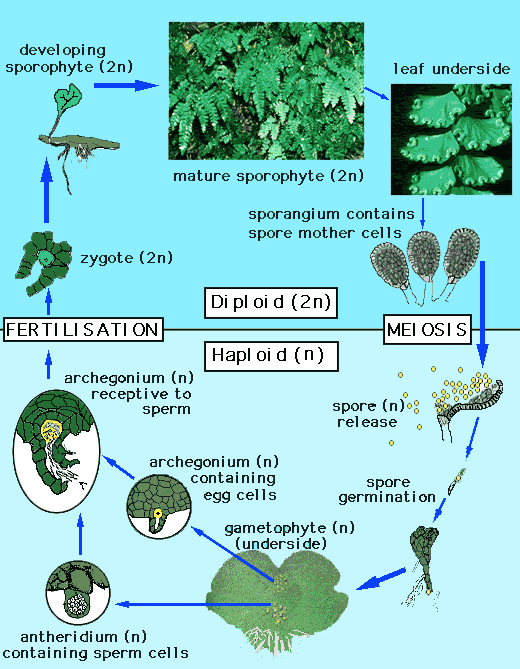
  • Goes through alternation of generations 
  • Sporophyte phase is the dominant stage
  • Fern gametophytes are small, flat plants anchored to the soil by root-like rhizoids
  • Antheridia & archegonia form on the underside of fern gametophytes

  • Sperm swim to egg through water droplets to form zygote (fertilized egg)
  • Zygotes form new sporophytes with roots, stems, & leaves
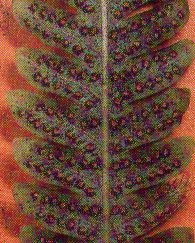
  • Spore cases called sori form on the underside of fern fronds (leaves)

  • Ferns are homosporous (single type of spore formed)


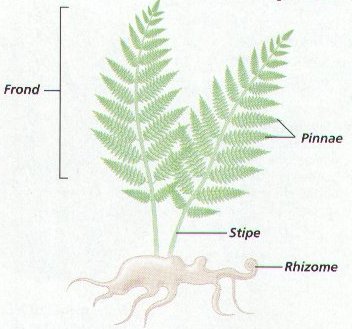
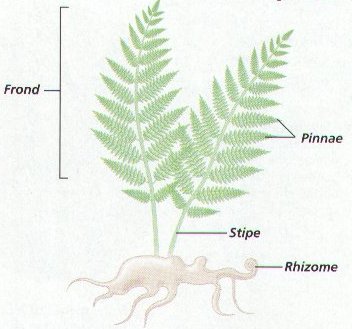
  • New fronds form from an underground stem called the rhizome
  • Vascular tissue carries nutrients & water between the parts of the fern
  • Fronds are compound leaves attached by a short stalk called the stipe to the underground stem or rhizome

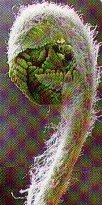
  • Immature fronds or fiddleheads are coiled

Characteristics & Life Cycle of Conifers:

  • Called gymnosperms
  • Have naked seeds that develop on scales of the female cones
  • Sporophyte is the dominant stage
  • Adapted to cooler climates
  • Called evergreens (pine, cedar, spruce, fir…)
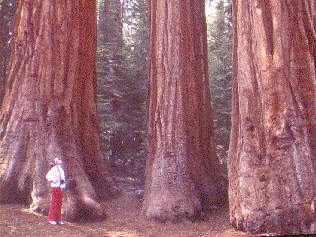
  • Giant Redwood is one of the Earth’s largest organisms
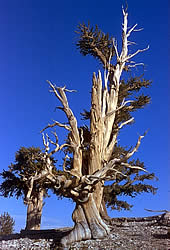
  • Bristlecone Pines are the oldest living organisms (some more than 5000 years old)


Giant Redwood Bristlecone Pine


  • Produce 2 types of spores (heterosporous)
  • Male spores called microspores grow into male gametophytes
  • Female spores called megaspores grow into female gametophytes
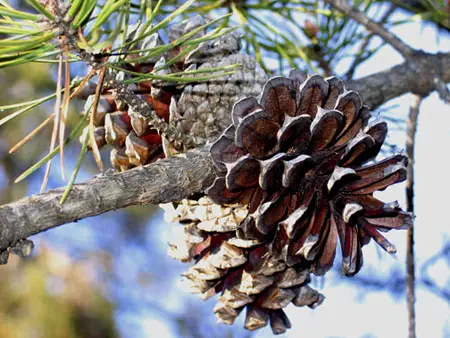
  • A Pine cone is the female cone on a pine tree
  • Male cones on pine trees are smaller & grow in clusters at the tips of branches
  • Both male & female cones appear on the same tree


Female Cones Male Cones


  • The pine life cycle takes 2-3 years from the formation of cones until seeds are released
  • Female cones have spirally-arranged scales with ovules at their base
  • Female cones produce sticky resin
  • Ovules contain an egg that will develop into a seed 
  • Male cones produce large amounts of pollen in the spring that is spread by wind to the female cones
  • Resin traps the pollen so pollination can occur
  • A tube from the pollen grain takes a year to grow to the ovule so a sperm can fertilize the egg and form seeds

Angiosperms or Flowering Plants:

  • Bright colors, attractive shapes, and fragrant aromas help flowering plants attract their pollinators (insects, birds, mammals…)
  • Flowers without bright colors and pleasing odors are usually wind or water pollinated (grasses)
  • Called angiosperms
  • Flowers, the reproductive part of a plant,  have a swollen base or receptacle to attach to the stem
  • Flowers have 4 whorls (modified leaves) attached to the receptacle — petals, sepals, pistils, and stamen
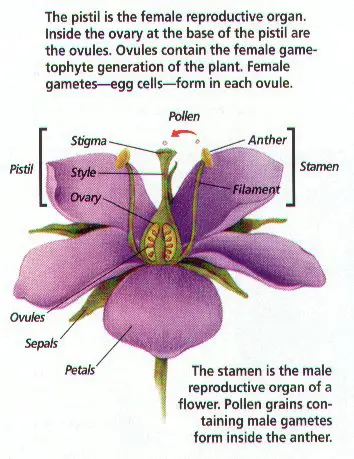
  • Pistils (innermost whorl) are the female part of the flower, while Stamens are the male part
  • Sepals (outermost whorl) are found below the petals and may look leaf-like (some may be the same color as petals)
  • Sepals enclose the flower bud before it opens 
  • Sepals are collectively called the calyx
  • Petals are often colorful to attract pollinators
  • Petals are collectively called the corolla

  • Monocot flower parts are arranged in multiple of THREES, while dicots are in multiples of FOUR or FIVE
  • Perfect flowers have both stamens & pistils (rose)
  • Imperfect flowers are either a male (pistillate) or female (staminate) flower (pumpkin or melons)
  • Some angiosperms have both male & female flowers on the SAME plant (monoecious)
  • Other angiosperms have entire male OR female plants (dioecious)

Female Reproductive Structures:

  • Called carpals
  • Carpals may be fused to form the pistil
  • Produce eggs
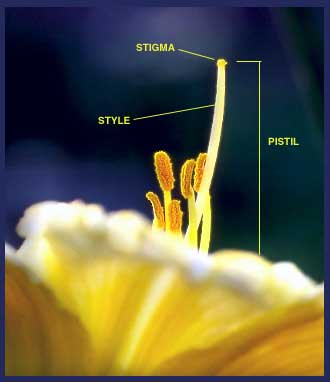
  • Composed of 3 parts — stigma, style, and ovary
  • Stigma is located at the top and may be sticky or have hairs to hold pollen grains landing there
  • Style is a stalk-like connection between the stigma and the ovary
  • Ovary is the enlarged base containing ovules with eggs


Pistil

Male Reproductive organs:

  • Called stamens
  • Produce pollen
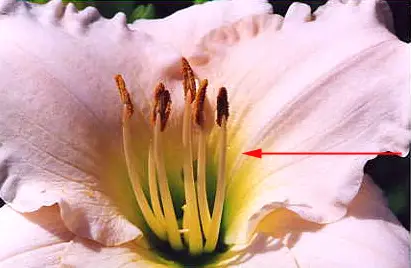
  • Composed of 2 parts — filament & anther (pollen sac)
  • Anthers produce pollen grains containing sperm
  • Filament is stalk-like & supports the pollen sacs


Stamen

Angiosperm Life Cycle:

  • Undergo alternation of generations
  • Sporophyte is dominant phase
  • Gametophytes (flowers) form male & female gametes
  • Anthers form pollen grains from microspores 
  • Pollen grains contain 2 cells — tube cell & generative cell (sperm)
  • Two protective layers called integuments surround the megasporangium
  • The entire structure including the integuments is the ovule and becomes the seed
  • Each ovule has 4 megaspores (three disintegrate)
  • The remaining megaspore undergoes mitosis to produce a large cell & polar nuclei 
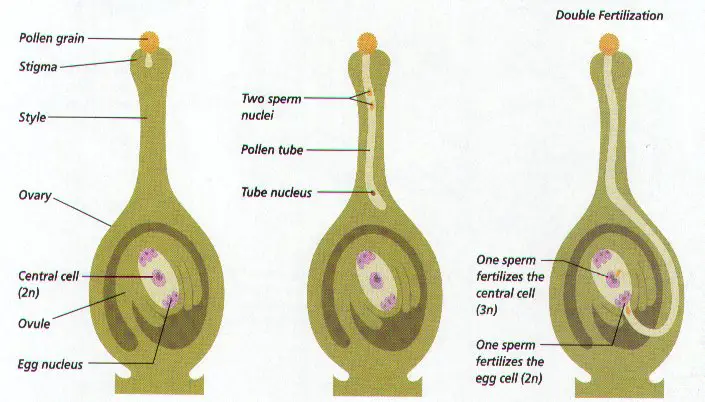
  • When pollen lands on the stigma, a pollen tube grows through the style to the ovary
  • Two sperm travel down the pollen tube — one fertilizes the egg and the other join with polar nuclei to form endosperm (stored food for Seed)
  • Called Double Fertilization

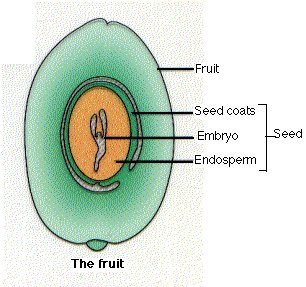
  • After fertilization, ovule becomes the seed and the ovary & surrounding tissues form a protective fruit
  • A fruit is a ripened ovary with seeds (apple, melon, cocklebur…)
  • When seed land on moist soil, they germinate (sprout) and form new sporophyte plants

Pollination:

  • Wind, water, and animals help spread pollen
  • As pollinators drink nectar or eat the fruit, pollen gets on their bodies and is spread to other flowers
  • Self pollination occurs whenever pollen from a flower lands on the stigma of that SAME flower (pea plants)
  • Cross pollination occurs whenever pollen is spread to a different flower producing hybrids (more gene combinations)

Seeds & Fruit:

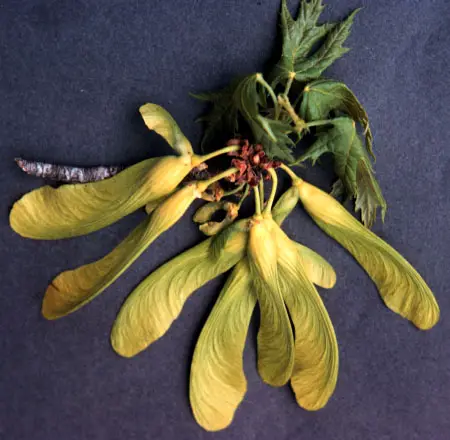
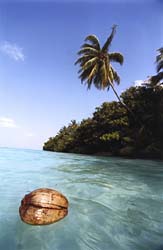
  • Fruits are adaptations for dispersing seeds (coconuts float, cockleburs catch onto animal fur, some seeds eaten by birds aren’t digestible…)
  • More energy is required to produce seeds than spores because they contain stored food
  • Seeds may be dormant (inactive) for weeks or years protected by their seed coat
  • Seeds contain a plant embryo and endosperm

  • Many fruits are fleshy & their seeds aren’t digested by the animals that eat them
  • Heavy seeds have adaptations such as wing-like structures (maple) or prickly coats (cocklebur) to help them disperse


maple seeds Cockleburs Coconut


  • Fruits may be dry or fleshy
  • Three types of fruits exist — simple, aggregate, & multiple
  • Simple fruits (apple) form from One pistil on a flower
  • Aggregate fruits (raspberry) form from several pistils on a flower
  • Multiple fruits (pineapple) form several flowers growing close together
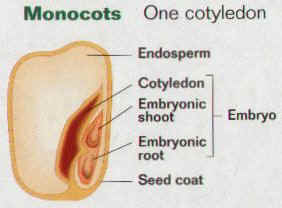
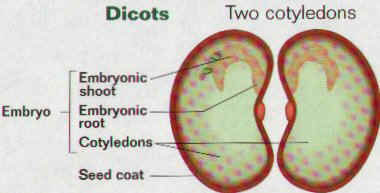
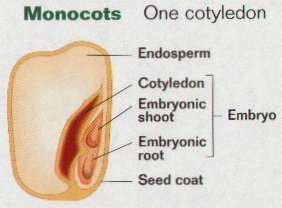
  • Cotyledons are leaf-like structures of the plant embryo
  • Monocot seeds have one seed leaf (Cotyledon), while dicots have two cotyledons


  • The epicotyl is the part of the plant embryo ABOVE the cotyledon & becomes the stem
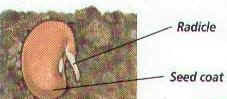
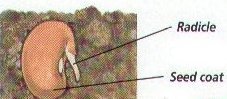
  • The radicle is the part of the plant embryo BELOW the cotyledon & becomes the root
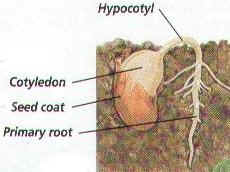
  • The hypocotyl is the part of the plant embryo BETWEEN the cotyledon &  the radicle
  • The hilium is a scar along the seed edge where it was attached to the ovary
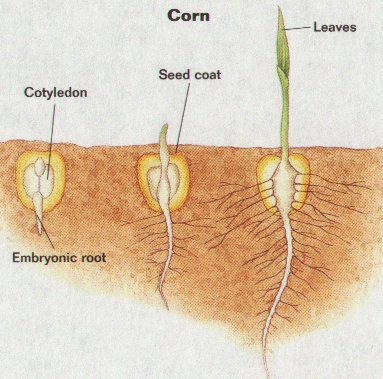
  • In monocot seeds like corn, a sheath called the coleoptile grows out of the ground to protect the newly emerging plant

Germination:

  • Many seeds require environmental factors, such as Water, Oxygen, and Temperature to trigger germination
  • Some seeds only germinate after exposure to extreme cold or after passing through an animal’s digestive tract
  • Water must FIRST be absorbed by the seed to break the seed coat & activate enzymes to change starch in the endosperm or cotyledons into simple sugars for energy
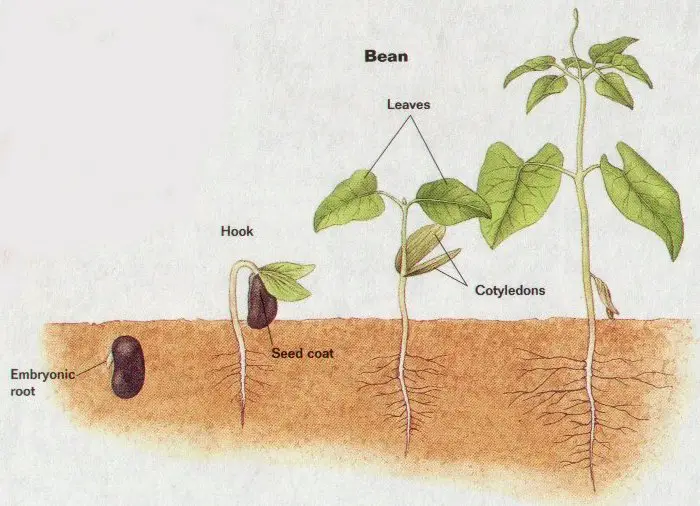
  • The radicle emerges first

  • Once the seed coat opens, OXYGEN is needed for cellular respiration carried on by the embryo plant
  • The shoot (hypocotyl & embryonic leaves) begin to grow, synthesize chlorophyll, and carry on photosynthesis

  • After the stored food is used up in dicots, the cotyledons fall off


Dicot Seed Germination

  • In Monocots like corn, the Cotyledon remains underground and transfers nutrients to the growing Embryo.

Asexual Reproduction in Plants:

  • Asexual reproduction is FASTER and produces well-adapted offspring
  • Called vegetative reproduction
  • Occurs from non-reproductive parts such as roots, stem, or leaves
  • Runners, Rhizomes, Bulbs, and Tubers can be used to produce new plants
  • Cutting is taking a piece of Stem or Leaf and growing a new plant
  • Grafting occurs whenever 2 cut ends of plant stems are fused
  • Layering occurs when aerial roots touch soil & start growing new plants

Plant Reproduction Bi


CHAPTER 32, PLANT REPRODUCTION

SECTION 32-1, PLANT LIFE CYCLES

A life cycle includes all of the stages of an organism’s growth and development.  A plant’s life cycle involves two alternating multicellular stages – a Diploid (2n) sporophyte stage and a Haploid (1n) gametophyte stage. This type of life cycle is called Alternation of Generations.  The size of gametophytes and sporophytes varies among the plant groups.

OBJECTIVES:  Describe the life cycle of a moss.  Describe the life cycle of a typical fern.  Describe the life cycle of a gymnosperm.  Compare and contrast homospory and heterospory.

THE LIFE CYCLE OF MOSSES

1. A Moss is a Nonvascular Seedless Plant belonging to the Phylum Bryophyta.

2. Mosses are the best known and most common Bryophytes.  The other Bryophytes are Liverworts and Hornworts.  There are about 14,000 kinds of mosses.

CHARACTERISTICS OF MOSSES

1. Mosses grow on moist brick walls, in sidewalks, as thick mats on forest floors, and on the Shaded Side of Trees.  Some are adapted to the Desert, or can survive periodic dry spells, reviving when Water becomes available.

2. ALL MOSSES NEED WATER TO COMPLETE THEIR LIFE CYCLE.

3. MOSSES SHARE SOME CHARACTERISTICS OF OTHER BRYOPHYTES:

A. They do not have complicated Vascular Systems. – Nonvascular Plants

    B. Water passes from cell to cell by osmosis. They are only a few cells thick.

    C. They do NOT have True Roots, Leaves, or Stems.

    D. They Require Water for Fertilization.

    E. They are small land plants.

THE LIFE CYCLE OF MOSSES

1. The Dominant form of a moss is a clump of leafy Green Gametophytes.

2. A typical moss Alternates between a HAPLOID GAMETOPHYTE and DIPLOID SPOROPHYTE Phases. (Figure 32-1)

3. Haploid and Diploid refer to the number of Chromosomes in the Cells of an Organism.

4. A Gametophyte is the Haploid (1n) generation that produces GAMETES.

5. The Sporophyte is the Diploid (2n) that produces SPORES by Meiosis.

6. The Gametophyte of a moss is usually the largest and longest-lived generation of the moss life cycle.

7. Gametophytes of Mosses have RHIZOIDS, slender, Rootlike Structures that Anchors the Moss in place.

8. The Gametophytes are the Photosynthetic Part of a Moss.

9. The Sporophyte of a Moss is usually smaller than the Gametophyte and is attached to and dependent on the Gametophyte.

10.  Sporophytes lack Chlorophyll, they Depend on the Photosynthetic Gametophyte for Food.

11. The Sporophyte consists of a Foot that anchors it to the Gametophyte and a Stalk.  The Stalk grows up from the Foot and resembles a Street Lamp.

12. Atop the long, slender Stalk is a CAPSULE.

13. A CAPSULE IS THE STRUCTURE OF A MOSS THAT FORMS HAPLOID SPORES.

SEXUAL REPRODUCTION

1. Mosses, like most sexually reproducing organisms, produce TWO Kinds of GAMETES: EGGS AND SPERM.

2. GAMETES OF ALL BRYOPHYTES ARE SURRROUNDED BY A JACKET OF STERILE CELLS.  The Sterile Cells are an important adaptation that protects the gametes from drying out and dying.

3. EGGS of Mosses are large, contain much Cytoplasm, and CANNOT Move.

4. SPERM are smaller and have FLAGELLA, enabling them to reach the Egg by swimming through Water.

5. THE EGG AND SPERM OF MOSSES FORM IN DIFFERENT REPRODUCTIVE STRUCTURES.

6. THE EGG-PRODUCING ORGAN OF A MOSS IS CALLED AN ARCHEGONIUM (ar-keh-GOH-nee-um).  Each Flask-Shaped Archegonium forms ONE EGG by Mitosis.  The Archegonia form on Branches of the Gametophyte.

7. THE SPERM-PRODUCING ORGAN OF A MOSS IS CALLED AN ANTHERIDIUM (an-theh-RIH-dee-um).  Each Antheridium produces Many Sperm.

8. BOTH THE ARCHEGONIA AND ANTHERIDIA ARE PART OF THE GAMETOPHYTE.

9. Bryophytes such as Mosses are sometimes called the “Amphibians of the Plant Kingdom”.  Mosses are Land Plants but they require Water for Sexual Reproduction.

10. For most Mosses, Fertilization can occur only during or soon after RAIN or after Flooding, when the Gametophyte is COVERED with Water.

11. The Sperm Swim to the Egg by following a Trail of Chemicals released by the Egg in the Water.

12. Fertilization produces a Zygote that undergoes Mitosis and becomes a Sporophyte.

13. When the Sporophyte matures cells inside the Capsule undergoes Meiosis and form Haploid Spores which are all the Same.

14. The production of One type of spores is called HOMOSPORY.  The life cycle of Mosses is called HOMOSPOROUS ALTERNATION OF GENERATION.

15. THESE SPORES BEGIN THE GAMETOPHYTE GENERATION.

16. When spores are mature, the Capsule opens and Spores are carried off by Wind.  If a spore lands in a Moist place, it Sprouts and forms a New Gametophyte.

ASEXUAL REPRODUCTION

1. Asexual Reproduction of most Mosses can occur in TWO WAYS:

A. FRAGMENTATION – Small pieces broken from a Gametophyte grow into a new plant.

B. GEMMAE – These are tiny pieces of Tissue that can form new Gametophytes.

2. When raindrops splash Gemmae from the Parent Plant, The Gemmae are carried to a new area where they can form Gametophytes.

THE LIFE CYCLE OF FERNS

1. Ferns are by far the LARGEST Group of Living Seedless Vascular Plants.

2. Ferns grow in a variety of places and are diverse in their appearance.

3. Like other Seedless Plants, Ferns usually live in Moist Habitats because they Need Water for Fertilization.

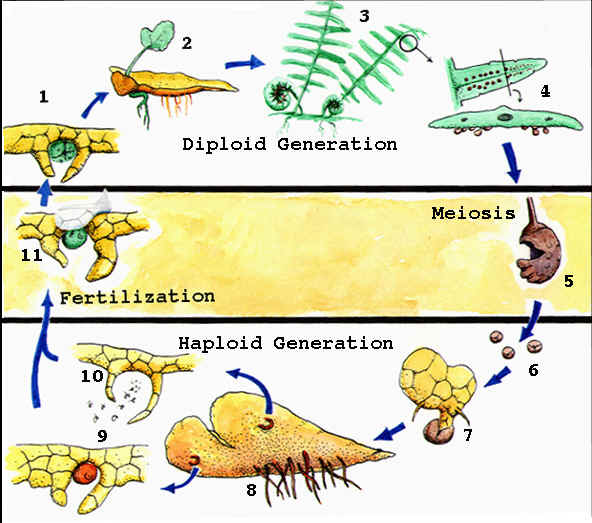
4. A TYPICAL FERN ALTERNATES BETWEEN HAPLOID GAMETOPHYE AND DIPLOID SPOROPHYTE PHASES. (Figure 32-2)

5. The Sporophyte Phase of the Fern’s Life Cycle is the Dominant Phase.

6. Fern Gametophytes are Tiny, Flat Plants that are Anchored to the soil by Rhizoids.

7. Both ANTERIDIA (Male) and ACHEGONIA (Female) form on the lower surface of a Fern Gametophyte.

8. When Water is present, Sperm released by Antheridia Swim to Archegonia.

9. One Sperm Fuses with the Egg in an Archegonium. Forming a Zygote, which is the First Cell of the Sporophyte.

10.  In its Sporophyte Stage, a typical Fern has a Stem with True Roots and True Leaves.  The Stem, Roots and Leaves are considered TRUE because they have special Water-Carrying Tissues.

11.  The Gametophyte Generation of Ferns begins with Spores.  Some Ferns form Spores on specialized stalk-like leaves.  Like mosses, most ferns are Homosporous.

12.  Other Ferns form Spores in Special Structures on the UNDESIDE OF THE LEAVES.  A SORUS (SORI) IS A GROUP OF SPORE-CONTAINING STRUCTURES (SPORANGIA) CLUSTERED ON THE UNDERSIDE OF A FERN LEAF (Figure 32-2).

13.  The Leaf of a Mature Fern Sporophyte is a Compound Leaf and is divided into smaller Leaflets.  A  MATURE LEAF OF A FERN IS CALLED A FROND, which grows from an underground stem, or RHIZOME.  The new young immature leaf is called a FIDDLEHEAD.

14.  Each Frond consists of TWO Parts: a BLADE and PETIOLE (PEH-tee-ohl).

A.  The BLADE is the broad, flat, photosynthetic surface of the Frond.  The Blade contains the Chloroplast.  The Blade also contains Vascular Tissue that brings water and minerals from roots.

B.   On most ferns, a Blade does not attach directly to a Stem.  Instead, a Stalk attaches the Blade to the Stem.  The PETIOLE is the Stalk that attaches the Frond’s Blade to the Stem.  The Petiole contains vascular tissue that carries Water and nutrients through the Plant.

LIFE CYCLES OF CONIFERS – GYMNOSPERMS – NAKED SEEDS – CONES

1. The oldest surviving Seed Plants on Earth are Gymnosperms.  In Seed Plants the Sporophyte Phase is the Dominant Phase.

2. Gymnosperms are referred to as Naked Seeds, because they develop on the Scales of Female Cones and NOT inside a Fruit.

3. Gymnosperms are adapted to live in cold climates; there are extensive forests of gymnosperms in most of the colder zones of northern temperate regions.

4. There are about 700 species of gymnosperms, such as pine, fir, and spruce, which are also called Evergreen Trees.

5. Gymnosperms include one of the largest and some of the oldest organisms on Earth.  The Giant Redwood is one of the Earth’s largest organisms.  The Bristlecone Pines is among the oldest, some more than 5000 years old.

6. Unlike mosses, and most Ferns, Gymnosperms produce TWO Types of spores – MALE MICROSPORES AMD FEMALE MEGASPORES.

7.  Microspores grow in into Male Gametophytes, while Megaspores grow into Female Gametophytes.

8. The Production of different types of Spores is called HETERSPORY.  The Gymnosperm Life Cycle is called HETEROSPOROUS ALTERNATION OF GENERATION.

9. Heterospory ensures that a Sperm will fertilize an Egg from Different Gametophyte and increase the chance that New Combinations of Genes will occur among Offspring.

10. Gymnosperms are Plants (Trees) that reproduce by way of CONES.  (Figure 32-3)

11. The Pine Tree is a typical Gymnosperm.  The Large, Familiar Cones known as Pinecones are actually the FEMALE Cones of a Pine Tree.

12. Pine trees also have MALE Cones, which are SMALLER than Female Cones.  Male and Female Cones have a vital roles in the reproductive cycle of pine trees and other Gymnosperms.

13. THE LIFE CYCLE OF A PINE TAKES TWO OR THREE YEARS FROM THE TIME THE CONES FORM UNTIL SEEDS ARE RELEASED.

14. Male and Female Gametes are made by the Male and Female Cones, which are on the SAME Tree.

15. The Female Cones consist of spirally arranged Scales and Secrete a STICKY RESIN.

16. At the Base of each scale are TWO EGG-CONTAINING OVULES.

17. AN OVULE IS A STRUCTURE, CONSISTING OF AN EGG INSIDE PROTECTIVE CELLS, THAT DEVELOPS INTO A SEED.

18. Each Male Cone produces huge amounts of POLLEN that are released in Spring.  Pollen Grains have WINGLIKE Structures that keep them aloft in the WIND.  Pollen Grains can be carried long distances to reach Female Cones FOR POLLINATION.

19. POLLINATION IS THE TRANSFER OF POLLEN FROM THE MALE TO THE FEMALE PART OF A PLANT.

20. When a Pollen Grain reaches a Female Cone, it sticks to the RESIN of the cone.  As the Resin dries, the Pollen Grain begins to grow a structure called a POLLEN TUBE that extends to an Ovule near the base of a Scale, it enables the sperm to reach an egg.  The Pollen Tube takes about a year to grow and reach the Egg.

21. A Sperm Cell released from the Pollen Tube Fertilizes an Egg in the Ovule forming a Zygote.  Pine sperm Do Not have Flagella and they do Not Swim to an Egg.

22. A Zygote forms and grows into an Embryo surrounded by a SEED.

23. As the Embryo Matures, the Pinecone enlarges and the scales Separate releasing the Seed from the Female Cone.

24. If the seed lands in an environment with the proper conditions for growth, it will sprout and form a New Sporophyte Pine Plant.

25. Seed Plants Do Not Require Water for Reproduction, Sexual Reproduction in Seed Plants can therefore take place independent of seasonal rains or other periods of moisture.
SECTION 32-2 SEXUAL REPRODUCTION IN FLOWERING PLANTS – ANGIOSPERMS – FLOWERS & FRUITS

You have probably admired flowers for their bright colors, attractive shapes, and pleasing aromas.  These characteristics are adaptations that help ensure sexual reproduction by attracting animal pollinators.  But some flowers are not so colorful, large, or fragrant.  Such flowers rely on wind or water for pollination.

OBJECTIVES:  Identify the four main flower parts, and state the function of each.  Describe ovule formation and pollen formation in angiosperms.  Relate flower structure to methods of pollination.  Describe fertilization in flowering plants.  Compare and contrast the gymnosperm and angiosperm life cycles.

ANGIOSPERMS REPRODUCTION (FLOWERS & FRUITS)

1. The importance of a Flower is NOT in the way it LOOKS or SMELLS, but in WHAT IT DOES.

2. A FLOWER IS IMPORTANT BECAUSE IT IS THE REPRODUCTIVE STRUCTURE OF AN ANGIOSPERM.

3. FLOWERS are MODIFIED STEMS with SPECIALIZED LEAVES and other structures for REPRODUCTION. All of these specialized leaves from on the Swollen Tip of a floral “Branch” which is called the RECEPTACLE.

4. FLOWERS HAVE THREE BASIC COMPONENTS: MALE, FEMALE, AND STERILE PARTS.

5. The Male and Female Parts Produce the GAMETES.  Sterile Parts ATTRACT POLLINATORS (The Birds and The Bees) and Protect the Female Gametes.

6. Flowers that produce BOTH Male and Female Gametes in the SAME Flower are called PERFECT FLOWERS.

7. IMPERFECT FLOWERS are EITHER a Male or a Female Flower.

8. Some Angiosperms have separate Male and Female Flowers, but BOTH SEXES are on the SAME Plant. Others, the entire plant is Male or Female.

FEMALE STRUCTURES OF FLOWERS

1. The Female Structures of flowers produce EGGS.

2. THE FEMALE, OR EGG-PRODUCING, PART OF A FLOWER IS CALLED THE CARPELS.

3. ONE OR MORE CARPELS FUSED TOGETHER MAKE UP THE STRUCTURE CALLED THE PISTIL. Pistils form at the CENTER of the Flower and usually have THREE PARTS:  STIGMA, STYLE, AND OVARY, EACH PART HAS A DIFFERENT FUNCTION:

A.  THE STIGMA IS THE STRUCTURE ON WHICH POLLEN LANDS AND GERMINATES.  IT IS USUALLY STICKY OR HAS HAIRS TO HOLD POLLEN GRAINS. THE TIP OF THE STYLE.

B.  THE STYLE IS THE STALK-LIKE STRUCTURE CONNECTING THE STIGMA TO THE OVARY.

C.  THE OVARY IS THE ENLARGED BASE OF A PISTIL, IT IS THE STRUCTURE THAT CONTAINS OVULES AND DEVELOPS INTO A FRUIT.  OVULES FORM IN THE OVARY, AND EACH OVULE CONTAINS AN EGG.

MALE STRUCTURES OF FLOWERS

1. THE MALE STRUCTURES OF FLOWERS PRODUCE POLLEN.

2. THE MALE, OR POLLEN-PRODUCING PART OF A FLOWER, IS CALLED THE STAMEN.

3. STAMENS USUALLY HAVE TWO PARTS: ANTHER AND FILAMENT.  EACH PART HAS A DIFFERENT FUNCTION:

A.  THE ANTHER IS THE STRUCTURE THAT CONTAINS MICROSPORANGIA, WHICH PRODUCE MICROSPORES THAT DEVELOP INTO POLLEN GRAINS.  POLLEN GRAINS CONTAIN SPERM CELLS.

B. THE FILAMENT IS THE STRUCTURE THAT HOLDS UP AND SUPPORTS THE ANTHER.

STERILE PARTS OF A FLOWER (ATTRACT/PROTECT)

1. THE STERILE PARTS OF A FLOWER ARE THE PETALS AND SEPALS.

2. PETALS are usually Colorful, Leaflike appendages on a Flower.  Their Function is to ATTRACT Pollinators.

3. ALL THE PETALS IN A FLOWER ARE COLLECTIVELY CALLED THE COROLLA.

4. The Protective Leaves at the Base of a Flower are SEPALS.  Sepals are often Green, cover the BUD of a Flower and Protect the developing Flower parts as they Grow.

5. ALL THE SEPALS ARE COLLECTIVELY CALLED THE CALYX.

6. Monocots and Dicots can often be distinguished by their Flowers.  MONOCOT Floral Parts are arranged in multiples of THREE, The Floral Parts of DICOTS are arranged in multiples of FOUR OR FIVE.

7. FLOWER PARTS ARE USUALLY FOUND IN FOUR CONCENTRIC WHORLS, OR RINGS. (Figure 32-5)

    A. OUTERMOST WHORL – THE SEPALS (Calyx) (#1)

    B. THE PETALS (Corolla) MAKE UP THE NEXT WHORL. (#2)

    C. THE TWO INNERMOST WHORLS OF FLOWER PARTS CONTAIN THE REPODUCTIVE STRUCTURES.  FIRST THE MALE (STAMENS, #3) AND THE INNERMOST WHORL CONTAINS THE FEMALE (CARPELS, #4).  ONE OR MORE CARPELS FUSED TOGETHER MAKE UP THE PISTIL.

LIFE CYCLE OF ANGIOSPERMS

1. An Angiosperm undergoes Alternation of Generations.  The Sporophyte undergoes meiosis to form spores, which then divide mitotically to form Gametophytes.

2. The Gametophytes form the GAMETES: EGG AND SPERM.

3. Sexual Reproduction BEGINS WHEN MICROSOPORE MOTHER CELLS undergo Meiosis in the ANTHER to become Pollen Grains, which is a two-celled or three-celled Male Gametophyte. (Figure 32-7) Notice:  Each of the four Microspores will form a Pollen Grain that consists of Two Cells a Tube Cell and a Generative Cell, The Male Gametophyte.

4. During the same time, MEGASPORE MOTHER CELLS undergo Meiosis in Ovules, forming four megaspores in each Ovule, One will become an EGG. (Figure 32-6) Notice:  Of the four Megaspores, Three of the Megaspores Degenerate, and the Fourth forms the structures of the Embryo Sac, The Female Gametophyte.

5. Because the Ovule of a flower contains the egg, the ovule contains the Female Gametophyte.

6. The next step is Pollination, the transfer of Pollen from the Anther to the Stigma.

7. When a pollen Grain lands on a Stigma, it sends out a POLLEN TUBE that grows through the Style to the Ovary.  Inside the Ovary it enters and Ovule which contains an Egg.

8. Fertilization occurs when a Sperm Nucleus from the Pollen Tube FUSES with the Egg and forms a Zygote.

9. While one sperm fertilizes and Egg, a Second Sperm Nucleus from the pollen tube fertilizes TWO Polar Nuclei.

10. The Second Fertilization forms a Food-Storing Tissue in the Seed called ENDOSPERM.

11. The process in plants that involves TWO Fertilizations is called DOUBLE FERTILIZATION.  ONLY ANGIOSPERMS HAVE DOUBLE FERTILIZATION.

12. After Fertilization, The Zygote develops into an Embryo; The Ovule Becomes a Seed, and Ovary and Surrounding Tissue from a Fruit.  A FRUIT IS A MATURE OR RIPPENED OVARY.

13. After a mature seed is planted, it sprouts and begins to develop a plant that is the next Sporophyte Generation.

POLLINATION – THE BRIDS AND THE BEES

1. POLLEN is usually carried from Plant to Plant by WIND, WATER or ANIMALS.

2. Many plants are Pollinated by Animals.  Plants may Attract Pollinators with Colorful Flowers, Fragrances, and Sugary Nectar.

3. As Pollinators climb around a Flower searching for and Drinking Nectar, they cover their bodies with Pollen.

4. As a Pollinator moves from one Flower to the Next, Pollen falls from the Pollinators Body as it moves, thus Pollinating the Flowers.

5.  BEES, LADYBUGS, MOTHS, BUTTERFLIES, BIRDS, BATS, AND BEETLES ARE SOME ANIMALS THAT POLLINATE PLANTS. (Figure 32-6)

6. WE CAN ALSO POLLINATE PLANTS, AS WE BRUSH UP AGAINST FLOWERS AND INADVERTENLY COLLECT AND TRANSFER POLLEN.

7. In some plants, Pollen Falls from Anther to Stigma on the same flower, thus eliminating the need for a Pollinator.  THIS PROCESS IS CALLED SELF-POLLINATION.

8. Self-Pollination is beneficial for plants that are isolated from their own kind.  Self-Pollination is usually Undesirable, because it reduces the chances of getting new combination of genes.

9. HYBRIDIZING OR CROSS POLINATION, THE MATING OF TWO INDIVIDUALS WITH DIFFERENT TRAITS, IS MORE DESIRABLE, BECAUSE IT ALLOWS FOR NEW COMBINATIONS OF GENES.

10. Mechanisms for increasing the chances of Hybridizing are common in many types of plants:

A.  Producing separate Male and Female Flowers.

B.  Having separate Male and Female Plants.

C.  Pollen of one plant matures at a different time from the eggs in the ovary.

ALL OF THESE MECHANISMS PROMOTE HYBIRDIZING, THE RECOMBINATION OF
GENES IN THE SPECIES.

11. FERTILIZATION, which is the Union of Gametes, follows Pollination.  (Figure 32-9)

12. In order for Fertilization to occur, a Pollen Tube must grow to an Egg, and Sperm must form.

 SECTION 32-3,  DISPERSAL AND PROPAGATION

Fruits and seeds normally result from sexual reproduction in flowering plants.  Fruits are adaptations for dispersing seeds, while seed function in the dispersal and propagation of plants.  Many plants also propagate (produce new individuals) through asexual reproduction.

OBJECTIVES:  Name different types of fruits. Describe several adaptations for fruit and seed dispersal.  Compare and contrast the structure and germination of different types of seeds.  Recognize the advantages of asexual reproduction.  Describe methods of vegetative propagation.

DISPERSAL OF FRUITS AND SEEDS

1. Seeds are as diverse as the plants they produce.  Some seeds, such as peach and apple seeds, grow inside Fleshy Fruit.  Others, such as bean seeds, grow in Pods.  Seeds of gymnosperms grow on the scales of cones.

2. The main difference between Seed Plants and Seedless Plants is that Seed Plants develop Reproductive Structures called SEEDS instead of Spores.

3. A Seed Protects and Nourishes the Embryo it contains.

4. Seeds may differ in appearance and some structures; ALL SEEDS contain a Plant Embryo and Stored Food in a Protective Coat.

5. It takes more energy for a plant to produce Seeds than to produce Spores.  But Seeds have an advantage over Spores, the ability to remain Dormant.

6. Dormant Seeds are inactive while they wait for optimal growing conditions.  Some seeds can only remain dormant for a few weeks, others for several or even thousands of years.

7. Spores are light and are easily dispersed by wind to new environments, Most Seeds are too HEAVY to be carried by Wind and require a means of Dispersal.

8. Fruits and Seeds Dispersed by wind or water are adapted to those methods of dispersal.  (Figure 32-10)  Milkweeds Seeds have “parachutes” that help them drift with the wind.

9. Many plants that grow near Water produce Fruits and Seeds that Contain Air Chambers, which allows them to Float.

10. Some seeds have Sticky or Prickly exteriors that cling to passing animals.  The animals carry the seeds away from the parent plant to new locations.

11. Other Seeds are encased in Fleshy Fruit.  The Smell, Bright Color, or Flavor of many Fruits Attract Animals.

12. When animals eat the fruit, the Seeds pass unharmed through the Digestive Tracts and are Deposited Elsewhere.

13. Botanists define a FRUIT as a Mature OVARY.  Many different types of fruits have evolved among flowering plants. (Figure 32-11)

14. Fertilization usually initiates the development of Fruits.  Fruits Protect the Seeds, aid in their dispersal, and often Delay their Sprouting.

15. Fruits are Classified Mainly on the basis of HOW MANY PISTILS OR FLOWERS FORM THE FRUIT AND WHETHER IT IS DRY OR FLESHY.   There are Three Basic Types of Fruits: Table 32-1

16. SIMPLE FRUIT – formed from One Pistil of a Single Flower.  Can be Dry or Fleshy at Maturity.

17. AGGREGATE FRUIT – formed from Several Pistils of a Single Flower.  Can be Dry or Fleshy at Maturity.

18. MULTIPLE FRUIT – Formed from SEVERAL FLOWERS Growing Together.  Can be dry or Fleshy at Maturity.

STRUCTURE OF SEEDS

1. ANGIOSPERMS ARE FLOWERING PLANTS. TODAY, ABOUT 270,000 SPECIES OF  ANGIOSPERMS HAVE BEEN DISCOVERED AND NAMED.

2. Angiosperms (Flowering Plants) are divided into TWO Groups Monocots and Dicots.

3. Angiosperms with only ONE Cotyledon in their Seeds are called Monocots.

4. Angiosperms with TWO Cotyledons are called Dicots.

5. Cotyledons are a leaflike structure that is part of the Plant Embryo.

6.  Although Cotyledons look like leaves and develop before leaves, they ARE NOT TRUE Foliage Leaves.

7. In Angiosperms Seeds, the THREE Parts of the Embryo are Named according to their relationship with the Cotyledons. (Figure 32-12)

8. THE PART OF THE PLANT EMBRYO ABOVE THE COTYLEDON IS CALLED THE EPICOTYL (EP-ih-kot-ul).  The Epicotyl includes most of what will become the Stem and Leaves of the plant.

9. THE AREA OF THE PLANT EMBRYO THAT WILL BECOME THE EMBRYONIC ROOT IS CALLED THE RADICLE.

10. THE AREA OF THE PLANT EMBRYO BETWEEN THE COTYLEDONS AND THE RADICLE  IS CALLED THE HYPOCOTYL (Hy-poh-kot-ul).

11. The Epicotyl, along with any Embryonic Leaves, is called the PUMULE.

12. Along the concave edge of the Seed is the HILUM, which is a Scar that marks where the Seed was Attached to the Ovary Wall.

13. Surrounding the Seed is a SEED COAT that Protects the Embryo and its Food Supply (ENDOSPERM).

14. In the Seeds of Monocots, the Sheath that Protects the young plant as it grows out of the soil is the COLEOPTILE. (Figure 32-14)

15. In most Seeds, food is stored as Starch, a Carbohydrate (SPECIAL FOOD STORING TISSUE CALLED ENDOSPERM); some Seeds also contain Proteins and Lipids (Fats).

SEED GERMINATION

1. Many plants are easily grown from seeds.  Although its embryo is alive, a Seed will Not Germinate, or Sprout, until it is exposed to Certain Environmental Conditions.

2. Delaying of Germination often assures the survival of the plant.  If Seeds that mature in the fall were to sprout immediately, the young plant could be killed by cold weather.

3. If all a plant’s seeds were to sprout at once and all of the New Seeds Died before producing seeds, the species could become Extinct.

4. Many seeds Will Not GERMINATE even when exposed to conditions ideal for Germination.  Such seeds exhibit DORMANCY, which is a state of reduced metabolism.

CONDITIONS NEEDED FOR GERMINATION

1. Environmental Factors, such as Water, Oxygen, and Temperature Trigger Seed Germination.

2. Most Seeds are Very DRY and must absorb Water to Germinate.

3. Water Softens the Seed Coat and Activates Enzymes that convert Starch in the Cotyledons or Endosperm into Simple Sugars, which provided energy for the embryo to grow.

4. As the embryo begins to grow, the soften seeds coat cracks open, enabling the Oxygen needed for Cellular Respiration to reach the embryo.

5. Seeds will only Germinate it the Temperature is within a certain Range.  Many Seeds need Light for Germination, this prevents the seeds from sprouting it they are buried to deeply.

6. Some Seeds Germinate only after being exposed to Extreme Conditions, After Freezing or passing through a digestive system that breaks down the Seed Coat.

PROCESS OF GERMINATION

1. The first Visible Sign of Seed Germination is the emergence of the RADICLE (ROOT).  (Figure 32-14)

2. Soon after the Radicle Breaks the Seed Coat, the SHOOT begins to Grow.

3. In some Seeds (Dicot, Bean) the Hypocotyl curves and become hooked-shaped.  Once the hook breaks through the soil, the Hypocotyl Straightens.

4. The Plumule’s Embryonic Leaves unfold, synthesize Chlorophyll, and begin Photosynthesis.  After their Stored Nutrients are used up, the shrunken Cotyledons fall off.

5. In contrast (Monocot, Corn), the Cotyledon of the Corn Seed Remains Underground and transfers Nutrients from the Endosperm to the growing Embryo.

6. The Corn Hypocotyl Does not Hook or Elongate, and the Cotyledons remains Below Ground. The Corn Plumule is protected by a Sheath (Coleoptile) as it passes through the soil.

7. When the Shoot breaks through the soil surface, the Leaves of the Plumule unfold.

ASEXUAL REPRODUCTION IN PLANTS

1. ASEXUAL REPRODUCTION involves NO FERTILIZATION AND PRODUCES OFFSPRING THAT ARE GENETICALLY IDENTICAL TO THE PARENTS -CLONES.

2. Most plants reproduce Asexually at least some of the time, while other plants reproduce Asexually most of the time.

3. In a sable environment with abundant resources, asexually reproduction is FASTER, and produces offspring that are well adapted to the existing environment.

4. ASEXUAL REPRODUCTION THAT OCCURS NATRUALLY IN PLANTS IS CALLED VEGETATIVE REPRODUCTION.  Reproduction occurs from Non-Reproductive Parts, such as Leaves, Stems, and Roots. (Figure 32-15)

5. WHEN WE USE ASEXUAL METHODS TO GROW PLANTS WE CALL IT VEGETATIVE (ARTIFICIAL) PROPAGATION.

6. VEGETATIVE PROPAGATION IS A BY-PRODUCT OF A PLANT’S ABILITY TO REGENERATE LOST PARTS.

7. Many species of plants are Vegetative Propagated from Specialized Structures such as Runners, Rhizomes, Bulbs, and Tubers. (Table 32-2)

8. METHODS OF VEGETATIVE PROPAGATION INCLUDE CUTTINGS, GRAFTING, TISSUE CULTURING AND LAYERING.

A.  CUTTING – Taking a piece of Stem or Leaf and planting it in soil to grow a new plant.

B.  GRAFTING – A way to make TWO Different plants grow as one by fusing their cut ends.

C.  TISSUE CULTURING – Growing a new plant from individual cells, or from small pieces of Leaf, Stem or Roots. (Figure 32-16)

D.  LAYERING – Roots form on Stems where they make Contact with the Soil.  People Stake the Branch Tips to the Soil or Cover the Base of Stems with Soil to Propagate the Plants.


Plant Structure & Function Bi


Plant Structure & Function


Plant Cells & Tissues:

  • All plants are made of cells with a central vacuole, plastids for storage, and a thick cell wall of cellulose around the cell membrane
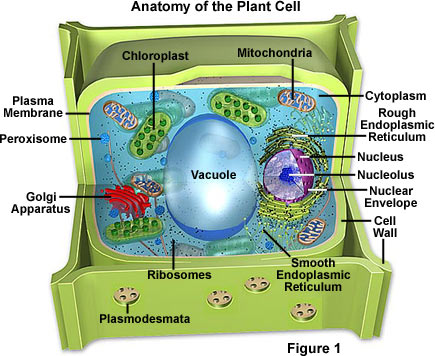
3. Plant Cells have unique structures, including a Central Vacuole, Plastids, and a Thick Cell Wall that surrounds the Cell Membrane. These common Features are found in the THREE TYPES of specialized Plant Cells.

4. PLANTS ARE MADE OF THREE TYPES OF CELLS AND FOUR TYPES OF TISSUES.

5. THE THREE BASIC TYPES OF PLANT CELLS ARE PARENCHYMA (puh-REHN-kih-muh), COLLENCHYMA (kuh-LEN-kih-muh), and SCLERENCHYMA (skleh-REN-kih-muh). (Figure 31-1)

6. PARENCHYMA CELLS: (Figure 31-1 (a))

    A.  The most Abundant and Least Structurally Specialized Cells.

    B.  Parenchyma Cells are usually loosely packed cubed-shaped or elongated cells that contain a large central vacuole and have thin, flexible cell walls.

    C.  Cells occur throughout the plant and have MANY Functions, INCLUDING PHOTOSYNTHESIS, FOOD STORAGE, AND GENERAL METABOLISM (photosynthesis, storage of water and nutrients, and healing).

    D.  AN IMPORTANT CHARACTERISTICS OF PARENCHYMA CELLS IS THAT THEY CAN DIVIDE AND BECOME SPECIALIZED FOR VARIOUS FUNCTION.

    E.  These cells usually form the bulk of non-woody plants.  For example, the fleshy part of an apple is made mostly of parenchyma cells.
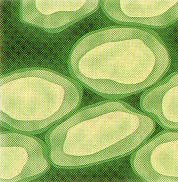
7. COLLENCHYMA CELLS: (Figure 31-1 (b))

    A.  Plant Cells that SUPPORT the Growing Parts of Plants.

    B.  The cell walls of Collenchyma Cells are thicker than those of Parenchyma CellS.  Collenchyma cell walls are also irregular in shape.  The thicker cell walls provide more support for the plant.

    C.  They have THICK Walls, STRETCHABLE Cell Walls that provide FLEXIBILITY SUPPORT.

    D.  Collenchyma cells are usually grouped in Strands.  They are specialized for supporting regions of the Plant that are Still Lengthening.  The Tough String of a Celery Stalk (Stems) are made of Collenchyma Cells.
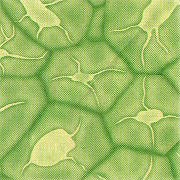
8. SCLERENCHYMA CELLS:  (Figure 31-1(c))

    A.  Support the NON-Growing Parts of plants.

    B.  Sclerenchyma cells have thick, even rigid cell walls.  They support and strengthen the plant in areas where growth is No Longer Occurring.

    C.   They Have THICK, NONSTRECHABLE Cell Walls.

    D.  The Cells Walls are so THICK that the Cell USUALLY DIES at maturity, providing a frame to support the plant.

    E.  WHEN THEY MATURE, MOST SCLERENCHYMA CELLS ARE EMPTY CHAMBERS SURROUNDED BY THICK WALLS.

9. THERE ARE TWO TYPES OF SCLERENCHYMA CELLS:

    A.  FIBERS – CELLS UP TO 50 cm LONG THAT USUALLY OCCUR IN STRANDS. FABRIC SUCH AS LINEN AND FLAX ARE MADE OF THESE FIBERS.

    B.  SCLEREIDS – HAVE THICKER CELLS WALLS THAN FIBERS, HAVE MANY SHAPES, AND CAN OCCUR SINGLY OR IN SMALL GROUPS.  The gritty texture of a pear is from Sclereids it contains.  Sclereids also cause the Hardness of a peach pit and a walnut shell.

PLANT TISSUES AND SYSTEMS

1. Cells that work together to perform a specific function form a Tissue.

2. Tissues are arranged into Systems in Plants, including the Dermal System, Ground System, and Vascular System. (Table 31-1)

3. These Systems are further organized into the Three Major Plant Organs – THE ROOTS, STEMS AND LEAVES.

4. THE FOUR BASIC PLANT TISSUES ARE VASCULAR TISSUE, DERMAL TISSUE, GROUND TISSUE, AND MERISTEMATIC TISSUE.
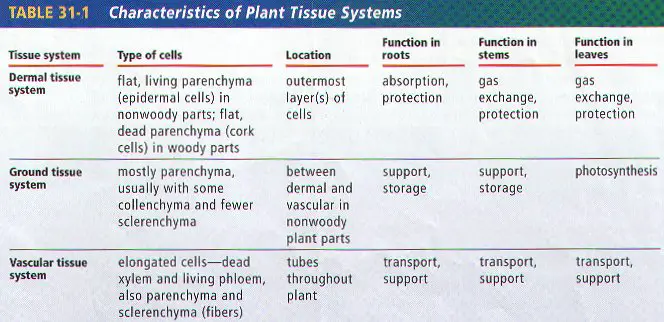
DERMAL TISSUE SYSTEM

1. DERMAL TISSUE forms the SKIN (the outside covering) of a Plant, Covering all parts of the ROOTS, STEMS, AND LEAVES.

2. One kind of Dermal tissue is the EPIDERMIS, made of Parenchyma Cells, which is usually only one cell thick, and is the outer protective tissue of young plants and mature Non-woody Plants.

3. Dermal Tissue has different functions, depending on its LOCATION on the plant.

4. ABOVE the Ground, Dermal Tissue prevents the plant from drying out by reducing water loss from evaporation (Transpiration).  This Dermis Tissue also Secrets a Waxy Layer called CUTICLE.

5. BELOW the Ground, Dermal Tissue ABSORBS Water.  On the underground parts of a plant, the Epidermis FORMS ROOT HAIRS that ABSORB Water and Nutrients.

6. On leaves and stems openings in the epidermis are called Stomata.  Stomata regulate the passage of gases and moisture into and out of the plant.

7. In woody stems and roots, the Epidermis is replaced by Dead Cork Cells.

GROUND TISSUE SYSTEM

1. Dermal Tissue surrounds the Ground Tissue System, which consists of all three types of Plant Cells.

2. Ground Tissue consists of everything that is not Dermal Tissue or Vascular Tissue.  Parenchyma, a simple tissue, makes up most Ground Tissue.

3.  Ground Tissue has many metabolic functions, including PHOTOSYNTHESIS, FOOD STORAGE AND SUPPORT.

4. Non-woody roots, stems, and leaves are made up primarily of Ground Tissue.

VASCULAR TISSUE SYSTEM

1. Vascular plants have specialized Tissue called Vascular Tissue.  Vascular Tissue carries WATER and Nutrients THROUGHOUT THE PLANT AND HELPS SUPPORT THE PLANT.

2. There are TWO Kinds of Vascular Tissue; both Kinds of Vascular Tissue contain SPECIALIZED CONDUCTING CELLS:
   A.  XYLEM  (ZY-lum) –  MOVES WATER AND MINERALS UPWARD FROM ROOTS TO LEAVES.

        (1) When Water and Minerals are absorbed by the Roots of a Plant, These substances must be transported up to the Plant’s Stems and Leaves.

        (2) XYLEM is the Tissue THAT CARRIES WATER AND DISSOLVED SUBSTANCES UPWARD IN THE PLANT.

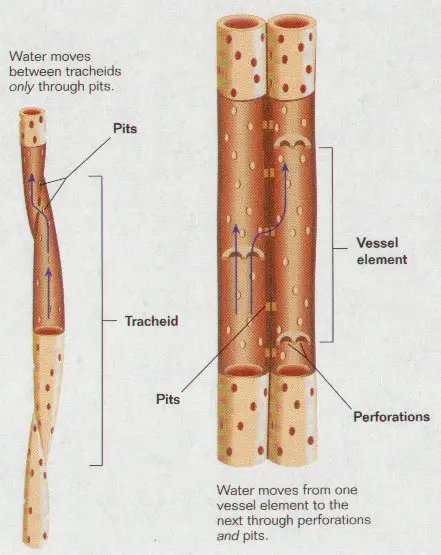
        (3) Two Kinds of Conducting Cells are present in Xylem of ANGIOSPERMS: TRACHEIDS and VESSEL ELEMENTS.  Both types of cells DO NOT conduct Water until they are DEAD and EMPTY. (Figure 31-2)

        (4) TRACHEIDS (TRAY-kee-idz) ARE LONG, THICK WALLED SCLERENCHYMA, NARROW CELLS OF XYLEM WITH THIN SEPARATIONS BETWEEN THEM. WATER MOVES FROM ONE TRACHEID TO ANOTHER THROUGH PITS, WHICH ARE THIN, POROUS AREAS OF THE CELL WALL.

        (5) VESSEL ELEMENTS ARE SHORT, SCLERENCHYMA, WIDE CELLS OF XYLEM WITH NO END WALLS. Vessel Elements DO NOT have separations between them; they are arranged end to end liked stacked barrels stack on top of each other.  These Vessels are wider than Tracheids, and more water moves through them.

        (6) Angiosperms, or Flowering Plants, contain Tracheids and Vessel Elements.

        (7) Gymnosperms, or cone bearing seed plants, contain Only Tracheids.
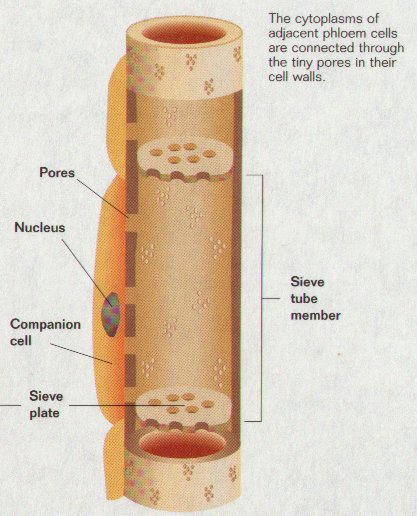
   B. PHLOEM (FLOH-um)  MOVES SUGARS OR SAPS IN BOTH DIRECTIONS THROUGHOUT THE PLANT ORIGINATING IN THE LEAVES.

        (1) Sugars made in the leaves of a plant by photosynthesis must be transported throughout the plant.

        (2) Phloem Tissue CONDUCTS SUGARS UPWARD AND DOWNWARD IN A PLANT.

        (3) The sugars move as Sugary Sap.

        (4) TWO Kinds of Cells are present in Phloem: SIEVE TUBE MEMBER AND COMPANION CELLS.

        (5) SIEVE TUBES MEMBERS  ARE CELLS OF PHLOEM THAT CONDUCT SAP. Sieve Tube members are stacked to form long SIEVE TUBES.  Compounds move from Cell to Cell through End Walls called SIEVE PLATES.

        (6) COMPANION CELLS ARE PARENCHYMA CELLS OF PHLOEM THAT ENABLE (ASSIST) THE SIEVE TUBE ELEMENTS TO FUNCTION.

        (7) Each Sieve Tube Element has a Companion Cell.  Companion Cells CONTROL the movement of substances through the sieve tubes.

        (8) The partnership between these two cells is vital; Neither Cell can Live without the other.

GROWTH IN MERISTEMS

1. Plants grow differently from Animals.  Instead of Growing only for a limited time, Plants grow as long as the plant is alive.

2. Instead of occurring throughout the organism, Plant Growth occurs only in Specific Growing Regions.
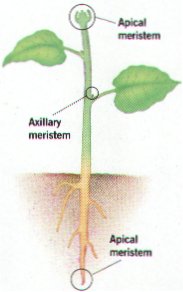
3. THE GROWING REGIONS OF PLANTS ARE CALLED MERISTEMS, regions where cells continuously divide.

4. MERISTEMS ARE LOCATED AT THE TIPS OF STEMS AND BRANCHES, AT THE TIPS OF ROOTS (APICAL), AND IN JOINTS WHERE LEAVES ATTACH TO STEMS (AXILLARY). (Table 31-2)

5. IN WOODY PLANTS (TREES), THERE ARE MERISTEMS BETWEEN THE XYLEM AND PHLOEM.

6. The type of Tissue found in Meristems is called MERISTEMATIC TISSUE.

7. MERISTEMATIC TISSUE IS THE ONLY TYPE OF PLANT TISSUE THAT PRODUCES NEW CELLS BY MITOSIS.

8. These New Cells are ALL ALIKE at First, but eventually they change (Differentiate) into VASCULAR TISSUE, DERMAL TISSUE, OR GROUND TISSUE.

9. The Growing tissue at the tips of Roots and Stems are Called APICAL MERISTEMS.
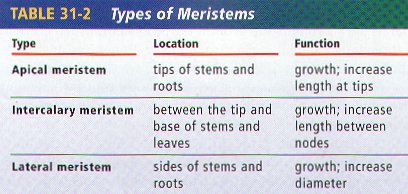
10. APICAL MERISTEMS LOCATED AT THE TIPS OF STEMS AND ROOTS, CAUSE ROOTS AND STEMS TO GROW LONGER AT THEIR TIPS.  THEY CAUSE PLANTS TO GROW TALLER AND ROOTS TO GROW DEEPER INTO THE SOIL.

11. Some Monocots have INTERCALRY MERISTEMS located above the bases of leaves and stems.  Intercalary Meristems allow grass leaves to quickly regrow after being Grazed or Mowed.

12. Gymnosperms and Most Dicots also have LATERAL MERISTEMS, which allow stems and roots to increase in Diameter.  Lateral Meristems are located near the Outside of Stems and roots.

13. There are TWO Types of Lateral Meristems, THE VASCULAR CAMBIUM, AND THE CORK CAMBIUM.

14. The VASCULAR CAMBIUM, located between the Xylem and Phloem, Produces Additional Vascular Tissues.

15. The CORK CAMBIUM, located Outside the Phloem, Produces CORK.  Cork Cells replace the Epidermis in Woody Stems and Roots, Protecting the Plant.  Cork cells are DEAD CELLS that provide Protection and Prevent Water Loss.

16. THERE ARE TWO PATTERNS OF GROWTH IN SEED PLANTS:

    A.  PRIMARY GROWTH – THE ELONGATION (GROWTH IN LENGTH) OF STEMS AND ROOTS IS CALLED PRIMARY GROWTH.  ALL PLANTS EXHIBIT PRIMARY GROWTH, IT OCCURS WHERE PLANTS GROW TALLER AND THEIR ROOTS GROW DEEPER.

    B.  SECONDARY GROWTH – GROWTH THAT MAKE PLANTS THICKER (GROWTH IN DIAMETER) IS CALLED SECONDARY GROWTH.  SOME SEED PLANTS HAVE SECONDARY GROWTH, IN WOODY PLANTS. THERE IS A MERISTEM (LATERAL MERISTEM) BETWEEN THE XYLEM AND PHLOEM CALLED THE VASCULAR CAMBIUM THAT PRODUCES ADDITIONAL VASCULAR TISSUE.

 SECTION 31-2, ROOTS

Plants have Three Kinds of Organs-Roots, Stems, and Leaves.  Roots are the structures that typically grow underground.  Roots are important because the anchor the plant in soil.  They also absorb and transport water and mineral nutrients.  The storage of water and organic compounds is provided by roots.

OBJECTIVES:  List the three major functions of roots. Explain the difference between a taproot system and a fibrous root system.  Distinguish between primary growth and secondary growth in roots.  Describe primary root tissues.

TYPES OF ROOTS

1. THE FIRST ROOT TO EMERGE FROM A SEED IS THE PRIMARY ROOT.  As the plant matures, branches grow from the Primary Root.

2. In some Plants the Primary Root Enlarges, If this first Root Becomes the Largest Root it is called a TAPROOT (THE LARGEST ROOT). (Figure 31-3)

3. Taproots can grow deep, reaching water far below the surface of the ground.

4. Beets and Carrots are plants with Taproots that are used for Food.
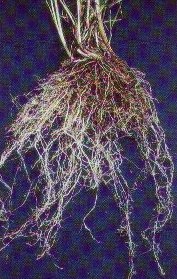
 

5. Not all plants have Taproots, especially Monocots, such as grasses, the Roots are Numerous and all about the same size.

6. NUMEROUS, EXTENSIVELY BRANCHED ROOTS ARE CALLED FIBROUS ROOTS.  These roots grow near the surface and can collect water in a wide area. Because of the numerous branches of the roots these plants are excellent for preventing Erosion (Grasses). Fibrous Roots of Monocots often develop from the base of the Stem rather than from other roots. (Figure 31-3)
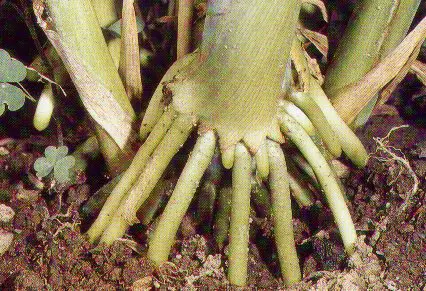
 

7. A Few plants have special roots called ADVENTITIOUS ROOTS. ROOTS THAT FORM ON A STEM OR LEAF.  SOME GROW ABOVE GROUND AND HAVE SPECIAL FUNCTIONS -CORN – PROP ROOTS HELP SUPPORT THE PLANT.  (Figure 31-4)

8. Air Roots of Orchids, obtain water and mineral nutrients from the Air.  Air roots on the Stems of Ivy and other vines enable them to climb walls and trees. (Figure 31-4)

ROOT STRUCTURES
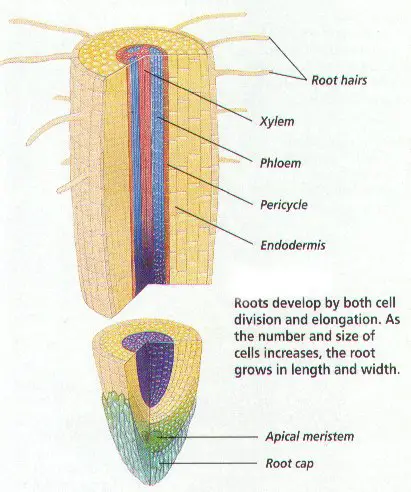
1.   The Root TIP is covered by a Protective ROOT CAP, which covers the Apical Meristem. (Figure 31-5)

2.  The Root Cap produces a Slimy Substance that functions like Lubricating Oil, allowing the root to move more easily through the soil as it grows.

3.  Cells that are crushed or knocked off the root Cap as the root moves through the soil are replaced by new cells produced in the Apical Meristem, where cells are continuously dividing.

4.  Roots do not absorb water and minerals through a smooth Epidermis.  Tiny, hairlike projections called ROOT HAIRS on the epidermis absorb water and dissolved minerals from the soil.  Root Hairs also INCREASE the Surface Area of the Plant Roots.  (Figure 31-6)

5.    The Core of a root consists of a Vascular Cylinder.  The Vascular Cylinder contains Xylem and Phloem.  Surrounding the Vascular Cylinder is a band of Ground Tissue called the CORTEX.  Outside the Cortex is the EPIDERMIS. (Figure 31-7)
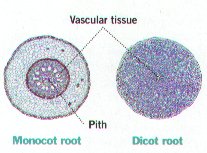
 

6.  The arrangement of Xylem and Phloem DIFFERS in the roots of Monocots and Dicots.

    A.  DICOTS – In Dicots the Vascular Tissue forms a solid core at the center of the root.

    B.  MONOCOTS – In Monocots the Vascular Tissue from a ring that surrounds a central region of Cells known as PITH.


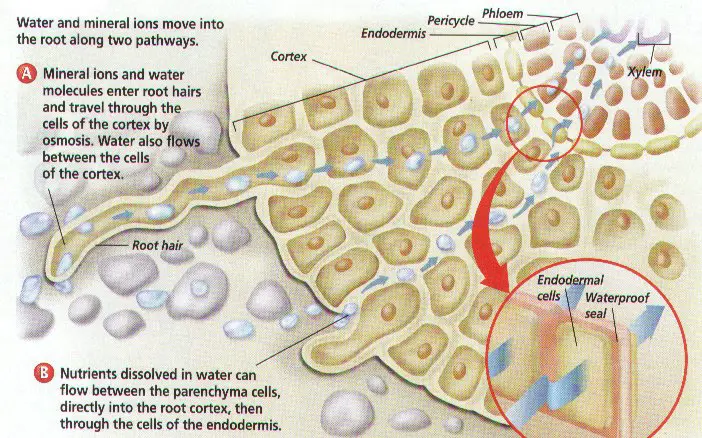
7. The Vascular Cylinder is separated from the Cortex by a tightly packed layer of cells.  The layer of cells that separates the Cortex from the Vascular Cylinder is called the ENDODERMIS (cell layer like a row of bricks).

8. Where the cells of the endodermis touch each other, they are coated with a waxy layer called the CASPARIAN STRIP.

9. The Casparian Strip blocks the movement of Water between adjacent cells of the Endodermis.

10. This Causes the water and dissolved minerals that enter a root to be channeled through the cytoplasm of the cells of the Endodermis into the Vascular Tissue.

11. The outermost layer or layers of the Central Vascular Tissue is termed the PERICYCLE.  Lateral Roots are formed by the division of Pericycle Cells. (Figure 31-8)

12. Dicots and Gymnosperms Roots often experience Secondary Growth.  Secondary Growth begins when the Vascular Cambium forms between Xylem and Phloem.

13. Pericycle Cells form the vascular cambium.  The Vascular Cambium produces Secondary Xylem toward the Inside of the Root and Secondary Phloem toward the Outside.
 

ROOT FUNCTIONS

1. Besides Anchoring a Plant in Soil, Roots Serve Two other Primary Functions; They Absorb Water and a Variety of Minerals, and they are often adapted to Store Carbohydrates and Water.

2. Roots are Selective about which minerals they Absorb.  Roots absorb some minerals and exclude others.  There are 13 Minerals that are essential for all plants.  They are absorbed mainly as Ions. (Table 31-3)

3. Plant Cells use some minerals, such as Nitrogen and Potassium in LARGE amounts.  These elements are called MACRONUTRIENTS.

4. Plant Cells use other Minerals is SMALL Amounts, these are called MICRONUTRIENTS.

5. Adequate amounts of all 13 Mineral Nutrients in Table 31-3 are required for Normal Growth.  Plants with deficiencies show characteristic symptoms and reduced growth.

6. Severe mineral deficiencies can kill a plant.  Excess amounts of some mineral nutrients also can be toxic to a plant.

7. Roots often store Carbohydrates or Water, Phloem Tissue carries Carbohydrates made in the Leaves to the roots.

8. Carbohydrates that the roots do not immediately need for energy are Stored. In roots these excess carbohydrates are usually Converted to STARCH and stored in Parenchyma Cells, Carrots, Turnips, and Sweet Potatoes are stored Starches.

9. The roots of some plants store large amounts of water, which helps the plant to survive during dry periods.

SECTION 31-3, STEMS

In contrast to roots, which are mainly adapted for absorption and anchoring, stems are usually adapted to support leaves.  Whatever their size and shapes, stems also function in transporting and providing storage.

OBJECTIVES:  Describe the difference between monocot stems and dicot stems.  List five differences and five similarities between structure of roots and the structure of stems.  Explain how annual rings are formed.  Describe the pressure-flow model for organic-compound movement in the phloem.  Describe the cohesion-tension theory for water movement in the xylem.

TYPES OF STEMS
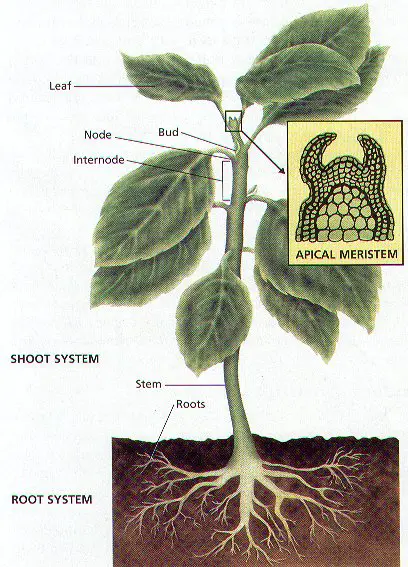
1.  The various differences in stem shape and growth represent adaptations to the environment.  (Figure 31-9)

2. STEMS HAVE TWO MAIN FUNCTIONS:

    A.  HOLDING LEAVES UP TO THE SUNLIGHT.

    B.  TRANSPORTING WATER AND FOOD BETWEEN ROOTS AND LEAVES.

3. In a few plants stems have additional functions, such as Food Storage.  Potatoes (tuber) are Underground Stems that store large amounts of food as starch.

STEM STRUCTURES

1. Stems have more complex structure than roots, yet they are similar in many ways.

2. Most Stems, like roots, grow in Length only at their Tips, where Apical Meristems produce new Primary Growth.

3. Stems, like Roots, grow in Circumference through Lateral Meristems.

4. Stems have a SPECIFIC PLACE where Leaves are attached.

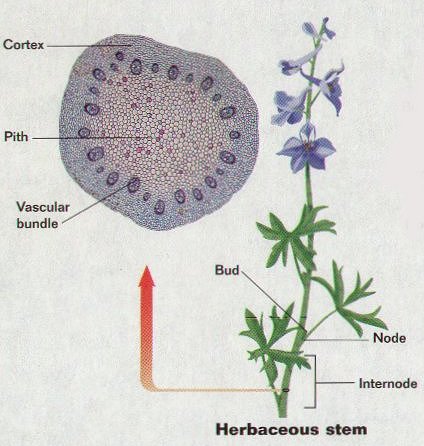
5. Stems are divided into segments called INTERNODES.  At the end of each Internode is a NODE. (Figure 31-10)

6. Initially, one or more Leaves are attached at each Node.  At the point of attachment of each Leaf, the Stem bears a LATERAL BUD.  A BUD is capable of developing into a new shoot.

7. A Bud contains an Apical Meristem and is enclosed by specialized leaves called BUD SCALES.  The tip of each stem usually has a TERMINAL BUD.  When growth resumes in the spring, the Terminal Bud opens, and the bud scales fall off.

8. LEAVES ATTACH TO STEMS A LOCATIONS CALLED NODES.

9. THE SECTION OF STEM BETWEEN NODES ARE CALLED INTERNODES.

PRIMARY GROWTH IN STEMS

1. Vascular Tissue is Continuous between Roots and Stems, the Arrangement of Vascular Tissue is DIFFERENT in Stems than in Roots.

2.  In ROOTS, Vascular Tissue forms a Central Cylinder.
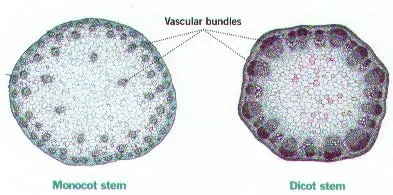
3. In STEMS, Vascular Tissue is arranged in VASCULAR BUNDLES, WHICH CONTAINS BOTH XYLEM (Toward the Inside) AND PHLOEM (Toward the Outside). (Figure 31-11)

4. In DICOTS, Vascular Bundles Form a RING that divides the Ground Tissue into CORTEX and PITH. The PITH is located in the Center of the Stem. (b)

5. In MONOCOTS, Vascular Bundles are SCATTERED throughout the Ground Tissue.  The Ground Tissue of Monocot Stems are usually Not clearly separated into Pith and Cortex.  Most monocots have No Secondary Growth. (a)

SECONDARY GROWTH IN STEMS
1. Stems Increase in Thickness due to the division of cells in the Vascular Cambium.  The Vascular Cambium in dicot and gymnosperm stems first arises between the Xylem and the Phloem in a Vascular Bundle.

2. The Vascular Cambium forms a Cylinder, and produces Secondary Xylem to the inside and Secondary Phloem to the outside.

3. It usually produces more Xylem than it does Secondary Phloem, The Secondary Xylem is Called WOOD.

4. Occasionally, the Vascular Cambium produces New Cambium Cells, which increase its diameter.

5. As new Xylem is formed, older portions of the Xylem eventually stop Transporting Water.  The often become Darker than the New Xylem due to the accumulation of Resins and other organic compounds. This Dark wood in the Center of a Tree Trunk is called HEARTWOOD. (Figure 31-12)
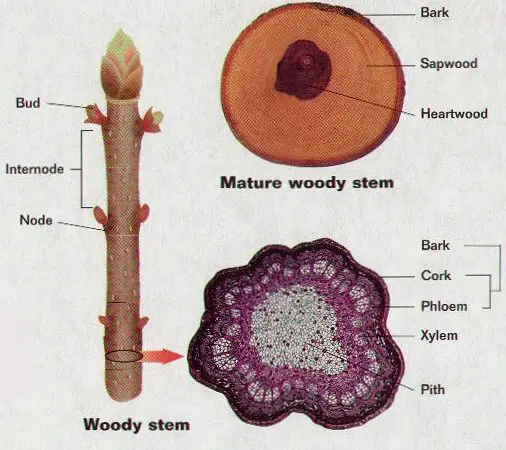
 

6. The Functional Xylem, often lighter colored wood nearer the Outside of the Tree Trunk is SAPWOOD.

7. In a large diameter Tree, the Heartwood keeps getting wider while the Sapwood remains about the same thickness.

8.  The Phloem produced near the Outside of the Stem is part of BARK.  Bark is the protective covering of Woody Plants.  It consists of Cork, Cork Cambium, and Phloem.  The Cork Cambium produces Cork near the outside.  Cork Cells are Dead at Maturity.

9.  During Spring, when Water is Plentiful, the Vascular Cambium forms New Xylem with cells that are Wide and Thin Walled.  This Wood is called SPRINGWOOD.

10.  In Summer, when water is more limited, the Vascular Cambium produces SUMMERWOOD, which has smaller cells with thicker walls.

11.  In a Stem Cross Section, the abrupt change between Small Summerwood Cells and the following year’s Large Springwood Cells produces an ANNUAL RING.

12.   Because one ring is usually formed each year, you can estimate the age of the Stem (Tree) by counting its annual rings.

STEM FUNCTIONS

1. Stems function in the transportation and storage of nutrients and water, and they support the leaves.

2. PHLOEM CELLS move SUGARS (Carbohydrates) from one part of a plant to another.

3. The transport of sugars is CONTROLLED by the overall Activities of a Plant.  Where they are Needed.

4. Sugars are moved from a place where they are MADE BY Photosynthesis, called a SOURCE,  to a place where they are STORED OR USED, called a SINK.

5. Botanists use the term TRANSLOCATION to refer to the movement of Carbohydrates through the plant.

6. Sugars are also moved from a place of being Stored to a place where they are Used.
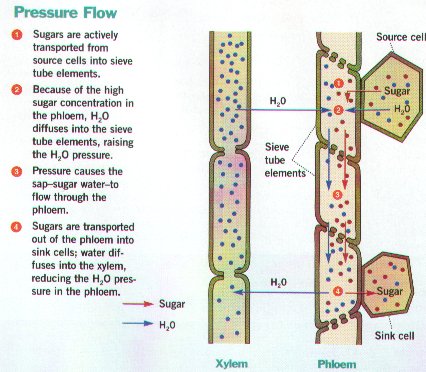
7. The Movement of sugars in Phloem is best explained by the PRESSURE-FLOW HYPOTHESIS. (Figure 31-13)

8. Sugars made in photosynthetic cells are PUMPED into Sieve Tubes by ACTIVE TRANSPORT at the Source.  The Pressure Increases as Water enters the Sieve Tube by Osmosis.  The pressure increase (TURGOR) moves the SAP toward the SINKS.

9. Because the movement of Sugars in and out of Sieve Tubes require Energy, Cells that make up the Phloem must be alive to function.

10.  Sugars move through plants more slowly than water.  Most of the sugar that moves in Phloem is SUCROSE, or Table Sugar.

11.   Transport in the Phloem can occur in different directions at different times, depending on the needs of the Plant.

THE TRANSPORT OF WATER

1. The Transport of Water and mineral Nutrients occurs in the Xylem of all plant Organs.

2. The THEORY of Water Movement in Plants today is known as the COHESION-TENSION THEORY.  According to this theory, water movement in plants is driven by TRANSPIRATION.  (Figure 31-13)

3. TRANSPIRATION IS THE EVAPORATION OF WATER FROM THE PARTS OF A PLANT EXPOSED TO THE AIR.

4. As water Evaporates from the cells of a leaf or stem, Replacement Water is PULLED from the Xylem Tissue, more water enters the roots from the soil to replace the lost water.

5. The Evaporation of Water from cells creates a NEGATIVE Pressure in the Xylem, which Pulls water Upward.

6. Transpiration creates a strong PULL, but another Force also helps Pull water up a plant -COHESION.

7. COHESION CAUSES WATER MOLECULES TO STICK TOGETHER AND PULL EACH OTHER UP INSIDE THE NARROW TUBES OF XYLEM.

8.  The movement also depends on the rigid xylem walls and the strong attraction of the water molecules to the Xylem Wall, which is called ADHESION.

9. THE MOVEMENT OF WATER IN PLANTS OCCURS BY A COMBINATION OF TRANPIRATION,  EVAPORATION, COHESION and ADHESION.

10. Water movement in plants varies with the time of day.

11. At midday, the Stomata are open, and water moves rapidly through the plant.

12. Water movement stops at night, when the Stomata are closed and there is no Transpiration.

SECTION 31-4, LEAVES

Most leaves are thin and flat, an adaptation that helps them capture sunlight for photosynthesis.  Although this structure may be typical, it is certainly not universal.  Like roots and stems, leaves are extremely variable.  This variability represents adaptations to environmental conditions.

OBJECTIVES:  Identify the difference between a simple leaf and compound leaf.  Describe the tissues that make up the internal structure of a leaf.  Describe adaptations of leaves for special purposes.  Explain the importance of stomata.

LEAF STRUCTURES AND TYPES
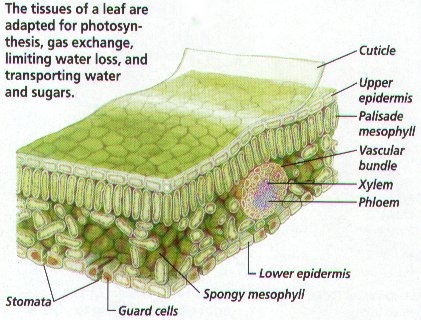
1. The Main function of Leaves is to Trap Light for Photosynthesis, the process of making Carbohydrates from Carbon Dioxide and Water in the presence of Sunlight.

2. Besides making food, the leaves of a few plants can also store food.  An Onion is an underground stem surrounded by thick, fleshy leaves that store food.

3. Leaves perform other functions such as protecting some plants from animals and storing water.

4. We use Leaves as sources of Dyes, Fibers, Fuels, Drugs, Wax, Soap, Spices and Food.

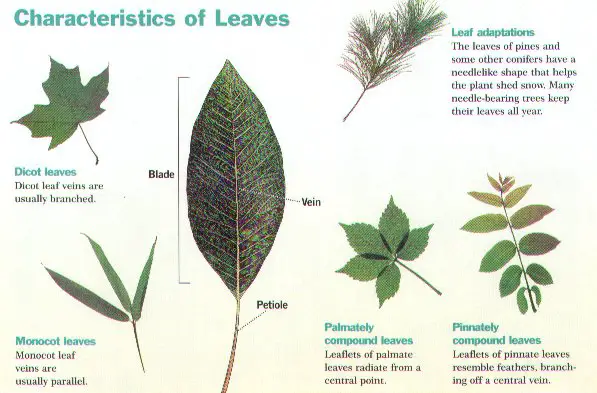
5. Leaves consist of a Flat Broad Blade and a Stem-like Petiole that attaches the Blade to the Stem.

6. SIMPLE LEAVES have ONE Undivided Blade per Petiole.

7. COMPOUND LEAVES have more than one Blade per Petiole.  The Blades of Compound Leaves are called Leaflets.

8. Leaves contain the same Three Tissues Types – Dermal, Ground, and Vascular – as stems and roots.
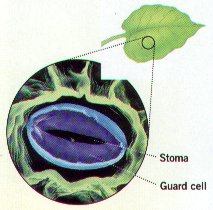
9. Leaf Epidermis has TWO Special Structures that are adaptations for Photosynthesis on land: A WAXY CUTICLE AND STOMATA.

10. STOMATA ARE PORES IN THE EPIDERMIS, CUTICLE IS A WATERPROOF COVERING THAT HELPS PLANTS CONSERVE WATER.
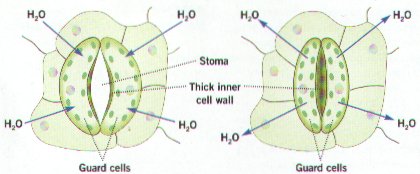
11. The Stomata allow Carbon Dioxide to Enter a Leaf and Water Vapor and Oxygen to go Out.

12. Guard Cells (two kidney-shaped cells) surround the stomata; they open or close the stomata, depending on environmental conditions and the needs of the plant.  Guard Cells are modified cells found on the leaf epidermis that regulate gas and water exchange.

13. A Leaf is covered on the top and bottom by epidermis, with Ground Tissue in between the layers.

14. The Middle Region is called the MESOPHYLL. (Figure 31-16)   In leaves, the Ground Tissue is called Mesophyll.  Mesophyll cells are packed with chloroplast, where photosynthesis occurs.  The chlorophyll in chloroplast makes leaves look green.

15. Most plants have leaves with TWO Layers of Mesophyll.

    A.  One or more rows of closely packed, columnar cells make up the PALISADE LAYER, which lies just beneath the upper epidermis. THIS IS THE SITE OF MOST PHOTOSYNTHESIS.

    B.  A layer of loosely packed, spherical cells, called the SPONGY LAYER, lies between the Palisade Layer and the Lower Epidermis.

16. Air spaces make up 20 to 70 percent of the volume of the Spongy Mesophyll.  The air spaces allow for the exchange of gases involved in Photosynthesis: Carbon Dioxide and Oxygen.

17. THE MESOPHYLL IS WHERE MOST PHOTOSYNTHESIS OCCURS IN LEAVES.  It is a ground tissue composed of chloroplast-rich parenchyma cells.

18. All leaves contain Vascular Tissue; The Vascular Bundles in leaves are called VEINS, and transport water and food.

19. Veins are separated from the Mesophyll by a layer of cells called the BUNDLE SHEATH.

20. In most plants, Photosynthesis occurs throughout the Mesophyll, but NOT IN the Bundle Sheath.
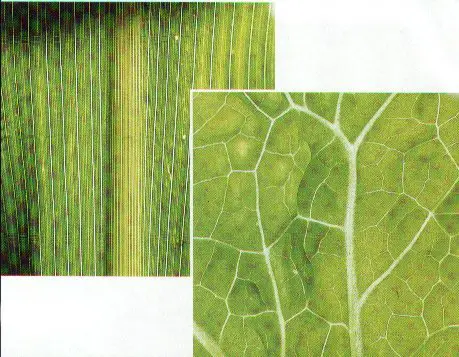
21. VENATION is the arrangement of Veins in a leaf.

22. Veins in Monocots leaves (suck as Grasses or Corn Plants) run Parallel (Parallel Venation) to each other, while Veins in Dicots leaves form a Branched network (Net Venation).  The main vein or veins repeatedly branch to form a conspicuous network of smaller veins.

23. Dicot leaves can be either PINNATE or PALMATE.

24. Pinnate Leaves are Featherlike, with smaller veins branching off a central vein called the MIDRIB.

25. Palmate Leaves are lobed and resemble the fingers and palm of your hand, with several main veins radiating from a central point.

26. In Compound Leaves, the words Pinnate and Palmate refer to the arrangement of leaflets around the Petiole.

27. A coiled structure called a Tendril is a specialized leaf found in many vines, such as peas and pumpkins.  It wraps around objects to support the climbing vine.  In some species, like grape, Tendrils are specialized Stems.

28. An unusual leaf modification occurs in carnivorous plants, in carnivorous plants the leaves function as Food Traps.  These plants grow in soil that is Poor in several nutrients, especially Nitrogen.  The plant receives substantial amounts of mineral nutrients when it traps and digests insects and other small animals.

29. Spines are modified leaves that protect the plant from being eaten by animals.  Because spines are small and non-photosynthetic, they greatly reduce Transpiration in Desert Species such as Cactuses.
LEAF FUNCTIONS

1. Leaves are the primary site of photosynthesis in most plants.

2. Mesophyll Cells in Leaves use Light Energy, Carbon dioxide, and Water to make Carbohydrates.

3. Light Energy is also used by Mesophyll Cells to synthesize amino acids, fats, and a variety of other organic molecules.

4. Carbohydrates made in a leaf can be used by the leaf as an Energy source or as building blocks.  They also may be transported to other parts of the plant, where they are either used or stored.

5. A major limitation to plant photosynthesis is insufficient Water due to transpiration.  About 98 percent of the water that is absorbed by the roots is lost through transpiration.  Transpiration may benefit the plant by cooling it and speeding the transport of mineral nutrients through the Xylem.

MODIFICATIONS FOR CAPTURING LIGHT

1. Leaves absorb light, which provides the energy for photosynthesis.

2.  Leaves often adapt to their environment to maximize light interception.

3. On the same Tree, Leaves that develop in full Sun are Thicker, have a Smaller area per leaf, and have More chloroplast per unit area.  Shade-leaf chloroplasts are arranged so that shading of one chloroplast by another is minimized, while sun-leaf chloroplast are not.

4. In dry environments, plants often receive more light than they need.  These plants often have structures that reduce the amount of light absorbed.

5. Many desert plants have evolved dense coatings of hairs that reduce light absorption.

6. The window plant protects itself from its dry environment by growing underground.  Only its transparent leaf tips protrude above the soil to gather light fro photosynthesis. (Figure 31-17)

 

Photosynthesis Notes Bi

  PHOTOSYNTHESIS
 CAPTURING THE ENERGY IN LIGHT

Organisms use energy to carry out the functions of life
Autotrophs obtain this energy directly from sunlight and store it within organic compounds
This energy transfer process  is called photosynthesis

ENERGY FOR LIFE PROCESSES

Energy is the ability to do work
Cellular work includes growth, repair, active transport, synthesis, & reproduction
Food made by autotrophs is the source of energy for all other organisms

5. Most AUTOTROPHS or PRODUCERS use PHOTOSYNTHESIS, to Convert the Energy in SUNLIGHT, CARBON DIOXIDE, AND WATER  into Chemical Energy OR FOOD.  (GLUCOSE)

6. THE FOODS MADE BY AUTOTROPHS ARE stored in various Organic Compounds, primarily CARBOHYDRATES, including a SIX-CARBON SUGAR called GLUCOSE.

7.  Plants, algae, and some prokaryotes (Bacteria) are all types of Autotrophs.

8. Only 10 percent of the Earth’s 40 million species are Autotrophs.

9. Without Autotrophs, all other living things would DIE.  Without PRODUCERS you cannot have CONSUMERS.

10. Autotrophs not only make Food for their own use, but STORE a great deal of Food for use by other organisms (CONSUMERS).

11. Most Autotrophs use ENERGY from the SUN to make their food, but there are other organisms deep in the ocean that obtain Energy from INORGANIC COMPOUNDS. (CHEMOSYNTHESIS)

12. Organisms that CANNOT Make their own food are called HETEROTROPHS OR CONSUMERS.

13. Heterotrophs include animals, fungi, and many unicellular organisms, they stay alive by EATING AUTOTROPHS or other HETEROTROPHS.

14. Because Heterotrophs must consume other organisms to get Energy, they are called CONSUMERS.

15. Only part of the energy from the Sun is Used by Autotrophs to make Food, and only part of that Energy can be passed on to other Consumers. A Great Deal of the Energy is LOST as HEAT.

16. Enough Energy is passed from Autotroph to Heterotroph to give the Heterotroph the Energy it needs.

17. Photosynthesis involves a COMPLEX SERIES of Chemical Reactions, in which the PRODUCT of One Reaction is Consumed in the Next Reaction.

18. A Series of Reactions linked in this way is referred to as a BIOCHEMICAL PATHWAY. (Figure 6-1)

19. Autotrophs use biochemical pathways of photosynthesis to manufacture organic compounds from Carbon Dioxide, CO2, and Water.  During this conversion, molecular OXYGEN, O2, is Released.

20. Some of the energy stored in organic Compounds is Released by Cells in another set of Biochemical Pathways, Known as CELLULAR RESPIRATION.  (Chapter 7)

21. Both Autotrophs and Heterotrophs Perform Cellular Respiration.

22. During Cellular Respiration in Most Organisms, Organic Compounds are Combined with O2 to Produce ADENOSINE TRIPHOSPHATE or ATP, Yielding CO2 and Water as Waste Products.

23. The PRODUCTS of Photosynthesis, ORGANIC COMPOUNDS and O2, are the REACTANTS used in CELLULAR RESPIRATION.

24. The WASTE PRODUCTS of CELLULAR RESPIRATION, CO2 and WATER, are the REACTANTS used in PHOTOSYNTHESIS.

LIGHT ABSORPTION IN CHLOROPLASTS

1. In Plants, the INITIAL REACTIONS in Photosynthesis are known as the LIGHT REACTIONS.

2. They begin with the ABSORPTION of Light in the organelle found in Plant Cells and algae called CHLOROPLASTS.
3. A Photosynthetic Cell contains anywhere from ONE to Several Thousands Chloroplasts.

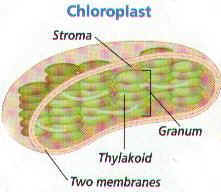
4. A Chloroplasts is surrounded by TWO MEMBRANES.  The INNER Membrane is Folded into many Layers. (Figure 6-2)

5. A Chloroplasts Inner Membrane layers fuse along the edges to Form THYLAKOIDS.

6. THYLAKOIDS ARE DISK-SHAPED STRUCTURES THAT CONTAIN PHOTOSYNTHETIC PIGMENTS.

7. Each Thylakoid is a closed Compartment surrounded by a Central Space.  THE THYLAKOIDS ARE SURROUNDED BY A GEL-LIKE MATRIX (SOLUTION) CALLED THE STROMA. (Figure 6-2)

8.THE NEATLY FOLDED THYLAKOIDS THAT RESEMBLE STACKS OF PANCAKES ARE CALLED GRANA. The Thylakoids are Interconnected and are Layered on top of one another to form the STACKS of Grana.

9. Each Chloroplasts may contain hundreds or more Grana.

10. Hundreds of Chlorophyll Molecules and other Pigments in the Grana are organized into PHOTOSYSTEMS.

11. PHOTOSYSTEMS ARE LIGHT COLLECTING UNITS OF CHLOROPLASTS.

LIGHT AND PIGMENTS

1. LIGHT is made of Particles called PHOTONS that move in WAVES.

2. The Distance between peaks of the waves is called WAVELENGTH.

3.  Different Wavelengths of Light Carry different amounts of Energy.

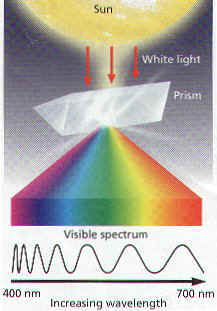
4.  Sunlight is visible as White, it is actually a variety of Different Colors.

5. You can separate White Light into its component colors by passing the light through a PRISM.

6. The resulting array of colors, ranging from red at one end to violet at the other is called the VISIBLE SPECTRUM.

7. Each Color of Light has different Wavelengths, and a Different Energy.

8.  When light strikes an object, its component colors can be Reflected, Transmitted, or Absorbed by an object.

9. An Object that ABSORBS ALL COLORS appears BLACK.

10.  A PIGMENT IS A MOLECULE THAT ABSORBS CERTAIN WAVELENGTHS OF LIGHT AND REFLECTS OR TRANSMITS OTHERS.

11. Objects or Organisms vary in Color because of their specific combination of Pigments.

12. WAVELENGTHS that are REFLECTED by Pigments are SEEN as the object’s COLOR.

CHLOROPLASTS PIGMENTS

1. Located in the Membrane of the Thylakoids are a variety of Pigments.

2. CHLOROPHYLLS ARE THE MOST COMMON AND IMPORTANT PIGMENTS IN PLANTS AND ALGAE.

3. The TWO most common Types of Chlorophylls are designated Chlorophyll a and Chlorophyll b.

4. A Slight difference in molecular structure between Chlorophyll a and Chlorophyll b causes the Two molecules to Absorb different colors of light.

5. Chlorophyll’s ABSORB VIOLET, BLUE AND RED LIGHT.  These are the Wavelengths of Light that Photosynthesis Occurs. (Figure 6-4)

6 Chlorophyll a ABSORBS LESS BLUE Light but MORE RED Light than Chlorophyll b Absorbs.

7. ONLY Chlorophyll a is DIRECTLY INVOLVED in the LIGHT REACTIONS of Photosynthesis.  Chlorophyll b ASSISTS Chlorophyll a in Capturing Light Energy and is called an ACCESSORY PIGMENT.

8. By Absorbing colors Chlorophyll a CANNOT Absorb, the Accessory Pigments enable Plants to Capture MORE of the Energy in Light

9. Chlorophylls REFLECT and TRANSMIT GREEN LIGHT, causing Plants to appear GREEN.

10. Another group of Accessory Pigments found in the Thylakoid Membranes, called the CAROTENOIDS,  INCLUDES YELLOW, RED, AND ORANGE PIGMENTS THAT COLOR CARROTS, BANANAS, SQUASH, FLOWERS AND AUTUMN LEAVES.

11. The Carotenoids in Green Leaves are usually masked by Chlorophylls until Autumn when Chlorophylls break down.

OVERVIEW OF PHOTOSYNTHESIS

“THE BIG PICTURE”

1. Photosynthesis is the process that provides energy for almost all Life.

2. During Photosynthesis, Autotrophs use the Sun’s Energy to make Carbohydrate Molecules from Water and Carbon Dioxide, Releasing Oxygen as a Byproduct.

3.  The Process of PHOTOSYNTHESIS CAN BE SUMMARIZED BY THE FOLLOWING EQUATION:

6CO2       +              6H2O          +      LIGHT    C6H12O2          +              6O2
CARBON               WATER               ENERGY                 6-CARBON                 OXYGEN
DIOXIDE                                                                                 SUGAR                         GAS
4. In this equation the Six-Carbon Sugar GLUCOSE and Oxygen are the Products.

5. The Energy Stored in Glucose and other Carbohydrates can be used later to produce ATP during Cellular Respiration.

6. The Process of Photosynthesis does NOT Happen all at Once; rather it occurs in  THREE STAGES:

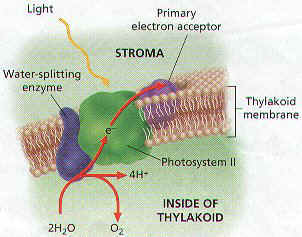
STAGE 1 – CALLED THE LIGHT DEPENDENT REACTIONS. Energy is Capture from Sunlight.  Water is Split into Hydrogen Ions, Electrons, and Oxygen (O2).  The O2 Diffuses out of the Chloroplasts (Byproduct).

STAGE 2 – The Light Energy is Converted to Chemical Energy, which is Temporarily Stored in ATP and NADPH.

STAGE 3 – CALLED THE CALVIN CYCLE. The Chemical Energy Stored in ATP and NADPH powers the formation of Organic Compounds (Sugars), Using Carbon Dioxide, CO2.

7. Photosynthesis occurs in the Chloroplasts of Plant Cells and Algae and in the Cell Membranes of certain Bacteria.
ELECTRON TRANSPORT – LIGHT REACTIONS

1. The Chlorophylls and Carotenoids are grouped in Cluster of a Few Hundred Pigment Molecules in the Thylakoid Membranes.

2. Each Cluster of Pigment Molecules is referred to as a PHOTOSYSTEM.  There are Two Types of Photosystems known as PHOTOSYSTEM I AND PHOTOSYSTEM II.

3. Photosystem I and Photosystem II are similar in terms of pigments, but they have Different Roles in the Light reactions.

4. The Light Reactions BEGIN when Accessory Pigment molecules of BOTH Photosystems Absorb Light.

5. By Absorbing Light, those Molecules Acquire some of the Energy that was carried by the Light Waves.

6. In each Photosystem, the Acquired Energy is Passed to other Pigment Molecules until it reaches a Specific Pair of CHLOROPHYLL a Molecules.

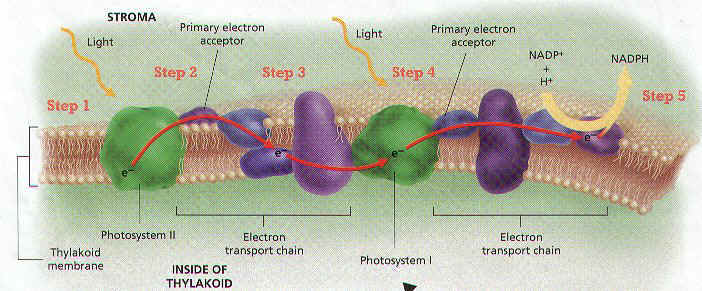
7. The Events occur from this point on can be Divided into 5 STEPS. (Refer to Figure 6-5)

STEP 1 – Light Energy Forces Electrons to enter a Higher Energy Level in the TWO Chlorophyll a Molecules of Photosystem II.  These Energized Electrons are said to be “EXCITED”.

STEP 2 – The Excited Electrons have enough Energy to Leave Chlorophyll a Molecules.  Because they have lost Electrons, the Chlorophyll a Molecules have undergone an OXIDATION REACTION (lost of Electrons).  Each Oxidation Reaction must be accompanied by a REDUCTION REACTION (some substance must Accept the Electrons).  The Substance is a Molecule in the Thylakoid Membrane Known as a PRIMARY ELECTRON ACCEPTOR.

STEP 3 – The Primary Electron Acceptor then Donates (gives) the Electrons to the First of a Series of Molecules located in the Thylakoid.  This Series of Molecules is called an ELECTRON TRANSPORT CHAIN, because it Transfers Electrons from One Molecule to the Next in Series.  As the Electrons are pass from molecule to molecule, they LOSE most of the Energy they acquired when they were Excited.  The Energy they LOSE is Harnessed to Move Protons into the Thylakoid.

STEP 4 –  At the same time Light is Absorbed by Photosystem II, Light is also Absorbed by Photosystem I.  Electrons move from a Pair of Chlorophyll a Molecules in Photosystem I to another Primary electron Acceptor.  The electrons that are LOST by these Chlorophyll a Molecules are REPLACED by the Electrons that have passed through the electron Transport Chain from Photosystem II.

STEP 5 – The Primary Electron Acceptor of Photosystem I donates Electrons to different Electron Transport Chain.  This Chain brings Electrons to the side of the Thylakoid Membrane that FACES THE STROMA.  There Electrons COMBINE with a PROTON and NADP+.  NADP+ is an Organic Molecule that ACCEPTS Electrons during REDOX Reactions.  This reaction causes NADP+ to be Reduced to NADPH.

RESTORING PHOTOSYSTEM II – PHOTOLYSIS

1. The Electrons from Chlorophyll Molecules on Photosystem II REPLACE the Electrons that Leave Chlorophyll Molecules in Photosystem I.
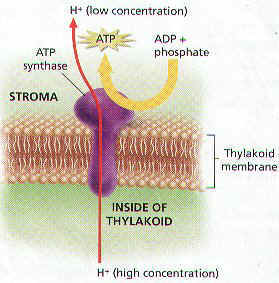
2. If the electrons were NOT Replaced, both Electron Transport Chains would STOP, and Photosynthesis would NOT Occur.

3. The Replacement Electrons are provided by WATER MOLECULES.  Enzymes (RuBP carboxylase or Rubisco) inside the Thylakoid SPLITS Water Molecules into PROTONS, ELECTRONS, AND OXYGEN.

2H2O   4H+   +   4e-   +  O2

4. For Every TWO Molecules of Water that are Split, FOUR Electrons become available to Replace those lost by Chlorophyll Molecules in Photosystem II.

5. The PROTONS that are produced are left inside the Thylakoid, while Oxygen Diffuses out of the Chloroplasts and can Leave The Plant.

6. OXYGEN can be regarded as a Byproduct of the Light Reaction – it is NOT Needed for Photosynthesis.

7. The Oxygen that results from Photosynthesis is ESSENTIAL for Cellular Respiration in most organisms, including Plants.

8. The photochemical splitting of water in the light-dependent reactions of photosynthesis, catalyzed by a specific enzyme is called Photolysis.

9. The enzyme that speeds up this reaction, called RuBP carboxylase (Rubisco), about 20-50% of the protein content in chloroplast, and it may be one of the most abundant proteins in the biosphere.

CHEMIOSMOSIS (KEM-ee-ahz-MOH-suhs)

1. An important part of the Light Reaction is the SYNTHESIS of ATP through a process called CHEMIOSMOSIS.
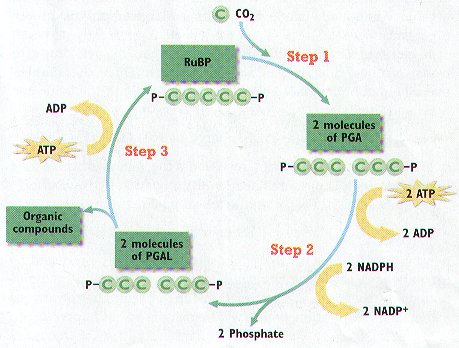
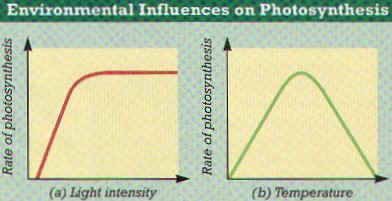
2. Chemiosmosis Relies on a CONCENTRATED GRADIENT of Protons Across the Thylakoid Membrane.

3. Protons are Produced from the Breakdown of Water Molecules, Other Protons are Pumped into the Thylakoid from the Stroma during Photosystem II.

4. Both these mechanisms act to build up a Concentration Gradient of Protons.  The Concentration of Protons is HIGHER in the Thylakoid than in the Stroma.

5. The Concentration Gradient Represents Potential Energy.  The energy is Harnessed by a Protein called ATP SYNTHASE, which is located in the Thylakoid Membrane.

6. ATP Synthase makes ATP by ADDING a PHOSPHATE GROUP to ADENOSINE DIPHOSPHATE, OR ADP.  By Catalyzing the Synthesis of ATP from ADP, ATP Synthase functions as an Enzyme.

7. ATP Synthase Converts Potential Energy of the Protons Concentrated Gradient into Chemical Energy of ATP.

8. Together, NADPH and ATP Provide Energy for the Second Set of Reactions in Photosynthesis.

SECTION 6-2  THE CALVIN CYCLE

The Second Set of reactions in photosynthesis involves a biochemical pathway known as the CALVIN CYCLE.  This pathway produces Organic Compounds, using the energy stored in ATP and NADPH during the Light Reactions.  The Calvin Cycle is named after Melvin Calvin (1911-1997), the American scientist who worked out the details of the pathway.

OBJECTIVES:  Summarized the main events of the Calvin Cycle.  Describe what happens to the compounds made in the Calvin Cycle.  Distinguish between C3, C4, and CAM Plants.  Explain how environmental factors influence photosynthesis.

CARBON FIXATION BY THE CALVIN SYSTEM

1. In the Calvin Cycle, Carbon Atoms From CO2 are Bonded, or “FIXED”, into Organic Compounds.

2. The incorporation of CO2 into Organic Compounds is referred to as CARBON FIXATION.

3. The Calvin Cycle has THREE Major Steps, Which OCCUR within the STROMA of the Chloroplasts.  (Figure 6-8)

STEP 1  –  CO2 Diffuses into the Stroma from the surrounding Cytosol.  An Enzyme combines a CO2 Molecule with a FIVE CARBON CARBOHYDRATE CALLED RuBP (ribulose bisphosphate).  The PRODUCT is a Six-Carbon Molecule that Splits into a Pair of Three-Carbon Molecules known as PGA (3-phosphoglycerate).

STEP 2 – PGA is Converted into another Three-Carbon Molecule, PGAL, in a Two Part Process:

A. Each PGA Molecule Receives a Phosphate Group from a molecule of ATP – forming ADP

B. The resulting compound then Receives a Proton from NADPH (forming NADP+) and Releases a Phosphate Group, Producing PGAL.

In addition to PGAL, these Reactions produce ADP, NADP+, and Phosphate.  These Three Products can be used again in the Light Reactions to Synthesis additional Molecules of ATP and NADPH.

STEP 3 – Most of the PGAL is Converted back into RuBP in a series of reaction to Return to Step 1 and allow the Calvin Cycle to Continue.  However, SOME PGAL Molecules LEAVE the Calvin Cycle and can be used by the Plant Cell to Make other Organic Compounds.

THE BALANCE SHEET FOR PHOTOSYNTHESIS

1. Each Turn of the Calvin Cycle Fixes One CO2 Molecule.  Since PGAL is a Three-Carbon Compound, it takes Three Turns of the Cycle to Produce each Molecule of PGAL.

2. For Each Turn of the Cycle TWO ATP, and TWO NADPH Molecules are used in Step 2, and ONE ATP Molecule used in Step 3.

3. THREE Turns of the Calvin Cycle uses NINE Molecules of ATP and SIX Molecules of NADPH.

4. The Simplest OVERALL Equation for Photosynthesis, including both Light Reactions and the Calvin Cycle, can be written as:

6CO2  +  6H20  +  LIGHT ENERGY   C6H12O6  +  6O2

ALTERNATIVE PATHWAYS

1. The Calvin Cycle is the MOST Common Pathway for Carbon Fixation.  Plant Species that fix Carbon EXCLUSIVELY through the Calvin Cycle are known as C3 PLANTS.

2. Other Plant Species Fix Carbon through alternative Pathways and then Release it to enter the Calvin Cycle.

3. These alternative pathways are generally found in plants that evolved in HOT, DRY Climates.

4. Under such conditions, plants can rapidly lose water to the air.  Most of the water loss from plants occurs through Small Pores on the Undersurface of the Leaves called STOMATA. Plants obtain carbon dioxide for photosynthesis from the air. Plants must balance their neeed to open their Stomata to receive carbon dioxide and release oxygen with their need to close their Stomata to prevent water loss. A stoma is bordered by TWO Kidney Shaped GUARD CELLS, Guard Cells are modified cells that Regulate Gas and Water Exchange.

5. Stomata are the major passageway through which CO2 Enters and O2 Leaves a Plant.

6. When a plant’s Stomata are partly CLOSED, the level of CO2 FALLS (Used in Calvin Cycle), and the Level of O2 RISES (as Light reactions Split Water Molecules).

7. A LOW CO2 and HIGH O2 Level inhibits Carbon Fixing by the Calvin Cycle.  Plants with alternative pathways of Carbon fixing have Evolved ways to deal with this problem.

8. C4 PLANTS – Allows certain plants to fix CO2 into FOUR-Carbon Compounds.  During the Hottest part of the day, C4 plants have their Stomata Partially Closed.  C4 plants include corn, sugar cane and crabgrass.  Such plants Lose only about Half as much Water as C3 plants when producing the same amount of Carbohydrate.

9. THE CAM PATHWAY – Cactus, pineapples have different adaptations to Hot, Dry Climates.  They Fix Carbon through a pathway called CAM.  Plants that use the CAM Pathway Open their Stomata at NIGHT and Close during the DAY, the opposite of what other plants do.  At NIGHT, CAM Plants take in CO2 and fix into Organic Compounds.  During the DAY, CO2 is released from these Compounds and enters the Calvin Cycle.  Because CAM Plants have their Stomata open at night, they grow very Slowly, But they lose LESS Water than C3 or C4 Plants.

RATE OF PHOTOSYNTHESIS

1. The Rate at which a plant can carry out photosynthesis is affected by the PLANT’S ENVIRONMENT.

2. THREE THINGS IN THE PLANT’S ENVIRONMENT AFFECT THE RATE OF PHOTOSYNTHESIS:  LIGHT INTENSITY,  CO2 LEVELS, AND TEMPERATURE. (Figure 6-10)

3. LIGHT INTENSITY – One of the most Important, As Light Intensity INCREASES, the Rate of Photosynthesis Initially INCREASES and then Levels Off to a Plateau.

4. CO2 LEVELS AROUND THE PLANT – Increasing the level of CO2 Stimulates Photosynthesis until the rate reaches a Plateau.

5. TEMPERATURE – RAISING the Temperature ACCELERATES the Chemical Reactions involved in Photosynthesis.  The rate of Photosynthesis Increase as Temperature Increases.  The rate of Photosynthesis generally PEAKS at a certain Temperature, and Photosynthesis begins to Decrease when the Temperature is further Increased. (Figure 6-10b)


Moss & Fern

Mosses & Ferns
fern gametophyte
Kingdom Plantae
All Materials © Cmassengale   

Seedless Nonvascular Plants

  • Includes mosses, liverworts, and hornworts
  • Lack vascular tissue (xylem & phloem) to carry water & food
  • Have a Sporophyte & Gametophyte stage known as alternation of generations
  • Gametophyte is dominant stage
  • Reproduce by spores

Division  Bryophyta

 Mosses:

  • Small, nonvascular land plants
  • No true roots, stems, or leaves
  • Class Musci
  • Most common bryophyte
  • Grow on moist areas (brick walls, as thick mats on forest floors, and on the shaded side of trees)
  • Some can survive periodic dry spells & revive when H2O becomes available
  • Must grow close together and must have H2O to complete their life cycle 
  • Sperm swims to egg through drops of water during fertilization
  • H2O moves cell-to-cell by osmosis
  • Sphagnum moss is known for its moisture holding capacity, absorbing up to 20 times its dry weight with water.


MOSS SPOROPHYTES & FERN GAMETOPHYTES

LIFE CYCLE OF MOSSES:

  • Mosses alternate between a haploid (n) gametophyte stage & a diploid (2n) sporophyte stage 
  • Gametophyte is the dominant generation


Moss Gametophyte Moss Sporophyte
Polytrichum formosum with moss flowers Tortula muralis?


  • Called alternation of generations

  • The haploid gametophyte stage contains half the chromosome number & produces gametes (egg & sperm) 
  • Gametophyte stage is dominant in the moss’s life cycle
  • Gametophytes are photosynthetic & have root-like rhizoids
  • The diploid sporophyte has a complete set of chromosomes & produces spores by meiosis
  • Sporophyte of a moss is smaller than, & attached to the Gametophyte
  • Sporophytes lack chlorophyll & depend on the photosynthetic gametophyte for food
  • Sporophyte has a long, slender stalk topped with a capsule
  • Capsule forms haploid (n) spores 


Moss Capsules

Sexual Reproduction in Moss:

  • Mosses produce 2 kinds of gametes (egg & sperm)
  • Gametes of Bryophytes are surrounded by a jacket of sterile cells that keep the cells from drying out
  • Female gametes or eggs are larger with more cytoplasm & are immobile
  • Flagellated sperm must swim to the egg through water droplets for fertilization
  • Moss gametes form in separate reproductive structures on the Gametophyte — Archegonium & Antheridium


Archegonium Antheridium
moss archegonial head X 40.jpg (102370 bytes) Mnium antheridial head 40X.jpg (660893 bytes)


  • Each Archegonium forms one egg, but each Antheridium forms many sperm
  • Fertilization can occur only after rain when the Gametophyte is covered with water
  • Sperms swim to the egg by following a chemical trail released by the egg 
  • A zygote (fertilized egg) forms that undergoes mitosis and becomes a Sporophyte
  • Cells inside mature Sporophyte capsule undergoes meiosis and form haploid spores
  • Haploid spores germinate into juvenile plants called protonema
  • Protonema begin the Gametophyte generation

Protonema of Funaria hygrometrica
Protonema

  • Spores are carried by wind & sprout on moist soil forming a new Gametophyte

Asexual reproduction in Mosses:

  • Asexual reproduction in moss may occur by fragmentation or gemmae
  • Pieces of a Gametophyte can break off & form new moss plants (fragmentation)
  • Gemmae are tiny, cup shaped structures on the Gametophytes 
  • Raindrops separate gemmae from the parent plant so they can spread & form new Gametophytes


Gemmae cups


Uses for Moss:

  • Help decomposer dead logs
  • Serve as pioneer plants on bare rock or ground
  • Help prevent erosion
  • Provide shelter for insects & small animals
  • Used as nesting materials by birds & mammals
  • Sphagnum or peat moss forms peat bogs (wet ecosystem)
  • Peat is burned as fuel in some areas

Division  Hepatophyta  

Liverworts:

  • Nonvascular
  • Undergo alternation of generations with Sporophyte attached to Gametophyte
  • Gametophytes are green & leafy and the dominant generation


Liverwort

  • Need abundant water for fertilization
  • Reproduce by spores
  • Grow on moist rocks or soil
  • Reproduce asexually by gemmae and by growing new branches

Division  Anthocerophyta

Hornworts:

  • Small, nonvascular bryophytes
  • Gametophyte leafy like liverworts
  • Archegonia & antheridia form inside the plant
  • After fertilization, zygotes develop into long, horn-shaped Sporophytes
  • Horn-shaped Sporophytes capable of photosynthesis so not completely dependent on Gametophyte


Hornwort

Seedless Vascular Plants

  • Includes club mosses, whisk ferns, horsetails, & ferns
  • Have specialized vascular tissues (xylem & phloem) to transport H2O, food, etc.
  • Have a Sporophyte & Gametophyte stage known as alternation of generations
  • Sporophyte is the dominant stage
  • Reproduce by spores

Division  Psilophyta

Whisk Ferns:

  • Photosynthetic, aerial stem forks repeatedly to form a small twiggy bush
  • No true roots, stems, or leaves
  • Have horizontal, underground stems called rhizomes
  • Root-like structures called rhizoids anchor plant
  • Reproduce by spores & vegetatively from rhizomes
  • Only 2 living genera


Whisk Fern

Division  Lycophyta

Club Mosses:

  • Low growing plants resembling pine trees
  • Have a club-shaped spore producing structure


Club Moss

  • Some like Lycopodium contain chemicals that burn quickly
  • Resurrection moss is green (after rains) when moist and brown when dry.


Resurrection Plant
resurrection plant


Division  Sphenophyta

Horsetails:

  • Equisetum called scouring rush is the only living species
  • Photosynthetic aerial stems & underground rhizomes
  • Stems contain silica & were once used to scrub pots
  • Reproduce by means of spores made in small cones at the tip of branches
  • In prehistoric times, some plants of this family grew to be large trees
  • Found in wetlands


Horsetail

Division  Pterophyta

Fern Gametophyte:

  • Largest group of living seedless vascular plants
  • Live in moist habitats
  • Alternates between dominant Sporophyte stage & Gametophyte stage
  • Sporophyte stage has true roots, stems, & leaves
  • Produce spores on the underside of leaves 

fern sporangia.jpg (47544 bytes)

  • Leaves are called fronds & are attached by a stem-like petiole


FERNS

Fern Life Cycle:

  • Spores produced on underside of fronds in clusters of sporangia called sori
  • Spores undergo meiosis, are spread by wind, & germinate on moist soil to form prothallus
  • Prothallus begins the Gametophyte stage
  • Mature Gametophytes are small, heart-shaped structures that live only a short time
  • Male antheridia & female archegonia grow on the prothalli
  • Sperm must swim to the egg to fertilize it & developing embryo becomes the Sporophyte generation
  • Newly forming fronds are called fiddleheads & uncurl

Uses for Ferns:

  • Prevent erosion
  • Fiddleheads serve as food
  • Ornamental plants
  • Formed coal million of years ago
BACK