Chapter 3 Biochemistry Studyguide

%CODE1%

Javascript not enabled

Name: 

Chapter 3 Biochemistry Study Guide


Modified True/False
Indicate whether the statement is true or false.  If false, change the identified word or phrase to make the statement true.
 1.
Atoms have a positive charge. _________________________


 2.
Electrons have very little mass. _________________________


 3.
Molecules are atoms that have gained or lost one or more electrons. _________________________


 4.
An atom with more electrons than protons has a positive charge. _________________________


 5.
A covalent bond forms between two atoms that share electrons to form a molecule. _________________________


 6.
Water molecules attract nonpolar molecules such as oil. _________________________


 7.
The ability of water to retain heat helps cells maintain a constant internal temperature. _________________________


 8.
The role of carbohydrates in cells is to supply energy. _________________________


 9.
RNA is made up of a double strand of nucleotides. _________________________


 10.
When cells break down food, the energy from the food is temporarily stored as ATP. _________________________


 11.
The amount of energy needed to cause a chemical reaction to start is called activation energy. _________________________


 12.
Without enzymes, chemical reactions necessary for life would not occur quickly or easily enough to sustain life. _________________________


 13.
When an enzyme binds with its substrate, the activation energy needed for the chemical reaction to occur is increased. _________________________


Multiple Choice
Identify the choice that best completes the statement or answers the question.
 14.
Atoms are not composed of
a.
protons.
c.
electrons.
b.
neutrons.
d.
chemical bonds
 15.
The electrons of an atom
a.
are found in the nucleus along with the protons.
b.
occupy the space surrounding the nucleus.
c.
have a positive charge.
d.
are attached to the positive charge of neutrons.
 16.
The smallest particle of matter that can retain the chemical properties of carbon is a carbon
a.
molecule.
c.
atom.
b.
macromolecule.
d.
element.
 17.
A substance that is composed of only one type of atom is called a(n)
a.
compound.
c.
element.
b.
cell.
d.
molecule.
 18.
All matter is composed of
a.
cells.
c.
atoms.
b.
molecules.
d.
carbon.
 19.
Covalent bonds form when
a.
two molecules of water share electrons.
b.
a molecule of water becomes an ion.
c.
two hydrogen atoms share electrons with one oxygen atom.
d.
two hydronium ions are attracted to each other.
 20.
Ionic bonds form between particles that have
a.
opposite charges.
c.
no charges.
b.
the same charge.
d.
neutral charges.
 21.
The bond formed when two atoms share a pair of electrons is called a(n)
a.
hydrogen bond.
c.
covalent bond.
b.
ionic bond.
d.
water bond.
 22.
Sharing of electrons in the outer energy levels of two atoms
a.
results in ion formation.
b.
makes both atoms stable.
c.
only occurs if both are atoms of the same element.
d.
is found only among carbon atoms.
 23.
A molecule that has a partial positive charge on one side and a partial negative charge on the other side is called a(n)
a.
nonpolar molecule.
c.
charged molecule.
b.
polar molecule.
d.
ion.
 24.
Nonpolar molecules have
a.
no negative or positive ends.
c.
only a negative end.
b.
both negative and positive ends.
d.
only a positive end.
 25.
When placed in the same container, oil and water do not mix because
a.
they are both polar.
c.
they are both nonpolar.
b.
water is polar and oil is nonpolar.
d.
water is nonpolar and oil is polar.
 26.
Attractions between water molecules are called
a.
covalent bonds.
c.
polar bonds.
b.
ionic bonds.
d.
hydrogen bonds.
 27.
Water is a polar molecule because
a.
it contains two hydrogen atoms for each oxygen atom.
b.
it has a charge.
c.
different parts of the molecule have slightly different charges.
d.
it does not have a charge.
 28.
Which is not a unique property of water?
a.
Frozen water floats.
b.
Water retains a large amount of heat.
c.
Water molecules stick to each other.
d.
Water cools rapidly.
 29.
Acidic solutions have a pH that is
a.
less than 7.
c.
a negative number.
b.
between 7 and 14.
d.
more than 7.
 30.
Hydronium ions, H+, react with hydroxide ions, OH-, to form
a.
water.
c.
a base.
b.
an acid.
d.
a buffer.
 31.
Which of the following is not a large biomolecule?
a.
carbohydrate
c.
lipid
b.
ice
d.
nucleic acid
 32.
The building blocks of most biomolecules contain the element
a.
carbon.
c.
calcium.
b.
nitrogen.
d.
sodium.
 33.
Which of the following molecules are classified as carbohydrates?
a.
amino acids
c.
nucleotides
b.
fats
d.
sugars
 34.
Polysaccharides are
a.
carbohydrates.
c.
proteins.
b.
lipids.
d.
nucleic acids.
nar001-1.jpg
nar001-2.jpg
Molecule A
Molecule B
 35.
Refer to the illustration above. Molecule A is a
a.
carbohydrate.
c.
nucleic acid.
b.
lipid.
d.
protein.
 36.
Plants store glucose in the form of
a.
starch.
c.
cellulose.
b.
glycogen.
d.
chitin.
 37.
Which of the following is a carbohydrate?
a.
ATP
c.
wax
b.
steroid
d.
sucrose
 38.
Lipids are
a.
soluble in water.
b.
made of chains of amino acids.
c.
linked together with peptide bonds.
d.
used by the body for storing energy.
 39.
All of the following are examples of lipids except
a.
oil.
c.
steroids.
b.
starch.
d.
candle wax.
 40.
Which molecules are most closely related to lipids?
a.
amino acids
b.
long chains of carbon and hydrogen
c.
nucleotides
d.
sugars
 41.
Which of the following molecules are most closely related to proteins?
a.
amino acids
c.
nucleotides
b.
monosaccharides
d.
sugars
 42.
Long chains of amino acids are found in
a.
carbohydrates.
c.
proteins.
b.
lipids.
d.
sugars.
 43.
The overall shape of a single chain of amino acids in a protein is that protein’s
a.
primary structure.
c.
tertiary structure.
b.
secondary structure.
d.
quaternary structure.
 44.
The amino group of one amino acid is linked to the carboxyl group of another amino acid in a protein. This link is a(n)
a.
peptide bond.
c.
ionic bond.
b.
hydrogen bond.
d.
polar bond.
 45.
What gives each amino acid its unique properties?
a.
its side group
c.
its carboxyl group
b.
its amino group
d.
its sequence
 46.
The two types of nucleic acids are
a.
RNA and ATP.
c.
DNA and ATP.
b.
DNA and RNA.
d.
nucleotides and ATP.
 47.
Which of the following molecules are most closely related to nucleic acids?
a.
amino acids
c.
nucleotides
b.
fats
d.
sugars
 48.
DNA stores
a.
fat.
c.
energy.
b.
carbohydrates.
d.
hereditary information.
 49.
The two strands of a DNA molecule are held together by
a.
ionic bonds.
c.
hydrogen bonds.
b.
covalent bonds.
d.
peptide bonds.
 50.
Which of the following is not part of a nucleotide in a DNA molecule?
a.
three phosphate groups
c.
a base
b.
a sugar
d.
a phosphate group
 51.
ATP (adenosine triphosphate) stores energy in the bonds between its
a.
hydrogen atoms.
c.
nucleotides.
b.
carbon atoms.
d.
phosphate groups.
 52.
When paper burns, the paper combines with oxygen to form carbon dioxide and water vapor. How does the mass of carbon dioxide plus water vapor compare with the mass of the paper plus oxygen?
a.
The mass of carbon dioxide plus water vapor is greater than that of paper plus oxygen.
b.
The mass of carbon dioxide plus water vapor is less than that of paper plus oxygen.
c.
It is impossible to tell.
d.
The mass of carbon dioxide plus water vapor is identical to that of paper plus oxygen.
 53.
The law of conservation of energy states that energy cannot be
a.
changed from one form to another.
b.
taken from the surroundings in a reaction.
c.
released into the surroundings in a reaction.
d.
created or destroyed in a chemical reaction.
 54.
A chemical reaction will probably occur between two substrate molecules if they
a.
are far apart.
b.
are aligned in the wrong spatial orientation.
c.
have large amounts of kinetic energy.
d.
have little kinetic energy.
 55.
Reducing activation energy
a.
is a violation of the laws of nature.
b.
requires higher temperatures than those found within cells.
c.
occurs only when reactants are quickly added to the reaction mixture.
d.
is accomplished by the action of enzymes on reactants.
nar002-1.jpg
 56.
Refer to the illustration above. Which of the following statements regarding the graph is true?
a.
Reaction 2 occurs faster than Reaction 3 because Reaction 2 requires more energy than Reaction 3.
b.
The difference between the graphs shown for Reaction 2 and Reaction 3 occurs because of a difference in the activation energy of these reactions.
c.
Reactant A contains more energy at the beginning of the reaction than product C has at the end of the reaction.
d.
Product B contains more energy at the end of the reaction than reactant A has at the beginning of the reaction.
 57.
Refer to the illustration above. Reaction 3 in the graph
a.
probably occurred in the presence of an enzyme.
b.
requires more activation energy than Reaction 2.
c.
is the same as Reaction 1, but faster.
d.
is slower than Reaction 2.
 58.
The molecule on which an enzyme acts is called a(n)
a.
active site.
c.
polar molecule.
b.
inactive site.
d.
substrate.
 59.
An enzyme
a.
is used up in a reaction.
b.
raises the activation energy of a reaction.
c.
bonds with an active site on a substrate molecule.
d.
lowers the activation energy of a reaction.
 60.
Enzymes
a.
are able to heat up molecules so that they can react.
b.
always provide carbon dioxide for chemical reactions.
c.
hold substrate molecules in the correct alignment.
d.
absorb excess heat so that reactions occur at low temperatures.
 61.
A cell contains
a.
thousands of different kinds of enzymes, each assisting in a different chemical reaction.
b.
one kind of enzyme that assists in thousands of different chemical reactions.
c.
approximately 100 kinds of enzymes, each assisting in a different chemical reaction.
d.
one enzyme that assists in reactions involving protein substrates and one enzyme that assists in reactions involving substrates that are not proteins.
 

Completion
Complete each statement.
 62.
The negatively charged particles in an atom are ____________________.

 63.
Protons and neutrons are found in the ____________________ of an atom.

 64.
A(n) ____________________ is a group of atoms held together by covalent bonds.

 65.
Sodium chloride, NaCl, is an example of a(n) _________________.

 66.
A(n) ____________________ bond forms between two atoms sharing electrons.

 67.
The attraction between oppositely charged ions results in the formation of a(n) ____________________.

 68.
Weak chemical attractions between polar molecules are ____________________ bonds.

 69.
Lipids are ____________________ molecules because they have no negative and positive poles.

 70.
Water heats and cools ____________________.

 71.
The attraction that causes water and other liquids to form drops and thin films is ____________________.

 72.
The medium in which most cellular events take place is ____________________.

 73.
Substances with a pH less than 7 are ____________________.

 74.
Substances with a pH greater than 7 are ____________________.

 75.
The pH scale measures the concentration of ____________________ ions in solutions.

 76.
A carbon atom can bond with four other atoms because it has ____________________ valence electrons.

 77.
A(n) ____________________ contains carbon, hydrogen, and oxygen in a ratio of 1:2:1.

 78.
Amino acids are the building blocks of __________________.

 79.
Most proteins consist of two or more ________________ that twist and fold around each other.

 80.
Long chains of nucleotides are called ____________________.

 81.
The ability to move or change matter is ____________________.

 82.
All living things require a source of ____________________ to carry out their life activities.

 83.
The starting materials for chemical reactions are called ____________________, while the new substances that are formed are called ____________________.

 84.
The energy needed to start a chemical reaction is called ____________________.

 85.
A biochemical reaction can be speeded up by adding a(n) ____________________, which lowers the amount of activation energy required to start the reaction.

 86.
The portion of an enzyme molecule into which a specific substrate can fit is called the ____________________.


Short Answer
 87.
How many different kinds of atoms are there in an element?

 88.
How does an atom become an ion?

 89.
An ionic bond forms between what two kinds of particles?

 90.
What makes a water molecule polar?

 91.
How well do nonpolar molecules dissolve in water?

 92.
What is an attraction between particles of different substances called?

 93.
What are the two most common elements found in large biomolecules?

 94.
What is the function of lipids in cells?

 95.
What determines the primary structure of a protein?

 96.
Where do your cells get most of the energy they need for metabolism?

 97.
How do enzymes speed up a chemical reaction?


Problem
 98.

The following statements are about the molecule ATP (adenosine triphosphate). For each statement, first determine whether it is true or false. Then, if it is false, rewrite the statement so that it is correct.

a. ATP is chemically similar to a carbohydrate.
b. Cells require ATP to function.
c. None of the energy in food molecules is stored in ATP.
d. ATP is the primary source of energy for chemical reactions occurring in all cells of all living organisms.

nar003-1.jpg
 99.

Refer to the illustration above. The graph depicts the relative energy levels of the products and reactants for the following chemical reaction: A + B « C + D.

a. Which substances, A, B, C, and/or D, are present at point 1 on the graph?
b. Which substances, A, B, C, and/or D, are present at point 3 on the graph?
c. Why is point 2 at a higher energy level than point 1?
d. Why is point 3 at a lower energy level than point 1?
e. Draw a dashed line on the graph indicating how the energy level of this reaction over time would be different if the enzyme that catalyzes the reaction were not present.

Enzymes catalyze a variety of biological reactions. The extent to which they can speed up the rate of a reaction is dependent on a number of factors. Draw a graph for the following condition(s), showing the effect of altering one factor on the relative rate of a reaction. Use “0” to indicate no activity, and “1” through “10” to indicate increasing rate of reaction from very low to very high. Include a label for your graph(s).
 100.
Refer to the paragraph above, and then draw your graph in the space below. Enzyme #1 is inactive between 0°C and 10°C. It is active above 10°C, with the rate increasing steadily until the temperature reaches 40°C. At 40°C, the rate of the reaction is very high. Above 40°C, the rate decreases steadily until the temperature reaches 60°C, at which point the enzyme is no longer active.

 101.
Refer to the paragraph above, and draw your graph. Enzyme #2 is inactive at a pH of 1–4. It is active above a pH of 4, with the rate increasing slowly until the pH reaches 6. Above a pH of 6, the rate increases sharply until the pH reaches 7. Above a pH of 7, the rate decreases sharply until the pH reaches 8. Above a pH of 8, the rate decreases gradually until the pH reaches 10, at which point the enzyme is no longer active.

 102.
Refer to the paragraph above, and draw your graph. Enzyme #3 is inactive when the concentration of the substrate it acts upon is zero. The enzyme is active when the substrate concentration is above zero, with the rate increasing only very slightly until the concentration reaches 30%. Above 30%, the rate increases very sharply to a high level, until the concentration reaches 60%. Above a concentration of 60%, the rate increases very little. The rate does not increase when the substrate concentration is above 80%.


Essay
 103.
Describe how an enzyme can function in speeding up a chemical reaction within a cell.


Check Your Work     Start Over

Biochemistry PCC

%CODE1%

Javascript not enabled

Name: 


Biochemistry PCC


Multiple Choice
Identify the choice that best completes the statement or answers the question.
 1.
At what temperature is water most dense?
a.
0 degrees Celsius
b.
1 degrees Celsius
c.
4 degrees Celsius
d.
10 degrees Celsius
e.
100 degrees Celsius
 2.
Which property of water enables living things to survive in it?
a.
high heat of vaporization
b.
high specific heat
c.
degree of surface tension
d.
cohesion
e.
density of ice
 3.
Which characteristic of water makes the existence of pH possible?
a.
ionization
b.
polarity
c.
adhesion
d.
cohesion
e.
None of the above.
 4.
Which of the following types of biologist would need an understanding of chemistry?
a.
molecular biologist
b.
ecologist
c.
evolutionary biologist
d.
botanist
e.
All of the above.
 5.
All of the following are inorganic compounds except:
a.
glucose.
b.
hydrochloric acid.
c.
sodium chloride.
d.
sodium hydroxide.
e.
water.
 6.
An element is defined as a substance that:
a.
is composed of more than one kind of atom.
b.
is held together by covalent bonds.
c.
cannot be broken into simpler substances by chemical reactions.
d.
cannot burn.
e.
is soluble in both acid and water.
 7.
Which of the following determines the type of element?
a.
the number of electrons
b.
the number of protons
c.
the number of neutrons
d.
the number of valence electrons
e.
the number of energy levels
 8.
Which of the following elements is not responsible for a significant portion of the mass of living organisms?
a.
O
b.
S
c.
N
d.
H
e.
C
 9.
An element found in minute quantities in living organisms is called:
a.
a heavy element.
b.
a vitamin.
c.
an organic compound.
d.
an isotope.
e.
a trace element.
 10.
Select the incorrectly matched pair:
a.
The 1st principal energy level contains 1 orbital.
b.
The 2nd principal energy level contains 4 orbitals.
c.
The 1st principal energy level contains a maximum of 2 electrons.
d.
The 2nd energy level contains a maximum of 10 electrons.
e.
All of the above are correctly matched.
 11.
Chlorine has seven electrons in its valence shell. The number of electrons it must gain to complete its valence shell is:
a.
one.
b.
two.
c.
three.
d.
seven.
e.
eight.
 12.
An atom has six protons and eight neutrons. Its atomic mass is ____________ atomic mass units.
a.
two
b.
four
c.
six
d.
eight
e.
fourteen
 13.
This determines the chemical properties of an element:
a.
the atomic number.
b.
the atomic weight.
c.
the number of energy levels.
d.
the number of valence electrons.
e.
orbitals.
 14.
The difference between an electrically neutral atom and an ion is that:
a.
an ion has an unequal number of protons and electrons, while an atom has an equal number.
b.
an ion has an equal number of protons and electrons, while an atom has an unequal number.
c.
an atom has an unequal number of neutrons and protons, while an ion has an equal number.
d.
an atom has its electrons in orbitals, while an ion has its electrons in its nucleus.
e.
an atom must have an equal number of neutrons and electrons, while an ion does not.
 15.
The difference between a stable isotope and a radioisotope is that:
a.
the stable isotope emits radiation.
b.
the radioisotope emits radiation.
c.
the stable isotope emits light.
d.
the stable isotope absorbs radiation.
e.
the radioisotope has an unequal number of protons and electrons.
Figure 02-01
Use the figure below to answer the corresponding questions.nar001-1.jpg

 16.
Figure 02-01 represents:
a.
two isotopes of the same element.
b.
two different elements.
c.
two different ions.
d.
an acid and a base.
e.
a cation and an anion.
 17.
The atomic mass of the atom identified as A in Figure 02-01 is:
a.
2.
b.
6.
c.
8.
d.
12.
e.
18.
 18.
The difference between the two atoms in Figure 02-01 is:
a.
pH.
b.
the number of electrons.
c.
the number of protons.
d.
the number of neutrons.
e.
electric charge.
 19.
Radioisotopes are used in all of the following scientific applications except:
a.
dating fossils.
b.
determining the sequence of genetic information in DNA.
c.
localization of a drug, such as marijuana.
d.
the treatment of cancer.
e.
monitoring changes in the salinity of an estuary.
 20.
Isotopes differ from each other with respect to the number of:
a.
protons.
b.
electrons.
c.
neutrons.
d.
protons and electrons.
e.
neutrons and protons.
 21.
When a chemical reaction is at equilibrium:
a.
the forward reaction is going faster.
b.
the reverse reaction is going faster.
c.
the forward and reverse reactions are proceeding at equal rates.
d.
the forward reaction stops.
e.
the reverse reaction stops.
 22.
Any chemical interaction between atoms:
a.
involves neutrons.
b.
may potentially involve any electron.
c.
involves protons.
d.
involves only valence electrons.
e.
involves only the nuclear subatomic particles.
 23.
The molecular mass of C6H12O6 is 180 amu. 0.25 moles of this substance contain:
a.
180 daltons.
b.
45 g.
c.
1.8 g.
d.
45 daltons.
e.
180 g.
 24.
How many molecules are present in one mole of C6H12O6?
a.
1.7 ´ 10-10 molecules
b.
1.3 ´ 1010 molecules
c.
5 molecules
d.
1.7 ´ 1022 molecules
e.
6.02 ´ 1023 molecules
Figure 02-02
Use the figure below to answer the corresponding questions.nar002-1.jpg

 25.
Figure 02-02 represents:
a.
elemental helium.
b.
molecular hydrogen.
c.
molecular helium.
d.
a water molecule.
e.
molecular oxygen.
 26.
The type of bond illustrated in Figure 02-02 is:
a.
an ionic bond.
b.
a polar bond.
c.
a single covalent bond.
d.
a hydrogen bond.
e.
a double covalent bond.
 27.
Select the covalent bond that involves 2 electrons:
a.
single
b.
double
c.
triple
d.
Both A and B.
e.
Both A and C.
 28.
The representation H – O – H is known as:
a.
a structural formula.
b.
a simplest formula.
c.
a molecular formula.
d.
a Lewis structure.
e.
an orbital diagram.
 29.
Which of the following choices correctly identifies a reactant in the following chemical equation? CO2 + H2O « H2CO3
a.
carbonic acid
b.
oxygen
c.
water
d.
sugar
e.
carbon monoxide
 30.
In a chemical reaction, the product is:
a.
generally written on the right side of the equation.
b.
always in equilibrium with the reactants.
c.
the substance that is generated by the reaction.
d.
only joined by an ionic bond.
e.
Both A and C.
 31.
A covalent bond:
a.
can form only between identical atoms.
b.
involves a sharing of only one pair of electrons.
c.
is always polar.
d.
may be polar or nonpolar depending on the atoms involved.
e.
always forms between identical molecules.
 32.
In a water molecule, because oxygen is more electronegative than hydrogen, the shared electrons are more commonly found around the ____________ nucleus than the ____________ nucleus.
a.
oxygen; hydrogen
b.
hydrogen; oxygen
c.
hydrogen; other hydrogen
d.
oxygen; nitrogen
e.
nitrogen; oxygen
 33.
The covalent bond between a hydrogen atom and the oxygen atom in water is formed when:
a.
hydrogen gains an electron from oxygen.
b.
hydrogen and oxygen share an electron pair.
c.
hydrogen and oxygen both lose electrons from their outer shells.
d.
hydrogen and oxygen both gain electrons in their outer shells.
e.
hydrogen gains an electron from oxygen.
 34.
Covalently bonded atoms with similar electronic negativities are:
a.
ionic.
b.
polar.
c.
nonpolar.
d.
partially positive.
e.
partially negative.
 35.
An atom becomes a cation if:
a.
it gains one or more electron.
b.
it loses one or more electron.
c.
it shares electrons.
d.
one or more of its electrons changes energy levels.
e.
it emits radiation.
 36.
In the formation of common table salt, sodium and chlorine interact because:
a.
sodium and chlorine share a pair of electrons.
b.
sodium and chlorine share two pairs of electrons.
c.
chlorine donates seven electrons to sodium.
d.
there is no electron exchange.
e.
sodium donates one electron to chlorine.
 37.
Table salt dissolves easily in water because:
a.
water can form covalent linkages with salt molecules.
b.
water can remove electrons from the chloride ion, which causes the latter to dissociate from the sodium and dissolve.
c.
water can add electrons to the sodium ion.
d.
water is polar and salt is nonpolar. Nonpolar compounds are more soluble in polar solvents because they are able to form strong covalent bonds that result in a breaking up of the molecule being dissolved.
e.
the partial positive charge of the hydrogens in the water molecule can associate with the negative charge of the chloride ion, and the partial negative charge of the oxygen of the water molecule can associate with the positive charge of the sodium atom.
 38.
Which one of the following atoms would most likely be involved in an ionic bond?
a.
hydrogen
b.
oxygen
c.
sodium
d.
Both A and B.
e.
Both A and C.
 39.
The process whereby water molecules surround ions during the process of dissolving is called:
a.
reduction.
b.
hydration.
c.
buffering.
d.
oxidation.
e.
vaporization.
 40.
Which component becomes oxidized in the following chemical reaction?
4 Fe + 3 O2 ® 2 Fe2O3
a.
water
b.
iron
c.
oxygen
d.
rust
e.
hydrogen
 41.
Which component is the oxidizing agent in the following chemical reaction?
4 Fe + 3 O2 ® 2 Fe2O3
a.
water
b.
iron
c.
oxygen
d.
rust
e.
hydrogen
 42.
Which of the following statements is not correct?
a.
Water heats up and cools down very quickly.
b.
The amount of heat required to raise the temperature of 1 g of water 1 °C is one calorie.
c.
Due to hydrogen bonds, water has a high surface tension.
d.
Large bodies of water have relatively constant temperatures.
e.
When one gram of water evaporates, it removes heat.
 43.
It takes one calorie of heat to raise the temperature of one gram of water one degree Celsius at sea level. This is referred to as the _______________________ of water.
a.
heat of fusion
b.
heat of vaporization
c.
specific heat
d.
heat of transformation
e.
heat of homeostasis
 44.

Which characteristic of water molecules directly contributes to the remarkable “water walking” success of the aquatic insects pictured in the accompanying figure?

mc044-1.jpg

a.
hydrogen bonds
b.
capillary action
c.
nonpolar covalent bonds
d.
ionic bonds
e.
adhesive forces
 45.
The cohesiveness between water molecules is due largely to:
a.
hydrogen bonds.
b.
polar covalent bonds.
c.
nonpolar covalent bonds.
d.
ionic bonds.
e.
hydrophobic interactions.
 46.
A stalk of celery is placed in a solution of blue colored dye. After one hour, the leaves have blue fluid in their veins. Which property of water is being demonstrated?
a.
adhesion and cohesion
b.
evaporation and cooling
c.
lower density as a solid than as a liquid
d.
high specific heat
e.
surface tension
 47.
Evaporative cooling is a process whereby ____________ moving ____________ molecules vaporize, thus ____________ large amounts of heat.
a.
slow; water; adding
b.
fast; water; removing
c.
slow; oxygen; adding
d.
fast; oxygen; removing
e.
fast; carbon dioxide; removing
 48.
In a mixture, which one would be present in the least amount?
a.
solvent
b.
solute
c.
water
d.
Both A and B.
e.
Both A and C.
 49.
This characteristic of a molecule determines the ability of hydrogen bonds to form between it and hydrogen:
a.
A non polar atom
b.
An atom with a partial positive charge
c.
An atom with a partial negative charge
d.
None of the above.
e.
All of the above.
 50.
A pH of 4 is ____________ times more ____________ than a pH of 7.
a.
3; basic
b.
3; acidic
c.
1000; neutral
d.
1000; basic
e.
1000; acidic
 51.
What is the OH- concentration of a solution having a pH of 2?
a.
1 ´ 10-12
b.
1 ´ 10-10
c.
1 ´ 10-7
d.
1 ´ 10-2
e.
1 ´ 10-1
 52.
When a small amount of hydrochloric acid (HCl) is added to a solution of Na2HPO4, the pH of the solution does not change markedly. The pH also does not change drastically when a small amount of sodium hydroxide (NaOH) is added to this same solution. Based on these observations, the compound Na2HPO4 is:
a.
able to donate hydrogen atoms to HCl.
b.
able to remove hydrogen ions from the OH- of NaOH.
c.
acting as a buffer.
d.
an enzyme facilitating the reaction between HCl and NaOH.
e.
All of the above.
 53.
A salt is a compound in which the hydrogen ion of _________________ is replaced by some other cation.
a.
a base
b.
an acid
c.
an anion
d.
a hydroxide ion
e.
water
 54.
Which concentration(s) results in a pH of 7?
a.
higher concentrations of hydrogen ions than hydroxide ions
b.
higher concentrations of hydroxide ions than hydrogen ions
c.
equal concentrations of hydroxide ions than hydrogen ions
d.
Both A and B.
e.
None of the above.
 55.
Identify the chemical(s) that act(s) as a buffer in human blood:
a.
bicarbonate
b.
hydrogen ions
c.
carbon dioxide
d.
water
e.
None of the above.
 56.
Identify the hydrogen ion concentration that represents the lowest pH from the following list:
a.
1 ´ 10-3
b.
1 ´ 10-4
c.
1 ´ 10-7
d.
1 ´ 10-11
e.
1 ´ 10-14
 57.
Which of the following has a pH closest to that of human blood?
a.
beer
b.
coffee
c.
rain water
d.
sea water
e.
oven cleaner
 58.
Which of the following would most likely form electrolytes in water?
a.
glucose
b.
ethanol
c.
An organic compound
d.
An inorganic compound
e.
None of the above.
 59.
Which of the following is not a property of carbon?
a.
Carbon-to-carbon bonds are limited to single bonds.
b.
Carbon has four valence electrons.
c.
Carbon can form bonds to various other atoms.
d.
Two carbon atoms can share three electron pairs with each other.
e.
Carbon-to-carbon bonds are strong.
 60.
What aspect of long carbon chains makes them ideal for forming the backbones of long biomolecules?
a.
The carbon atom itself is strong and hard to split.
b.
Carbon can form a maximum of five covalent bonds with other atoms.
c.
Carbons can form a maximum of three covalent bonds with other atoms.
d.
Carbon-to-carbon covalent bonds are strong.
e.
Carbon-to-carbon hydrogen bonds are weak and transitory.
 61.
The highly polarized nature of compounds containing carboxyl groups can be attributed to:
a.
the presence of two highly electronegative carbon atoms.
b.
the presence of two highly electropositive carbon atoms.
c.
the presence of two highly electronegative oxygen atoms.
d.
the presence of two highly electropositive oxygen atoms.
e.
None of the above.
 62.

The number of electron pairs shared between carbon 2 and 3 in the accompanying figure is:

mc062-1.jpg

a.
one.
b.
one and a half.
c.
two.
d.
three.
e.
None of the above.
 63.

The two molecules in the following figure represent:

mc063-1.jpg

a.
ionized structures.
b.
enantiomers.
c.
secondary structures.
d.
geometric isomers.
e.
polymers.
 64.
This functional group is weakly basic because it can accept an H+ ion:
a.
hydroxyl
b.
carbonyl
c.
amino
d.
phosphate
e.
sulfhydryl
 65.
This functional group forms cross bridges that help stabilize protein tertiary structure:
a.
hydroxyl
b.
carbonyl
c.
amino
d.
phosphate
e.
sulfhydryl
 66.
The chemical interactions of large hydrocarbons are largely determined by:
a.
their solubility in water.
b.
their functional groups.
c.
their polar nature.
d.
isomerization of these hydrocarbons into other forms.
e.
the hydrogens bonded to the carbon atoms.
 67.
Hydrocarbons are hydrophobic because:
a.
the covalent bonds between hydrogen and carbon are nonpolar.
b.
they contain functional groups.
c.
they exist as isomers.
d.
Both A and B.
e.
Both A and C.
 68.
Which pair is mismatched?
a.
monsaccharide:maltose
b.
disaccharide:sucrose
c.
polysaccharide:cellulose
d.
None of these pairs are correctly matched.
e.
All of these pairs are correctly matched.
 69.
Which of these terms is most inclusive?
a.
monosaccharide
b.
starch
c.
polysaccharide
d.
disaccharide
e.
carbohydrate
 70.
Glucose dissolves in water because:
a.
it ionizes.
b.
it is a polysaccharide.
c.
it has polar hydroxyl groups that interact with polar water molecules.
d.
it has a very reactive primary structure.
e.
it is hydrophobic.
 71.
Carbohydrate molecules:
a.
serve as structural components of human cell walls.
b.
form the regulatory compounds known as enzymes.
c.
are a source of energy.
d.
help protect vital organs from damage.
e.
contain the genetic information of a cell.
 72.
A chemical reaction in which organic compounds are synthesized from their building blocks is called:
a.
hydrolysis.
b.
condensation.
c.
oxidation.
d.
reduction.
e.
dissociation.
Figure 03-01
Use the figure below to answer the corresponding questions.nar003-1.jpg

 73.
The process illustrated in Figure 03-01 is called:
a.
condensation.
b.
protein synthesis.
c.
hydrolysis.
d.
dehydration synthesis.
e.
denaturation.
 74.
The products of the process in Figure 03-01 are:
a.
amino acids.
b.
molecules of glycerol.
c.
representative of a glycoside linkage.
d.
enzymes.
e.
monosaccharides.
 75.
Which one of the following carbohydrates is the most structurally complex?
a.
sucrose
b.
fructose
c.
cellulose
d.
glucose
e.
a disaccharide
 76.
In which of the following reactions must the equivalent of a water molecule be added in order to break a bond?
a.
fatty acids + glycerol ® fat
b.
glucose + fructose ® sucrose
c.
glycogen ® glucose
d.
alanine + glycine ® dipeptide
e.
glucose ® cellulose
 77.
Which of the following illustrates hydrolysis?
a.
the reaction of two monosaccharides to form a disaccharide
b.
the reaction of two amino acids to form a dipeptide
c.
the reaction of a hydrogen atom and a hydroxide ion to form water
d.
the reaction of a fat to form glycerol and fatty acids
e.
the formation of ATP from ADP and inorganic phosphate
 78.
The difference between a hexose and a pentose is that:
a.
a hexose is saturated, and a pentose is undersaturated.
b.
a hexose is hydrophilic, and a pentose is hydrophobic.
c.
a hexose always has six hydroxyl groups, and a pentose always has five.
d.
a hexose always has six carbons, but a pentose always has five carbons.
e.
a hexose can be polymerized, but a pentose cannot.
 79.
Monosaccharides are water soluble because:
a.
they contain a large number of methyl groups.
b.
they have a large number of polar hydroxyl groups.
c.
they have at least one double bond between adjacent carbons.
d.
they have large numbers of nonpolar carbons in their backbones.
e.
they can form ring structures.
 80.
A carbohydrate energy storage molecule found in animal liver and muscle cells is:
a.
starch.
b.
glycogen.
c.
cellulose.
d.
fatty acids.
e.
cholesterol.
 81.
Amyloplasts are organelles that store:
a.
fat.
b.
starch.
c.
protein.
d.
lipids.
e.
DNA.
 82.
The major function(s) of lipids includes:
a.
storing energy.
b.
serving as structural components of cellular membranes.
c.
serving as hormones.
d.
Both A and B.
e.
A, B, and C are correct.
 83.
The hydrolysis of triacylglycerol will yield:
a.
three fatty acids and one glycerol.
b.
three glycerols and one fatty acid.
c.
two fatty acids and three glycerols.
d.
one fatty acid, one amino acid, and one glucose.
e.
one fatty acid, one phosphate, and one glycerol.
 84.
A molecule of a saturated triacylglycerol contains:
a.
the maximum number of double bonds between carbons in the fatty acid chains.
b.
the maximum number of triple bonds between carbons in the fatty acid chains.
c.
the maximum number of hydrogen atoms in the fatty acid chains.
d.
fatty acid chains with both amino and carboxyl groups.
e.
alternating single and double bonds between carbons in the fatty acid chains.
 85.
Which of the following statements concerning unsaturated fats is correct?
a.
They are more common in animals.
b.
They have no double bonds in the carbon chains of their fatty acids.
c.
They are generally liquids at room temperature.
d.
They contain more hydrogen than do saturated fats having the same number of carbon atoms.
e.
They have fewer fatty acids per fat molecule than do saturated fats.
 86.
The major difference between a structural lipid, such as those in cell membranes, and a storage fat is the fact that the structural lipid:
a.
most commonly contains phosphate.
b.
does not contain glycerol.
c.
has four fatty acids attached to glucose.
d.
is entirely hydrophobic.
e.
is nonpolar.
 87.
An amphipathic molecule has:
a.
two polar ends.
b.
two hydrophobic ends.
c.
a hydrophobic and a hydrophilic portion.
d.
only one hydrophobic end.
e.
only one hydrophilic end.
 88.

The most abundant molecules in this structure are:

mc088-1.jpg

a.
structural proteins.
b.
polysaccharides.
c.
triacylglycerols.
d.
phospholipids.
e.
polypeptides.
 89.
Which of the following molecules is not grouped with the lipids?
a.
prostaglandins
b.
steroids
c.
cholesterol
d.
carotenoids
e.
None of the above, all are lipids.
 90.
The hydrogenation process used to make margarine from cooking oil produces fatty acids that:
a.
are known to increase the risk of cardiovascular disease.
b.
contain fewer double bonds.
c.
can contain rearrange double bonds to the cis configuration.
d.
Both A and B are correct.
e.
A, B, and C are correct.
 91.
Which statement is false?
a.
Trans fatty acids are unsaturated.
b.
Trans fatty acids are more solid at room temperature than cis fatty acids.
c.
Unsaturated fatty acids are liquid at room temperature.
d.
Saturated fatty acids are solid at room temperature.
e.
All of these statements are true.
 92.
The major function(s) of proteins includes:
a.
catalyzing chemical reactions.
b.
controlling the expression of genes.
c.
strengthening and protecting cells and tissues.
d.
Both A and B.
e.
A, B, and C are correct.
 93.
There are 20 different amino acids in the proteins that make up the tissues of living organisms. The primary difference between these amino acids is in their:
a.
R or variable groups.
b.
number of potassium groups.
c.
number of phosphate groups.
d.
number of carbonyl groups.
e.
number of asymmetric carbons.
Figure 03-02
Use the figure below to answer the corresponding questions.nar004-1.jpg

 94.
In Figure 03-02, ionic attractions would form between the R groups of which amino acids?
a.
1 and 3
b.
2 and 4
c.
3 and 5
d.
4 and 6
e.
None of the above.
 95.
Hydrophobic interactions would occur between the R groups of which two amino acids in Figure 03-02?
a.
1 and 4
b.
2 and 5
c.
3 and 6
d.
2 and 4
e.
3 and 5
 96.
Which of the following is responsible for the alpha-helical structure of proteins?
a.
hydrophobic interactions
b.
nonpolar covalent bonds
c.
ionic interactions
d.
hydrogen bonds
e.
polar covalent bonds
 97.
At which level of protein structure are peptide bonds most important?
a.
primary
b.
secondary
c.
tertiary
d.
quaternary
e.
globular
 98.
Proteins with alpha helical forms exhibit this property:
a.
strength
b.
elasticity
c.
heat stability
d.
rigidity
e.
All of the above.
 99.
Which of the following would help stabilize a protein the most?
a.
alpha helix
b.
beta pleated sheet
c.
hydrogen bonds
d.
hydrophobic interactions
e.
disulfide bonds
 100.
Some proteins are important biological buffers because:
a.
they react with water to produce carbon dioxide, which neutralizes acids.
b.
they contain weakly acidic and weakly basic groups.
c.
they are able to absorb great amounts of carbon dioxide during condensation reactions.
d.
they produce carbonic acid upon hydrolysis.
e.
All of the above.
 101.
The tertiary structure of proteins is typified by the:
a.
association of several polypeptide chains by weak bonds.
b.
order in which amino acids are joined in a peptide chain.
c.
bonding of two amino acids to form a dipeptide.
d.
folding of a peptide chain to form an alpha helix.
e.
three-dimensional shape of an individual polypeptide chain.
 102.

All of the following types of chemical bonds are responsible for maintaining the tertiary structure of this polypeptide except:

mc102-1.jpg

a.
ionic bonds.
b.
hydrogen bonds.
c.
hydrophobic interactions.
d.
disulfide bonds.
e.
peptide bonds.
 103.
Regulatory proteins:
a.
defend against foreign invaders.
b.
store nutrients.
c.
catalyze a specific chemical reaction.
d.
control the expression of specific genes.
e.
strengthen and protect cells and tissues.
 104.
Molecular chaperones are proteins that mediate the folding process of:
a.
other proteins.
b.
amino acids.
c.
lipids.
d.
DNA.
e.
sugars.
 105.

The following amino acid would be characterized as __________ based on the chemical properties of its side chain.

mc105-1.jpg

a.
nonpolar
b.
acidic
c.
basic
d.
hydrophilic
e.
electrically charged
 106.
Which of the following statements is true of proteins?
a.
Proteins lose some or all of their normal activity if their three-dimensional structure is disrupted.
b.
Proteins are composed of ribose, phosphate, and a nitrogen-containing base.
c.
The activity of proteins is independent of temperature and pH.
d.
Denaturation is usually reversible.
e.
All proteins are enzymes.
 107.

If the differently shaded portions of this molecule represent different polypeptide chains, then this figure is representative of:

mc107-1.jpg

a.
an amino acid.
b.
the quaternary structure of a protein.
c.
a steroid hormone.
d.
cellulose.
e.
a carotenoid.
 108.
Which of the following statements is false?
a.
DNA is usually composed of two nucleotide strands.
b.
DNA contains deoxyribose.
c.
DNA does not normally contain uracil.
d.
The nucleotides of DNA are linked by phosphodiester linkages.
e.
DNA does not normally contain a phosphate group.
 109.
ATP is important in living organisms because:
a.
like all other nucleic acids, it stores hereditary information.
b.
like RNA, it acts as a source code for the formation of proteins.
c.
it can transfer some of its energy to other chemicals.
d.
it is an important structural component of cell membranes.
e.
it is easily converted to starch for long-term storage.
 110.
Which of the following statements best summarizes the differences between RNA and DNA?
a.
RNA is a protein and DNA is a nucleic acid.
b.
DNA is a polymer and RNA is a monomer.
c.
DNA comprises the genes, while RNA is a direct participant in the process of protein synthesis.
d.
RNA is a single-stranded form of DNA.
e.
DNA is the primary energy currency of all cells.
 111.
Analysis of a certain complex compound shows that it contains phosphate groups, ribose groups, and pyrimidines. Based on this information, which of the following is the best description of this compound?
a.
It is most likely ribonucleic acid.
b.
It is DNA.
c.
It is an inorganic compound.
d.
It contains thymine.
e.
It is a polypeptide.
 112.
Which of the following are most directly arranged from DNA structure?
a.
polysaccharides
b.
polypeptides
c.
nucleotides
d.
triglycerides
e.
fatty acids
 113.
This molecule transmits heredity information:
a.
cholesterol
b.
adenosine triphosphate
c.
nucleic acid
d.
fatty acid
e.
polysaccharide
Figure 03-03
Use the figure to answer the corresponding questions.
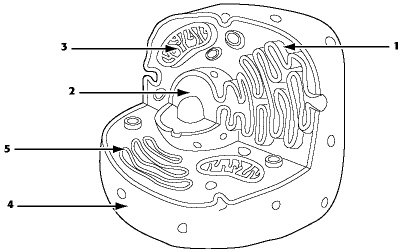
nar005-1.jpg
 114.
The molecular fragment represented in Figure 03-03 is:
a.
ATP.
b.
RNA.
c.
a protein.
d.
a nucleotide.
e.
a polysaccharide.
 115.
The type of connection between the atoms at the point labeled 1 in Figure 03-03 is:
a.
a peptide bond.
b.
a glycoside linkage.
c.
a disulfide bond.
d.
a phosphodiester linkage.
e.
a hydrogen bond.
 116.

Which portion of the following molecule is easily transferred and therefore responsible for the energy transfer property of this molecule?

mc116-1.jpg

a.
1
b.
2
c.
3
d.
1 and 2
e.
None of the above.
 117.
Ester linkages would not be formed during condensation reactions that produce:
a.
polysaccahrides.
b.
triacylglycerols.
c.
polypeptides.
d.
nucleic acids.
e.
All of the above contain ester linkages that are formed during condensation reactions.
 118.
Which monomer is incorrectly matched with the corresponding polymer?
a.
Amino acids are used to build proteins.
b.
Monosaccharides are used to build polysaccharides.
c.
Fatty acids are used to build nucleic acids.
d.
Glucose molecules are used to build starches.
e.
All of these monomers are correctly matched with the corresponding polymer.


Check Your Work     Start Over

AP Unit 1 – Biochemistry

%CODE1%

Javascript not enabled

Name: 


AP Unit 1     Biocehemistry


Multiple Choice
Identify the choice that best completes the statement or answers the question.
 1.
Which of the following properties or processes do we associate with living things?
a.
evolutionary adaptations
b.
energy processing
c.
responding to the environment
d.
growth and reproduction
e.
all of the above
 2.
Which of the following sequences represents the hierarchy of biological organization from the most to the least complex level?
a.
organelle, cell, organ system, population, community, ecosystem
b.
ecosystem, community, organism, tissue, cell, organelle
c.
biosphere, population, organism, cell, tissue, molecule
d.
biosphere, community, tissue, organ system, molecule, organelle
e.
organism, population, organ system, tissue, molecule, cell
 3.
What is a localized group of organisms that belong to the same species?
a.
biosystem
b.
community
c.
population
d.
ecosystem
e.
organ system
 4.
A maple leaf is at which level in the hierarchy of biological organization?
a.
tissue
b.
cell
c.
organelle
d.
organ
e.
organ system
 5.
Which of these is an example of an organelle?
a.
chloroplast
b.
muscle
c.
epidermis
d.
intestine
e.
maple leaf
 6.
Plants convert the energy of sunlight into
a.
the energy of motion.
b.
carbon dioxide and water.
c.
the potential energy of chemical bonds.
d.
minerals.
e.
kinetic energy.
 7.
As a result of photosynthesis, plants release ____ into the atmosphere.
a.
methane
b.
carbon dioxide
c.
water
d.
minerals
e.
oxygen
 8.
The dynamics of any ecosystem include the following major processes:
a.
the flow of energy from sunlight to producers
b.
the flow of energy from sunlight to producers and then to consumers
c.
the recycling of chemical nutrients
d.
the flow of energy to producers and the recycling of nutrients
e.
the flow of energy from sunlight to producers and then to consumers, and the recycling of chemical nutrients
 9.
For most ecosystems ____ is (are) the ultimate source of energy, and energy leaves the ecosystem in the form of ____.
a.
sunlight; heat
b.
heat; light
c.
plants; animals
d.
plants; heat
e.
producers; consumers
 10.
The lowest level of biological organization that can perform all the activities required for life is the
a.
organelle-for example, a chloroplast.
b.
cell-for example, a skin cell.
c.
tissue-for example, nervous tissue.
d.
organ system-for example, the reproductive system.
e.
organism-for example, an amoeba, dog, human, or maple tree.
 11.
Which of the following is true regarding deoxyribonucleic acid (DNA)?
a.
Each deoxyribonucleic acid molecule is composed of two long chains of nucleotides arranged in a double helix.
b.
Genes are composed of deoxyribonucleic acid.
c.
DNA is composed of chemical building blocks called nucleotides.
d.
Only A and C are correct.
e.
A, B, and C are correct.
 12.
What are the basic “building blocks” of deoxyribonucleic acid (DNA)?
a.
100,000 different kinds of proteins
b.
26 different kinds of chromosomes
c.
20 different kinds of amino acids
d.
4 different kinds of nucleotides
e.
3 different kinds of genomes
 13.
Which of the following types of cells utilize deoxyribonucleic acid (DNA) as their genetic material?
a.
animal
b.
plant
c.
archaea
d.
A and B only
e.
A, B, and C
 14.
The chemical reactions within cells are regulated by organic catalysts called
a.
feedback activators.
b.
feedback inhibitors.
c.
enzymes.
d.
metabolites.
e.
nutrients.
 15.
Once labor begins in childbirth, contractions increase in intensity and frequency until delivery. The increasing labor contractions of childbirth are an example of
a.
a bioinformatic system.
b.
positive feedback.
c.
negative feedback.
d.
feedback inhibition.
e.
both C and D
 16.
When blood glucose level rises, the pancreas secretes insulin, and as a result blood glucose level declines. When blood glucose level is low, the pancreas secretes glucagon, and as a result blood glucose level rises. Such regulation of blood glucose level is the result of
a.
catalytic feedback.
b.
positive feedback.
c.
negative feedback.
d.
bioinformatic regulation.
e.
both A and B
 17.
Which of the following are characteristics shared by members of both domain Bacteria and domain Archaea?
a.
cytosol
b.
nucleus
c.
DNA
d.
A and C only
e.
A, B, and C
 18.
All eukaryotes belong to which group(s)?
a.
domain Bacteria
b.
domain Archaea
c.
domain Eukarya
d.
kingdom Protista
e.
both C and D
 19.
Species that are in the same ____ are more closely related than species that are only in the same ____.
a.
phylum; class
b.
family; order
c.
class; order
d.
family; genus
e.
kingdom; phylum
 20.
Which of these is reflective of the hierarchical organization of life from most to least inclusive?
a.
kingdom, order, family, phylum, class, genus, species
b.
phylum, class, order, kingdom, family, genus, species
c.
kingdom, phylum, class, order, family, genus, species
d.
genus, species, kingdom, phylum, class, order, family
e.
class, order, kingdom, phylum, family, genus, species
 21.
About 25 of the 92 natural elements are known to be essential to life. Which four of these 25 elements make up approximately 96% of living matter?
a.
carbon, sodium, chlorine, nitrogen
b.
carbon, sulfur, phosphorus, hydrogen
c.
oxygen, hydrogen, calcium, sodium
d.
carbon, hydrogen, nitrogen, oxygen
e.
carbon, oxygen, sulfur, calcium
 22.
Which of the following statements is false?
a.
Atoms of the various elements differ in their number of subatomic particles.
b.
All atoms of a particular element have the same number of protons in their nuclei.
c.
The neutrons and protons present in the nucleus of an atom are almost identical in mass; each has a mass of about 1 dalton.
d.
An atom is the smallest unit of an element that still retains the properties of the element.
e.
Protons and electrons are electrically charged particles. Protons have one unit of negative charge, and electrons have one unit of positive charge.
 23.
Each element is unique and different from other elements because of the number of protons in the nuclei of its atoms. Which of the following indicates the number of protons in an atom’s nucleus?
a.
atomic mass
b.
atomic weight
c.
atomic number
d.
mass weight
e.
mass number
 24.
The mass number of an element can be easily approximated by adding together the number of ____ in an atom of that element.
a.
protons and neutrons
b.
energy levels
c.
protons and electrons
d.
neutrons and electrons
e.
isotopes
 25.
Calcium has an atomic number of 20 and an atomic mass of 40. Therefore, a calcium atom must have
a.
20 protons.
b.
40 electrons.
c.
40 neutrons.
d.
A and B only
e.
A, B, and C
 26.
An atom with an atomic number of 9 and a mass number of 19 would have an atomic mass of approximately
a.
9 daltons.
b.
9 grams.
c.
10 daltons.
d.
20 grams.
e.
19 daltons.
 27.
How do isotopes of the same element differ from each other?
a.
number of protons
b.
number of electrons
c.
number of neutrons
d.
valence electron distribution
e.
amount of radioactivity
 28.
One difference between carbon-12 and carbon-14 is that carbon-14 has
a.
two more protons than carbon-12.
b.
two more electrons than carbon-12.
c.
two more neutrons than carbon-12.
d.
A and C only
e.
B and C only
 29.
Electrons exist only at fixed levels of potential energy. However, if an atom absorbs sufficient energy, a possible result is that
a.
an electron may move to an electron shell farther out from the nucleus.
b.
an electron may move to an electron shell closer to the nucleus.
c.
the atom may become a radioactive isotope.
d.
the atom would become a positively charged ion, or cation.
e.
the atom would become a negatively charged ion, or anion.

Use the figure below to answer the following questions.

nar001-1.jpg

 30.
Which drawing depicts the electron configuration of neon (Ne)?
a.
Drawing A
b.
Drawing B
c.
Drawing C
d.
Drawing D
e.
Drawing E
 31.
Which drawing depicts the electron configuration of oxygen (O)?
a.
Drawing A
b.
Drawing B
c.
Drawing C
d.
Drawing D
e.
Drawing E
 32.
Which drawing is of an atom with the atomic number of 6?
a.
Drawing A
b.
Drawing B
c.
Drawing C
d.
Drawing D
e.
Drawing E
 33.
Which drawing depicts an atom that is inert or chemically unreactive?
a.
Drawing A
b.
Drawing B
c.
Drawing C
d.
Drawing D
e.
Drawing E

Use the information extracted from the periodic table in the figure below to answer the following questions.

nar002-1.jpg

 34.
How many electrons does nitrogen have in its valence shell?
a.
2
b.
5
c.
7
d.
8
e.
14
 35.
How many electrons does phosphorus have in its valence shell?
a.
1
b.
2
c.
3
d.
4
e.
5
 36.
What do atoms form when they share electron pairs?
a.
elements
b.
ions
c.
aggregates
d.
isotopes
e.
molecules
 37.
If an atom of sulfur (atomic number 16) were allowed to react with atoms of hydrogen (atomic number 1), which of the molecules below would be formed?
a.
S-H
b.
H-S-H
c.
H-S-H
|
H
d.
H
|
H-S-H
|
H
e.
H=S=H
 38.
What is the maximum number of covalent bonds an element with atomic number 8 can make with hydrogen?
a.
1
b.
2
c.
3
d.
4
e.
6
 39.
A molecule of carbon dioxide (CO2) is formed when one atom of carbon (atomic number 6) is covalently bonded with two atoms of oxygen (atomic number 8). What is the total number of electrons that must be shared between the carbon atom and the oxygen atoms in order to complete the outer electron shell of all three atoms?
a.
1
b.
2
c.
3
d.
4
e.
5
 40.
When two atoms are equally electronegative, they will interact to form
a.
equal numbers of isotopes.
b.
ions.
c.
polar covalent bonds.
d.
nonpolar covalent bonds.
e.
ionic bonds.
 41.
What results from an unequal sharing of electrons between atoms?
a.
a nonpolar covalent bond
b.
a polar covalent bond
c.
an ionic bond
d.
a hydrogen bond
e.
a hydrophobic interaction
 42.
In a single molecule of water, the two hydrogen atoms are bonded to a single oxygen atom by
a.
hydrogen bonds.
b.
nonpolar covalent bonds.
c.
polar covalent bonds.
d.
ionic bonds.
e.
van der Waals interactions.
 43.
What determines the cohesiveness of water molecules?
a.
hydrophobic interactions
b.
nonpolar covalent bonds
c.
ionic bonds
d.
hydrogen bonds
e.
both A and C
 44.
What do cohesion, surface tension, and adhesion have in common with reference to water?
a.
All increase when temperature increases.
b.
All are produced by ionic bonding.
c.
All are properties related to hydrogen bonding.
d.
All have to do with nonpolar covalent bonds.
e.
C and D only
 45.
Which of the following is possible due to the high surface tension of water?
a.
Lakes don’t freeze solid in winter, despite low temperatures.
b.
A water strider can walk across the surface of a small pond.
c.
Organisms resist temperature changes, although they give off heat due to chemical reactions.
d.
Water can act as a solvent.
e.
The pH of water remains exactly neutral.
 46.
Water’s high specific heat is mainly a consequence of the
a.
small size of the water molecules.
b.
high specific heat of oxygen and hydrogen atoms.
c.
absorption and release of heat when hydrogen bonds break and form.
d.
fact that water is a poor heat conductor.
e.
inability of water to dissipate heat into dry air.
 47.
Desert rabbits are adapted to the warm climate because their large ears aid in the removal of heat due to the
a.
high surface tension of water.
b.
high heat of vaporization of water.
c.
high specific heat of water.
d.
buffering capacity of water.
e.
dissociation of water molecules.
 48.
The formation of ice during colder weather helps moderate the seasonal transition to winter. This is mainly because
a.
the breaking of hydrogen bonds absorbs heat.
b.
the formation of hydrogen bonds releases heat.
c.
the formation of hydrogen bonds absorbs heat.
d.
there is greater evaporative cooling of lakes.
e.
ice is denser than liquid water.
 49.
Why does ice float in liquid water?
a.
The liquid water molecules have more kinetic energy and thus support the ice.
b.
The ionic bonds between the molecules in ice prevent the ice from sinking.
c.
Ice always has air bubbles that keep it afloat.
d.
Hydrogen bonds stabilize and keep the molecules of ice farther apart than the water molecules of liquid water.
e.
The crystalline lattice of ice causes it to be denser than liquid water.
 50.
Which of the following solutions has the greatest concentration of hydrogen ions [H+]?
a.
gastric juice at pH 2
b.
vinegar at pH 3
c.
tomato juice at pH 4
d.
black coffee at pH 5
e.
household bleach at pH 12
 51.
Which of the following solutions has the greatest concentration of hydroxide ions [OH-]?
a.
lemon juice at pH 2
b.
vinegar at pH 3
c.
tomato juice at pH 4
d.
urine at pH 6
e.
seawater at pH 8
 52.
Organic chemistry is a science based on the study of
a.
functional groups.
b.
vital forces interacting with matter.
c.
carbon compounds.
d.
water and its interaction with other kinds of molecules.
e.
inorganic compounds.
 53.
Which property of the carbon atom gives it compatibility with a greater number of different elements than any other type of atom?
a.
Carbon has 6 to 8 neutrons.
b.
Carbon has a valence of 4.
c.
Carbon forms ionic bonds.
d.
A and C only
e.
A, B, and C
 54.
How many electron pairs does carbon share in order to complete its valence shell?
a.
1
b.
2
c.
3
d.
4
e.
8
 55.
What type(s) of bond(s) does carbon have a tendency to form?
a.
ionic
b.
hydrogen
c.
covalent
d.
A and B only
e.
A, B, and C
 56.

The two molecules shown in the following figure are best described as

mc056-1.jpg

a.
optical isomers.
b.
radioactive isotopes.
c.
structural isomers.
d.
nonradioactive isotopes.
e.
geometric isomers.
 57.
A compound contains hydroxyl groups as its predominant functional group. Which of the following statements is true concerning this compound?
a.
It lacks an asymmetric carbon, and it is probably a fat or lipid.
b.
It should dissolve in water.
c.
It should dissolve in a nonpolar solvent.
d.
It won’t form hydrogen bonds with water.
e.
It is hydrophobic.
 58.

What is the name of the functional group shown in the following figure?

a.
carbonyl
b.
ketone
c.
aldehyde
d.
carboxyl
e.
hydroxyl
 59.
Which two functional groups are always found in amino acids?
a.
ketone and aldehyde
b.
carbonyl and carboxyl
c.
carboxyl and amino
d.
phosphate and sulfhydryl
e.
hydroxyl and aldehyde

Use the figure below to answer the following questions.

nar003-1.jpg

 60.
Which is a hydroxyl functional group?
a.
Group A
b.
Group B
c.
Group C
d.
Group D
e.
Group E
 61.
Which is an amino functional group?
a.
Group A
b.
Group B
c.
Group C
d.
Group D
e.
Group E
 62.
Which is a carbonyl functional group?
a.
Group A
b.
Group B
c.
Group C
d.
Group D
e.
Group E
 63.
Which is a functional group that helps stabilize proteins by forming covalent cross-links within or between protein molecules?
a.
Group A
b.
Group B
c.
Group C
d.
Group D
e.
Group E

Use the molecules shown in the figure below to answer the following questions..

nar004-1.jpg

 64.
Which molecule contains a sulfhydryl functional group?
a.
Molecule A
b.
Molecule B
c.
Molecule C
d.
Molecule D
e.
Molecule E
 65.
Which of the following is not one of the four major groups of macromolecules found in living organisms?
a.
glucose
b.
carbohydrates
c.
lipids
d.
proteins
e.
nucleic acids
 66.
Polymers of polysaccharides, fats, and proteins are all synthesized from monomers by which process?
a.
connecting monosaccharides together (condensation reactions)
b.
the addition of water to each monomer (hydrolysis)
c.
the removal of water (dehydration reactions)
d.
ionic bonding of the monomers
e.
the formation of disulfide bridges between monomers
 67.
Which of the following best summarizes the relationship between dehydration reactions and hydrolysis?
a.
Dehydration reactions assemble polymers, and hydrolysis breaks down polymers.
b.
Hydrolysis only occurs in the urinary system, and dehydration reactions only occur in the digestive tract.
c.
Dehydration reactions can occur only after hydrolysis.
d.
Hydrolysis creates monomers, and dehydration reactions break down polymers.
e.
A and C are correct.
 68.
A molecule with the chemical formula C16H32O16 is probably a
a.
carbohydrate.
b.
lipid.
c.
protein.
d.
nucleic acid.
e.
hydrocarbon.
 69.

If 128 molecules of the general type shown in the figure below were covalently joined together in sequence, the single molecule that would result would be a

mc069-1.jpg

a.
polysaccharide.
b.
polypeptide.
c.
polyunsaturated lipid.
d.
monosaccharide.
e.
disaccharide.
 70.
Lactose, a sugar in milk, is composed of one glucose molecule joined by a glycosidic linkage to one galactose molecule. How is lactose classified?
a.
as a pentose
b.
as a hexose
c.
as a monosaccharide
d.
as a disaccharide
e.
as a polysaccharide
 71.
Which of the following are polysaccharides?
a.
glycogen
b.
starch
c.
chitin
d.
A and B only
e.
A, B, and C
 72.
Which of the following is (are) true for the class of large biological molecules known as lipids?
a.
They are insoluble in water.
b.
They are an important constituent of cell membranes.
c.
They contain twice as much energy as an equivalent weight of polysaccharide.
d.
Only A and B are correct.
e.
A, B, and C are correct.
 73.
Saturated fatty acids
a.
are the predominant fatty acid in corn oil.
b.
have double bonds between carbon atoms of the fatty acids.
c.
have a higher ratio of hydrogen to carbon than do unsaturated fatty acids.
d.
are usually liquid at room temperature.
e.
are usually produced by plants.
 74.

What is the molecule illustrated in the figure below?

mc074-1.jpg

a.
a saturated fatty acid
b.
an unsaturated fatty acid
c.
a polyunsaturated triacylglyceride
d.
a trans polyunsaturated triacylglyceride
e.
a steroid similar to cholesterol
 75.

The molecule shown in the figure below is a

mc075-1.jpg

a.
polysaccharide.
b.
polypeptide.
c.
saturated fatty acid.
d.
triacylglycerol.
e.
unsaturated fatty acid.
 76.
The 20 different amino acids found in polypeptides exhibit different chemical and physical properties because of different
a.
carboxyl groups attached to an alpha carbon
b.
amino groups attached to an alpha carbon
c.
side chains (R groups).
d.
alpha carbons.
e.
asymmetric carbons.
 77.

The chemical reaction illustrated in the figure below results in the formation of a (an)

mc077-1.jpg

a.
ionic bond.
b.
peptide bond.
c.
glycosidic linkage.
d.
ester linkage.
e.
phosphodiester linkage.
 78.

The figure below shows the

mc078-1.jpg

a.
1-4 linkage of the glucose monomers of starch.
b.
1-4 linkage of the glucose monomers of cellulose.
c.
double helical structure of a DNA molecule.
d.
helix secondary structure of a polypeptide.
e.
pleated sheet secondary structure of a polypeptide.
 79.
What is the term used for a change in a protein’s three-dimensional shape or conformation due to disruption of hydrogen bonds, disulfide bridges, or ionic bonds?
a.
hydrolysis
b.
stabilization
c.
destabilization
d.
renaturation
e.
denaturation
 80.
Which of the following best describes the flow of information in eukaryotic cells?
a.
DNA RNA proteins
b.
RNA proteins DNA
c.
proteins DNA RNA
d.
RNA DNA proteins
e.
DNA proteins RNA


Check Your Work     Start Over

AP UNIT 1B BIOCHEMISTRY

%CODE1%

Javascript not enabled

Name:     ID: 

Email: 

AP UNIT 1B BIOCHEMISTRY
 

Multiple Choice
Identify the choice that best completes the statement or answers the question.
 1.
Organic chemistry is a science based on the study of
a.
functional groups.
b.
vital forces interacting with matter.
c.
carbon compounds.
d.
water and its interaction with other kinds of molecules.
e.
inorganic compounds.
 2.
How many electron pairs does carbon share in order to complete its valence shell?
a.
1
b.
2
c.
3
d.
4
e.
8
 3.
What type(s) of bond(s) does carbon have a tendency to form?
a.
ionic
b.
hydrogen
c.
covalent
d.
A and B only
e.
A, B, and C
 4.
What is the reason why hydrocarbons are not soluble in water?
a.
The majority of their bonds are polar covalent carbon to hydrogen linkages.
b.
The majority of their bonds are nonpolar covalent carbon-to-hydrogen linkages.
c.
They are hydrophilic.
d.
They exhibit considerable molecular complexity and diversity.
e.
They are lighter than water.
 5.

The two molecules shown in the following figure are best described as

mc005-1.jpg

a.
optical isomers.
b.
radioactive isotopes.
c.
structural isomers.
d.
nonradioactive isotopes.
e.
geometric isomers.
 6.

The two molecules shown in the following figure are best described as

mc006-1.jpg

a.
enantiomers.
b.
radioactive isotopes.
c.
structural isomers.
d.
nonisotopic isomers.
e.
geometric isomers.
 7.
Research suggests that side effects from Ritalin, the drug used to treat attention deficit disorder, may be caused by contamination of enantiomers, or molecules that
a.
have identical three-dimensional shapes.
b.
are mirror images of one another.
c.
lack an asymmetric carbon.
d.
differ in the location of their double bonds.
e.
differ in their electrical charge.
 8.
Which is the best description of a carbonyl group?
a.
an oxygen joined to a carbon by a single covalent bond
b.
a nitrogen and two hydrogens joined to a carbon by covalent bonds
c.
a carbon joined to two hydrogens by single covalent bonds
d.
a sulfur and a hydrogen joined to a carbon by covalent bonds
e.
a carbon atom joined to an oxygen by a double covalent bond
 9.

What is the name of the functional group shown in the following figure?

a.
carbonyl
b.
ketone
c.
aldehyde
d.
carboxyl
e.
hydroxyl
 10.
Which of the following contains nitrogen in addition to carbon, oxygen, and hydrogen?
a.
an alcohol such as ethanol
b.
a monosaccharide such as glucose
c.
a steroid such as testosterone
d.
an amino acid such as glycine
e.
a hydrocarbon such as benzene
 11.
Which two functional groups are always found in amino acids?
a.
ketone and aldehyde
b.
carbonyl and carboxyl
c.
carboxyl and amino
d.
phosphate and sulfhydryl
e.
hydroxyl and aldehyde
 12.
A chemist wishes to make an organic molecule less acidic. Which of the following functional groups should be added to the molecule in order to do so?
a.
carboxyl
b.
sulfhydryl
c.
hydroxyl
d.
amino
e.
phosphate

Use the figure below to answer the following questions.

nar001-1.jpg

 13.
Which is a hydroxyl functional group?
a.
Group A
b.
Group B
c.
Group C
d.
Group D
e.
Group E
 14.
Which is an amino functional group?
a.
Group A
b.
Group B
c.
Group C
d.
Group D
e.
Group E
 15.
Which is a functional group that helps stabilize proteins by forming covalent cross-links within or between protein molecules?
a.
Group A
b.
Group B
c.
Group C
d.
Group D
e.
Group E
 16.
Polymers of polysaccharides, fats, and proteins are all synthesized from monomers by which process?
a.
connecting monosaccharides together (condensation reactions)
b.
the addition of water to each monomer (hydrolysis)
c.
the removal of water (dehydration reactions)
d.
ionic bonding of the monomers
e.
the formation of disulfide bridges between monomers
 17.
Which of the following best summarizes the relationship between dehydration reactions and hydrolysis?
a.
Dehydration reactions assemble polymers, and hydrolysis breaks down polymers.
b.
Hydrolysis only occurs in the urinary system, and dehydration reactions only occur in the digestive tract.
c.
Dehydration reactions can occur only after hydrolysis.
d.
Hydrolysis creates monomers, and dehydration reactions break down polymers.
e.
A and C are correct.
 18.

If 128 molecules of the general type shown in the figure below were covalently joined together in sequence, the single molecule that would result would be a

mc018-1.jpg

a.
polysaccharide.
b.
polypeptide.
c.
polyunsaturated lipid.
d.
monosaccharide.
e.
disaccharide.
 19.
Lactose, a sugar in milk, is composed of one glucose molecule joined by a glycosidic linkage to one galactose molecule. How is lactose classified?
a.
as a pentose
b.
as a hexose
c.
as a monosaccharide
d.
as a disaccharide
e.
as a polysaccharide
 20.
Which of the following is true of both starch and cellulose?
a.
They are both polymers of glucose.
b.
They are geometric isomers of each other.
c.
They can both be digested by humans.
d.
They are both used for energy storage in plants.
e.
They are both structural components of the plant cell wall.
 21.
Which of the following is true of cellulose?
a.
It is a polymer composed of sucrose monomers.
b.
It is a storage polysaccharide for energy in plant cells.
c.
It is a storage polysaccharide for energy in animal cells.
d.
It is a major structural component of plant cell walls.
e.
It is a major structural component of animal cell plasma membranes.
 22.
Triacylglycerol is a
a.
protein with tertiary structure.
b.
lipid made with three fatty acids and glycerol.
c.
lipid that makes up much of the plasma membrane.
d.
molecule formed from three alcohols by dehydration reactions.
e.
carbohydrate with three sugars joined together by glycosidic linkages.
 23.

What is the molecule illustrated in the figure below?

mc023-1.jpg

a.
a saturated fatty acid
b.
an unsaturated fatty acid
c.
a polyunsaturated triacylglyceride
d.
a trans polyunsaturated triacylglyceride
e.
a steroid similar to cholesterol
 24.

The molecule shown in the figure below is a

mc024-1.jpg

a.
polysaccharide.
b.
polypeptide.
c.
saturated fatty acid.
d.
triacylglycerol.
e.
unsaturated fatty acid.
 25.
A polypeptide can best be described as a
a.
monomer of a protein polymer.
b.
polymer containing 20 amino acid molecules.
c.
polymer containing 19 peptide bonds.
d.
polymer containing 20 peptide bonds.
e.
polymer of amino acids.
 26.

The chemical reaction illustrated in the figure below results in the formation of a (an)

mc026-1.jpg

a.
ionic bond.
b.
peptide bond.
c.
glycosidic linkage.
d.
ester linkage.
e.
phosphodiester linkage.
 27.
Which bonds are created during the formation of the primary structure of a protein?
a.
peptide bonds
b.
hydrogen bonds
c.
disulfide bonds
d.
phosphodiester bonds
e.
A, B, and C
 28.
What maintains the secondary structure of a protein?
a.
peptide bonds
b.
hydrogen bonds
c.
disulfide bonds
d.
ionic bonds
e.
phosphodiester bonds
 29.

The figure below shows the

mc029-1.jpg

a.
1-4 linkage of the glucose monomers of starch.
b.
1-4 linkage of the glucose monomers of cellulose.
c.
double helical structure of a DNA molecule.
d.
helix secondary structure of a polypeptide.
e.
pleated sheet secondary structure of a polypeptide.
 30.
Altering which of the following levels of structural organization could change the function of a protein?
a.
primary
b.
secondary
c.
tertiary
d.
quaternary
e.
all of the above
 31.
Which of the following descriptions best fits the class of molecules known as nucleotides?
a.
a nitrogenous base and a phosphate group
b.
a nitrogenous base and a pentose sugar
c.
a nitrogenous base, a phosphate group, and a pentose sugar
d.
a phosphate group and an adenine or uracil
e.
a pentose sugar and a purine or pyrimidine
 32.
All of the following nitrogenous bases are found in DNA except
a.
thymine.
b.
adenine.
c.
uracil.
d.
guanine.
e.
cytosine.
 33.
Which of the following statements best summarizes the structural differences between DNA and RNA?
a.
RNA is a protein, whereas DNA is a nucleic acid.
b.
DNA is a protein, whereas RNA is a nucleic acid.
c.
DNA nucleotides contain a different sugar than RNA nucleotides.
d.
RNA is a double helix, but DNA is single-stranded.
e.
A and D are correct.


         Start Over