| Cell Structure & Function Review |
 |
1. The first Person to describe microscopic organisms and living cells was
________________________________.
2. The maximum size to which a cell may grow is limited mainly by the cell’s ___________________________ ____________________________.
3. Short, hair-like organelles that can move and may cover a unicellular organism or line the respiratory tract are called ______________________________________.
4. Some Ribosomes are free in the cytoplasm, while others line the membrane of the
_________________ __________________ __________________________.
5. Everything between the cell membrane and the nucleus, is the cell’s
____________________________________.
6. All cells, from all organisms, are surrounded by a _______________ _____________________.
7. Membranes are _______________________ and have the consistency of vegetable oil.
8. The organelle that stores DNA and synthesizes RNA _________________________.
9. The organelle that processes and packages substances produced by the cell ______________________ _________________________.
10. The ____________________________ is the control center of the cell.
11. The DNA in the form of a long strand is called ______________________________.
12. Cytoplasm consists of two main components: ____________________________ and
______________________________.
13. The cell membrane functions like a ______________________, controlling what
__________________ and _______________________ the cell.
14. A lipid is a simple form of ________________________________.
15. There are many kinds of ______________________ in cell membranes; they help to move material into and out of the cell.
16. Scientist call the modern view of the cell membrane structure the
______________________________ ____________________ _________________.
17. The nucleus is surrounded by a double layer membrane called the
__________________________ _________________________________.
18. During cell division, _________________________ strands coil and condense into thick structures called _____________________________________.
19. The nucleoli make ___________________________. Which in turn build proteins.
20. Membranes are made mostly of ___________________ and ______________________.
21. The _________________ is the smallest unit that can carry out all of the processes of life. The basic unit of life.
22. The maximum size to which a cell may grow is limited mainly by the cell’s ___________________ ____________________.
23. The discovery of cells is linked most directly the development of the __________________________.
24. Organisms whose cells never contain a membrane bound nucleus are called _____________________________________.
24. Suspended in the cell’s cytosol are tiny ___________________________________.
25. Cell membranes consist of two phospholipid layers called a ___________________.
26. The chromosomes in the nucleus contain coded _____________________ that control all cellular activity.
27. When a cell prepares to reproduce the _______________________ disappears.
28. Cytosol is a jelylike mixture that consists mostly of _____________________.
29. The nucleus is one ______________________________.
30. In Eukaryotic cells, most organelles are surrounded by a _____________________.
31. Organisms whose cells always or usually contain a nucleus or nuclei are called
____________________________________.
32. ________________________ are structures that carry out specific functions in the cell.
33. Most cells have a single ______________________; some cells have more than one.
34. Unicellular organisms such as bacteria and their relatives are ___________________________.
35. The Fluid Mosaic Model presents the modern view of a
__________________ ___________________________.
36. The “Blueprints” in a Cell that controls all its activity are the ___________________.
37. Where are poisons and waste detoxified in a cell? _________________________ _________________________________.
38. A cell synthesizes protein by using organelles called _______________________________.
39. The Mitochondria of a cell contain an inner membrane called _____________________________.
40. What are the membrane-bound sacs that package and secrete cell products?
___________________________ ___________________________.
41. Unlike animal cells, plant cells have ______________ ________________.
42. A Chloroplast can convert _________________, __________________________, and ____________________________ into ________________________.
43. What are Flagella? ___________________________________________________.
44. In animal cells, the Cytoskeleton maintains three-dimensional structure and helps the cell ___________________________.
45. The organelle that digest molecules, old organelles, and foreign substances in the cell _______________________________________.
46. A pigment that absorbs energy in sunlight ________________________________.
47. The organelle that prepares proteins for export and synthesizes steroids is ________________________ ________________________.
48. Ribosomes differ from most organelles because they have no ___________________________.
49. What type of cells would you expect to find large numbers of mitochondria? _______________________ _________________.
50. The “Powerhouse” of the cell _______________________________.
51. Short, hairlike organelles that can move and may cover a unicellular organism or line the respiratory tract are called _______________________________.
52. The first cells on Earth were likely _______________________ that did __________ make their own _________________.
53. Microfilaments and microtubules function in cell _______________________ and ____________________________.
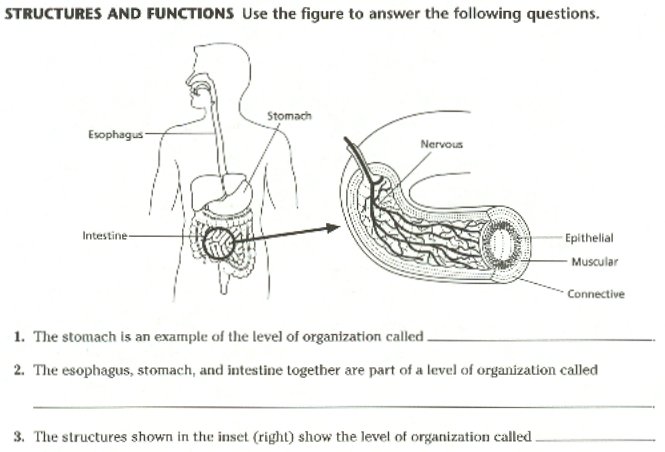
54. What is the correct order of structures in living things, from simplest to the most complex? ______________________, __________________________, ______________________________, ______________________________.
55. The is the organelle that transfers energy in ATP _______________________________.
56. What word means “Water Fearing”? ____________________________.
57. What word means “Water Loving”? _____________________________.
58. What is cell specialization? Give an example.
59. Distinguish between the structure of rough ER and that of smooth ER.
60. Explain how ribosomes, endoplasmic reticulum, Golgi apparatus function together in protein synthesis.
61. Explain the difference between a tissue and an organ.
62. Why is the cell membrane said to be selectively permeable?
63. If a cell has a high energy requirement, would you expect it to have many or few mitochondria? Explain your answer.
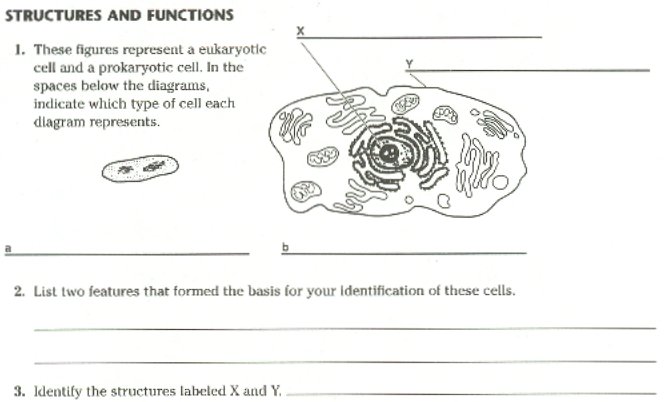
64. Describe TWO differences between prokaryotic cells and eukaryotic cells.
65. How can you determine whether a unicellular organism is a prokaryote or a eukaryote?
66. Plant cells have cell walls, but animal cells do not. Why do you think that is so?
67. What are the THREE Parts of the Cell Theory?
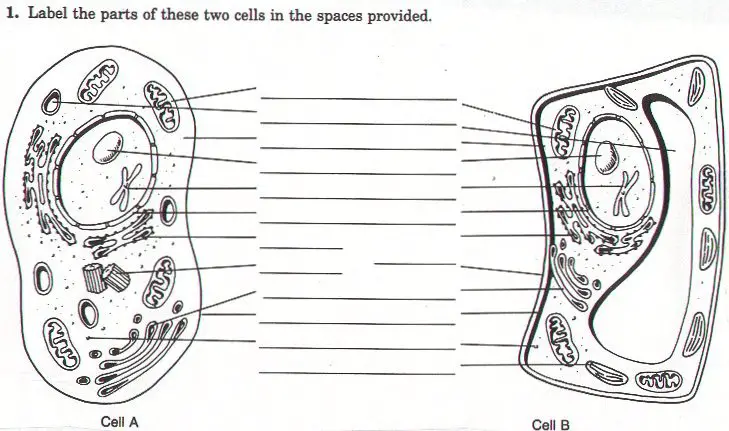
68. Describe three differences between plant and animal cells.
69. Name the TWO different kinds of animal cells, and describe how their shape is related to their function.
70. What is the difference between chromatin and chromosomes?
71. What are the major roles of the nucleus, and what parts of the nucleus carry out these roles?
72. What is a colonial organism, and what does it have in common with multicellular organisms?