Homeostasis Worksheet Ch5 BI


Homeostasis & Transport


Section 5-1 Passive Transport

1. What is the purpose of the cell membrane?

2. Explain passive transport.

3. What is the simplest type of passive transport?

4. In which direction does diffusion occur?

5. What is a concentration gradient?

6. Sugar dissolving in water is an example of _______________________.

7. What supplies the energy for diffusion?

8. Molecules are constantly _____________________.

9. What is meant by equilibrium?

10. Do molecules stop moving when equilibrium is reached? Explain.

11. List three things that determine if a molecule will be able to diffuse across a membrane.

12. Name the 2 parts of a solution.

13. Define osmosis. Is it passive or active transport?

14. The direction water moves across a cell membrane depends on the concentration of what on either side of the cell membrane?

15. Explain what is true about solutes if the outside of the cell is hypotonic to the cytosol? Which way does water move?

16. Explain the solute conditions if the outside is hypertonic to the cytosol. Which way does water move?

17. What occurs if the solute concentration on each side of the cell membrane is isotonic?

18. If the inside & outside of a cell are both isotonic, does water still move across the cell membrane? Explain.

19. If the inside of the cell is hypotonic, the outside will be _________________________.

20. Water tends to diffuse from ____________________ to ___________________ solutions.

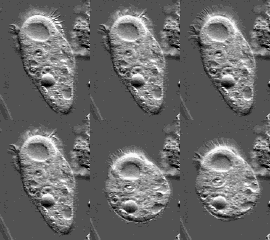
21. How does a unicellular paramecium get rid of its excess water? Is energy used?

22. Many cells in multicellular organisms have _________________ pumps to prevent them from taking in too much water in hypotonic solutions.

23. What structure around the outside of plant cells keeps hem from rupturing from too much water?

24. What is turgor pressure & how does it help plant cells?

25. What happens to plant cells placed in a hypertonic solution? Name this process.

26. What is cytolysis & what causes it?

27. Another type of passive transport is __________________________ diffusion.

28. Explain how carrier proteins help in facilitated.

29. Sketch the changes that take place in a carrier protein as it helps molecules move across the cell membrane.

30. What sugar moves across the cell membrane by facilitated diffusion?

31. What are ion channels & are they used in passive or active transport?

32. Name 4 ions that cross the cell membrane through ion channels.

33. Why can’t these ions diffuse across the lipid bilayer of the cell membrane?

34. Ion channels may be always ________________ or have ___________________.

35. Name 3 stimuli that open & close gated channels.

Section 5-2 Active Transport

36. Define active transport.

37. Why are carrier proteins in the cell membrane that are used for active transport called “pumps”?

38. What is the best-known carrier protein pump in animal cells?

39. What 2 ions move up their concentration gradient in this pump?

40. ___________________ ions are pumped out, while ______________ ions are pumped into the cell.

41. Is energy required for active transport? Explain.

42. Sodium ions are exchanged for potassium ions at a ____________ to ____________ ratio.

43. Name 2 processes used to move macromolecules & food particles across the cell membrane. Is energy required?

44. Explain how cells move large particles into the cell by endocytosis.

45. Name & describe the 2 types of endocytosis.

46. How do phagocytes protect cells?

47. What process moves large materials such as wastes & proteins out of the cell?

BACK


How Surface Area to Volume Ratio Limits Cell Size


How Surface Area to Volume Ratio Limits Cell Size

  1. A cell is a metabolic compartment where a multitude of chemical reactions occur.
  2. The number of reactions increase as the volume of metabolic volume within a cell increases. (The larger the volume the larger the number of reactions)
  3. 3.All raw materials necessary for metabolism can enter the cell only through its cell membrane.
  4. The greater the surface area the larger the amount of raw materials that can enter at only one time.
  5. Each unit of volume requires a specific amount of surface area to supply its metabolism with raw materials. The amount of surface area available to each unit of volume varies with the size of a cell.
  6. As a cell grows its SA/V decreases.
  7. At some point in its growth its SA/V becomes so small that its surface area is too small to supply its raw materials to its volume. At this point the cell cannot get larger.


Homeostasis & Transport


HOMEOSTASIS AND TRANSPORT
All Materials © Cmassengale


I. Cell Membranes


A. Cell membranes help organisms maintain homeostasis by controlling what substances may enter or leave cells

B. Some substances can cross the cell membrane without any input of energy by the cell

C. The movement of such substances across the membrane is known as passive transport


D. To stay alive, a cell must exchange materials such as food, water, & wastes with its environment

E. These materials must cross the cell or plasma membrane

F. Small molecules like water, oxygen, & carbon dioxide can move in and out freely

G. Large molecules like proteins & carbohydrates cannot move easily across the plasma membrane

H. The Cell Membrane is semipermeable or selectively permeable only allowing certain molecules to pass through


II. Diffusion


A. Diffusion is the movement of molecules from an area of higher concentration to an area of lower concentration

B. Small molecules can pass through the cell membrane by a process called diffusion


C. Diffusion across a membrane is a type of passive transport because it does not require energy

D. This difference in the concentration of molecules across a membrane is called a concentration gradient


E. Diffusion is driven by the kinetic energy of the molecules

F. Kinetic energy keeps molecules in constant motion causing the molecules to move randomly away from each other in a liquid or a gas

G. The rate of diffusion depends on temperature, size of the molecules, & type of molecules diffusing


H. Molecules diffuse faster at higher temperatures than at lower temperatures

I. Smaller molecules diffuse faster than larger molecules

J. Most short-distance transport of materials into & out of cells occurs by diffusion

K. Solutions have two parts — the solute which is being dissolved in the solvent


L. Water serves as the main solvent in living things

M. Diffusion always occurs down a concentration gradient (water moves from an area where it is more concentrated to an area where it is less concentrated)

N. Diffusion continues until the concentration of the molecules is the same on both sides of a membrane


O. When a concentration gradient no longer exists, equilibrium has been reached but molecules will continue to move equally back & forth across a membrane


III. Osmosis


A. The diffusion of water across a semipermeable membrane is called osmosis

B. Diffusion occurs from an area of high water concentration (less solute) to an area of lower water concentration (more solute)


C. Movement of water is down its concentration gradient & doesn’t require extra energy

D. Cytoplasm is mostly water containing dissolved solutes

E. Concentrated solutions have many solute molecules & fewer water molecules

F. Water moves from areas of low solute concentration to areas of high solute concentration

G. Water molecules will cross membranes until the concentrations of water & solutes is equal on both sides of the membrane; called equilibrium


H. At equilibrium, molecules continue to move across membranes evenly so there is no net movement

I. Hypertonic Solution
1. Solute concentration outside the cell is higher (less water)
2. Water diffuses out of the cell until equilibrium is reached
3. Cells will shrink & die if too much water is lost
4. Plant cells become flaccid (wilt); called plasmolysis

J. Hypotonic Solution
1. Solute concentration greater
inside the cell (less water)
2. Water moves into the cell until equilibrium is reached
3. Animal cells swell & burst (lyse) if they take in too much water
4. Cytolysis is the bursting of cells
5. Plant cells become turgid due to water pressing outward against cell wall
6. Turgor pressure in plant cells helps them keep their shape
7. Plant cells do best in hypotonic solutions

K. Isotonic Solutions
1. Concentration of solutes same inside & outside the cell
2. Water moves into & out of cell at an equal rate so there is no net movement of water
3. Animal cells do best in isotonic solutions


IV. How Cells Deal With Osmosis


A. The cells of animals on land are usually in isotonic environment (equilibrium)

B. Freshwater organisms live in hypotonic environments so water constantly moves into their cells

C. Unicellular freshwater organisms use energy to pump out excess water by contractile vacuoles

D. Plant cell walls prevent plant cells from bursting in hypotonic environments

E. Some marine organisms can pump out excess salt


V. Facilitated Diffusion


A. Faster than simple diffusion

B. Considered passive transport because extra energy not used

C. Occurs down a concentration gradient

D. Involves carrier proteins embedded in a cell’s membrane to help move across certain solutes such as glucose


E. Carrier molecules change shape when solute attaches to them

F. Change in carrier protein shape helps move solute across the membrane
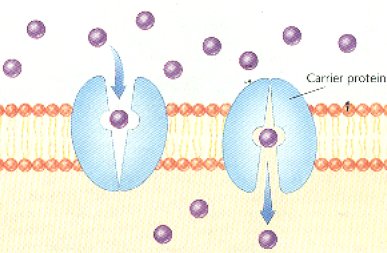
G. Channel proteins in the cell membrane form tunnels across the membrane to move materials

H. Channel proteins may always be open or have gates that open & close to control the movement of materials; called gated channels


I. Gates open & close in response to concentration inside & outside the cell


VI. Active Transport


A. Requires the use of ATP or energy

B. Moves materials against their concentration gradient from an area of lower to higher concentration

C. May also involve membrane proteins

D. Used to move ions such as Na+, Ca+, and K+ across the cell membrane

E. Sodium-Potassium pump moves 3 Na+ out for every 2 K+ into the cell
1. Causes a difference in charge inside and outside the cell
2. Difference in charge is called membrane potential


F. Ion pumps help muscle & nerve cells work


G. Plants use active transport to help roots absorb nutrients from the soil (plant nutrients are more concentrated inside the root than outside)


VII. Bulk Transport


A. Moves large, complex molecules such as proteins across the cell membrane

B. Large molecules, food, or fluid droplets are packaged in membrane-bound sacs called vesicles


C. Endocytosis moves large particles into a cell

D. Phagocytosis is one type of endocytosis
1. Cell membrane extends out forming pseudopods (fingerlike projections) that surround the particle
2. Membrane pouch encloses the material & pinches off inside the cell making a vesicle
3. Vesicle can fuse with lysosomes (digestive organelles) or release their contents in the cytoplasm
4. Used by ameba to feed & white blood cells to kill bacteria
5. Known as “cell eating”


E. Pinocytosis is another type of endocytosis
1. Cell membrane surrounds fluid droplets
2. Fluids taken into membrane-bound vesicle
3. Known as “cell drinking”


F. Exocytosis is used to remove large products from the cell such as wastes, mucus, & cell products

G. Proteins made by ribosomes in a cell are packaged into transport vesicles by the Golgi Apparatus

H. Transport vesicles fuse with the cell membrane and then the proteins are secreted out of the cell (e.g. insulin)

BACK

Food Chemistry


Food Chemistry

Introduction:

All living things are made up of one or more cells, and the cells in turn contain many kinds of molecules.  In this lab we will be looking at several different macromolecules (large molecules): proteins, carbohydrates, and lipids (specifically fats).  Various chemicals will be used in this laboratory to test for the presence of these molecules.  Most often, you will be looking for a particular color change.  If the change is observed, the test is said to be positive because it indicates that a particular molecule is present.  If the color change is not observed, the test is said to be negative because it indicates that a particular molecule is not present.

You will be using these tests to determine which of the macromolecules are present in various samples of food.

In all of the procedures, you will need to include a distilled water sample as a control.  Usually, a control goes through all the steps of the experiment but lacks one essential factor (the experimental variable).  This missing factor allows you to observe the difference between a positive result and a negative result.  If the control sample tests positive, you know your test is invalid.  Some tests may also contain other controls to make sure certain additives are not contaminated with the substance for which you are testing.

Proteins:

Protein molecules are long chains of amino acids joined by peptide bonds.

Biuret reagent, which is a blue color, contains a strong solution of sodium or potassium hydroxide (NaOH or KOH) and a very small amount of very dilute copper sulfate (CuSO4) solution.  The reagent changes color in the presence of proteins or peptides because the amino group (H2N-) of the protein or peptide chemically combines with the copper ions in biuret reagent.

Carbohydrates:

Carbohydrates include sugars and molecules that are chains of sugars.  Glucose is a simple sugar, also known as a monosaccharide.  Sucrose, or table sugar is a disaccharide, two sugar units bonded together.  Starch is a polysaccharide, a long chain of glucose units.

Benedict’s reagent reacts with many sugars (both mono- and disaccharides) after being heated in a boiling water bath.  Increasing concentrations of sugar give a continuum of colored products ranging from green through yellow and orange to orange red.

Iodine solution reacts with starch to produce colors ranging from a brownish to blue black.

Lipids:

Lipids are hydrophobic molecules which are insoluble in water and soluble in solvents such as alcohol and ether.  Lipids include fats, oils, and cholesterol.

Lipids do not evaporate from brown paper, instead leaving an oily spot.  Lipids also do not mix with water, forming a separate layer, usually on top of the water.  However, some molecules mix with both water and lipids, and can be used to mix the two.  These molecules are known as emulsifiers.  The liver produces bile salts which act as emulsifiers in the digestive tract.  Soaps and detergents also act as emulsifiers.

Summary of tests:


Biuret Reagent
Benedict’s Reagent
Iodine Solution
Brown Paper
Reacts with proteins or peptides, turns purple (protein) or pink (peptides) Reacts with sugars, turns green through yellow to orange (green, less sugar, orange, more sugar) Reacts with starch, turns dark brown to black Lipids leave oily spot

Procedure:

Take some time to plan with your lab partner what tests you will do, and in what order before beginning the procedures.

There are available in the lab a variety of different types of common food.  Choose at least 3 foods and test each for the presence of protein, carbohydrate (both starch and simple sugars), and fats.  Be sure to plan your experiments before starting.

Form a hypothesis for each sample you have chosen to test.

Samples will need to be suspended in water for most tests.  Using a mortar and pestle if necessary, break each sample to be tested into small pieces and suspend the pieces in a small amount of distilled water.

Also available are samples of each of the types of molecules for which you will be testing.  Use these samples to try out the tests so that you will know what a positive result looks like.

Be sure to include a blank control (distilled water) with each test so you know what a negative result looks like.  You may also include a positive control, a sample which you know contains the substance for which you are testing.

The procedures for testing for each type of molecule are given below.

Proteins and Peptides

Proteins:

  1. Use a separate test tube for each sample to be tested, as well as one for a control.
  2. Label each test tube.
  3. Place about 1 mL of each sample (and control) in its test tube.
  4. Add 5 drops of copper sulfate solution to each tube.
  5. Add 10 drops of potassium hydroxide solution to each tube and mix.
  6. Record the tube contents and final color in a data table.
  7. Conclusions: which tubes contained protein?

Carbohydrates: Sugars and starch

Starch

  1. Use a separate test tube for each sample to be tested, as well as one (or two) for a control.
  2. Label each test tube.
  3. Place about 1 mL of each sample (and control) in its test tube.
  4. Add 5 drops of iodine solution to each tube and mix.
  5. Record the tube contents and final color in a data table.
  6. Conclusions: which tubes contained starch?

Sugar

  1. Use a separate test tube for each sample to be tested, as well as one (or two) for a control.
  2. Label each test tube.
  3. Place about 1 mL of each sample (and control) in its test tube.
  4. Add about 2 mL of Benedict’s reagent to each tube and mix.
  5. Heat the tubes in a boiling water bath for 5-10 minutes.
  6. Record the tube contents and final color in a data table.
  7. Conclusions: which tubes contained sugar?

Lipids

  1. Place a small sample of the material to be tested on a square of brown paper.
  2. Place a small drop of water on the square of brown paper.
  3. Compare the drop of water to the sample.
  4. Wait at least 5 minutes.  Evaluate which substance impregnates the paper and which is subject to evaporation.  Record your results.
  5. Conclusions: which sample contained lipids?

Conclusion Questions:

  1. Why do experimental procedures include control samples?
  2. How would you test an unknown solution for each of the following:
    1. Sugars
    2. Fat
    3. Starch
    4. Protein
  3. Assume that you have tested an unknown sample with both biuret solution and Benedict’s solution and that both tests result in a blue color.  What have you learned?
  4. What purpose is served when a test is done using water instead of a sample substance?
  5. Compare your results.

Lab report:

Lab reports must include the following:

  1. A Title to the lab.  A Purpose: What was studied in this lab, and why did we study it?
  2. Procedure: a brief description of each type of test, what constitutes a positive test and what constitutes a negative test.
  3. All data tables.
  4. For each food sample, state your hypothesis and your conclusions.  Did your results confirm or refute your hypothesis?
  5. Answers to questions.
  6. A brief analysis of what worked in this lab and what didn’t work, and why.