Cell Division PPT Questions


Mitosis & Meiosis
 PPT Questions
1.   From where do new cells arise?


2.   Why does the body constantly make new cells?


3.   Is cell division the same in all cells?  Explain.


4.   Why must each new cell get a complete copy of the original cell’s DNA?


5.   Copying DNA is known as ____________________.

6.   The original cell that divides is called the _____________ cell, while the two, new identical cells are called ______________ cells.

Chromosomes

7.   Describe the chromosome of a prokaryote like a bacterial cell.


8.   About how many chromosomes are in the body cell of eukaryotes?

9.   How many chromosomes are in a human body cell?

10. What makes up each chromosome?


11. Chromosomes can only be seen when a cell is __________________.

12. Uncoiled chromosomes are called ____________________.

13. DNA tightly coils by wrapping around what kind of proteins?

14. What are duplicated (doubled) chromosomes called?

15. What holds chromatids together?

16. Sketch & label all parts of sister chromatids.


17. What is a karyotype?


18. Where are autosomes found on a karyotype?

19. Where are sex chromosomes found on a karyotype?

20. What is the genotype for males?        For females?

21. The presence of which chromosome determines the sex of the child?


Cell Reproduction

22. What is asexual reproduction?


23. Give 2 examples of asexual reproduction.

a.

b.


24. What is sexual reproduction and give an example?

25. Which process produces identical new cells — mitosis, meiosis, or both?

Prokaryotic Cell Division

26. Name a prokaryote that reproduces by binary fission.

27. Sketch and explain how binary fission occurs in a bacterial cells.


28. What forms to divide the 2 new bacterial cells?


Cell Cycle

29. Name the 5 phases of the cell cycle.


30. What is the longest phase of the cell cycle?                       the shortest phase?

31. Which phase has 3 stages & name them?


32. Which phase has 4 stages & name them?


33. Describe what occurs in the G1 stage of interphase.


34. When is DNA copied?

35. How do the new copies of DNA compare to the original DNA?

36. What does a cell make during the G2 stage right before mitosis?


37. Name a structure needed for cell division that is made during the G2 stage.  In what type of cell is this organelle found?


38. Can the nucleus and nucleolus be seen during interphase?

39. Sketch & label all parts of the cell cycle.


Mitosis

40. What part of a cell actually divides during mitosis?

41. Give another name for mitosis.

42. In which type of cell does mitosis occur — prokaryote or eukaryote? Explain why.


43. Name a type of cell that doesn’t undergo mitosis.

44. Name, in order, the four stages of mitosis.


45. Name 2 things that happen to a cell during Early Prophase.

a.


b.

46. What happens to the nucleus & nucleolus during prophase?


47. Why do chromosomes become visible during prophase?


48. What are kinetochores?


49. Where do kinetochore fibers attach to a chromosome?

50. What finishes forming by the end of Late Prophase?


51. Sketch and label a kinetochore fiber attached to a chromosome.


52. From what does the spindle form in plants?             in animals?

53. What are polar fibers? Do they attach to chromosomes?


54. What are asters & where are they in a cell?


55. Where are the poles of a cell?      the equator of a cell?


56. Sketch & label the parts of a spindle.


57. What happens to chromosomes during metaphase?


58. During metaphase, where do chromosomes line up & what MOVES them there?


59. Which mitotic phase occurs rapidly?

60. What happens to sister chromatids during anaphase?


61. What pulls sister chromatids apart during anaphase?

62. Where are chromatids located during telophase?

63. What disassembles in telophase?

64. What reforms around each set of sister chromatids during telophase?

65. What organelle reappears inside the nucleus?

66. During telophase as the chromosomes uncoil, they reappear as ____________________.

67. What process or phase follows telophase?

68. What divides during cytokinesis?

69. Explain how cytokinesis occurs in plants.


70. Explain how cytokinesis occurs in animals.


71. How does the chromosome number of the parent cell compare to that of the 2 daughter cells? How do the 3 cells compare in size?


72. What is the first thing the daughter cells must do following cytokinesis?


73. If the parent cell has a chromosome number of 2n = 6, what will be the chromosome number of the daughter cells?

74. Label these mitosis diagrams.


75. Label these stages.


76. Eukaryotic cell division is used for _______________ and _____________ of cells.

77. Parent cells before division are diploid or _______ chromosome number.  What will be the chromosome number of the two new cells?


78. Name these actual stages of  cell division.


TEST YOURSELF ON MITOSIS

79. Identify these stages.

80. Locate the four mitotic stages.


81. Eukaryotic cells before and after mitosis are ________________ or 2n.

82. What happens if mitosis is NOT controlled?


83. What are oncogenes?

Meiosis

80a. Do chromosomes replicate or double before meiosis?

81a. How many divisions occur in meiosis? Is this the same as mitosis? Explain.


82a. Meiosis is also called _____________________________________.

83. The original cell that divides by meiosis is ________________ or 2n.

84. How many daughter cells can be produced by meiosis? Is this the same as mitosis? Explain.


85.  What is the chromosome number of the daughter cells produced by meiosis? How does this compare to the number of chromosomes in the original cell?


86. What are the daughter cells called that are produced by meiosis? Name them.


87. Name the 2 types of meiosis.

a.

b.

88. Where does spermatogenesis occur?

89. Where does oogenesis occur?

90. In humans, how many chromosomes are in the original that undergoes meiosis? Are they single or double stranded?

91. After one division, how many chromosomes are in the cells? Are they single or double stranded?


92. After the second division, how many chromosomes are in the cells? Are they double or single stranded?


93. Is meiosis sexual or asexual reproduction?

94. Are eggs & sperm haploid or diploid?

95. What process joins the egg & sperm to restore the original chromosome number of the organism?


96. When a sperm fertilizes an egg, a new 2n cell forms called the _____________________.

97. ________________ are pairs of sister chromatids that have the same genes, but may have different alleles.

98. _____________ reduces the chromosome number by half, while ____________ restores it.

99. In Meiosis I, what separates?


100. In Meiosis II, what separates?


101. Name these stages of Meiosis I.


102. Name 2 things that occur in Early Prophase I.


103. Name 3 things that happen in Late prophase I.


104. What is a tetrad? Label the centromere and put a box around a sister chromatid.


105. ____________ is the process in prophase I that forms tetrads.

106. Once tetrads form, what happens to the homologous chromosomes? What is this called?


107. Crossing-over results in genetic ________________ in the offspring.

108. What happens during Metaphase I?


109. Name 2 things that occur in Anaphase I?


110. Name 3 things that occur in Telophase I?


111. At the beginning of Meiosis II, each  cell has how many homologs of each chromosome?


112. Sister chromatids carry ____________ genetic information (same genes & same alleles).

113. The gametes at the end of Meiosis II will have how many copies of a gene for a trait?


114. Name the stages in Meiosis II.


115. What happens in Prophase II?

116. Where are the sister chromatids in Metaphase II?

117. What happens to the sister chromatids during Anaphase II?


118. Name 4 things that occur in Telophase II?


119. Meiosis results in __________ haploid cells called _________ that have _______ copy of each chromosome and _________ allele for each gene in different ___________________.

Gametogenesis

120. Gametogenesis that produces sperm cells is called ______________________________.

121. Where does spermatogenesis occur?

122. Immature sperm cells are called ___________________.

123. How do mature sperm cells move?

124. Approximately how many sperm do men produce each day?

125. Label the diagram of spermatogenesis.


126.  Where does oogenesis occur?


127. Name the 4 cells produced by oogenesis.

128. What happens to the polar bodies & WHY?


129. ________________ are immature eggs.

130. How often do females produce an oocyte & starting at what age?

131. Label the diagram of oogenesis.


Comparing Mitosis & Meiosis

132. Complete the following table comparing mitosis & meiosis.


Mitosis Meiosis
Number of divisions
Number of Daughter cells
Genetically Identical
Chromosome Number
Where Occurs
When occurs
Role


Cell Respiration Lab Online

The Biology Place – Lab Bench Activity – Cellular Respiration

www.phschool.com ——> go to “The Biology Place” —–> go to LabBench —> go to “Lab 5: Cell Respiration”

1. In this lab activity:

a) You will observe __________________________________________________________________
b) You will investigate ________________________________________________________________

2. Write the equation for cellular respiration:


3. What are the three ways in which you can measure the rate of cellular respiration?


4. Sketch a respirometer and label its important features.


5. As the organism inside the respirometer consumes oxygen, what happens to the water? _________________________

6. What happens to the CO2 that the organism produces? ____________________________

7. Experimental Setup (View the graphic)

a) fill out the table

Vial 1
Vial 2
Vial 3
Vial 4
Vial 5
Vial 6
Contents
Temperature

b) How do you ensure that each vial has an equal volume?

c. What is the purpose of the vial with only glass beads?

8. Analyzing Results

a) What is the equation to determine the rate of respiration?


b) What is X _______________ What is Y _______________

9. Read the respirometers and determine the rate of respiration. Show your calculations

10. Analysis – Self Quiz

a) Describe the relationship between temperature and consumption of oxygen.


b) Calculate the rate of oxygen consumption for germinating corn at 12 degrees. (Show calculations)


c) Based on the graph, would you conclude that non germinating seeds respire?


11. Extension (You do not need the computer to finish this section, do as homework)

A cricket is placed in a respirometer and data taken at three temperatures. The following table shows the data collected.

Temperatures
Time (min) 10 degrees 18 degrees 25 degrees
0 0.0 0.0 0.0
5 0.25 0.6 0.9
10 0.5 0.9 1.4
15 0.7 1.2 1.8
20 0.9 1.6 2.4

a ) Graph the data.


b) Determine the rate of respiration for each of the three temperatures. (Show work)


c) Write a paragraph stating your conclusions


BACK


Cell Respiration PPT Q-B1

ADP, ATP, & Cellular Respiration
PowerPoint Question Guide

1. _______ is the energy used by all cells.

2. ATP stands for ________________ ______________.

3. ATP is an ___________ molecule containing high-energy ____________ bonds.

4. The sugar in ATP is ____________, while the nitrogen base is ___________.

5. How many phosphate groups does ATP contain?

6. How do we get energy from ATP?


7. Make a simple sketch of ATP and show the high-energy bond that is broken.


8. To break the last phosphate bond in ATP, _________ must be added.

9. The process is called ___________.

10. What enzyme is used to help weaken & break the last phosphate bond in ATP?

11. Can ATP be remade?

12. When the last phosphate bond of ATP is broken, __________ and a free __________ form.

13. What enzyme can be used to rejoin ADP and a free phosphate to make more ATP?

14. Using ATP’s energy and then remaking it is called the ________________ cycle.

15. In the body, ATP is made during the process of _____________ ________________.

16. Cellular respiration takes place in both ____________ and ____________.

17. Cellular respiration requires the gas ____________.

18. In cellular respiration, _____________ is oxidized (loses electrons) and ___________ is reduced (gains electrons).

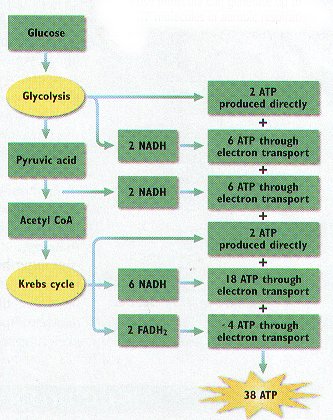
19. The breakdown of one glucose molecule results in ________ to _______ ATP molecules of energy.

20. Write the overall equation for cellular respiration.


21. Cellular respiration is an example of a ________ reaction.

22. REDOX stands for _____________-____________ reactions.

23. What are the products of cellular respiration?

24. What carries the energized electrons from glucose in cellular respiration?

25. NAD+_ is a _____________ that forms ____________ when it is reduced (picks up electrons).

26. What does NAD+ stand for?

27. Name a second coenzyme that acts as an energy carrier in cellular respiration.

28. What does FAD+ stand for?

29. FAD+ becomes __________ whenever it is reduced.

30. Cellular respiration like photosynthesis is a _______________ ____________ because it involves many reactions to make or break down carbohydrates.

31. Cellular respiration is an ______________ reaction because it releases energy from glucose.

32. Glucose is broken down into __________ and _________.

33. Is cellular respiration catabolic or anabolic? explain why.


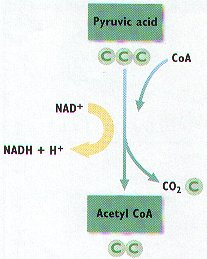
34. Name the 3 stages of cellular respiration.


35. ____________ takes place in the cytoplasm of cells., while the __________ cycle and ETC take place in the _______________.

36. Sketch and label the parts of a mitochondrion.


37. Describe the outer surface of the mitochondria.

38. The inner membrane of the mitochondria is ___________.

39. The folds of the inner mitochondrial membrane are called ___________.

40. The innermost space of the mitochondria is known as the ___________.

41. Using the PowerPoint diagram, answer the following:

a. Glycolysis occurs where?

b. Glycolysis produces what energy molecule?

c. The products of glycolysis enter what other part of a cell?

d. What organic compound enters the Krebs cycle?

e. Electron carriers (NADH & FADH) carry electrons to what?

f. The ETC occurs across what?

g. What is the product at the end of the ETC?

h. What gas is added at the end of the ETC?

i. The Krebs cycle occurs where?

j. What gas is a product of the Krebs cycle?

k. Is ATP made in the Krebs cycle?

l. Is ATP in the ETC?

42. Is glycolysis aerobic or anaerobic? Explain why.


43. Glycolysis requires how much ATP to get started?

44. In glycolysis, glucose is split into two molecules of ______________ or pyruvic _________.

45. Is any CO2 produced during glycolysis?

46. Glycolysis uses 2 ATP and produces ______ ATP.

47. How much NADH (energy carrier) is made during glycolysis?

48. Glycolysis does ______ require oxygen but may occur if _________ is present.

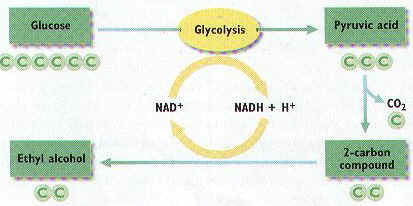
49. If oxygen is NOT present, the products of glycolysis enter a process called _______________.

50. Fermentation is an _____________ process because no ___________ is needed.

51. Name the 2 types of fermentation.


52. Which fermentation occurs in tired muscle cells?

53. _________ acid builds up and makes muscles feel tired.

54. ____________ fermentation in yeasts produces an alcohol called _____________.

55. Fermentation only nets ______ molecules of ATP.

56. Why did Hans Krebs receive the Nobel Prize in medicine in 1953?


57. Why did he have to leave Germany before WWII?

58. Does the Krebs cycle need oxygen?

59. Processes needing oxygen are said to be ____________.

60. How many turns of the Krebs cycle are needed to burn one molecule of glucose?

61. What gas is made during the Krebs Cycle?

62. Where does the Krebs cycle take place?

63. TWO TURNS of the Krebs cycle produces ______ CO2 molecules, ______ NADH, _____FADH, and ____ ATP molecules.

64. Label the parts of the Krebs Cycle.

65. The ETC occurs across the inner membrane of the ____________ and produces ________ as an end product.

66. The ETC uses the energized electrons carried by the coenzymes __________ and ________ to make 34 ATP’s of energy.

67. Each NADH makes _______ ATP’s, while each FADH makes only ______ ATP’s.


CLICK HERE FOR PRINTABLE COPY


Cell Respiration PPT Questions – B1

ADP, ATP, & Cellular Respiration
PowerPoint Question Guide

1. _______ is the energy used by all cells.

2. ATP stands for ________________ ______________.

3. ATP is an ___________ molecule containing high-energy ____________ bonds.

4. The sugar in ATP is ____________, while the nitrogen base is ___________.

5. How many phosphate groups does ATP contain?

6. How do we get energy from ATP?


7. Make a simple sketch of ATP and show the high-energy bond that is broken.


8. To break the last phosphate bond in ATP, _________ must be added.

9. The process is called ___________.

10. What enzyme is used to help weaken & break the last phosphate bond in ATP?

11. Can ATP be remade?

12. When the last phosphate bond of ATP is broken, __________ and a free __________ form.

13. What enzyme can be used to rejoin ADP and a free phosphate to make more ATP?

14. Using ATP’s energy and then remaking it is called the ________________ cycle.

15. In the body, ATP is made during the process of _____________ ________________.

16. Cellular respiration takes place in both ____________ and ____________.

17. Cellular respiration requires the gas ____________.

18. In cellular respiration, _____________ is oxidized (loses electrons) and ___________ is reduced (gains electrons).

19. The breakdown of one glucose molecule results in ________ to _______ ATP molecules of energy.

20. Write the overall equation for cellular respiration.


21. Cellular respiration is an example of a ________ reaction.

22. REDOX stands for _____________-____________ reactions.

23. What are the products of cellular respiration?

24. What carries the energized electrons from glucose in cellular respiration?

25. NAD+_ is a _____________ that forms ____________ when it is reduced (picks up electrons).

26. What does NAD+ stand for?

27. Name a second coenzyme that acts as an energy carrier in cellular respiration.

28. What does FAD+ stand for?

29. FAD+ becomes __________ whenever it is reduced.

30. Cellular respiration like photosynthesis is a _______________ ____________ because it involves many reactions to make or break down carbohydrates.

31. Cellular respiration is an ______________ reaction because it releases energy from glucose.

32. Glucose is broken down into __________ and _________.

33. Is cellular respiration catabolic or anabolic? explain why.


34. Name the 3 stages of cellular respiration.


35. ____________ takes place in the cytoplasm of cells., while the __________ cycle and ETC take place in the _______________.

36. Sketch and label the parts of a mitochondrion.


37. Describe the outer surface of the mitochondria.

38. The inner membrane of the mitochondria is ___________.

39. The folds of the inner mitochondrial membrane are called ___________.

40. The innermost space of the mitochondria is known as the ___________.


Chapter 10 Protein Synthesis PPT Questions


Protein Synthesis
ppt Questions

DNA and Genes

1. What are genes and what do they code for?


2. Proteins are made of chains of _______________.

3. How do cells use proteins?


4. The subunits making up polypeptides are called _________________.

5. How many amino acids exist?

6. Sketch and label the basic structure of an amino acid.


7. The group that makes amino acids different from each other & gives the amino acid its unique properties is called the ___________ group.

8. DNA is found in the ____________ of a cell and begins the process of making a _______________.

9. Where are proteins made?

10. Describe the two types of ribosomes.


11. The first step in making a protein is to make a copy of ___________ in the nucleus.

RNA

12. What nucleic acid contains the master code for making proteins?

13. What nucleic acids acts as a blueprint in copying the master code?

14. Compare and contrast the sugars on DNA and RNA.


15. Compare and contrast the nitrogen bases on DNA and RNA.


16. RNA is made of a ____________ strand, while DNA is a ___________ stranded molecule.

17. What base replaces thymine on RNA?

18. Name the 3 types of RNA molecules.


19. What is the function of mRNA?


20. What is the function of rRNA?


21. What is the function of tRNA?


22. Describe the shape of mRNA.

23. How does mRNA get out of the nucleus once it has copied DNA’s instructions?

24. What bases pair together on RNA?

25. How long is mRNA?

26. What is a codon?


27. Methionine is called the __________ codon & is represented by the bases ________.

28. Name the 3 stop codons.

29. How long in rRNA?

30. What is the shape of rRNA?

31. What two things make up ribosomes?

32. What process occurs at the ribosomes?

33. Each codon stands for an _______________.

34. Can amino acids have more than one codon?

35. There are ______ amino acids and ______ possible codons.

36. How do you read the circular genetic codon table?


37. Use the genetic codon table and name these amino acids:

GGG?
UCA?
CAU?
GCA?
AAA?

38. Name the complementary bases on DNA.


39. Name the complementary bases on RNA.


40. What is the shape of tRNA?

41. What can attach to one end of a tRNA molecule for transport?

42. Opposite the attachment site on tRNA are 3 nucleotide bases called the ______________.

43. Make a sketch of a tRNA molecule with its attachment site and anticodon labeled.


44. A codon on mRNA is complementary to an _____________ on tRNA.

45. What anticodon is complementary to the codon – ACU?

Transcription and Translation

46. Sketch the pathway to making a protein.


47. define protein synthesis.


48. Name the 2 phases of protein synthesis.

49. Before mRNA can leave the nucleus it must be _______________ in order to correctly make proteins.

50. Define transcription and tell where it occurs.


51. What RNA copies DNA?

52. Are both strands of DNA copied?

53. What enzyme is required to copy DNA?

54. The DNA strand that is copied is called the _____________ strand.

55. What would be the complementary RNA sequence for the DNA sequence- 5′- GCGTATG-3′?

56. What enzyme separates the DNA strands in transcription?

57. RNA polymerase adds complementary ____________ to the DNA template strand.

58. ___________ are regions on DNA where RNA polymerase binds to start transcription.

59. The promoter contains a sequence called the _________ box.

60. Other sequences on DNA called __________ signals tell the RNA polymerase when to stop transcribing.

61. Newly made mRNA must be _________ to make the nucleic acid functional.

62. What are introns & what happens to them during mRNA processing?


63. What are exons and what happens to them during mRNA processing?


64. Describe the cap that is added to the new mRNA transcript.


65. What type of tail is added to the mRNA transcript?

66. The new mRNA transcripts is made of _____________ with a 5′ _________ and a 3′ ____________ tail.

67. What happens next to the newly made mRNA?

68. Define translation & tell where it occurs?


69. How do ribosomes read mRNA?

70. Describe the structure of a ribosome.


71. Ribosomes are composed of ________ rRNA and ________ protein.

72. Ribosomes have 2 tRNA sites called _______ and ______ along with an exit site.

73. The first part of translation is called ____________.

74. The small ribosomal subunit attaches to what codon on mRNA?

75. Once the mRNA and small subunit attach, what happens next?

76. Sketch an label a ribosome with both its subunits, its 2 tRNA sites, and the attached mRNA transcript.


77. The ______________ moves along the mRNA strand ________ codon at a time.

78. How many tRNA’s will fit into a ribosome at one time?

79. What happens to the two amino acids carried by the 2 tRNA’s inside a ribosome?

80. The joining of amino acids by ___________ bonds is the second part of translation called ______________.

81. Once an amino acid is joined to the growing polypeptide chain, the tRNA leaves the _______________ to pick up another ________________.

82. When a tRNA leaves the ribosome, the ribosome moves down the _________ strand allowing another ________ and its amino acid to enter.

83. each time the ribosome moves, it moves over _________ codon.

84. The last stage of translation is called _______________.

85. Name the 3 termination codons.

86. The sequence of amino acids in the polypeptide chain is called the ____________ protein structure.