Which characteristic of living things relates to stability?
What does homeostasis mean?
What is ecology?
How do heterotrophs obtain energy?
List distinct properties of living things.
What is the smallest unit that can carry on life called?
What are all living things made of?
Which of the following are characteristics of ALL living things — growth, development, cellular organization, & movement?
A scientist noticed that bacteria weren’t growing in some test tubes. Is this observation, hypothesis, or experimentation?
The scientist suggests that bacteria aren’t growing in some test tubes because they aren’t getting the nutrients they need. Is this observation, hypothesis, experimentation, or conclusion?
A scientist adds a different nutrient to half of the test tubes in which he is growing bacteria. Is this observation, hypothesis, or experimentation?
Define hypothesis.
What is a theory?
A hypothesis is rejected if it does not explain what?
When scientists are planning experiments, do they have a good idea of the possible results?
If new evidence emerges, do theories change?
Are theories supported with some scientific knowledge?
Are theories proved scientific ideas?
For scientists to communication with each other about their data, what do they do with their data?
How do scientists organize data?
If a microscope has a 30X objective lens & a 10X ocular (eyepiece) lens, what is its magnification?
What are the base units for each of these SI measurements — length? second? volume? mass?
Refer to the ' + 'illustration above. Reproduction ensures the ongoing success of both species.
'; answerText[0] = '
T
'; numberText[1] = '2.'; questionText[1] = '
Refer to the ' + 'illustration above. The sand dollar and paramecium both show organization.
'; answerText[1] = '
T
'; numberText[2] = '3.'; questionText[2] = '
Scientists have not discovered any new species on Earth in more than 20 ' + 'years.
'; answerText[2] = '
F
'; numberText[3] = '4.'; questionText[3] = '
Publication of the results of scientific investigations enables other scientists to ' + 'verify these results.
'; answerText[3] = '
T
'; numberText[4] = '5.'; questionText[4] = '
Resolution is a microscope’s power to increase an object’s apparent ' + 'size.
'; answerText[4] = '
F
'; numberText[5] = '6.'; questionText[5] = '
Biology is the study of
a.
minerals.
c.
the weather.
b.
life.
d.
energy.
'; answerText[5] = '
B
'; numberText[6] = '7.'; questionText[6] = '
Homeostasis means
a.
a change over long periods of time.
c.
rapid change.
b.
keeping things the same.
d.
the same thing as evolution.
'; answerText[6] = '
B
'; numberText[7] = '8.'; questionText[7] = '
Which of the ' + 'following is a means by which heterotrophs can obtain energy?
a.
using water, carbon dioxide, and energy from the sun to produce ' + 'sugars
b.
using water and ' + 'carbon dioxide to produce energy-rich compounds
c.
consuming autotrophs
d.
consuming simple chemicals from the environment and using them to ' + 'assemble complex chemicals and structures needed by the organism
'; answerText[7] = '
D
'; numberText[8] = '9.'; questionText[8] = '
Which of the ' + 'following is not necessarily a distinct property of living things?
a.
homeostasis
c.
complexity
b.
metabolism
d.
reproduction
'; answerText[8] = '
C
'; numberText[9] = '10.'; questionText[9] = '
All organisms ' + 'are composed of
a.
diatoms.
c.
cells.
b.
cellulose.
d.
None of the ' + 'above
'; answerText[9] = '
C
'; numberText[10] = '11.'; questionText[10] = '
Which example ' + 'of scientific methodology is incorrect?
a.
Observation—A number of people in Zaire dying of a disease ' + 'outbreak
b.
Measurement—A record of the number of people with symptoms of the disease and the ' + 'number of people who had died from the disease
c.
Analysis of data—Comparison of the effects of mixing monkey cells ' + 'with virus-containing blood in test tubes and the effects of mixing of liquid from these test tubes ' + 'with fresh monkey cells
d.
Inference making—Identification of the Ebola virus as the cause of ' + 'the disease by taking electron micrographs of substances found in the blood of persons affected with ' + 'the disease
'; answerText[10] = '
D
'; numberText[11] = '12.'; questionText[11] = '
Scientific hypotheses are most often tested by the process of
a.
communicating.
c.
experimenting.
b.
inferring.
d.
analyzing data.
'; answerText[11] = '
C
'; numberText[12] = '13.'; questionText[12] = '
A hypothesis ' + 'is
a.
a definite answer to a given problem.
b.
a testable possible explanation of an ' + 'observation.
c.
a proven statement.
d.
a concluding statement.
'; answerText[12] = '
B
'; numberText[13] = '14.'; questionText[13] = '
A hypothesis ' + 'that does not explain an observation
a.
is known as an inaccurate forecast.
c.
is rejected.
b.
often predicts a different observation.
d.
None of the above
'; answerText[13] = '
C
'; numberText[14] = '15.'; questionText[14] = '
A scientific ' + 'theory
a.
is absolutely certain.
b.
is unchangeable.
c.
may be revised as new evidence is presented.
d.
is a controlled experiment.
'; answerText[14] = '
C
'; numberText[15] = '16.'; questionText[15] = '
observation : hypothesis ::
a.
theory : observation
c.
certainty : investigation
b.
guess : hypothesis
d.
theory : control
'; answerText[15] = '
C
(leads to ' + 'a(n))
'; numberText[16] = '17.'; questionText[16] = '
Which of the ' + 'following components of a scientific investigation would benefit from communication between ' + 'scientists?
a.
observing
c.
analyzing data
b.
measuring
d.
All of the ' + 'above
'; answerText[16] = '
D
'; numberText[17] = '18.'; questionText[17] = '
Most typically, ' + 'the order in which the steps of the scientific method are applied is
"); document.writeln(""); document.writeln(""); document.close(); return(false); } function GetResponse(answerIndex, answer) { var listIndex; var responseText; if (listMap.charAt(answerIndex) == "1") { listIndex = answer.selectedIndex; responseText = answer.options[listIndex].text; } else responseText = answer.value; return(responseText); } function ScoreAnswer(answerIndex, responseText) { var listIndex; var answerText; answerText = ansMap[answerIndex]; if (qtypeMap.charAt(answerIndex) == "4") return(NumericCompare(responseText, answerText)); else if (qtypeMap.charAt(answerIndex) == "5") return(MultiCompare(responseText, answerText)); else if (responseText.toUpperCase() == answerText.toUpperCase()) return(true); else return(false); } function BuildPrefixText(answerIndex, responseText, isCorrect) { var text; var listIndex; text = "
" if (isCorrect) text += "" else text += "" if (listMap.charAt(answerIndex) == "1") { if (responseText.length == 0) responseText = " "; text += " " + responseText + " "; } text += "
" return(text); } function StripSpaces(s) { var len; var i; len = s.length; for (i=len - 1; i >= 0 && s.charAt(i) == " "; --i) len = i; if (len == 0) s = ""; else if (len != s.length) s = s.substring(0, len); return(s); } function TranslateHtmlString(text) { var newText; var replaceString; var position; var length; var breakPos; var skipExtra; var i; newText = ""; position = 0; length = text.length; while (position < length) { skipExtra = 0; breakPos = -1; for (i=position; i < length && breakPos < 0; ++i) { switch(text.charAt(i)) { case '>': replaceString = ">"; breakPos = i; break; case '<': replaceString = "<"; breakPos = i; break; case '&': replaceString = "&"; breakPos = i; break; case 'r': if ((i + 1) < length && text.charAt(i + 1) == 'n') skipExtra = 1; replaceString = " "; breakPos = i; break; case 'n': replaceString = " "; breakPos = i; break; case ' ': if ((i + 1 < length) && text.charAt(i + 1) == ' ') { replaceString = " "; breakPos = i; } break; } } if (breakPos < 0) { newText += text.substring(position, length); position = length; } else { if (breakPos > position) newText += text.substring(position, breakPos); newText += replaceString; position = breakPos + 1 + skipExtra; } } return(newText); } function FixMCNotes(notesText, studentText) { var displayText; var searchText; var upperNotes; var charCode; var startIndex; var endIndex; displayText = ""; if (studentText.length > 0 && notesText.length > 0) { upperNotes = notesText.toUpperCase(); studentText = studentText.toUpperCase(); charCode = studentText.charCodeAt(0); searchText = "/" + String.fromCharCode(charCode) + "/"; startIndex = upperNotes.indexOf(searchText); if (startIndex >= 0) { startIndex += searchText.length; searchText = "/" + String.fromCharCode(charCode + 1) + "/"; endIndex = upperNotes.indexOf(searchText, startIndex); if (endIndex < startIndex) endIndex = notesText.length; displayText = notesText.substring(startIndex, endIndex); } else if (notesText.charAt(0) != "/") displayText = notesText; } return(displayText); } function NumericCompare(s1, s2) { var s1Sign; var s2Sign; var tempString; var decimalCount; var decimalPos; var numToDelete; var len; var ch; var i; s1.toUpperCase(); s2.toUpperCase(); if (s1 == s2) return(true); else { s1Sign = 1; s2Sign = 1; tempString = ""; for (i=0; i < s1.length; ++i) { ch = s1.charAt(i); if (ch == "-" && tempString.length == 0) s1Sign = -1; else if ((ch >= "0" && ch <= "9") || ch == ".") tempString += ch; } s1 = tempString; decimalCount = 0; decimalPos = -1; for (i=0; i < s1.length; ++i) { if (s1.charAt(i) == '.') { ++decimalCount; if (decimalPos < 0) decimalPos = i; } } if (decimalCount == 1 && decimalPos >= 0) { len = s1.length; for (i=len - 1; i >= decimalPos; --i) { if (i == decimalPos || s1.charAt(i) == '0') len = i; else break; } if (len < s1.length) s1 = s1.substring(0, len); if (s1.length == 0) s1 = "0"; } numToDelete = 0; for (i=0; i < s1.length; ++i) { if (s1.charAt(i) == "0") ++numToDelete; else break; } if (numToDelete > 0) { if (numToDelete == s1.length) --numToDelete; if (numToDelete > 0) s1 = s1.substring(numToDelete); } ///////////////////////////////////////////// tempString = ""; for (i=0; i < s2.length; ++i) { ch = s2.charAt(i); if (ch == "-" && tempString.length == 0) s2Sign = -1; else if ((ch >= "0" && ch <= "9") || ch == ".") tempString += ch; } s2 = tempString; decimalCount = 0; decimalPos = -1; for (i=0; i < s2.length; ++i) { if (s2.charAt(i) == '.') { ++decimalCount; if (decimalPos < 0) decimalPos = i; } } if (decimalCount == 1 && decimalPos >= 0) { len = s2.length; for (i=len - 1; i >= decimalPos; --i) { if (i == decimalPos || s2.charAt(i) == '0') len = i; else break; } if (len < s2.length) s2 = s2.substring(0, len); if (s2.length == 0) s2 = "0"; } numToDelete = 0; for (i=0; i < s2.length; ++i) { if (s2.charAt(i) == "0") ++numToDelete; else break; } if (numToDelete > 0) { if (numToDelete == s2.length) --numToDelete; if (numToDelete > 0) s2 = s2.substring(numToDelete); } if (s1Sign == s2Sign && s1 == s2) return(true); } return(false); } function MultiCompare(responseText, answerText) { var startIndex; var endIndex; var partialText; responseText = responseText.toUpperCase(); answerText = answerText.toUpperCase(); startIndex = 0; do { endIndex = answerText.indexOf("r", startIndex); if (endIndex < 0) partialText = answerText.substring(startIndex); else partialText = answerText.substring(startIndex, endIndex); if (responseText == partialText) return(true); startIndex = endIndex + 1; } while (endIndex > 0); return(false); } function FixMTF(f) { var text; var letter; var theList; var listIndex; var number; var i; for (i=0; i < f.length; ++i) { if (f.elements[i].name.indexOf("MTF:") == 0) { number = parseInt(f.elements[i].name.substring(4), 10); theList = f["MTF-" + number + "-1"]; if (theList) { listIndex = theList.selectedIndex; letter = theList.options[listIndex].text; } else letter = ""; text = StripSpaces(f["MTF-" + number + "-2"].value); if (text == "") f.elements[i].value = letter; else f.elements[i].value = letter + "," + text; } } } function AllowReset() { return(window.confirm("Do you want to clear all of your answers?")); } // -->
Name:
Introduction Quiz
True/False
Indicate whether the sentence or statement is true or false.
1.
Refer to the illustration above. Reproduction ensures the ongoing success of both species.
2.
Refer to the illustration above. The sand dollar and paramecium both show organization.
3.
Scientists have not discovered any new species on Earth in more than 20 years.
4.
Publication of the results of scientific investigations enables other scientists to verify these results.
5.
Resolution is a microscope’s power to increase an object’s apparent size.
Multiple Choice
Identify the letter of the choice that best completes the statement or answers the question.
6.
Biology is the study of
a.
minerals.
c.
the weather.
b.
life.
d.
energy.
7.
Homeostasis means
a.
a change over long periods of time.
c.
rapid change.
b.
keeping things the same.
d.
the same thing as evolution.
8.
Which of the following is a means by which heterotrophs can obtain energy?
a.
using water, carbon dioxide, and energy from the sun to produce sugars
b.
using water and carbon dioxide to produce energy-rich compounds
c.
consuming autotrophs
d.
consuming simple chemicals from the environment and using them to assemble complex chemicals and structures needed by the organism
9.
Which of the following is not necessarily a distinct property of living things?
a.
homeostasis
c.
complexity
b.
metabolism
d.
reproduction
10.
All organisms are composed of
a.
diatoms.
c.
cells.
b.
cellulose.
d.
None of the above
11.
Which example of scientific methodology is incorrect?
a.
Observation—A number of people in Zaire dying of a disease outbreak
b.
Measurement—A record of the number of people with symptoms of the disease and the number of people who had died from the disease
c.
Analysis of data—Comparison of the effects of mixing monkey cells with virus-containing blood in test tubes and the effects of mixing of liquid from these test tubes with fresh monkey cells
d.
Inference making—Identification of the Ebola virus as the cause of the disease by taking electron micrographs of substances found in the blood of persons affected with the disease
12.
Scientific hypotheses are most often tested by the process of
a.
communicating.
c.
experimenting.
b.
inferring.
d.
analyzing data.
13.
A hypothesis is
a.
a definite answer to a given problem.
b.
a testable possible explanation of an observation.
c.
a proven statement.
d.
a concluding statement.
14.
A hypothesis that does not explain an observation
a.
is known as an inaccurate forecast.
c.
is rejected.
b.
often predicts a different observation.
d.
None of the above
15.
A scientific theory
a.
is absolutely certain.
b.
is unchangeable.
c.
may be revised as new evidence is presented.
d.
is a controlled experiment.
16.
observation : hypothesis ::
a.
theory : observation
c.
certainty : investigation
b.
guess : hypothesis
d.
theory : control
17.
Which of the following components of a scientific investigation would benefit from communication between scientists?
a.
observing
c.
analyzing data
b.
measuring
d.
All of the above
18.
Most typically, the order in which the steps of the scientific method are applied is
Smithers thinks that a special juice will increase the productivity of workers. He creates two groups of 50 workers each and assigns each group the same task (in this case, they’re supposed to staple a set of papers). Group A is given the special juice to drink while they work. Group B is not given the special juice. After an hour, Smithers counts how many stacks of papers each group has made. Group A made 1,587 stacks, Group B made 2,113 stacks.

Identify the:
1. Control Group
2. Independent Variable
3. Dependent Variable
4. What should Smithers’ conclusion be?
5. How could this experiment be improved?
Homer notices that his shower is covered in a strange green slime. His friend Barney tells him that coconut juice will get rid of the green slime. Homer decides to check this out by spraying half of the shower with coconut juice. He sprays the other half of the shower with water. After 3 days of “treatment” there is no change in the appearance of the green slime on either side of the shower.
6. What was the initial observation?
Identify the-
7. Control Group
8. Independent Variable
9. Dependent Variable
10. What should Homer’s conclusion be?
Bart believes that mice exposed to microwaves will become extra strong (maybe he’s been reading too much Radioactive Man). He decides to perform this experiment by placing 10 mice in a microwave for 10 seconds. He compared these 10 mice to another 10 mice that had not been exposed. His test consisted of a heavy block of wood that blocked the mouse food. he found that 8 out of 10 of the micro waved mice were able to push the block away. 7 out of 10 of the non-micro waved mice were able to do the same.

Identify the-
11. Control Group12. Independent Variable
13. Dependent Variable
14. What should Bart’s conclusion be?
15. How could Bart’s experiment be improved?
Krusty was told that a certain itching powder was the newest best thing on the market, it even claims to cause 50% longer lasting itches. Interested in this product, he buys the itching powder and compares it to his usual product. One test subject (A) is sprinkled with the original itching powder, and another test subject (B) was sprinkled with the Experimental itching powder. Subject A reported having itches for 30 minutes. Subject B reported to have itches for 45 minutes.
Identify the-
16. Control Group17. Independent Variable
18. Dependent Variable
19. Explain whether the data supports the advertisements claims about its product.
Lisa is working on a science project. Her task is to answer the question: “Does Rogooti (which is a commercial hair product) affect the speed of hair growth”. Her family is willing to volunteer for the experiment.
20. Describe how Lisa would perform this experiment. Identify the control group, and the independent and dependent variables in your description.
A line graph is most useful in displaying data or information that changes continuously over time. The example below shows the changes in the temperature over a week in January. Notice that the title of the graph is “Average Daily Temperature for January 1-7 in degrees Fahrenheit”.
To the left is a table that shows the date in one column and the corresponding temperature in the second column. The line graph on the right shows the degrees of temperature going up the vertical axis (up and down numbers on the left of the graph) and the days of the week on the horizontal axis (going sideways from left to right). The points for the temperature for each day are connected by a line – thus the graph is a line graph.
Average Daily Temperature for January 1-7 in Degrees Fahrenheit
Date
Temperature
1
10
2
25
3
30
4
42
5
23
6
25
7
40
BAR GRAPHS
Bar graphs are an excellent way to show results that are one time, that aren’t continuous – especially samplings such as surveys, inventories, etc. Below is a typical survey asking students about their favorite after school activity. Notice that in this graph each column is labeled – it is also possible to label the category to the left of the bar. In this case, the numbers for each category are across the bottom of the chart.
A bar chart is marked off with a series of lines called grid lines. These lines typically mark off a numerical point in the series of numbers on the axis or line. In this case, each grid line going up and down marks a multiple of 20 as the graph is divided. More gridlines can make it easier to be exact with the amounts being shown on the bar graph, but too many can make it confusing. Notice that for data that does not fall evenly on a multiple of 20, the bar is in between two grid lines. Bar graphs are useful to get an overall idea of trends in responses – which categories get many versus few responses.
Favorite Student After School Activity
Activity
Number
Visit W/Friends
175
Talk on Phone
168
Play Sports
120
Earn Money
120
Use Computers
65
CIRCLE/PIE GRAPHS
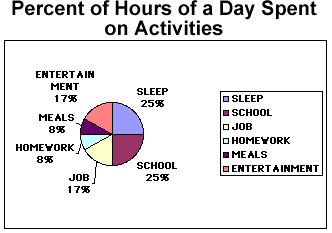
Circle or pie graphs are particularly good illustrations when considering how many parts of a whole are inception. In the table below both the number of hours in a whole day devoted to certain activities is listed as well as the percent of time for each of these activities. The pie chart is then divided very much as a baker’s pie would be into slices that represent the proportional amounts of time spent on each activity.
To the right of the pie chart is a legend that tells which color stands for which category. In addition, the percents are also near the pie slice that stands for that particular amount of time spent.