Biochemistry Bi Worksheet


Biochemistry Worksheet


Section 3.1 – Properties of Water  


1. Why is water such an important molecule to living things?


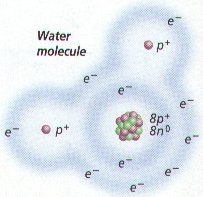
2. Describe the chemical make up and type of bonding found in water molecules.


3. Explain why the hydrogen and oxygen atoms don’t share electrons equally in a water molecule.


4. What is the effect of this uneven sharing of electrons in water?


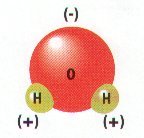
5. Sketch a molecule of water showing the charges on the molecule.


6. What is the overall charge on a water molecule? Explain why.


7. Define polar compound and give an example.


8. Water’s polarity makes it very effective in _____________ other substances.

9. Name 2 types of compounds that dissolve well in water.

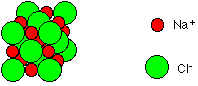
10. What happens when an ionic compound such as sodium chloride (table salt) dissolves in water?


11. Water molecules are ___________ to other water molecules.

12. What type of bonding holds 2 or more water molecules together?

13. Are hydrogen bonds strong or weak bonds? Can they be easily broken?

14. Water molecules attracting other water molecules is called _________________.

15. Cohesion of water molecules produces ________________ tension making water seem like it has a “skin” on it. Surface tension enables some _____________ to walk across the surface of the water.

16. Water molecules attracting other types of molecules is called _________________.

17. Adhesion and cohesion together enable water molecules to move ____________ through narrow tubes against the force of gravity.

18. The above property of water is called _________________.

19. Give an example of an organism using capillarity.


20. What must be true for water to change temperature?

21. What effect does heating water have on the hydrogen bonds holding the water molecules together? What happens to the speed at which the molecules are moving?


22. Give an example of how this water property helps organisms in the environment.


Section 3.2 – Carbon Compounds

23.  What is an organic compound?


24. Besides carbon, name 3 other elements that make up most organic compounds.

25. Carbon dioxide, CO2, is NOT an organic compound. Explain why.


26. How many electrons are in the outermost energy level of carbon? How many does it need to have this energy level filled?

27. How many covalent bonds can carbon form?

28. Name 3 structural shapes that form whenever carbon atoms bond to other carbon atoms.


29. How many electrons are being shared in a single covalent bond? double covalent bond? triple covalent bond? quadruple covalent bond?


30. Draw these 3 molecules and circle a single bond, double bond, and a triple bond in your drawings — benzene, acetylene, and ethanol.


31. Explain what is meant by a functional group, & tell what effect they have on the molecules they are attached to.


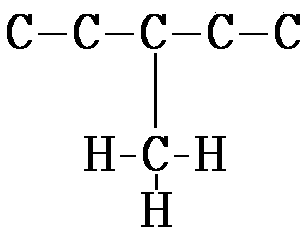
32. Write the formula for these functional groups (use your textbook & handout) — hydroxyl, carboxyl, phosphate group, amino group, and methyl group.


33. Hydroxyl groups attached to carbon atoms forms an _____________. Name an alcohol used in humans to assemble molecules needed for life.

34. Large carbon molecules are built from smaller, simpler molecules called ____________.

35. Large carbon molecules made of monomers are called _______________.

36. What are large polymers called?

37. What type of reaction links monomers to make polymers?

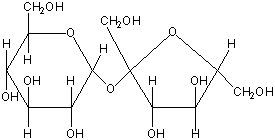
38. Sketch a molecule of sucrose (table sugar) formed from condensation. Name the 2 sugars that were combined to form sucrose.


39. Condensation reactions involve the removal of a molecule of ____________.

40. What reaction is used to breakdown polymers? Is water added or removed? How does this compare to condensation?


41. All life processes require a constant supply of ____________. Name the molecule used by cells to get energy. Give its abbreviation.

42. ATP contains what 3 functional groups covalently bonded together? Write the formula for this functional group.

43. Which bonded phosphate group on ATP releases the MOST energy when broken?

Section 3.3 – Macromolecules

44. Name the 4 main classes of macromolecules (organic molecules) & tell what 3 elements all of these contain.


Carbohydrates store energy for organisms!

45. In what ratio are hydrogen & oxygen atoms in carbohydrates?

46. In what 3 forms do carbohydrates exist?

47. What are the monomers of carbohydrates called? What is their common name? Give the ratio of carbons, hydrogens, & oxygens.

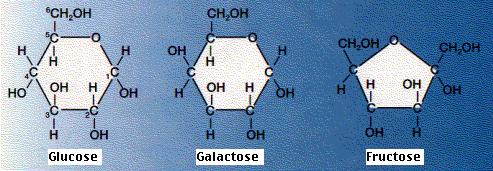
48. Name the 3 MOST common monosaccharides.

49. Sketch & label a molecule of each of these monosaccharides. How do they compare? Write the chemical formula for all three.


50. Because all 3 simple sugars have the same chemical, but different structural formulas, they are called _______________.

51. What are double sugars called? Name & describe the process that forms them.


52. Name a disaccharide.

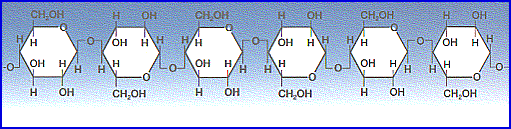
53. What forms a polysaccharide? Name a polysaccharide found in animals. Name 2 found in plants?


54. What chemical reaction formed these large molecule? What reaction would be needed to break these molecules?


Proteins are used to build cells, & they act as enzymes!

55. What are the 4 main elements making up proteins? How many covalent bonds does each of these elements form?


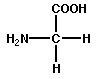
56. Sketch these two amino acids — glycine & alanine.  Circle the center carbon, place a triangle around the amino group, and put a box around the carboxyl group.


57. What are the monomers of proteins called? How many are there? Name the 4 things bonded to the center carbon of this monomer.


58. The main difference among amino acids is their ___________ group. What is the R-group on glycine? on alanine?

59. Differences in R-groups give different proteins different ______________.

60. How does a dipeptide form? Sketch the dipeptide formed from glycine and alanine. What molecule had to be removed to join these 2 amino acids?


61. What do you call the covalent bonds that hold amino acids together? Put a box around these bond in the sketch you did on question 60.

62. Long chains of amino acids are called ___________________ and these join together to make a ________________.

63. Hydrogen bonding among individual amino acids in a chain cause what effect on the protein’s shape?

64, What is the effect of temperature on protein shape? Give an example of this.


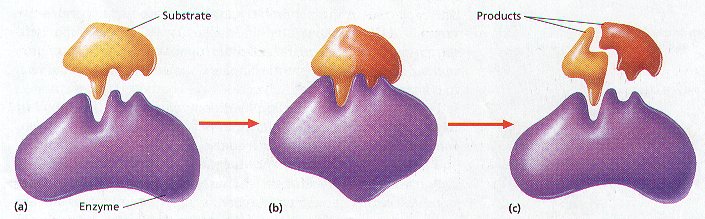
65. Most proteins act as catalysts or __________________ inside of cells.

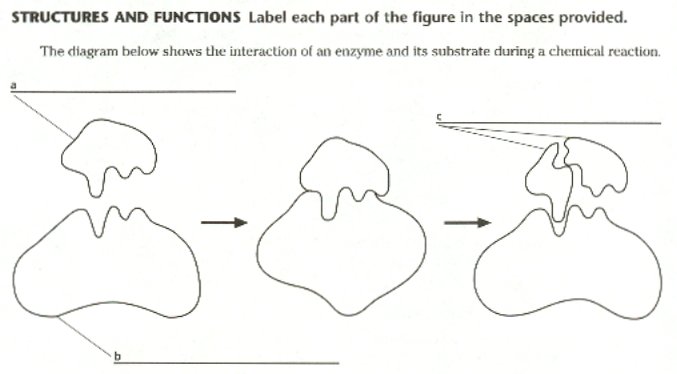
66. The substance an enzyme is acting upon is called the _____________ and it must ______ into a place called the active site on the enzyme.

67. When a substrate joins with an enzyme, what effect does this have on chemical bonding of that substrate? Is the enzyme affected temporarily or permanently? How is it affected?


68. When chemical bonds in a substrate are weakened, what effect does this have on activation energy needed to start the reaction?

69. After the reaction, what happens to the products? Can the enzyme be re-used & why?


70. Besides temperature, what else can effect how an enzyme works by changing the enzyme’s shape? Can the reaction still take place?

Lipids include fats that are used for long-term energy storage!

71. Are lipids polar or nonpolar? What happens to lipids when they are placed in water?

72. Compared to carbohydrates, what is true about the ratio of carbon & hydrogen atoms to oxygen atoms? If a compound has more bonds, what can it store more of in those bonds?


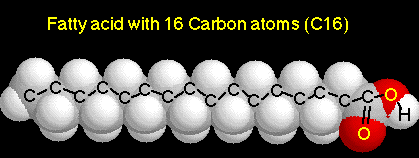
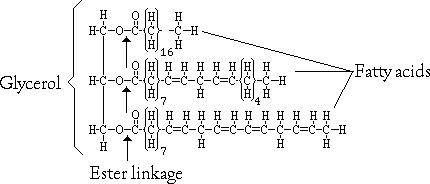
73. Most lipids are made of ______________ acids. Describe their shape. What functional group is found on the head end of the molecule?


74. Sketch these 2 fatty acids — palmitic & linoleic.  Circle the carboxyl group on the “head” of the molecule. Is this end polar or nonpolar? Will this end be attracted to  or repelled by water?


75. Are both ends of a fatty acid polar? Explain.

76. Hydophilic means water ___________. Which end of  a fatty acid is hydrophilic. The nonpolar end of a fatty acid is said to be _______________ or “water fearing”.

77. Which end of a fatty acid chain WOULD dissolve in water? Which WOULDN’T?


78. In what type of fatty acid are there only single bonds in the carbon chain? Name one such fatty acid.

79. What type of bond appears in an unsaturated fatty acid? Give an example of an unsaturated fatty acid. Go back to your fatty acid drawings in question 74 and put a box around the double bond in the unsaturated fatty acid.


80. Name the 3 groups of complex lipids.

81. What makes up a triglyceride? What is the difference between a saturated & unsaturated triglyceride?


82. What type of triglycerides tend to be solids at room temperature & why? Which are liquids & why?


83. What type of triglyceride would this of  substance be — vegetable oil?  butter & shortening?

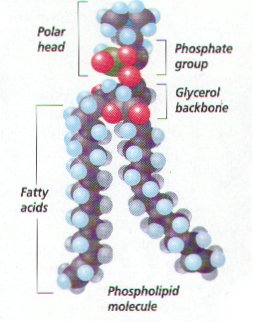
84. What makes up a phospholipid? How are they different from triglycerides? What main part of a cell is made of phospholipids?


85. What is meant by a lipid bilayer? What makes this such an effective barrier between the inside & the outside of the cell?


86. Wax is another complex lipid. Describe its structure.


87. Waxes are highly _________________. Explain how plants make use of this property? animals?


88. What makes up steroids? To what group of organic compounds do steroids belong? How are they used in animals?


89. Name a steroid made by the body & used by nerve cells.

Nucleic acids  store genetic information for cells!

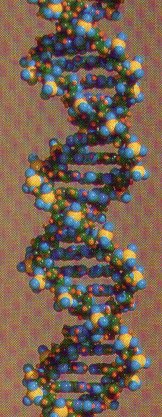
90. Give the name & abbreviation for 2 nucleic acids found in cells.


91. DNA and RNA are both examples of _____________ made of linked monomers called ________________.  The instructions in these molecules is used to make ____________.

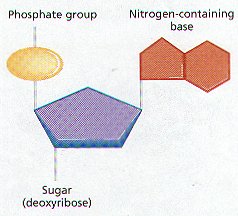
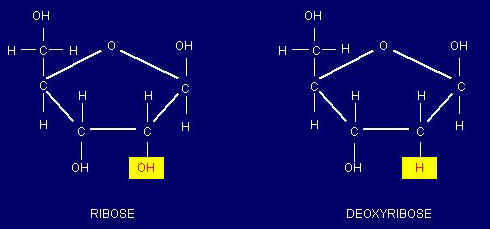
92. Name the 3 parts to a nucleotide then draw and label one.


BACK

Biochemistry Quiz

Name: 

Biochemistry Quiz


True/False
Indicate whether the sentence or statement is true or false.
1.
Because water is a polar molecule, it tends to cause ionic compounds mixed in water to dissociate into ions.
2.
Capillarity is apparent when you put a straw in water and the water level inside the straw rises higher than the level in the surrounding container.
3.
Organic compounds are substances produced and found in living things.
4.
Functional groups are side groups of carbon compounds that confer specific properties to these compounds.
 

Multiple Choice
Identify the letter of the choice that best completes the statement or answers the question.
5.
Which of the following characteristics of water is not a result of hydrogen bonding?
a.
adhesive strength
b.
capillarity
c.
cohesive strength
d.
All of the above are a result of hydrogen bonding.
6.
Carbon is different from most other elements in that
a.
it has four electrons in its outermost energy level.
b.
it readily bonds with other carbon atoms.
c.
it can form single, double, or triple bonds with other atoms.
d.
it shares two electrons with another atom when it forms a covalent bond.
7.
Which of the following is not true of alcohols?
a.
They contain a hydroxyl group (–OH).
b.
They are polar molecules.
c.
They can affect processes in living things, either positively or negatively.
d.
They are the only kind of functional group in organic molecules that contain oxygen.
8.
Amino acids are monomers of
a.
disaccharides.
c.
nucleotides.
b.
proteins.
d.
steroids.
9.
Which organic molecule below is most closely related to lipids?
a.
amino acids
c.
nucleotides
b.
CH2 chains
d.
sugars
10.
Which organic molecule below is most closely related to nucleic acids?
a.
amino acids
c.
nucleotides
b.
CH2 chains
d.
sugars
 

Completion
Complete each sentence or statement.
11.
Water is very effective at dissolving other polar substances because of its ____________________.

12.
Breaking of ____________________ bonds is the first thing that happens when water is heated, which means that it takes a great deal of thermal energy to raise the temperature of water.

13.
In the molecule that has the chemical formula C2H4, the carbon atoms are bonded together with a ____________________ bond.

14.
Because oxygen atoms tend to attract positively charged atoms, organic compounds that contain oxygen atoms tend to form ____________________ bonds.

15.
In a condensation reaction, two molecules become linked together and a molecule of  ____________________ is produced.

16.
The formation of polymers from monomers occurs as a result of ____________________ reactions, and the breakdown of polymers into monomers occurs as a result of ____________________ reactions.

17.
Lipids are ____________________ molecules because they have no negative and positive poles.

18.
A phospholipid is a molecule with a(n) ____________________ head.

19.
Lipids are ____________________ molecules because they have no negative and positive poles.

20.
A phospholipid is a molecule with a(n) ____________________ head.


Check Your Work     Reset

Biochemistry Study Guide


Biochemistry Study Guide


1. Molecules with a slightly negative end and a slightly positive end are called ___________________  _____________________________.

2. A monomer of protein is called an __________________  __________________.

3. An attractive force between like particles is called ___________________________.

4. Organic molecules that catalyze reactions in living systems are ______________________.

5. The compound found in living things that supplies the energy in one of its chemical bonds directly to cells is ______________________.

6. Enzymes lower activation energy by___________ to the ____________________ and ______________________ bonds within the ________________________.

7. The monomers that make up nucleic acids are called __________________________.

8. The type of attraction that holds two water molecules together is called __________________________  __________________________.

9. The sharing of three pairs of electrons is called a ___________________  _____________.

10.  The structural building block that determines the characteristics of a compound is called the _____________________________  _______________________.

11.  Large carbon compounds are built from smaller molecules called ______________________________.

12.  What is the type of reaction that forms large molecules from smaller ones? _________________________________  _____________________________.

13.  What type of reaction breaks large molecules into smaller ones? _______________________

14.  What is the by product of a condensation reaction? __________________________

15.  The attractive force between unlike particles is called ____________________________.

16.  A compound that is stored as glycogen in animals and as a starch in plants is ____________________________________.

17.  Lipids are good energy storage molecules because they have many _________________-___________________ bonds.

18.  What are the components of many lipids? ________________________  ______________________

19.  What is the monomer of many polysaccharides? ______________________________

20.  What kind of reaction allows amino acids to become linked together? ________________________________  _____________________________.

21.  Nucleic acids function primarily to carry __________________________  ____________________ and direct _____________________  ______________________.

22. Tends not to react with water, “Water Fearing”  ________________________________

23. Attracted to water molecules, “Water Loving” _________________________________

24. Water is called a ___________________________  ___________________________.
DIRECTIONS: Read Chapter 3, Biochemistry, and Answer the questions below as completely and as thoroughly as possible. Answer the question in essay form (not outline form), using complete sentences. You may use diagrams or pictures to supplement your answers, but a diagram or picture alone without appropriate discussion is inadequate.

1. Describe the structure of a water molecule, and explain how the electrical charge is distributed over the molecule.

2. Describe the structure of amino acids and proteins.

3. What are the structural differences between monosaccharides, disaccharides, and polysaccharides?

4. What is capillarity? Include defining Adhesion and Cohesion.

5. How does a condensation reaction differ from a hydrolysis reaction?

6. Give Three reasons why water is an effective solvent.

7. What is an organic compound?

8. What property allows carbon compounds to exist in a number of forms?

9. The presence of four electrons in the outermost energy level of a carbon atom enables
carbon atoms to form what THREE Things.

10. Living things contain many different proteins of vastly different shapes and functions.
What determines the shape and thus the function of a particular protein?

11. How does the structure of a phospholipid, linear molecules with a polar end and a
nonpolar end, relate to their function in the cell membrane?


Ap Lab 1 Sample 5


Osmosis & Diffusion – Lab 1 

Introduction:

All molecules have kinetic energy and are constantly in motion.  This motion causes the molecules to bump into each other and move in different directions.  The result is diffusion.  Diffusion is the random movement of molecules from an area of high concentration to an area of low concentration. This will continue until dynamic equilibrium is reached; no net movement will occur.  Osmosis is a special kind of diffusion.  It is the diffusion of water through a selectively permeable membrane. A selectively permeable membrane means that the membrane will only allow certain molecules through such as water, small solutes, oxygen, carbon dioxide, and glucose, because no additional ATP is required. The membrane will not let ions, nonpolar molecules, or large molecules through because extra ATP is needed for them to travel across the membrane.  Active transport is how molecules (such as ions) move against the concentration gradient.  Additional ATP is required to perform this process.

Water will travel from an area of high water potential to an area of low water potential.  Water potential is the measure of free energy of water in a certain solution.  It is measured by using the Greek letter psi (ψ).  The formula for figuring water potential is:

ψ          =             ψp             +           ψs

Water Potential   =   Pressure Potential   +  Solute Potential

Water potential is affected by 2 different factors.  They are the addition of a solute and the pressure potential.  If a solute is added to the water, then the water potential is lowered.  If more pressure is placed on the water, then the potential is raised. The addition of a solute and water potential are inversely proportional.  Pressure being placed onto the water and the potential of the water are directly proportional.

Solutions can have three relationships with each other; isotonic, hypertonic, or hypotonic.  When the solutions have the same concentration of solutes, they are isotonic.  There is no net change in the amount of water on each side of the membrane.  If the solutions differ in their solute concentrations, the solution that has the most solute is hypertonic to the other solution.  The solution with the smaller amount of solute is hypotonic to the other solution. The net movement of water will be from the hypertonic solution to the hypotonic solution. Net movement will occur until dynamic equilibrium is reached, then there will be no net movement of water.

Hypothesis:

In this lab, osmosis and diffusion will occur between the solutions of different concentration until dynamic equilibrium is reached and there is no net movement of water.

Materials:

Exercise 1A:

The materials used include a 30cm piece of 2.5cm dialysis tubing, string, scissors, 15mL of 15% glucose/1% starch solution, 250mL beaker, distilled water, and 4mL of Lugol’s solution (Iodine Potassium-Iodine or IKI).

Exercise 1B:

This exercise required six 30cm strips of presoaked dialysis tuning, six 250mL cups or beakers, string, scissors, a balance, and 25mL of  these solutions: distilled water, 0.2M sucrose, 0.4M sucrose, 0.6M sucrose, 0.8M sucrose, and 1.0M sucrose.

Exercise 1C:

The materials that were required include 100mL of these solutions: distilled water, 0.2M sucrose, 0.4M sucrose, 0.6M sucrose, 0.8M sucrose, and 1.0M sucrose, six 250mL beakers or cups, a potato, a cork borer, a balance, paper towel, and plastic wrap.

Exercise 1D:

The materials used include a calculator, and a pencil.

Procedure:

Exercise 1A:

Soak the dialysis tubing in water.  Tie off one end of the tubing to form a bag.  Open the bag and place the glucose/starch solution in it.  Tie off the other end of the bag, leaving enough room for expansion of the contents in the bag.  Record the color of the solution in Table 1.1.  Next, test the glucose/starch solution for the presence of glucose.  Record the results in Table 1.1.  Fill a 250mL beaker or cup with 2/3 full with distilled water.  Add 4mL of Lugol’s solution to the distilled water and record the color of the solution in Table 1.1.  Test the solution for glucose and record the results in Table 1.1.  Immerse the bag in the beaker of solution.  Allow the beaker and bag to stand for approximately 30 minutes or until you see a distinct color change in the bag and the beaker.  Record the final color of the solution in the bag, and the solution in the beaker, in Table 1.1.  Test the liquid in the beaker and in the bag for the presence of glucose.  Record the results in Table 1.1.

Exercise 1B:

Obtain the six strips of presoaked dialysis tubing and create a bag out of each one by tying off one end.  Pour 25mL of the 6 solutions into separate bags. Tie off the other end of the 6 bags.  Rinse each bag gently with distilled water and blot dry.  Determine the mass of each bag and record it in Table 1.2.  Immerse each bag in one beaker filled will distilled water and label the beaker to indicate the molarity of the solution in the bag.  Let the setups stand for 30 minutes.  Remove the bags from the water.  Carefully blot them dry and determine their masses.  Record them in Table 1.2.  Obtain the other lab groups data to complete Table 1.3.

Exercise 1C:

Pour 100mL of the solutions into a labeled 250mL beaker.  Use a cork borer to cut potato cylinders.  You need 4 cylinders for each cup.  Determine the mass of the 4 cylinders together and record the amount in Table 1.4.  Place the cylinders into the beaker of sucrose solution.  Cover the beaker with plastic wrap to prevent evaporation.  Let it stand overnight.  Remove the cores from the beaker and blot them gently on a paper towel and determine their total mass.  Record the results in Table 1.4.  Calculate the percentage change.  Do this for the individual and class data.  Graph the class average percentage change in mass.

Exercise 1D:

Determine the solute, pressure, and water potential of the sucrose solution.  Then, graph the information that is given about the zucchini cores.

Results:

Exercise 1A:

 Table 1.1


Initial Contents Initial Color Final Color Initial Presence of Glucose Final Presence of Glucose
Bag 15% glucose & 1% starch Cloudy White Purple Yes Yes
Beaker Water & IKI Brown Orange No Yes


  1. Which substances are entering the bag and which are leaving the bag? What evidence supports the answer?  Distilled water and IKI are  leaving and entering.  Glucose is able to leave the bag.
  2. Explain the results that were obtained.  Include the concentration differences and membrane pore size in the discussion.  Glucose and small molecules were able to move through the pores.  Water and IKI moved from high to low concentration.
  3. How could this experiment be modified so that quantitative data could be collected to show that water diffused into the dialysis bag?  You could mass the bag before and after it was placed into the solution.
  4. Based on your observations, rank the following by relative size, beginning with the smallest: glucose molecules, water molecules, IKI molecules, membrane pores, and starch molecules.  Water molecules, IKI molecules, Glucose molecules, Membrane pores, and Starch molecules
  5. What results would you expect if the experiment started with a glucose and IKI solution inside the bag and only starch and water outside?  The glucose and IKI would move out of the bag and turn the starch and water solution purple/blue.  The starch couldn’t move inside the bag because its molecules are too big to pass through the membrane of the tubing.

Exercise 1B:


Table 1.2: Dialysis Bag Results: Individual Data


Contents in dialysis bag Initial mass (g) Final mass (g) Mass difference (g) % Change in mass
Distilled Water 24.7 23.7 1 4.1
0.2M 26.7 27.4 .7 2.62
0.4M 27.4 29 1.6 5.84
0.6M 25.9 29 3.1 12
0.8M 29 32.6 3.6 12.41
1.0M 28 33.7 5.7 20.4


Table 1.3: Dialysis Bag Results: Class Data


Group 1

Group 2

Group 3

Total Class Average
Distilled Water 4.1% .7% 1.6% 6.4% 2.13%
0.2M 2.62% 6.4% 4.1% 13.12% 4.37%
0.4M 5.84% 9.9% 9.5% 25.24% 8.41%
0.6M 12% 13.4% 9.3% 34.37% 11.57%
0.8M 12.41% 14.6% 15.2% 42.21% 14.07%
1.0M 20.4% 19.7% 15.9% 56% 18.67%


  1. Explain the relationship between the change in mass and the molarity of sucrose within the dialysis bags.  The solute is hypertonic and water will move into the bag.  As the molarity increases the water moves into the bag.
  2. Predict what would happen to the mass of each bag in this experiment if all the bags were placed in a 0.4M sucrose solution instead of distilled water.  Explain.  With the 0.2M bag, the water would move out.  With the 0.4M bag, there will be no net movement of water because the solutions reach dynamic equilibrium.  With the 0.6M-1M bags, the water would move into the bag.
  3. Why did you calculate the percent change in mass rather than simply using the change in mass?  This was calculated because each group began with different initial masses and we would have different data.  All the groups needed consistent data.
  4. A dialysis bag is filled with distilled water and then places in a sucrose solution.  The bag’s initial mass is 20g and its final mass is 18g.  Calculate the percent change of mass, showing your calculations.  ((18-20)/20) x 100 = 10%
  5. The sucrose solution in the beaker would have been hypotonic to the distilled water in the bag.

Exercise 1C


Table 1.4: Potato Core: Individual Data


Contents of Beaker Initial Mass (g) Final Mass (g) Difference in Mass % Change in Mass
Distilled Water 2.8 3.7 .9 32.14
0.2M 2.9 3.1 .2 7
0.4M 2.5 2.2 .3 12
0.6M 2.3 1.9 .4 17.39
0.8M 2.5 1.9 .6 24
1.0M 2.3 1.8 .5 21.74


Table 1.5: Potato Core: Class Data


Group 1 Group 2 Total Class Average
Distilled Water 32.14% 21.1% 53.24% 26.62%
0.2M 7% 6.7% 13.7% 6.85%
0.4M -12% -6.5% -18.5% -9.25%
0.6M -17.39% -15.2% -32.59% -16.30%
0.8M -24% -20% -44% -22%
1.0M -21.74% -19% -40.74% -20.37%


Determine the molar concentration of the potato core.  0.3M

Exercise 1D


What is the molar concentration of the zucchini cores? .35M


  1. If a potato core is allowed to dehydrate by sitting in the open air, would the water potential of the potato cells decrease or increase? Why?  It would decrease because the water would leave the cells and cause the water potential to go down.
  2. If a plant cell has a lower water potential than its surrounding environment and if pressure is equal to zero, is the cell hypertonic or hypotonic to its environment? Will the cell gain water or lose water?  It is hypotonic and it will gain water.
  3. The beaker is open to the atmosphere.  What is the pressure potential of the system?  The pressure potential is zero.
  4. Where is the greatest water potential?  In the dialysis bag.
  5. Water will diffuse out of the bag. Why? It is because the water moves from and area of high water potential to an area of lower water potential.
  6. What effect does adding solute have on the solute potential component of that solution? Why?  It makes is more negative.
  7. Consider what would happen to a red blood cell placed in distilled water: a) Which would have the higher concentration of water molecules?  Distilled Water  b) Which would have the higher water potential?  Distilled Water  c)  What would happen to the red blood cell? Why?  It would lyce, because it would take on too much water.

Error Analysis:

Possible errors that could have affected the results of the lab include incorrectly mixing the solutions, ineffectively tying the dialysis tubing, inaccurately measuring , and inaccurately calculating.

Conclusion:

            During Exercise 1A the data that was collected help determine which molecules can and can not move across a cell membrane. Obviously, because of the color change in the bag, the IKI was able to move across the membrane.  It is small enough to fit through the pores in the selectively permeable membrane, along with water.  Starch was too large to move across the membrane. Glucose, as the Benedict’s test proves, was able to move freely along with the water and IKI solution.

In Exercise 1B, it was proven that water moves faster across the cell membrane than sucrose.  The water moved to help reach dynamic equilibrium between the 2 solutions.  The sucrose molecules are too big to move across the membrane as fast as water can.

The data in Exercise 1C showed that the potatoes contained sucrose.  The sucrose in the potato raised the solute potential, which lowered the water potential.  The beaker of distilled water had a high water potential.  Water moves down the concentration gradient, causing the potato cores to take on water.

Exercise 1D helped better understand the lab with simple algebra equations.  It proved that the data that was collected was correct through mathematics.


Ap Unit 6 Heredity Study Guide


Unit 5    Molecular Genetics  Study Guide 


ü     Be able to describe & explain the experiments of the following scientists:
Frederick Griffith
Erwin Chargraff
Alfred Hershey
Martha Chase
Watson & Crick
Meselson & Stahl
Beadle & Tatum
“Dolly” experiment

ü     Know how DNA replicates including steps & the enzymes involved, energy required, nucleotides, leading & lagging strands, proofreading

ü     Be able to describe the ultrastructure of each component of the DNA & RNA molecules

ü     Know the steps of transcription, enzymes involved, etc

ü     Know the steps of translation, enzymes involved, etc.

ü     Be able to describe the structure & function of free and bound ribosomes

ü     Know the processing steps of newly made mRNA

ü     Know the types of mutations and their effects

ü     Know viral structure, reproduction, host recognition, viral genome, etc

ü     Be able to describe the prokaryotic genome, mechanisms for genetic recombination, & defenses against phages

ü     Differentiate between hetero- & euchromatin

ü     Know the function and use of restriction enzymes

ü     Be able to describe genomic differentiation

BACK