Cell Reproduction Quiz

Name: 

Cell Reproduction


True/False
Indicate whether the sentence or statement is true or false.
1.
DNA replicates during interphase
2.
Chromatids separate from each other during telophase.
3.
Four sperm are produced from each cell undergoing meiosis in a male.
4.
Chromatin appears as tightly coiled, rod-shaped structures in the cell nucleus.
5.
Each homologue of a chromosome pair has a different size and shape.
6.
Meiosis produces diploid cells.
7.
Sperm and egg cells contain only one member of each homologous pair of chromosomes
8.
The information needed by a cell to direct its activities and to determine its characteristics is contained in molecules of deoxyribonucleic acid (DNA).
9.
Meiosis is identical to mitosis except for the kind of cells in which it occurs
10.
Variation promotes a better chance for survival should change in the environment occur.
 

Multiple Choice
Identify the letter of the choice that best completes the statement or answers the question.
11.
During anaphase I of meiosis
a.
one chromatid of each chromosome is pulled to each pole
b.
one pair of chromatids of each tetrad is pulled to each pole
c.
a tetrad is pulled to each pole
d.
centromeres are split
12.
This process results in the production of diploid cells.
a.
mitosis
c.
spermatogenesis
b.
meiosis
d.
oogenesis
13.
Which does not occur during mitosis in an animal cell?
a.
Asters form during metaphase.
c.
Centrioles separate during prophase.
b.
Sister chromatids split during telophase.
d.
Telophase overlaps cytokinesis.
14.
A certain cell contains the following chromosomes F and F*; G and G*; the possible combinations of these chromosomes in the gametes of this organism are
a.
FF*, F*F*,FF*,F*F*
c.
FG,GG,FF*,G*G
b.
FF,FF*,GG*,F*G*
d.
FG,FG*,F*G,F*G*
15.
During cell division, the cytoplasm divides to become two new cells during
a.
synthesis.
c.
telophase.
b.
anaphase.
d.
cytokinesis.
16.
Each pair of chromatids is attached at an area called the
a.
chromatid.
c.
chromatin.
b.
centromere.
d.
cytokinesis.
17.
Which cells in the normal human body rarely undergo cell division?
a.
skin
c.
digestive tract
b.
bones
d.
nerves
18.
The DNA of chromosomes is coiled around special proteins called
a.
nucleosomes.
c.
histones.
b.
chromatids.
d.
chromatin.
19.
Separation of homologues occurs during
a.
mitosis.
c.
meiosis II.
b.
meiosis I.
d.
fertilization.
20.
crossing over : genetic variation::
a.
dividing squares : circles
c.
stacking pennies : disorder
b.
card shuffling : new combinations
d.
measuring lines : lack of exactness
21.
Two nuclei are produced during
a.
mitosis only
c.
both mitosis and meiosis
b.
meiosis only
d.
neither mitosis nor meiosis
22.
The two main stages of cell division are called
a.
mitosis and interphase.
b.
synthesis and cytokinesis.
c.
the M phase and the S phase.
d.
cytokinesis and mitosis.
23.
Fertilization produces a
a.
monoploid zygote
c.
monoploid sperm
b.
diploid zygote
d.
diploid ovum
24.
What is responsible for growth by increasing cell number?
a.
mitosis only
c.
both mitosis and meiosis
b.
meiosis only
d.
neither mitosis nor meiosis
25.
In order to fit within a cell, DNA becomes more compact by
a.
breaking apart into separate genes.
b.
extending to form very long, thin molecules.
c.
wrapping tightly around associated proteins.
d.
being enzymatically changed into a protein.
26.
The genetic information in a cell is contained in the
a.
nucleus
c.
Golgi bodies
b.
ribosomes
d.
chloroplasts
27.
The thread-like structure that helps move the chromosomes apart during mitosis is called the
a.
centriole.
c.
aster.
b.
spindle.
d.
nucleosome.
28.
growth : G ::
a.
mitosis : C
c.
cytokinesis : M
b.
mitosis : meiosis
d.
DNA copying : S
29.
Human cells with 26 chromosomes are produced during
a.
mitosis only
c.
both mitosis and meiosis
b.
meiosis only
d.
neither mitosis nor meiosis
30.
During crossing-over, portions of the chromatids
a.
replicate their DNA
c.
exchange their genes
b.
double their length
d.
uncoil their proteins
31.
As a result of mitosis in a human body cell, the nucleus of each daughter cell contains
a.
92 chromosomes.
c.
23 chromosomes.
b.
46 chromosomes.
d.
64 chromosomes.
32.
One difference between cell division in plant cells and in animal cells is that plant cells have
a.
centrioles.
b.
centromeres.
c.
a cell plate.
d.
chromatin.
33.
When during the cell cycle are chromosomes visible?
a.
only during interphase
b.
only when they are being replicated
c.
only during cell division
d.
only during the G1 phase
34.
Which of the following is NOT a correct statement about the events of the cell cycle?
a.
Interphase is usually the longest phase.
b.
DNA replicates during the S phase.
c.
Cell division ends with cytokinesis.
d.
The cell grows only occurs during the G2 phase.
35.
female : XX::
a.
female : gametes
c.
male : YY
b.
female : eggs
d.
male : XY
36.
In cell division, chromatin material becomes
a.
asters
c.
nucleoli
b.
microtubules
d.
chromosomes
37.
A student can study a karyotype to learn about the
a.
molecular structure of a chromosome.
b.
genes that are present in a particular strand of DNA.
c.
medical history of an individual.
d.
chromosomes present in a somatic cell.
38.
What is the role of the spindle during mitosis?
a.
It helps separate the chromosomes.
b.
It breaks down the nuclear membrane.
c.
It duplicates the DNA.
d.
It divides the cell in half.
39.
Meiosis I is often called “reduction division” because
a.
chromosomes gain electrons and hydrogen atoms.
b.
gametes are much smaller than the cells from which they are produced.
c.
the number of cells is reduced from four to two.
d.
diploid cells divide to become haploid cells.
40.
The process by which a cell divides into two daughter cells is called
a.
cell division.
b.
metaphase.
c.
interphase.
d.
mitosis.


Check Your Work     Reset

Ecosystem Quiz

Name: 


Ecosystem Interactions


True/False
Indicate whether the sentence or statement is true or false.
1.
Freshwater habitats are independent of terrestrial habitats.
2.
An ecosystem consists of biotic and abiotic factors.
3.
Clearing a forest would reduce the amount of energy available to the consumers.
4.
While an understanding of the interactions between organisms and their environment was very important to early hunter and gatherer humans, it is even more important today because humans are having significant effects on the environment.
5.
Cutting down trees in a forest alters the habitat of the organisms living in the forest.
6.
An organism’s niche includes its habitat.
 

Multiple Choice
Identify the letter of the choice that best completes the statement or answers the question.
7.
Abiotic factors affect an ecosystem by all of these except the
a.
quantity and quality of water
c.
nitrogen-fixing bacteria
b.
amount of light available
d.
quantity of minerals
8.
The most important single factor affecting the biosphere is
a.
solar radiation
c.
precipitation
b.
the biotic community
d.
wind
9.
Which of the following is the smallest ecological unit?
a.
a community
c.
a population
b.
a biome
d.
an ecosystem
10.
Collectively, physical factors such as light, temperature, and moisture that affect an organism’s life and survival are called the
a.
biotic environment
c.
ecosystem
b.
abiotic environment
d.
niche
11.
The rate of photosynthesis carried on by plants living in a body of water depends upon the
a.
oxygen content of the water
c.
amount of light that penetrates the water
b.
nitrogen content of the water
d.
elevation of the body of water
12.
Which of the following would not be included in a description of an organism’s niche?
a.
its trophic level
c.
its color
b.
the humidity it prefers
d.
when it reproduces
13.
Ecology is the study of the interaction of living organisms
a.
with each other and their habitat.
b.
and their communities.
c.
with each other and their physical environment.
d.
and the food they eat.
14.
The destruction of the ozone layer may be responsible for an increase in
a.
cataracts.
c.
cancer of the retina.
b.
melanoma.
d.
All of the above
15.
Ozone in the atmosphere
a.
leads to formation of acid precipitation.
b.
combines readily with water vapor.
c.
absorbs harmful radiation from the sun.
d.
All of the above
16.
Ecological models are useful for
a.
making predictions about future ecological changes.
b.
testing predictions about future ecological changes.
c.
evaluating proposed solutions to environmental problems.
d.
All of the above
17.
The physical location of an ecosystem in which a given species lives is called a
a.
habitat.
c.
community.
b.
tropical level.
d.
food zone.
18.
Which of the following is not an adaptation for avoiding unfavorable conditions?
a.
acclimation
c.
dormancy
b.
body temperature regulation
d.
migration
19.
Which of the following would not be included in a description of an organism’s niche?
a.
its trophic level
b.
the humidity and temperature it prefers
c.
its number of chromosomes
d.
when it reproduces


Check Your Work     Reset

Chlorophyll Fluorescence


Chlorophyll Fluorescence

INTRODUCTION

When a pigment absorbs light, electrons of certain atoms in the pigment molecules are boosted to a higher energy level. The energy of an absorbed photon is converted to the potential energy of the electron that has been raised to an excited state. In most pigments, the excited electron drops back to its ground-state, or normal orbit, and releases the excess energy as heat. Some pigments, including chlorophyll, emit light as well as heat after absorbing photons.
In the chloroplast, these excited electrons jump from the chlorophyll molecule to a protein molecule in the thylakoid membrane, and are replaced by electrons from the splitting of water. The energy thus transferred, is used in carbohydrate production.
This release of light is called fluorescence. Chlorophyll will fluoresce in the red part of the spectrum, and also give off heat. In this lab, you will observe this fluorescence by separating the chlorophyll from the thylakoid membrane.

MATERIALS


Spinach leaves Flashlight or small lab light
Mortar and pestle Test tube
Acetone Filter paper
25-mL graduated cylinder Funnel
Ring stand or funnel rack Safety goggles

PROCEDURE

1. Grind the spinach leaves using a mortar and pestle.

2. Add acetone to the ground leaves, using enough acetone and spinach leaves to get between 10 and 15 mL of extract.

3. Set up your filtering apparatus, and using proper filtering technique, filter the extract to a test tube. NOTE: Use a small amount of acetone to wet the filter paper, to hold it into place, instead of water.

4. Shine a flashlight, or other similar light source, through the test tube and extract.

5. Observe the fluorescence of the chlorophyll at a 90 degree angle to the flashlight.


Chromatography Plant Pigments


Chromatography of Plant Pigments

INTRODUCTION:

Chlorophyll often hides the other pigments present in leaves. In Autumn, chlorophyll breaks down, allowing xanthophyll and carotene, and newly made anthocyanin, to show their colors.
The mix of pigments in a leaf may be separated into bands of color by the technique of paper chromatography. Chromatography involves the separation of mixtures into individual components. Chromatography means “color writing.” With this technique the components of a mixture in a liquid medium are separated. The separation takes place by absorption and capillarity. The paper holds the substances by absorption; capillarity pulls the substances up the paper at different rates. Pigments are separated on the paper and show up as colored streaks. The pattern of separated components on the paper is called a chromatogram.

PRELAB PREPARATION:

Gather leaves from several different plants. CAUTION: Avoid poisonous plants. Autumn leaves from deciduous trees are especially interesting. Sort the leaves by kind (maple, etc.) and color. Review a diagram of a plant cell . Find the grana and the chloroplasts of the cell.

MATERIALS:

Safety goggles
Chromatography solvent (92 parts Petroleum ether to 8 parts acetone)
Chromatography paper (or filter paper) about 1 cm x 15 cm
Ethyl alcohol
Fresh spinach
Test tube
Test tube rack
Scissors and Ruler
Fresh leaves of plants
Glass stirring rod
Paper clip
Cork (to fit test tube)
Mortar and pestle
Sand (optional)
10-ml Graduated cylinder

PROCEDURE:

Leaves should be grouped by kind (maple, etc.) and color. Work with a spinach leaf and with one or more other types. CAUTION: Chromatography solvents are flammable and toxic. Have no open flames; maintain good ventilation; avoid inhaling fumes.

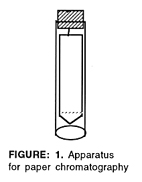
1. Cut a strip of filter paper or chromatography paper so that it just fits inside a 15-cm (or larger) test tube. Cut a point at one end. Draw a faint pencil line as shown in figure 1. Bend a paper clip and attach it to a cork stopper. Attach the paper strip so that it hangs inside the tube, as shown. The sides of the strip should not touch the glass.

2. Tear a spinach leaf into pieces about the size of a postage stamp. Put them into a mortar along with a pinch or two of sand to help with grinding. Add about 5 ml ethyl alcohol to the leaf pieces. Crush leaves with the pestle, using a circular motion, until the mixture is finely ground. The liquid in which the leaf pigments are now for paper chromatography dissolved is called the pigment extract.

3. Use a glass rod to touch a drop of the pigment extract to the center of the pencil line on the paper strip. Let it dry. Repeat as many as 20 times, to build up the pigment spot. NOTE: You must let the dot dry after each drop is added. The drying keeps the pigment dot from spreading out too much.

4. Pour 5 ml chromatography solvent into the test tube. Fit the paper and cork assembly inside. Adjust it so that the paper point just touches the solvent (but not the sides of the tube). The pigment dot must be above the level of the solvent. Watch the solvent rise up the paper, carrying and separating the pigments as it goes. At the instant the solvent reaches the top, remove the paper and let it dry. Observe the bands of pigment. The order, from the top, should be carotenes (orange), xanthophylls (yellow), chlorophyll a (yellow-green), chlorophyll b (blue-green), and anthocyanin (red). Identify and label the pigment bands on the dry strip. Write the species of leaf on the strip as well.
Record the species, external color, and chromatogram pigments in the DATA TABLE of your report sheet.

5. Each pigment has an Rf value, the speed at which it moves over the paper compared with the speed of the solvent.

Rf = Distance moved by the pigment / Distance moved by the solvent

Measure the distance in cm from the starting point (pencil line) to the center of each pigment band. Then measure the entire distance traveled by the solvent. Remember, the starting point for the solvent is also the pencil line and the ending point for the solvent is the top edge of the paper. Do the required divisions and record your Rf values in the DATA TABLE of your report sheet.

6. Wash the mortar and pestle thoroughly, using a little alcohol to remove any remaining pigment.

7. Repeat steps 1 through 6 for each species.

DATA TABLE:

Chromatography Data

Leaf Type (species) External color Chromatogram Pigments
Colors from the Top Pigment Names Rf Values


DNA Quiz 2

Name: 

Mendel’s Genetics


True/False
Indicate whether the sentence or statement is true or false.
1.
The law of segregation states that two or more pairs of alleles separate independently of one
another during gamete formation.
2.
Cells that contain a single set of chromosomes are said to be haploid (N).
3.
Crosses involving a study of one gene are called monohybrid crosses.
4.
A dominant allele masks the effect of a recessive allele.
5.
Mendel concluded that the patterns of inheritance are determined entirely by the environment.
6.
A Punnett square represents the phenotype of an organism.
7.
The physical appearance of an individual organism, as determined by the genes it has inherited from its parents, is called its genotype.
8.
Individuals must exhibit a trait in order for it to appear in their offspring.
9.
In codominance, two alleles are expressed at the same time.
 

Multiple Choice
Identify the letter of the choice that best completes the statement or answers the question.
10.
In fruit flies, the gene for long wings, L, is dominant to the gene for short wings, l.  A heterozygous long wing male and a short wing female produce many offspring. The possible genotype(s) among the long-winged offspring is (are)
a.
Ll only
c.
LL and Ll
b.
ll only
d.
Ll and ll.
11.
In drosophila, curled wing is recessive to straight wing. If a homozygous straight-winged fly is mated with a curled-wing fly, how many different phenotypes will be produced?
a.
1
c.
3
b.
2
d.
4
12.
If an organism has two identical alleles for a trait, it is
a.
homozygous.
c.
homozygous dominant.
b.
heterozygous.
d.
heterozygous recessive.
13.
Alleles for the same trait separate during
a.
fertilization.
c.
meiosis I.
b.
mitosis.
d.
meiosis II.
14.
The inheritance of genes that determine one trait (hair color) is not affected by the inheritance of genes that control another trait (tongue rolling).  Which of Mendel’s rules apply to the above statement?
a.
the rule of dominance
c.
the rule of independent assortment
b.
the rule of segregation
15.
In fruit flies, the gene for straight wings, C, is dominant to the gene for curly wings, c. Two flies, when bred, produced 98 straight-winged and 102 curly-winged offspring.  What was the genotype of the curly-winged offspring?
a.
CC
c.
cc
b.
Cc
d.
straight-winged
16.
All homozygous individuals have:
a.
the same genotype
c.
two alleles exactly alike
b.
the same phenotype
d.
a hybrid genotype.
17.
If a family has three daughters, the probability that the next child will be a girl is
a.
1/4.
c.
1/2.
b.
1/3.
d.
3/4.
18.
Mendel explained the reappearance of recessive traits in the F2 generation in his principle of
a.
independent assortment.
c.
dominance.
b.
segregation.
d.
blending inheritance.
19.
If any offspring from a test cross show a recessive phenotype, the parent with the unknown genotype is
a.
heterozygous dominant.
c.
heterozygous recessive.
b.
homozygous dominant.
d.
homozygous recessive.
20.
A homozygous black rabbit is mated with a heterozygous rabbit. If black is dominant over white, they should produce:
a.
all white rabbits
b.
all black rabbits
c.
half black and half white rabbits
d.
one pure dominant and heterozygous individual.
21.
Mendel’s finding that the inheritance of one trait had no effect on the inheritance of another became known as the
a.
law of dominance.
c.
law of segregation.
b.
law of universal inheritance.
d.
law of independent assortment.
22.
The phenotype of an organism
a.
represents its genetic composition.
b.
reflects all the traits that are actually expressed.
c.
occurs only in dominant pure organisms.
d.
cannot be seen.
23.
In humans the ability to taste PTC paper is dominant to non-tasting and hair color shows incomplete dominance (Dark hair x blond hair => brown hair).  A brown haired man who cannot taste PTC paper marries a woman with brown hair and who can taste PTC paper.  Their first child had brown hair and could not taste PTC paper. What are the chances that their next child will be a brown taster?
a.
1/4
c.
1/8
b.
1/2
d.
3/8
24.
Two long-furred cats were mated and produced 25 percent short-furred cats.  The parents were probably:
a.
pure recessive individuals
b.
pure dominant individuals
c.
heterozygous individuals
d.
one pure dominant and heterozygous individual.
25.
When certain types of black roosters are crossed with white hens, speckled chickens result. These chickens, which have a mixture of black and white feathers, show
a.
dominance.
c.
polygenes.
b.
codominance.
d.
recessive
26.
codominance : both traits are displayed::
a.
probability : crosses
c.
homozygous : alleles are same
b.
heterozygous : alleles are the same
d.
Punnett square : chromosomes combine
27.
A Punnett square is used to determine the
a.
probable outcome of a cross.
c.
result of segregation.
b.
actual outcome of a cross.
d.
result of meiosis I.
28.
If a family has four sons, the probability that the next child will be a boy is
a.
1/2.
c.
1/5.
b.
1/4.
d.
4/5.
29.
Suppose that on Mars green creatures are dominant over red creatures and that 3-eyes are recessive to 4-eyes.  Assume that inheritance of traits on Mars occurs the same way as on Earth.  A cross between 2 GgEe Martians would result in what fraction of the offspring being red-3-eyed Martians?
a.
1/16
c.
4/16
b.
2/16
d.
9/16
30.
The fact that a man and woman, both of whom have wavy hair, could have children with curly hair, wavy hair, or straight hair is best explained by the phenomenon called
a.
codominance.
b.
dominance.
c.
incomplete dominance.
d.
None of the above; this would be impossible.
31.
A Punnett square does not show the
a.
genetic makeup of the eggs.
c.
genetic makeup of the sperm.
b.
probable outcome of a cross.
d.
actual outcome of a cross.
32.
The “father” of genetics was
a.
T. A. Knight.
c.
Gregor Mendel.
b.
Dr. Judd.
d.
None of the above
33.
What is the probability that the offspring of a homozygous dominant individual and a  homozygous recessive individual will exhibit the dominant phenotype?
a.
0.25
c.
0.66
b.
0.5
d.
1.0
34.
Which of the following is the designation for Mendel’s original pure strains of plants?
a.
P
c.
F1
b.
P1
d.
F2
35.
F2 : F1 ::
a.
P : F1
c.
F1 : P
b.
F1 : F2
d.
dominant trait : recessive trait
36.
The passing of traits from parents to offspring is called
a.
genetics.
c.
development.
b.
heredity.
d.
maturation.
37.
homozygous : heterozygous ::
a.
heterozygous : Bb
c.
dominant : recessive
b.
probability : predicting chances
d.
homozygous : BB
38.
The phenotype of an organism
a.
represents its genetic composition.
b.
reflects all the traits that are actually expressed.
c.
occurs only in dominant pure organisms.
d.
cannot be seen.
39.
If an individual has two recessive alleles for the same trait, the individual is said to be
a.
homozygous for the trait.
c.
heterozygous for the trait.
b.
haploid for the trait.
d.
mutated.
40.
Tallness (T) is dominant to shortness (t) in pea plants. Which of the following represents a genotype of a pea plant that is heterozygous for tallness?
a.
T
c.
Tt
b.
TT
d.
tt
41.
How many different phenotypes can be produced by a pair of codominant alleles?
a.
1
c.
3
b.
2
d.
4
chp_9_web_tutorial_files/i0440000.jpg
42.
Refer to the illustration above. The genotype represented by the cell labeled “2” is
a.
GgIi.
c.
GI.
b.
GGIi.
d.
Gi.
In rabbits, black fur (B) is dominant to brown fur (b). Consider the following cross between two rabbits.
      chp_9_web_tutorial_files/i0460000.jpg
43.
Refer to the illustration above. Both of the parents in the cross are
a.
black.
c.
homozygous dominant.
b.
brown.
d.
homozygous recessive.
44.
Refer to the illustration above. The genotypic ratio of the F1 generation would be
a.
1:1.
c.
1:3.
b.
3:1.
d.
1:2:1.
45.
In pea plants, yellow seeds are dominant over green seeds. What would be the expected genotype ratio in a cross between a plant with green seeds and a plant that is heterozygous for seed color?
a.
1:3
c.
4:1
b.
1:2:1
d.
1:1


Check Your Work     Reset