

Category: Curriculum Map
Amylase on Starch Lab
| Enzyme Amylase Action on Starch |
INTRODUCTION:
In this experiment you will observe the action of the enzyme amylase on starch. Amylase changes starch into a simpler form: the sugar maltose, which is soluble in water. Amylase is present in our saliva, and begins to act on the starch in our food while still in the mouth.
Exposure to heat or extreme pH (acid or base) will denature proteins. Enzymes, including amylase, are proteins. If denatured, an enzyme can no longer act as a catalyst for the reaction.
Benedict’s solution is a test reagent that reacts positively with simple reducing sugars like maltose, but will not react with starch. A positive test is observed as the formation of a brownish-red cuprous oxide precipitate. A weaker positive test will be yellow to orange.
MATERIALS:
| Cornstarch Distilled water Saliva Vinegar Benedict’s qualitative solution 3 graduated cylinders (10mL) 250-ml beaker Stirring rod 3 test tubes (16 x 125mm) Test tube rack Wax pencil Water Bath |
 |
PRE-LAB:
Add 1g of cornstarch to a beaker containing 100ml of cold distilled water. While stirring frequently, heat the mixture just until it begins to boil. Allow to cool.
PROCEDURE:
1. Fill the 250-mL beaker about 3/4 full of water and place on the hot plate for a boiling water bath. Keep the water JUST AT BOILING.
2. Mark 3 test tubes A, B and C. “Spit” between 1 and 2 mL of saliva into each test tube.
3. Into tube A, add 2 mL of vinegar. Into tubes B and C, add 2 mL of distilled water. Thump the tubes to mix.
4. Place tube B into the boiling water bath for 5 minutes. After the five minutes, remove from the bath, and place back into the test tube rack.
5. Add 5 mL of the starch solution to each tube and thump to mix. Allow the tubes to sit for 10 minutes, occasionally thumping the tubes to mix.
6. Add 5 mL of Benedict’s solution to each tube and thump to mix. Place the tubes in the hot water bath. The reaction takes several minutes to begin.
OBSERVATIONS:
Tube A: Starch + saliva treated with vinegar (acid)
-
- Was the test positive or negative? _______________________
What does this indicate?__________________________________________________
____________________________________________________________________
____________________________________________________________________
Tube B: Starch + saliva and water, treated in a boiling water bath
-
- Was the test positive or negative? _______________________
What does this indicate?__________________________________________________
____________________________________________________________________
____________________________________________________________________
Tube C: Starch + saliva
-
- Was the test positive or negative? _______________________
What does this indicate?__________________________________________________
____________________________________________________________________
____________________________________________________________________
QUESTIONS:
1. What is the function of an enzyme?
2. Where does a substrate attach to an enzyme?
3. If an enzyme is present in a reaction, less ________________ _________________ will be needed to get the reaction started.
4. What is a common suffix found at the end of most biological enzymes?
5. Most enzymes are macromolecules called ________________.
6. Define denaturation of proteins.
7. Name 3 things that can denature or unfold an enzyme.
8. In this lab, what weak acid denatured the protein?
9. What was the purpose of placing one test tube in a hot water bath?
10. What happens to enzymes in your body whenever you run fever?
Antibiotic Resistant Lab
Antibiotic resistance of bacteria
Procedure Using a sterile loop, pick an isolated colony from you bacterial plate. Try to find one that grew well but is all by itself. Move the colony (don’t scoop up the agar) to a new plate.  Using a moist, sterile, cotton swab, spread the bacteria around on the plate.
The goal is to get an complete, even, coverage of bacterial growth on the plate (called a “lawn”). Remember to open the plate only minimally, using the lid as an “umbrella” to prevent contamination (see image below). Label each plate on the bottom (agar contaning side) and store it for examination during next week’s lab.Each new prepared plate will receive four paper discs containing antibiotics. We will be using several different types of Antibiotics and/or antimicrobials.
(please fill in which antibiotics you used below)
- 1
- 2
- 3
- 4
The antibiotic discs come in a little tube-like dispenser. To remove the discs take a sterile toothpick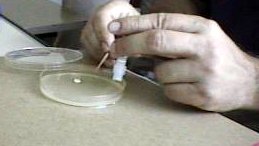 and push out a disc into your plate. Use the toothpick to gently press the disc onto the agar. Once you have added the five antibiotic discs to your plates, make sure the plates are labelled and store them in the back of the lab until next week.
If the bacteria are susceptible to the antibiotic a zone of inhibited growth will be evident next week. Measuring the size of this zone is a relative indication of the effect of the antibiotic on the particular bacteria.
Bacteria possess several characteristics that enable them to become resistant to antimicrobial drugs:
- Asexual reproduction
- Short generation times
- High mutation rates
Some Information on Antibiotics
Questions –
1. Name two ways (1. and 2. ) that common human practices towards antimicrobials aids bacteria in becoming resistant.
2. Name two reasons your Physician will perform cultures such as the ones you have done in this lab.
4. How are materials are collected for cultures?
5. Why is neccesary to use sterile technique when obtaining cultures?
Animal Symmetry and Phyla

Amylase Writeup
What to Include in Your Lab Write–Up
Lab: Enzyme Amylase Action on Starch
Introduction:
- What is an enzyme
- Describe an enzyme’s structure
- Explain how an enzyme works (substrate, active site)
- What’s amylase
- Where is amylase found
- What denatures amylase (proteins)
- Describe the Benedict’s test
Hypothesis:
Exposure to heat or extreme pH will …
Materials:
The materials used include…
Methods:
Type the procedure in paragraph form.
Results:
Complete this table
| Test Tube | Contents of Tube | Color of Tube After Heating | + or – Benedict’s test | Enzyme Denatured
Yes or no |
| A | Starch + Saliva + Vinegar | |||
| B | (Starch + Saliva) Heated | |||
| C | Starch + Saliva |
Conclusion:
- Restate the hypothesis
- Explain the results of the Benedict’s test on Tube C (color change, contents of tube, NOT heated)
- Explain the results of the Benedict’s test on Tube A ( color change, contents on tube, what was added before heating)
- Explain the results of the Benedict’s test on Tube B ( color change, contents on tube, heating tube)
- Tell what denaturing proteins is & how did the Benedict’s test show this.