
|
||||||||||||||||||||||||||||||||||||||||||||||||||||||||||||
|
||||||||||||||||||||||||||||||||||||||||||||||||||||||||||||
Found at the Biology Corner Name __________________ Period ______
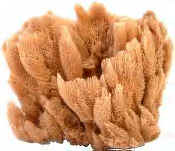 Sponges – A Coloring Worksheet
Since sponges look like plants, it is understandable why early biologists thought they were plants. Today, we know that sponges are simple, multicellular animals in the Kingdom Animalia, Phylum Porifera. This phylum is thought to represent the transition from unicellular animals to multicellular animals. Most (but not all) sponges are asymmetrical and have no definite shape. Sponges, like all animals, are eukaryotic – meaning their cells have a nucleus. Porifera in Latin means “pore-bearer” and refers to the many pores or openings in these animals. Because of these pores, a sponge can soak up and release water. At one time, real sponges were used for cleaning and bathing. Today, most are artificially made.
All adult sponges are sessile, meaning they are attached to some surface. Since they cannot move, sponges cannot pursue their food. Instead, they are filter feeders, meaning they obtain their food by straining the water for small bits of food like bacteria, algae or protozoans.
Sponges exhibit less specialization (adaptation of a cell for a particular function) of cells than most invertebrates. The primitive structure of a sponge consists of only two layers of cells separated by a non-living jelly like substance. The outer layer of the sponge is the epidermis which is made of flat cells called epithelial cells. Color all the epithelial cells (B) of the epidermis peach or pink.
The inner layer consists of collar cells (A) whose function is to circulate water through the sponge. They do this by swishing their flagella which pulls water through the incurrent pore – water then travels out the osculum at the top of the sponge. As water passes through the sponge in this way, cells absorb food and oxygen and waste is excreted. Color the osculum (D) dark blue, the incurrent pores (C) light blue. Color the inside of the sponge where water circulates the same light blue as you colored the incurrent pores. Color all the collar cells (A) red.
In the jelly-like substance between the epidermis and the collar cells are cells called amebocytes – because they look like amebas. The job of the amebocytes is to travel around distributing food and oxygen to the cells of the epidermis. Because of the amebocytes, scientists believe that sponges evolved from protists. Color all of the amebocytes (E) green – look for them carefully.
The body of the sponge would collapse if it did not have some type of supporting structure. Some sponges have a soft network of protein fibers called spongin. Others have tiny, hard particles called spicules. Many of these spicules also stick out of the epidermis and provide the sponge with protection. Most sponges have a combination of spicules and spongin, the ratio often determines how soft or hard the sponge is. Search for and color all the pointy spicules (F) brown.
Reproduction for sponges can be accomplished both sexually and asexually. There are three ways for a sponge to reproduce asexually: budding, gemmules, and regeneration. Sponges can simply reproduce by budding, where a new sponge grows from older ones and eventually break off. Color the adult sponge (J) pink and all the buds (G) you can find red. Sponges can also reproduce by regeneration, where missing body parts are regrown. People who harvest sponges often take advantage of this by breaking off pieces of their catch and throwing them back in the water, to be harvested later. Finally, sponges can reproduce by creating gemmules – which is a group of amebocytes covered by a hard outer covering. Color the gemmule (H) yellow.
Sexual reproduction occurs when one sponge releases sperm into the water. This sperm travels to another sponge and fertilizes its eggs. The larva form will then swim to another location using its flagella where it will grow into an adult sponge. Most sponge species are hermaphrodites, they can produce both eggs and sperm.
Questions:
1. What did early biologists think sponges were? ______________________
2. Sponges belong to the Kingdom _________________ and the Phylum _______________
3. Sponges are [ unicellular or multicelluar ] and [ prokaryotic or eukaryotic ]
4. What type of symmetry do sponges have? ___________________________________
5. What does it mean to be sessile? ____________________________________
6. How do sponges get their food? ___________________________________
7. Water enters the sponge through the _____________________ and leaves through the
_____________________.
8. What is the job of the amebocyte? ________________________________________
9. What two substances give the sponge support? _________________________________
10. Tiny sponges growing from the main body of the sponge are called _________________
11. What is a gemmule? ___________________________________________________
12. What is a hermaphrodite? ______________________________________________
Label the letters on the diagrams
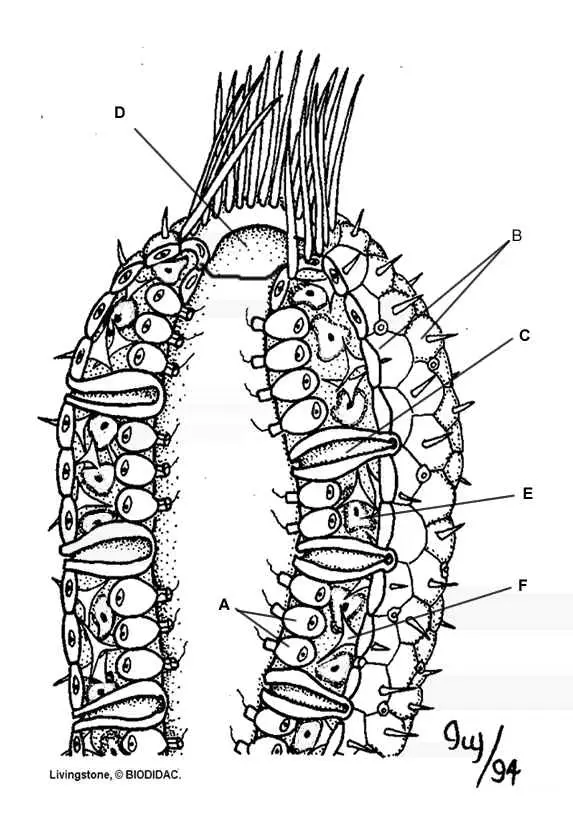
Label the letters on the diagrams
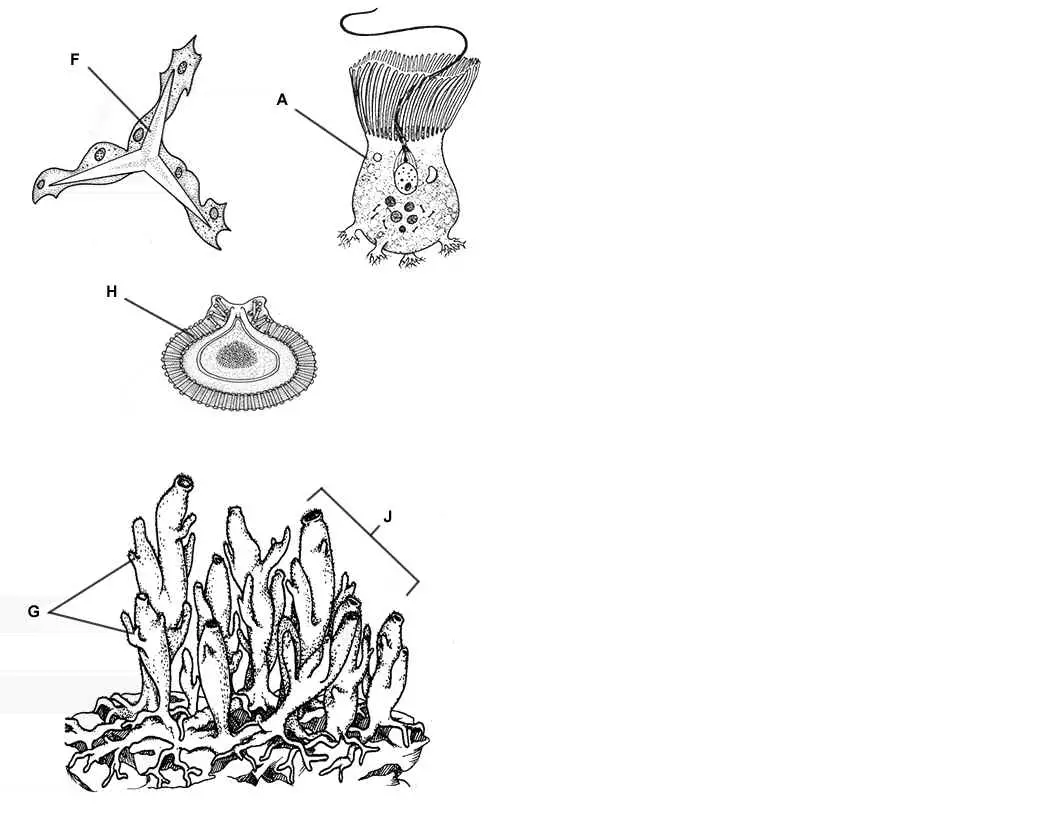
Found at www.biologycorner.com
| First Semester Review 2004-05 |  |
| What are the smallest units that can carry on life functions called? | |
| Living things are composed of ______________. | |
| Give an example of a scientific observation. | |
| What is a hypothesis? | |
| What 3 things compose an atom? | |
| Matter is made of ________________. | |
| When atoms gain energy, what happens to electrons? | |
| Do cells contain a few or thousands of different kinds of enzymes? | |
| __________________ reactions are important in organisms because they allow the passage of energy from one molecule to another. | |
| What is a polar molecule? | |
| Water molecules break up other polar substances. Give an example of such a polar molecule. | |
| What happens to ionic compounds in water? | |
| Which is not a carbohydrate —– glycogen, steroids, cellulose, or sugars? | |
| Amino acids are the monomers for making ________________. | |
| Is ice an example of an organic molecule? | |
| The type & order of the amino acids determines the ___________ of a protein. | |
| Very active cells need more of which organelle? | |
| What organelle is the packaging & distribution center of the cell? | |
| What membrane surrounds the nucleus? | |
| What is the function of mitochondria. Sketch their shape. | |
| Where is chlorophyll found in plants? | |
| Diffusion takes place from ________________ concentration to ___________. | |
| If a cell has a high water content, will it lose or gain water? | |
| Ink dispersing in a beaker is an example of ________________. | |
| Very large molecules enter cells by a process called ________________. | |
| Endocytosis and exocytosis occur in ______________ directions across a cell membrane. | |
| What is photosynthesis? | |
| Where do the dark reactions of photosynthesis take place? | |
| When chlorophyll absorbs light energy ATP is made and what other energy carrying molecule? | |
| When chlorophyll absorbs light energy, what happens to its electrons? | |
| _______________ molecules are responsible for the photosystems. | |
| Electrons that have absorbed energy & moved to a higher energy level enter what chain? | |
| When cells break down food molecules, energy is temporarily stored in what molecule? | |
| When muscles do not get enough oxygen, what acid forms during exercise? | |
| If you are growing bacteria in a culture and lactic acids starts to form, the bacteria are not getting enough of what gas? | |
| The 2 stages of cellular respiration are _____________ & oxidative respiration. | |
| Citric acid forms in which cycle during cellular respiration? | |
| ATP molecules are formed inside what cellular organelle? | |
| What is the study of life called? | |
 |
|
First Semester Test 2006 Study Guide
1. What is the study of life called?
2. Instructions for traits passed from parent to offspring?
3. Keeping things stable or the same in cells?
4. Smallest units that can carry on life?
5. All living things require _________ for metabolism.
6. All living things are made of __________.
7. Salamanders with curved tails in polluted water are an example of which part of the scientific method?
8. The smallest part of carbon with all the same properties is called?
9. Where are electrons found in an atom & what is their charge?
10. When electrons gain energy they move to _____________________.
11. How many covalent bonds can carbon form?
12. Compounds may form from the transfer or __________ of electrons.
13. What happens to ionic compounds when placed in water?
14. Ionic bonds form from the ____________ of electrons.
15. Covalent bonds form from the ___________ of electrons.
16. What element do all organic compounds contain?
17. Give several examples of carbohydrates.
18. In what from do animals store glucose?
19. What are the monomers for proteins?
20. Is the following model a carbohydrate, lipid, or protein?

21. Sketch a fatty acid chain found in lipids.
22. What type of fatty acids contains double bonds?
23. Name the 2 nucleic acids.
24. When the volume of a cell increases, what happens to the surface area?
25. How does a prokaryotic cell differ from a eukaryotic cell?
26. What’s the job of the plasma membrane?
27. Parts of cells performing specific functions are called?
28. The ER sends proteins & lipids it makes to the __________ to be modified.
29. The Golgi ships & receives cell products in transport ___________.
30. In what organelle is ATP produced?
31. Ribosomes make ____________.
32. All eukaryotic cells have a ___________ containing the genetic material.
33. Diffusion occurs in what direction?
34. What is osmosis?
35. Ink dissolving in water is an example of _____________.
36. Riding of cell wastes in sacs is called _____________.
37. What is the effect of placing a plant into a hypertonic solution?
38. What is the ultimate energy for life on Earth?
39. Grana are suspended in the _________ of chloroplasts.
40. ____________ absorbs light energy for plants.
41. What happens to chlorophyll’s electrons when they absorb sunlight?
42. What is the source of oxygen in photosynthesis?
43. What gas is a byproduct of photosynthesis?
44. What type of skeleton do insects have?
45. The Calvin cycle occurs in what process?
46. The breaking down of food to release energy is called?
47. __________ builds up in heavily exercised muscles.
48. Name the 3 parts of cellular respiration.
49. How many chromosomes are in a human egg or sperm cell?
50. DNA compacts itself by wrapping around ____________.
51. How do insects help crops?
LAB REPORT RUBRICS
Title (center on top line; on the right of line 2, put date & lab #)
The title should indicate clearly & concisely the subject and scope of the report.
Introduction – 20 points (PARAGRAPH FORM)
Hypothesis – 20 points (SINGLE SENTENCE)
Materials – 5 points (SINGLE SENTENCE)
Methods (Procedure)- 5 points (STEPS; NUMBER)
Results (Data & Questions) – 20 points
Error Analysis
Discussion and Conclusion – 30 points
Discussion is the most important part of your report, because here, you show that you understand the experiment beyond the simple level of completing it.!!
Additional help with Conclusions
