Practice Making Line Graphs


Practice Making Line Graphs  

Review your notes on line graphs. (Notes)

Problem # 1:

The relative hormone levels vary greatly during the 28-day human menstrual cycle. The table below shows the relative levels of the four major hormones by day.

Day Luteinizing
Hormone (LH)
Follicle Stimulating
Hormone (FSH)
Estrogen Progesterone
1 6 10 10 2
2 7 11 10 2
3 8 12 10 2
4 8 13 10 2
5 8 14 10 2
6 8 13 13 2
7 8 12 16 2
8 8 12 19 2
9 8 12 22 2
10 10 13 28 2
11 12 14 35 2
12 22 16 28 3
13 32 20 22 4
14 20 15 19 5
15 6 10 16 8
16 6 9 15 10
17 6 8 15 12
18 6 8 15 15
19 6 8 15 18
20 6 7 15 24
21 6 6 15 28
22 6 6 15 28
23 6 6 15 28
24 5 6 13 24
25 4 6 10 18
26 3 8 10 12
27 3 10 10 7
28 3 10 10 2
  1. Estrogen levels are highest on day number?
  2. LH levels are highest on day number?
  3. This data is very accurately measured. Plot the data points and then draw a line graph in “connect-the-dot” fashion.

Title _________________________________________


Problem # 2:

Amount of ethylene in ml/m2 Wine sap Apples:
Days to Maturity
Golden Apples:
Days to Maturity
Gala Apples:
Days to Maturity
10 14 14 15
15 12 12 13
20 11 9 10
25 10 7 9
30 8 7 8
35 8 7 7
  1. Ethylene is a plant hormone that causes fruit to mature. The data above concerns the amount of time it takes for fruit to mature from the time of the first application of ethylene by spraying a field of trees.
  2. Make a line graph of the data.
  3. What is the dependent variable?
  4. What is the independent variable?


Title _________________________________________


Problem # 3:

Age of the tree in years Average thickness of the annual rings in cm.
Forest A
Average thickness of the annual rings in cm.
Forest B
10 2.0 2.2
20 2.2 2.5
30 3.5 3.6
35 3.0 3.8
50 4.5 4.0
60 4.3 4.5
  1. The thickness of the annual rings indicate what type of environmental situation was occurring at the time of its development. A thin ring, usually indicates a rough period of development. Lack of water, forest fires, or a major insect infestation. On the other hand, a thick ring indicates just the opposite.
  2. Make a line graph of the data.
  3. What is the dependent variable?
  4. What is the independent variable?
  5. What was the average thickness of the annual rings of 40 year old trees in Forest A?
  6. Based on this data, what can you conclude about Forest A and Forest B?

Title _________________________________________


Preap Homeostasis Study Guide


Homeostasis & Transport Review  


1. A type of transport in which water moves across and down its concentration gradient is called ______________________________________.

2. Net movement of water across a cell membrane occurs from a ___________________ solution to a ________________________ solution.

3. A _____________________  ___________________ only allows certain molecules to pass thorough.

4. A __________________________  _____________________ is the concentration difference across space.

5. A structure that can move excess water out of a unicellular organism is a __________________________  ______________________.

6. The movement of some substances, without any input of energy by the cell, is called ________________________   ________________________.

7.  The process of diffusion requires________________________________________________
___________________________________________________________________________.

8. If the molecular concentration of a substance is the same throughout space, the substance is in ____________________________________.

9. All forms of passive transport depend on the ___________________  ________________ of molecules.

10.  The movement of molecules from an area of higher concentration to an area of lower concentration is called ______________________________.

11.  Sodium-potassium pumps move ___________________ ions _______________ of the cell and ___________________________ ions ___________________ the cell.  This causes the inside of the cell to have what type of charge? __________________________.

12.  Most of the time, the environment that plant cells live in is ________________________.

13.  Plasmolysis of a human red blood cell would occur if the cell were in a(n) ____________________________  ____________________________.

14.  The bursting of cells is called _____________________________.

15.  The pressure that water molecules exert against a cell wall is called ___________________  _________________________________.

16.  A membrane bound organelle used in endocytosis is called a _______________________.

17.  A relatively high solute concentration is called _____________________________.

18.  The uptake of large particles is called ________________________________.

19. The shrinking of cells is called _____________________________________.

20.  A relatively low solute concentration is called ___________________________.

21.  The uptake of solutes or fluids is called ________________________________.

22.  Molecules always diffuse ___________________ their concentration gradient.

23.  The diffusion of water across a membrane is called __________________________.

24.  In an ________________________  _____________________ the concentration of solutes outside and inside the cell are equal.

25. Transport that requires the cell to expend energy is called _____________________  ________________________________.

26. Which type of molecule forms a bilayer within a cell membrane? __________________________________

27.  Most food and wastes materials that move into and out of a cell go through ____________________________  ________________________________.

28. Glucose molecules cross the cell membrane by means of ______________________________ _______________________________.

29. Ridding the cell of material by discharging it from sacs (vesicles) at the cell surface is called ____________________________________________________.

30. Molecules that are too large to be moved across a cell membrane can be removed from the cell by ________________________________________________.

31. A substance that dissolves in another substance is called a (n) _________________________________________.

32. The diffusion of ___________________________ through the cell membranes is called osmosis.

33. When water enters the cell, it creates pressure. This pressure is called _____________________________  _______________________________________________.

34. A cell does not expend __________________________ when diffusion takes place.

35. __________________________ is the most common solvent in cells.

36. A cell membrane is said to be _______________________________________ permeable because it allows  the passage of some solutes and not others.

37. Facilitated diffusion and active transport are two types of ________________________________ transport.

38. __________________________ _______________________________ allows a cell to stockpile substances in far greater concentrations that they occur outside the cell.

39. Active transport systems are a form of cell transport that requires energy from molecules of __________________________________________________.

40. The process in which an amoeba engulfs its prey and takes it in is known as _______________________________________________________________.

For each of the following, Identify the transport type:

a) A cell membrane encloses and takes in a droplet of fluid.______________________________
b) Carrier proteins use energy and act as a pump to move nutrients into a root cell. ____________________________________________
c) Carrier proteins take sugar (glucose) into a cell without requiring energy input. ____________________________________________
d) Water diffuses across a cell membrane from a region of high concentration to a region of low concentration. _______________________________________
e) Mucus and waste products packaged by Golgi apparatus are secreted by a cell. ________________________________________
f) A cell membrane encloses and takes in food particles. ________________________________

DIRECTIONS: Read Chapter 5, Homeostasis and Transport, and Answer the questions below as completely and as thoroughly as possible. Answer the question in essay form (not outline form), using complete sentences. You may use diagrams to supplement your answers, but a diagram alone without appropriate discussion is inadequate.

1. Name and Describe Three types of passive transport AND Three types of active transport.

2. How do ions cross the lipid bilayer of the cell membrane?

3. Toward what condition does diffusion eventually lead, in the absence of other influences?

4. Explain the difference between pinocytosis and phagocytosis.

5. What is the fundamental difference between carrier proteins that participate in facilitated diffusion and carrier proteins that function as pumps.

6. Explain the difference between passive transport and active transport.

7. Describe what would happen to the molecules in a drop of ink dropped into a beaker of water.  What is this process called?

8.  What would happen to a freshwater unicellular organism if its contractile vacuole stopped functioning? Explain your answer.

9. How is osmosis related to diffusion?

10.  Contrast endocytosis with exocytosis.

11. Define a hypotonic, hypertonic and isotonic solution.

12. Describe the action of the sodium-potassium pump.

13.  Three red blood cells are placed in hypertonic, hypotonic, and isotonic solutions.  Compare the behavior of the three cells. Explain your answer on the basis of concentration gradients, diffusion, and give the name of the effects.




Planarian Regeneration Activity

Flatworms – Observation of a Live Planarian

click here for background


You will receive a small petri dish with a flatworm inside it.  The flatworm is the freshwater planarian, also known as Dugesia.


1.  List 3 characteristics of flatworms.


2.  What type of symmetry does this worm have?


3.  Where do planarians live?


4.  Observe your worm, using a microscope or hand lens. Sketch the planarian below. Label the eyespots. Label the anterior and posterior ends. 


5.  Measure your planarian.  This operation is best performed by removing some of the water from the dish and waiting for the worm to stretch out.   Measure the length of the worm in millimeters.  (Always replace the water; you can use the dish lid to transfer water to and from the planarian environment.)


 Length of Planarian  _______mm


Write your length on the board and when all the lengths are down, determine the average planarian size.


 Average    ____________ mm


6.  Observe the planarian for five minutes. Does the planarian seem active or passive?  How does it move?  Does it swim or creep?   Where in the dish does it spend most of its time? Make a current in the water with a pipette.  How does the planarian react?  Fill out the table below.

  Description
Movement   
Worm location  
Reaction to current  


7.  Planarians actually display a “handedness” being right or left handed.   You can discover whether your worm is right or left handed by flipping the planarian over on its dorsal (back) and seeing which way it recovers.   If it rolls to the right, it is right handed, if it rolls to the left, it is left-handed.    Do five trials to determine the handedness of your planarian. 

 Fill out the data table:

  Which way does it turn (left or right)
Trial 1  
Trial 2  
Trial 3  
Trial 4  
Trial 5  


Based on your data, is your planarian right or left handed?   ____________


8.   Design an experiment to test the planarians reaction to light and dark.  You will have flashlights and the room will be darkened for this part of the lab. Describe your experiment.


Conduct your experiment to determine whether the planarian prefers light or dark.   Construct a data table


Write your conclusions.  Make sure you answer the question:  Does the planarian prefer a light or dark environment and include your reasoning.


9.  Drop a piece of food into the petri dish with the planarian.  Observe the planarian’s reactions.  It may take a few minutes.   How does it eat the food?   Where is its mouth?  Use the space below to write your observations.


Reaction to food _______________________________________________________


How does it feed?


Where is the mouth located?


What is the name of the tube used for feeding in the planarian?


Planarian Reproduction –Make sure your planarian has finished eating entirely and its pharynx is withdrawn, if it gets too close to the end of the hour, ask your teacher for a different planarian


Planarians are hermaphrodites.  Define hermaphrodite


Planarians can also reproduce by regeneration. Define regeneration.


Is this method of reproduction sexual or asexual?


Pour out some of the water, so that the planarian is mostly un-submerged.  When it stretches out, use a razor blade to cut it cleanly in half. Replace the water and put the lid on it. Observe the two pieces of the planarian under the microscope.  

Fill out the table below.


Movement (observations) Sketch
Anterior end  


Posterior end


Label the lid with your NAME and HOUR.


Make a prediction:  How long do you think (in days) will it take for your planarian to completely regenerate?


Planarian Regeneration by Lora Bueker


Planarian Regeneration

Lab Objective
When a brown planarian’s body part is lost or damaged, the planarian will regenerate a new body part to replace the lost one.

Planarian Background
The brown planarian is the Dugesia tigrina.  It is in the class Turbellaria, which is in the phylum Platyhelminthes.  The freshwater Tubellarians are found in almost all aquatic habitats. Planarians hide under rocks, leaves, and debris to avoid light.  Planarians have no definite eyes, just eyespots that cannot form an image and are sensitive to light. Planarians are known as triciads because of their triple gut with a single anterior and two posterior branches. Planarians reproduce both sexually and asexually.  In sexual reproduction they produce “summer” eggs, which are thin-shelled and transparent; and “winter” eggs, which are usually black and set on stalks.  Planarians are hermaphroditic, possessing complete male and female systems.  They produce asexually by fragmentation and tail dropping in which they spontaneously drop their tails and each end regenerates the missing part. Planarians are carnivorous eating both living and dead organic matter.  Kept in captivity, they feed on raw liver.

Lab Materials
Materials used in the lab include two petri dishes, a pencil, paper, two planarians, a microscope slide, lens paper, scalpel, dropper/pipette, magnifying glass, camel’s hair brush, ruler, scissors, tape, raw data folder, and aged water.

 Lab Procedure
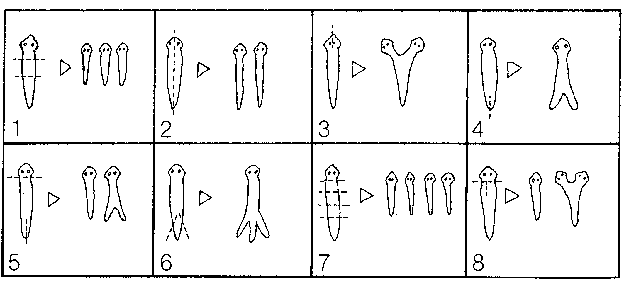
Choose two cuts from the eight operations given. (Figure 1)  Record your name & the number of the cut on a label and tape this on the underside of the petri dish so it is visible from the top.  Repeat this procedure with the second cut & dish.  Fill both dishes with aged water. Next, choose two planarians and measure the length and width of each worm and record this in your data folder. Prepare an “operating table” by wrapping  lens paper around a microscope slide.  Using a camel’s hair brush, transfer a planarian from the petri dish to the operating table.  Allow the planarian to become fully extended on the slide, but do not let it dry out.  When the planarian is fully extended, make the chosen cut quickly and cleanly.  When the operation is complete, rinse the pieces of planarian into the petri dish with a stream of aged water from the dropper.  Replace the lids on the petri dish and place in a shaded area at room temperature.  Repeat with the second cut. During the regeneration process, do not feed the planarians, and they should not be disturbed as little as possible.
* Because planarians foul their water quickly, it is necessary to change their water twice a week by pipetteing the old water out and replacing with new aged water.  It will also be necessary to oxygenate the water by blowing bubbles in the water with the dropper.

Figure 1

Data
* Cut one is a transverse cut, while cut two is a longitudinal cut.

Table 1


CUT ONE Length Width Number of Pieces Other
Day 1 10 mm 2mm 3
Day 2 3mm each 1mm each 4 Head part moving, others floating
Day 6 3mm each 1mm each 4 Tail dropped on one piece
Day 8 3mm each 1mm each 4 Slight growth
Day 13 3mm each 1mm each 4 Water changed & oxygenated
Day14 3mm each 1mm each 4 Vast regeneration, all part moving, transparent in color in some areas


Table 2


CUT TWO Length Width Number of Pieces Other
Day 1 9mm 2mm 2 Both tails dropped
Day 2 4mm each 1mm each 1 1 piece disintegrated
Day 6 0 0 0 Total disintegrated/ new cut
Day 8 3mm & 4mm 1mm & 1mm 2 Slight growth
Day 13 3mm & 4mm 1mm & 1mm 2 Slight growth
Day14 3mm & 4mm 1mm & 1mm 2 Definite movement


Error Analysis
Some tail dropping occurred & some pieces were so small that they disintegrated instead of regenerating

Conclusion
It can be concluded that when a planarian loses or damages a body part, it will regenerate over a certain period of time into a whole new planarian.  There are some conditions that may occur during the regeneration process.  For instance, the tail end of a headpiece grows faster, and the eyes first begin to appear about a week into the lab.  Between the eyes and pharynx, the pharynx regenerates faster.  While the rest of the body is brown, the regenerated areas are transparent and also show polarity.

BACK