Preap Nucleic Acid Study Guide

Nucleic Acids, Protein Synthesis, & DNA Technology Study Guide
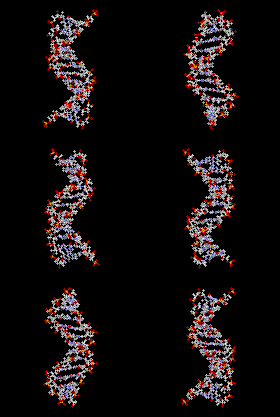
1. What are purines & pyrimidines and give examples of each?

2. Which scientists determined the structure of DNA?

3. DNA and RNA are named by their __________.

4. What three things make up a nucleotide?

5. Describe the structure of DNA.

6. An organism’s characteristics are coded for by molecules of __________.

7. What are the subunits called that make up DNA?

8. Sketch the basic structure of a nucleotide.

9. What 2 things are found on RNA, but are not found on DNA molecules?

10. What is the primary function of DNA?

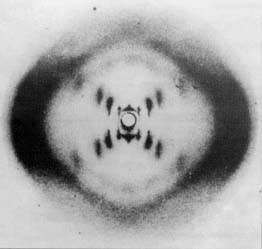
11.What did Rosalind Franklin’s x-ray photographs of DNA crystals tell us about this molecule?

12. State Chargaff’s rule.

13. What happens to tRNA anticodons during translation?

14. What is a codon & where are they found?

15. What is the function of rRNA?

16. What bases pair with each other on: a) DNA?   b) RNA?

17. Name the 3 types of RNA & tell the function of each.

18. What is the function of DNA polymerase?

19. If the code on DNA is TTAGCCTGA, what will be the code on the complementary section of DNA when it’s copied during replication?

20. List all the ways that RNA differs from DNA?

21. Where does mRNA go for proteins to be made in a cell?

22. What is transcription?

23. What is translation?

24. Which RNA carries instructions for making proteins?

25. What is the function of DNA helicases?

26. What is the job of restriction enzymes?

27. What are “sticky ends” and how are they helpful?

28. What is the difference between introns & exons?

29. What is an operon and in what type of cell would they be found?

30. What does RFLP stand for?  How is this process used?

31. What is meant by cloning?

32.What is DNA fingerprinting and how can it be used?

33. How is recombinant DNA formed?

NOTES                STUDY GUIDES

Nucleic Acids & Protein Synthesis

Nucleic Acids and Protein Synthesis
All Materials © Cmassengale

Cell   à   Nucleus    à    Chromosomes   à   Genes    à     DNA 

Proteins

  • Organic molecules (macromolecules) made by cells
  • Make up a large part of your body
  • Used for growth, repair, enzymes, etc.
  • Composed of long chains of small units called amino acids bonded together by peptide bonds
  • Twenty amino acids exist

DNA

  • Deoxyribonucleic acid is a coiled double helix carrying hereditary information of the cell

  • Contains the instructions for making proteins from 20 different amino acids
  • Appears as chromatin when cell not dividing

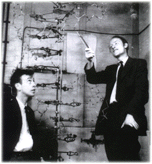
  • Structure discovered by Watson & Crick in 1953
  • Sides made of pentose (5-sided) sugars attached to phosphate groups by phosphodiester bonds
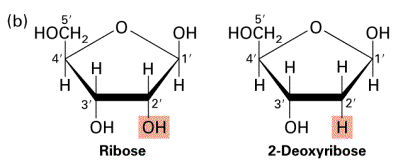
  • Pentose sugar called Deoxyribose

  • Steps or rungs of DNA made of 4 nitrogen-containing bases held together by weak hydrogen bonds
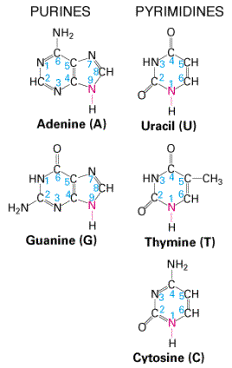
  • Purines (double carbon-nitrogen rings) include adenine (A) and guanine (G)
  • Pyrimidines (single carbon-nitrogen rings) include thymine (T) and cytosine (C)

  • Base pairing means a purine bonds to a pyrimidine   (Example:  A — T   and   C — G)
  • Coiled, double stranded molecule known as double helix
  • Make up chromosomes in the nucleus
  • Subunits of DNA called nucleotides
  • Nucleotides contain a phosphate, a Deoxyribose sugar, and one nitrogen base (A,T,C, or G)

  • Free nucleotides also exist in nucleus
  • Most DNA is coiled or twisted to the right
  • Left twisted DNA is called southpaw or Z-DNA
  • Hot spots which can result in mutations occur where right & left twisted DNA meet


History of DNA discovery

  • Freidrich Miescher (1868) found nuclear material to be ½ protein & ½ unknown substance
  • 1890’s, unknown nuclear substance named DNA
  • Walter Sutton (1902) discovered DNA in chromosomes
  • Fredrick Griffith (1928) working with Streptococcus pneumoniae conducted transformation experiments of virulent & nonvirulent bacterial strains
  • Levene (1920’s) determined 3 parts of a nucleotide
  • Hershey & Chase (1952) used bacteriophages (viruses) to show that DNA, not protein, was the cell’s hereditary material
  • Rosalind Franklin (early 1950’s) used x-rays to photograph DNA crystals


Click for larger picture!


  • Erwin Chargraff (1950’s) determined that the amount of A=T and amount of C=G in DNA; called Chargaff’s Rule
  • Watson & Crick discovered double helix shape of DNA & built the 1st model

Click for larger picture!

 DNA Replication

  •  Process by which DNA makes a copy of itself
  • Occurs during S phase of interphase before cell division
  • Extremely rapid and accurate (only 1 in a billion are incorrectly paired)
  • Requires many enzymes & ATP (energy)
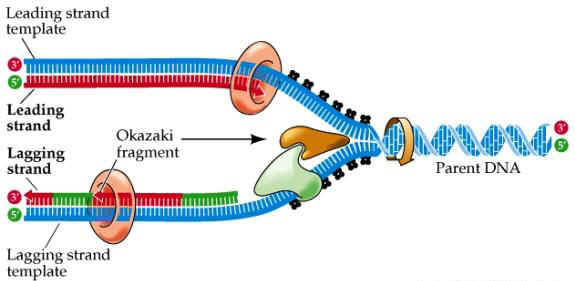
  • Begins at special sites along DNA called origins of replication where 2 strands open & separate making  a replication fork


  • Nucleotides added & new strand forms at replication forks
  • DNA helicase (enzyme) uncoils & breaks the weak hydrogen bonds between complementary bases (strands separate)
  •  DNA polymerase adds new nucleotides to the exposed bases in the 5’ to 3’ direction

  •  Leading strand (built toward replication fork) completed in one piece
  • Lagging strand (built moving away from the replication fork) is made in sections called Okazaki fragments


OKAZAKI FRAGMENTS

  •  DNA ligase helps join Okazaki segments together

  • DNA polymerase proofreads the new DNA checking for errors & repairing them; called excision repair
  • Helicase recoils the two, new identical DNA molecules

RNA

  • Ribonucleic acid
  • Single stranded molecule  

  • Found in nucleus & cytoplasm
  • Contains ribose sugar
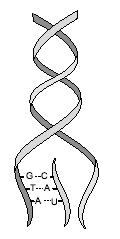
  • Contains the nitrogen base uracil (U) instead of thymine so A pairs with U
  • Base pairings are A-U and C-G
  • Three types of RNA exist (mRNA, TRNA, & rRNA)

mRNA

  • Messenger RNA
  • Single, uncoiled, straight strand of nucleic acid
  • Found in the nucleus & cytoplasm
  • Copies DNA’s instructions & carries them to the ribosomes where proteins can be made
  • mRNA’s base sequence is translated into the amino acid sequence of a protein
  • Three consecutive bases on mRNA called a codon (e.g. UAA, CGC, AGU)
  • Reusable

tRNA

  • Transfer RNA
  • Single stranded molecule containing 80 nucleotides in the shape of a cloverleaf
  • Carries amino acids in the cytoplasm to ribosomes for protein assembly
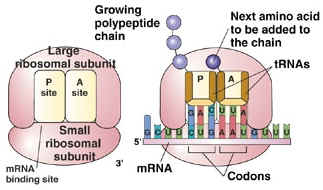
  • Three bases on tRNA that are complementary to a codon on mRNA are called anticodons (e.g. codon- UUA; anticodon- AAU)
  • Amino Acid attachment site across from anticodon site on tRNA
  • Enters a ribosome & reads mRNA codons and links together correct sequence of amino acids to make a protein
  • Reusable  

rRNA

  • Ribosomal RNA
  • Globular shape
  • Helps make up the structure of the ribosomes  
  • rRNA & protein make up the large & small subunits of ribosomes
  • Ribosomes are the site of translation (making polypeptides)

  • Aids in moving ribosomes along the mRNA strand as amino acids are linked together to make a protein

Amino Acids

  • 20 exist
  • Linked together in a process called protein synthesis in the cytoplasm to make polypeptides (subunits of proteins)
  • DNA contains the instructions for making proteins but is too large to leave the nucleus
  • Three consecutive bases on DNA called a triplet (e.g. TCG, ATG, ATT)
  • mRNA codon table tells what 3 bases on mRNA code for each amino acid (64 combinations of 3 bases)
  • Methionine (AUG) on mRNA is called the start codon because it triggers the linking of amino acids
  • UAA, UGA,  & UAG on mRNA signal ribosomes to stop linking amino acids together

Genetic Code (RNA)


 Amino Acid  3 Letter
Abbreviation
 Codons
 Alanine  Ala  GCA GCC GCG GCU
 Arginine  Arg  AGA AGG CGA CGC CGG CGU
 Aspartic Acid  Asp  GAC GAU
 Asparagine  Asn  AAC AAU
 Cysteine  Cys  UGC UGU
 Glutamic Acid  Glu  GAA GAG
 Glutamine  Gln  CAA CAG
 Glycine  Gly  GGA GGC GGG GGU
 Histidine  His  CAC CAU
 Isoleucine  Ile  AUA AUC AUU
 Leucine  Leu  UUA UUG CUA CUC CUG CUU
 Lysine  Lys  AAA AAG
 Methionine  Met  AUG
 Phenylalanine  Phe  UUC UUU
 Proline  Pro  CCA CCC CCG CCU
 Serine  Ser  AGC AGU UCA UCC UCG UCU
 Threonine  Thr  ACA ACC ACG ACU
 Tryptophan  Trp  UGG
 Tyrosine  Tyr  UAC UAU
 Valine  Val  GUA GUC GUG GUU
 Start  AUG
 Stop  UAA UAG UGA


  Practice Table:

DNA
Codon
mRNA
Codon
tRNA
Anticodon
Amino
Acid

GCU

TAC    
    AUU
  UUU  
TCA    
    UCU
CTT    
  ACU
ACU  

Protein Synthesis

  • Consists of 2 parts — Transcription & Translation
  • Begins in the nucleus with mRNA copying DNA’s instructions for proteins (transcription)
  • Completed in the cytoplasm when tRNA enters ribosomes to read mRNA codons and link together amino acids (translation)

 Steps in Transcription

  1. DNA helicase (enzyme) uncoils the DNA molecule
  2. RNA polymerase  (enzyme) binds to a region of DNA called the promoter which has the start codon TAC to code for the amino acid methionine
  3. Promoters mark the beginning of a DNA chain in prokaryotes, but mark the beginning of 1 to several related genes in eukaryotes
  4. The 2 DNA strands separate, but only one will serve as the template & be copied
  5. Free nucleotides are joined to the template by RNA polymerase in the 5’ to 3’ direction to form the mRNA strand
  6. mRNA sequence is built until the enzyme reaches an area on DNA called the termination signal
  7. RNA polymerase breaks loose from DNA and the newly made mRNA
  8. Eukaryotic mRNA is modified (unneeded sections snipped out by enzymes & rejoined) before leaving the nucleus through nuclear pores, but prokaryotic RNA isn’t
  9. All 3 types of RNA called transcripts are produced by this method

Steps in Translation

  1. mRNA brings the copied DNA code from the nucleus to the cytoplasm
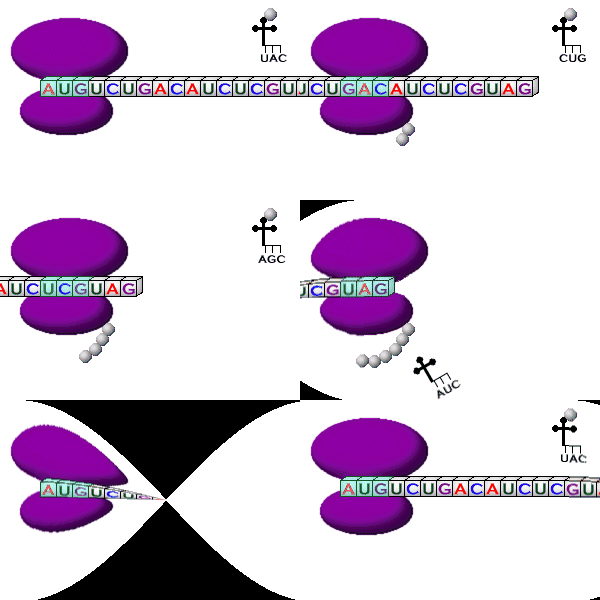
  2. mRNA attaches to one end of a ribosome; called initiation
  3. tRNA’s attach the correct amino acid floating in the cytoplasm to themselves
  4. tRNA with its attached amino acid have 2 binding sites where they join the ribosome
  5. The tRNA anticodon “reads” & temporarily attaches to the mRNA codon in the ribosome
  6. Two amino acids at a time are linked together by peptide bonds to make polypeptide -chains (protein subunits); called elongation
  7. Ribosomes) move along the mRNA strand until they reach a stop codon (UAA, UGA, or UAG); called termination

  1. tRNA’s break loose from amino acid, leave the ribosome, & return to cytoplasm to pick up another amino acid

Click here for an animation of Translation 

BACK


Nucleotide Model preap


Model of a Nucleotide


Introduction

Nucleotides consist of three parts — a pentose sugar, a nitrogen-containing base, and a phosphate group. A pentose sugar is a five-sided sugar. There are 2 kinds of pentose sugars — deoxyribose and ribose. Deoxyribose has a hydrogen atom attached to its #2 carbon atom (designated 2′), and ribose has a hydroxyl group atom there. Deoxyribose-containing nucleotides are the monomers of DNA, while Ribose-containing nucleotides are the monomers of RNA.

A nitrogen-containing ring structure is called a base. The base is attached to the 1′ carbon atom of the pentose. In DNA, four different bases are found — two purines, called adenine (A) and guanine (G) and two pyrimidines, called thymine (T) and cytosine (C). RNA contains The same purines, adenine (A) and guanine (G).  RNA also uses the pyrimidine cytosine (C), but instead of thymine, it uses the pyrimidine uracil (U).


The Purines The Pyrimidines

The combination of a base and a pentose is called a nucleoside.  A phosphate group is attached to the 5′ carbon of the pentose sugar.

Objective

Students will construct a 3-dimensional model of a single nucleotide, the monomer of which nucleic acids are composed.

Materials

Various materials may be used for the atoms that make up a nucleotide such as styrofoam balls, plastic coke bottle caps, beads, etc. Bonds between atoms may be made from toothpicks, plastic stirring sticks, popsicle sticks, etc. Single & double bonds must be represented by the correct number of “sticks”. The atoms and bonds may NOT be made of any food item. Your model should be glued together to make the model rigid for hanging. Attach string and a label with the nucleotide’s name to your model. Models must be sturdy, light weight, and small enough to hang from the ceiling.

Color Code for atoms:

CARBON – BLACK
HYDROGEN – YELLOW
OXYGEN – RED
NITROGEN – BLUE

Structural Formulas of Nucleotides:

Uracil Nucleotide (Ribose ) & Thymine Nucleotide (Deoxyribose)


Adenine Nucleotide (Deoxyribose)
Cytosine Nucleotide (Deoxyribose)
Guanine Nucleotide (Deoxyribose)


Olfaction


The Nobel Prize in Physiology or Medicine for 2004 awarded

jointly to

Richard Axel and Linda B. Buck

Richard AxelLinda B. Buck

for their discoveries of

“odorant receptors and the organization of the olfactory system”


Introduction

The sense of smell long remained the most enigmatic of our senses. The basic principles for recognizing and remembering about 10,000 different odors were not understood. This year’s Nobel Laureates in Physiology or Medicine have solved this problem and in a series of pioneering studies clarified how our olfactory system works. They discovered a large gene family, comprised of some 1,000 different genes (three per cent of our genes) that give rise to an equivalent number of olfactory receptor types. These receptors are located on the olfactory receptor cells, which occupy a small area in the upper part of the nasal epithelium and detect the inhaled odorant molecules.

Each olfactory receptor cell possesses only one type of odorant receptor, and each receptor can detect a limited number of odorant substances. Our olfactory receptor cells are therefore highly specialized for a few odors. The cells send thin nerve processes directly to distinct micro domains, glomeruli, in the olfactory bulb, the primary olfactory area of the brain. Receptor cells carrying the same type of receptor send their nerve processes to the same glomerulus. From these micro domains in the olfactory bulb the information is relayed further to other parts of the brain, where the information from several olfactory receptors is combined, forming a pattern. Therefore, we can consciously experience the smell of a lilac flower in the spring and recall this olfactory memory at other times.

Richard Axel, New York, USA, and Linda Buck, Seattle, USA, published the fundamental paper jointly in 1991, in which they described the very large family of about one thousand genes for odorant receptors. Axel and Buck have since worked independent of each other, and they have in several elegant, often parallel, studies clarified the olfactory system, from the molecular level to the organization of the cells.

The olfactory system is important for life quality

When something tastes really good it is primarily activation of the olfactory system which helps us detect the qualities we regard as positive. A good wine or a sun ripe wild strawberry activates a whole array of odorant receptors, helping us to perceive the different odorant molecules.

A unique odor can trigger distinct memories from our childhood or from emotional moments – positive or negative – later in life. A single clam that is not fresh and will cause malaise can leave a memory that stays with us for years, and prevent us from ingesting any dish, however delicious, with clams in it. To lose the sense of smell is a serious handicap – we no longer perceive the different qualities of food and we cannot detect warning signals, for example smoke from a fire.

Olfaction is of central importance for most species

All living organisms can detect and identify chemical substances in their environment. It is obviously of great survival value to be able to identify suitable food and to avoid putrid or unfit foodstuff. Whereas fish has a relatively small number of odorant receptors, about one hundred, mice – the species Axel and Buck studied – have about one thousand. Humans have a somewhat smaller number than mice; some of the genes have been lost during evolution.

Smell is absolutely essential for a newborn mammalian pup to find the teats of its mother and obtain milk – without olfaction the pup does not survive unaided. Olfaction is also of paramount importance for many adult animals, since they observe and interpret their environment largely by sensing smell. For example, the area of the olfactory epithelium in dogs is some forty times larger than in humans.

 A large family of odorant receptors

The olfactory system is the first of our sensory systems that has been deciphered primarily using molecular techniques. Axel and Buck showed that three per cent of our genes are used to code for the different odorant receptors on the membrane of the olfactory receptor cells. When an odorant receptor is activated by an odorous substance, an electric signal is triggered in the olfactory receptor cell and sent to the brain via nerve processes. Each odorant receptor first activates a G protein, to which it is coupled. The G protein in turn stimulates the formation of cAMP (cyclic AMP). This messenger molecule activates ion channels, which are opened and the cell is activated. Axel and Buck showed that the large family of odorant receptors belongs to the G protein-coupled receptors (GPCR).

All the odorant receptors are related proteins but differ in certain details, explaining why they are triggered by different odorous molecules. Each receptor consists of a chain of amino acids that is anchored into the cell membrane and traverses it seven times. The chain creates a binding pocket where the odorant can attach. When that happens, the shape of the receptor protein is altered, leading to G protein activation.

One type of odorant receptor in each olfactory receptor cell

Independently, Axel and Buck showed that every single olfactory receptor cell expresses one and only one of the odorant receptor genes. Thus, there are as many types of olfactory receptor cells as there are odorant receptors. It was possible to show, by registering the electrical signals coming from single olfactory receptor cells, that each cell does not react only to one odorous substance, but to several related molecules – albeit with varying intensity.

Buck’s research group examined the sensitivity of individual olfactory receptor cells to specific odorants. By means of a pipette, they emptied the contents of each cell and showed exactly which odorant receptor gene was expressed in that cell. In this way, they could correlate the response to a specific odorant with the particular type of receptor carried by that cell.

Most odors are composed of multiple odorant molecules, and each odorant molecule activates several odorant receptors. This leads to a combinatorial code forming an “odorant pattern” – somewhat like the colors in a patchwork quilt or in a mosaic. This is the basis for our ability to recognize and form memories of approximately 10,000 different odors.

Olfactory receptor cells activate micro regions in the olfactory bulb

The finding that each olfactory receptor cell only expresses one single odorant receptor gene was highly unexpected. Axel and Buck continued by determining the organization of the first relay station in the brain. The olfactory receptor cell sends its nerve processes to the olfactory bulb, where there are some 2,000 well-defined microregions, glomeruli. There are thus about twice as many glomeruli as the types of olfactory receptor cells.

Axel and Buck independently showed that receptor cells carrying the same type of receptor converge their processes into the same glomerulus, and Axel’s research group used sophisticated genetic technology to demonstrate in mice the role of the receptor in this process. The convergence of information from cells with the same receptor into the same glomerulus demonstrated that also glomeruli exhibit remarkable specificity (see figure).

In the glomeruli we find not only the nerve processes from the olfactory receptor cells but also their contacts with the next level of nerve cells, the mitral cells. Each mitral cell is activated only by one glomerulus, and the specificity in the information flow is thereby maintained. Via long nerve processes, the mitral cells send the information to several parts of the brain. Buck showed that these nerve signals in turn reach defined micro regions in the brain cortex. Here the information from several types of odorant receptors is combined into a pattern characteristic for each odor. This is interpreted and leads to the conscious experience of a recognizable odor.

Pheromones and taste

The general principles that Axel and Buck discovered for the olfactory system appears to apply also to other sensory systems. Pheromones are molecules that can influence different social behaviors, especially in animals. Axel and Buck, independent of each other, discovered that pheromones are detected by two other families of GPCR, localized to a different part of the nasal epithelium. The taste buds of the tongue have yet another family of GPCR, which is associated with the sense of taste.

Reference: Buck, L. and Axel, R. (1991) Cell, vol. 65, 175-187.

 Odorant Receptors and the Organization of the Olfactory System

Source: http://nobelprize.org/nobel_prizes/medicine/laureates/2004/press.html