Grades

AP Biology Biology I Pre AP Biology

This site will be updated every few weeks during the school year.  To check grades, click on the appropriate clipboard.  Student are listed in random order using a four digit number.  To obtain the 4 digit number for your child, a parent must set up a conference with Ms. Massengale.


    Home

Fruitfly Lab


Report by Josh Jackson


BACK

Fungi


Fungi
All Materials © Cmassengale

Characteristics

  • Eukaryotic 
  • Do not contain chlorophyll
  • Nonphotosynthetic
  • Absorptive heterotrophs – digest food first & then absorb it into their bodies
  • Release digestive enzymes to break down organic material or their host
  • Store food energy as glycogen
  • Most are saprobes – live on other dead organisms
  • Important decomposers & recyclers of nutrients in the environment
  • Most are multicellular, but some unicellular like yeast
  • Some are internal or external parasites; a few are predators that capture prey
  • Nonmotile
  • Lack true roots, stems, & leaves
  • Cell walls are made of chitin (a complex polysaccharide)
  • Grow as microscopic tubes or filaments called hyphae that contain cytoplasm & nuclei
  • Hyphal networks are called mycelium
  • Some are edible
  • Reproduce by sexual & asexual spores
  • Antibiotic penicillin comes from Penicillium mold
  • Classified by their sexual reproductive structures
  • Grow best in warm, moist environments preferring shade
  • Mycology – study of fungi
  • Fungicide – chemicals used to kill fungi
  • Includes yeasts, molds, mushrooms, ringworm, puffballs, rusts, smuts, etc.
  • Fungi may have evolved from prokaryotes by endosymbiosis

Vegetative (nonreproductive) Structures of Fungi

  • Body of a fungus made of tiny filaments or tubes called hyphae
  • Hyphae contain cytoplasm & nuclei and has a cell wall of chitin


HYPHAE

  • Each hyphae is one continuous cell
  •  Hyphae continually grow & branch
  • Septum (septa-plural) are cross walls with pores to allow the movement of cytoplasm in hyphae
  • Hyphae with septa are called septate hyphae
  • Hyphae without septa are called coenocytic hyphae

  • Tangled mats of hyphae are known as mycelium
  • All hyphae within a mycelium share the same cytoplasm so materials move quickly
  • Hyphae grow rapidly from the tips by cell division
  • Stolon is a horizontal hyphae that connects groups of hyphae to each other
  • Rhizoids are rootlike parts of hyphae that anchor the fungus

Reproductive Structures

  • Most fungi reproduce asexually & sexually
  • Asexual reproduction produces genetically identical organisms & is the most common method used
  •  Sexual reproduction in fungi occurs when nutrients or water are scarce
  • Fruiting bodies are modified hyphae that make asexual spores
  • Fruiting bodies consist of an upright stalk or sporangiophore with a sac containing spores called the sporangium


SPORANGIOPHORES

  • Types of fruiting bodies include basidia, sporangia, & ascus
  • Spores – haploid cells with dehydrated cytoplasm & a protective coat capable of developing into new individuals
  • Wind, animals, water, & insects spread spores
  • When spore lands on moist surface, new hyphae form

Asexual Reproduction in Fungi

  • Fungi reproduce asexually when environmental conditions are favorable
  • Some unicellular fungi reproduce by mitosis
  • Yeast cells reproduce by budding where a part of the cell pinches off to produce more yeast cells

  • Athlete’s foot fungus reproduce by fragmentation from a small piece of mycelium
  • Most fungi reproduce asexually by spores
  • Penicillium mold produces spores called conidia without a protective sac on the top of a stalk called the conidiophore

Sexual Reproduction in Fungi

  • Fungi reproduce sexually when environmental conditions are unfavorable
  • No male or female fungi
  •  Two mating types — plus (+) and minus (-)
  • Fertilization occurs when (+) hyphae fuse with (-) hyphae to form a 2N or diploid zygote
  • Some fungi show dimorphism (ability to change their form in response to their environmental conditions)

Classification of Fungi

  • Fungi are classified by their reproductive structures
  • The 4 phyla of fungi are Basidiomycota, Zygomycota, Ascomycota, & Deuteromycota

Zygomycota

  • Called sporangium fungi or common molds
  • Includes molds & blights such as Rhizopus stolonifer (bread mold)

  • No septa in hyphae (coenocytic)
  • Asexual reproductive structure called sporangium & produces sporangiospores
  • Rhizoids anchor the mold, release digestive enzymes, & absorb food
  • Asexual reproductive structure called sporangium & produces sporangiospores
  • Sexual spore produced by conjugation when (+) hyphae & (-) fuse is called zygospore
  • Zygospores can endure harsh environments until conditions improve & new sporangium


Basidiomycota

  • Called club fungi
  •  Includes mushrooms, toadstools, puffballs, bracket fungi, shelf fungi, stinkhorns, rusts, & smuts
  • Some are used as food (mushroom) & others cause crop damage (rusts & smuts)
  • Seldom reproduce asexually
  • Basdiocarp made up of stalk called the stipe & a flattened cap
  • Stipe may have a skirt like ring below cap called the annulus
  • Gills are found on the underside of the cap & are lined with basidia
  • Basidium – sexual reproductive structure that make basidiospores
  • Basidiospores are released from the gills & germinate to form new hyphae & mycelia
  • Vegetative structures found below ground & include rhizoids (anchor & absorb nutrients), hyphae, & mycelia

Ascomycota

  • Called sac fungi
  • Includes yeast, cup fungi, truffles, powdery mildew, & morels

  • Some are parasites causing Dutch elm disease & chestnut blight
  • Sac Fungi can reproduce both sexually and asexually
  •  Yeast reproduce asexually by budding (form small, bud-like cells that break off & make more yeasts)
  • Asexual spores called conidia form on the tips of specialized hyphae called condiophores
  • Ascocarp – specialized hyphae formed by parent fungi during sexual reproduction
  • Ascus – sacs within the ascocarp that form spores called ascospores

Lichens

  • Symbiotic association between a sac fungus & a photosynthetic green algae or cyanobacteria
  • Both organisms benefit (algae makes food & fungus supplies moisture, shelter, & anchorage)
  • Grow on rocks, trees, buildings, etc. & help form soil
  • Crustose lichens grow on rocks & trees; fructose lichens grow shrub-like; foliose lichens grow mat-like on the soil

Mycorrhizae

  • Symbiotic association of a fungus living on plant roots
  • Most plants have mycorrhizae on their roots
  • Fungus absorbs sugars made by plant
  • Plants absorb more water & minerals with aid of the fungus

Importance of Fungi

  • Fungal spores cause allergies
  • Molds, mildew, rusts, & smuts damage crops
  • Yeasts are used to make beer & bread
  •  Antibiotic penicillin
  • Decomposers & recyclers of nutrients
  • Mushrooms eaten as food
  • Help form blue cheeses
  • Aspergillus is used to make soy sauce
  • Cause athlete’s foot & ringworm
  • Amanita is poisonous mushroom
  • Can cause yeast infections


Graph Examples

Examples of Graphs

LINE GRAPHS

Line Graph title

A line graph is most useful in displaying data or information that changes continuously over time. The example below shows the changes in the temperature over a week in January. Notice that the title of the graph is “Average Daily Temperature for January 1-7 in degrees Fahrenheit”.

To the left is a table that shows the date in one column and the corresponding temperature in the second column. The line graph on the right shows the degrees of temperature going up the vertical axis (up and down numbers on the left of the graph) and the days of the week on the horizontal axis (going sideways from left to right). The points for the temperature for each day are connected by a line – thus the graph is a line graph.

Average Daily Temperature for January 1-7 in Degrees Fahrenheit

Date
Temperature
1 10
2 25
3 30
4 42
5 23
6 25
7 40
Line Graoh of Average Temperatures


Bar Graph Animated title

BAR GRAPHS

Bar graphs are an excellent way to show results that are one time, that aren’t continuous – especially samplings such as surveys, inventories, etc. Below is a typical survey asking students about their favorite after school activity. Notice that in this graph each column is labeled – it is also possible to label the category to the left of the bar. In this case, the numbers for each category are across the bottom of the chart.

A bar chart is marked off with a series of lines called grid lines. These lines typically mark off a numerical point in the series of numbers on the axis or line. In this case, each grid line going up and down marks a multiple of 20 as the graph is divided.  More gridlines can make it easier to be exact with the amounts being shown on the bar graph, but too many can make it confusing.  Notice that for data that does not fall evenly on a multiple of 20, the bar is in between two grid lines.  Bar graphs are useful to get an overall idea of trends in responses – which categories get many versus few responses.

Favorite Student After School Activity

Activity Number
Visit W/Friends 175
Talk on Phone 168
Play Sports 120
Earn Money 120
Use Computers 65
Bar Graph

Circle Pie Graph Title

CIRCLE/PIE GRAPHS

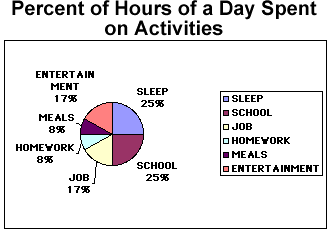
Circle or pie graphs are particularly good illustrations when considering how many parts of a whole are inception. In the table below both the number of hours in a whole day devoted to certain activities is listed as well as the percent of time for each of these activities. The pie chart is then divided very much as a baker’s pie would be into slices that represent the proportional amounts of time spent on each activity.

To the right of the pie chart is a legend that tells which color stands for which category. In addition, the percents are also near the pie slice that stands for that particular amount of time spent.

Percent of Hours of a Day Spent on Activities

ACTIVITY HOURS PERCENT OF DAY
Sleep 6 25
School 6 25
Job 4 17
Entertainment 4 17
Meals 2 8
Homework 2 8


Pie Graph of Day's Activities