DNA Code for Insulin


DNA’s Instructions for Insulin  


Introduction:

Below are two partial sequences of DNA bases (shown for only one strand of DNA)  Sequence 1 is from a human and sequence 2 is from a cow.  In both humans and cows, this sequence is part of a set of instructions for controlling the production of a protein.  In this case, the sequence contains the gene to make the protein insulin.  Insulin is necessary for the uptake of sugar from the blood.  Without insulin, a person cannot use digest sugars the same way others can, and they have a disease called diabetes.

Materials:

paper, pencil, codon table

Procedure:

  1. Using the DNA sequence given in table 1, make a complimentary RNA strand for  the human.  Write the RNA directly below the DNA strand (remember to substitute U’s for T’s in RNA).
  2. Repeat step 1 for the cow.  Write the RNA directly below the DNA strand in table 2.
  3. Use the codon table in your book to determine what amino acids are assembled to make the insulin protein in both the cow and the human.   Write your amino acid chain directly below the RNA sequence.

Table 1 


Sequence 1 ­ Human
DNA C C A T A G C A C G T T A C A A C G T G A A G G T A A
RNA
Amino Acids


Table 2

Sequence 1 ­ Cow
DNA C C G T A G C A T G T T A C A A C G C G A A G G C A C
RNA
Amino Acids

Analysis:

1. The DNA sequence is different for the cow and the human, but the amino acid chain produced by the sequence is almost the same.  How can this happen?


2. Diabetes is a disease characterized by the inability to break down sugars. Often a person with diabetes has a defective DNA sequence that codes for the making of the insulin protein. Suppose a person has a mutation in their DNA, and the first triplet for the gene coding for insulin is C C C  (instead of C C A).   Determine what amino acid the new DNA triplet codes for.    Will this person be diabetic?


3. What if the first triplet was C A A ?


4. How is it that a code consisting of only four letters, as in DNA ( A, T, G, C ) can specify all the different parts of an organism and account for all the diversity of organisms on this planet?


DNA sequences are often used to determine relationships between organisms.  DNA sequences that code for a particular gene can vary widely.  Organisms that are closely related will have sequences that are similar. Below is a list of sequences for a few organisms:


Human CCA   TAG   CAC   CTA
Pig CCA   TGG   AAA   CGA
Chimpanzee CCA   TAA   CAC   CTA
Cricket CCT   AAA   GGG   ACG


5. Based on the sequences, which two organisms are most  closely related?


6. An unknown organism is found in the forest, and the gene is sequenced, and found to be   C C A  T G G  A A T  C G A  ,  what kind of animal do you think this is?


DNA Model


Structure of DNA Lab


Introduction:

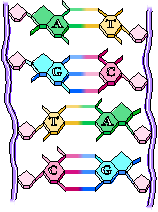
Deoxyribonucleic acid (DNA) is one of the two types of nucleic acids found in organisms and viruses. The structure of DNA determines which proteins particular cells will make. The general structure of DNA was determined in 1953 by James Watson and Francis Crick. The model of DNA that they constructed was made of two chains now referred to as the double helix. Each chain consists of linked deoxyribose sugars and phosphates units. The chains are complementary to each other. One of four nitrogen-containing bases connects the chains together like the rungs of a ladder. The bases are cytosine, guanine, thymine, and adenine. The DNA molecule looks like a spiral staircase. The structure of DNA is illustrated by a right handed double helix, with about 10 nucleotide pairs per helical turn.

DNA is a polymer. The monomer units of DNA are nucleotides. Each nucleotide consists of a 5-carbon sugar (deoxyribose), a nitrogen containing base attached to the sugar, and a phosphate group. (See Table 1.) There are four different types of nucleotides found in DNA, differing only in the nitrogenous base. Adenine and guanine are purines. Purines are the larger of the two types of bases found in DNA. They have two rings of carbons & nitrogens. Cytosine and thymine are pyrimidines and have a single carbon-nitrogen ring. (See Table 2.) The sequence of these bases encodes hereditary instructions for making proteins—which are long chains of amino acids. These proteins help build an organism, act as enzymes, and do much of the work inside cells.

Table 1


DNA Nucleotide
(Sugar + Phosphate + Base)


 Table 2


Pyrimidine
(single ring of C & N)
Purine
(double ring of C & N)


Materials:

Colored paper (any 5 different colors to run templates), scissors, transparent tape, coat hanger, hole punch, string or fishing line

Procedure:

  1. Use the section of DNA you have been assigned (Human hemoglobin or Chicken Hemoglobin), and figure out the sequence of bases present on the complementary strand of this molecule Table 1.


Human Hemoglobin Chicken Hemoglobin
Left Strand Complementary Strand Left Strand Complementary Strand
TAA GTT
TGT TGT
CGA CCG
CCG CCG
CTG CGA
GTC GTC
CAA TAT
GTC CGA
CTT TTG
TGA AGG


  1. Count the number of bases (A, T, C, and G) you will need for both strands of the DNA model your group has been assigned, and cut out these bases. (60 total)
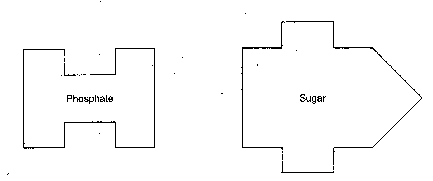
  2. Cut out a sugar and a phosphate for each of your DNA bases. (120 of each)
  3. Construct a nucleotide for each base that you have cut (sugar + phosphate + base) by taping these together. (20 total nucleotides)
  4. Using your assigned DNA sequence from Table 1, line up the nucleotides in the right order forming he left strand of your DNA molecule. (30 nucleotides)
  5. Add the other complementary nucleotides to form the right strand by taping the bases together (A bonds with T; C bonds with G).
  6. Once the strand is complete, secure it by adding more transparent tape or ask your teacher to laminate your model.
  7. Punch two holes at the top of your model, and attach the DNA model to a coat hanger with string.
  8. Carefully twist your model into a double helix (5 base pairs in a 1/2 turn and 10 in a complete turn).
  9. Attach thin fishing line to the sides of the nucleotides to hold the turns in place.
  10. Hang your model from the ceiling using the top of your coat hanger.

TEMPLATES:

Questions & Observations:

1. What 2 molecules make up the sides of the DNA molecule?

2. What nitrogen bases form the rungs of the DNA double helix?

3. What is meant by the complementary strand of DNA?


4. What sugar makes up DNA nucleotides?

5. How are nucleotides named?


6. DNA is the instructions for building what molecule in our cells?

7. What would happen if one or more bases on the DNA strand were changed?


Effect of Detergent on Gelatin


“How Good Is Your Enzymatic Detergent?


Introduction:
In nature there are enzymes called proteases that “digest” or degrade proteins. Some of these enzymes have been genetically engineered and added to our laundry detergents in the hope that they will “digest” the protein off of our clothing. Do they work? Do they assist in cleaning? In this experiment you can compare different detergents and their ability to “digest” protein.
What is gelatin? Gelatin consists of protein chains that are easily digested into their amino acid components. Gelatin is prepared from collagen, a protein found in animal tendons and skin and taken out during the meat rendering process. Boiling collagen reduces the  weight by about one-third and separates the protein strands by breaking bonds. When the boiled collagen is cooled, it does not revert back to collagen but sets to a gel we know as gelatin.

Purpose :
To test the effectiveness  of laundry detergent brands (and their enzymes) to digest protein (in the form of gelatin)

Prelab

Hypothesis:   ____________ will decompose more gelatin in millimeters than ______________.

Materials:
Gelatin in 4 test tubes  Wax Pencil/ Permanent marker
3 detergent brands
Distilled water
Test tube rack
Parafilm®
Ruler

Procedure:
Day 1
1. Pour 5 ml of melted gelatin into 4 test tubes. Let the gelatin solidify.
2. Make 10% solutions of the five non-liquid detergents selected for testing. (Mix 10 g of detergent in 90 mL of distilled water). Label the solutions carefully and note whether enzymes are listed as a component of each.
3. Mark the top level of the gelatin with a permanent marker. Add 15 drops of each detergent solution to the top surface of the hardened gelatin in a test
tube. To one tube add 15 drops of distilled water. Label carefully.
Day 2
4. After 24 hours examine the test tubes. Notice that the gelatin has been liquefied in some tubes.  Use a ruler to measure the depth of the liquefication. Measure from the mark where the hardened gelatin started down to where it is still hard. Measure to the nearest mm. Record.
Day 3
5. Measure the depth of liquefication again after 48 hours.

Data   1 data table, 1 graph (time vs. mm. liquefied)

Enzymes listed? Liquefied After 24 hours (mm.) Liquefied After 48 hours (mm.)
Distilled Water
Detergent 1 ?
Detergent 2 ?
Detergent 3 ?


Conclusion:

1. What is the job of enzymes?


2. Why do laundry detergents often contain enzymes?


3. Why was gelatin used in this lab?


4. How is gelatin made?


5.  Name each of the laundry detergents you used and describe the effect each one had on the gelatin.


6.  Did any of the laundry detergents contain enzymes? If so, which one(s)?


7. Was your original hypothesis correct? Explain.