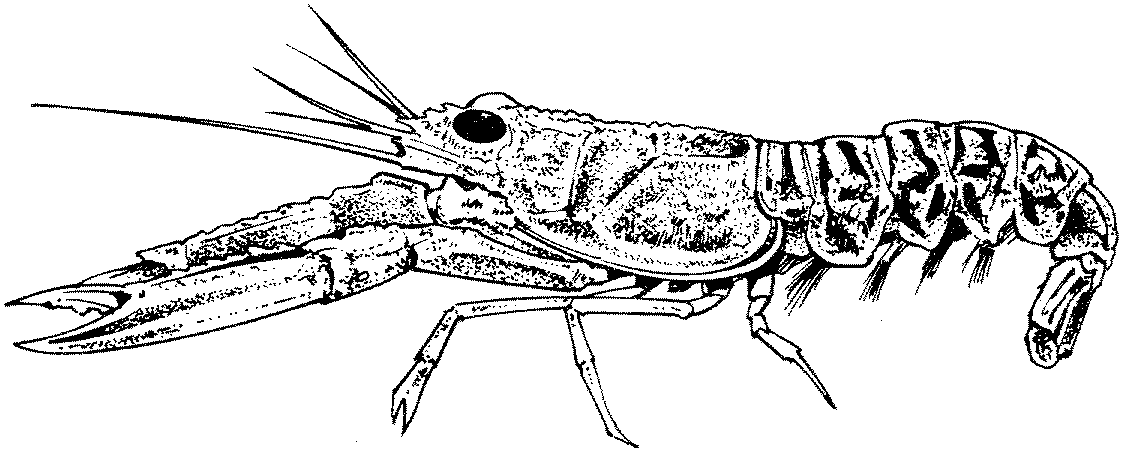
Crayfish Dissection


Crayfish Dissection


By Day:    Day 1        Day 2        Day 3

By Region: External Anatomy    Internal Anatomy

By Topic:      Skeletal       Integumentary     Cardiovascular     Muscular    Endocrine    Nervous
Reproductive     Respiratory    Excretory    Digestive


You must create a series of labeled drawings that illustrate the structures outlined below:

Day 1

I. Abdomen – Ventral View          (Day 1)         top

Place the crayfish supine (ventral surface up) on the dissecting tray and DRAW the following:


  1. Telson (What is the telson’s function?)
  2. Uropod  (Describe the location of the Uropod to the telson.   How do the add to the telson’s function?)
  3. Anus (In which of the two structures above did you find the anus? 1 or 2 way digestive system?)
  4. Swimmerets -numbered in pairs, 1-5 w/ the 5th one the most posterior (What is their function, and how is it different from the telson’s function?)
  5. Is your Crayfish a male or a female (Note the anterior-most swimmeret.   In the male, its function is to guide the sperm toward the female during copulation; as such, it will be enlarged, and pointed anteriorly in the male.  In the female there is no difference between the swimmerets)?  (Describe the appearance of the crayfish’s swimmerets in your answer.)
  6. Walking Legs (How many are there?  In terms of this feature alone, is this organism closer to an insect, or an arachnid?)
  7. Chelipeds – some people like this meat the best . . . (What is their function?)


II. Head – Ventral View             (Day 1-2)         top


  1. Mandibles – 2 – hard & white  (What are they equivalent to in humans?  How is their action – think direction of movement – different from that of humans?)
  2. Maxilla – softer w/ jagged edges  (Given the difference in texture, how is their function different from that of the mandibles?)
  3. Maxillapeds, or “mouth-feet” -3 pairs  (What is their function?  Why not use the Chelipeds?)
  4. Green Gland Ducts – (From what organ do they open out?  What is the equivalent organ in humans? What is the purpose of the duct?  Is its location at all disturbing to you?)


II. Cephalothorax – Dorsal View             (Day 1-2)         top

  1. Rostrum (What is cephalization?  Given that, what organ would you expect to be inside the rostrum?)
  2. Eyes (Does this organism have binocular vision – depth perception, why or why not?)


    Eye


  3. Carapace (What is the function of the carapace?  What two body systems in humans perform equivalent functions?  The support function is in reference to one system in particular; given the external location of the carapace, explain the name of the type of system compared to our own, internal variety.  The support function implies specifically the attachment of organs of what body system to the inside of the carapace?

Day 2

Make a Dorsal Midline Incision from the posterior end of the thorax to the posterior end of the rostrum using the rounded scissors w/ the rounded end down! Open the carapace and pin it back.

III. Thorax – Dorsal View, Part I          (Day 2)         top

  1. Heart & Ostia – the opening on the heart’s superior surface (Is this a sign of an open or closed circulatory system?  Differentiate between the two in your answer.)
  2. Gills (What are they equivalent to in humans?  To what body system do they belong?  Why are the gills so feathery – i.e., how does this aid in their function?)
  3. Cardiac Stomach -draw whole (There appear to be fibers attached to the outside of the stomach.  What is their purpose in relation to the stomach and the esophagus?)

IV. Thorax – Dorsal View, Part II         (Day 2)         top

  1. Remove one gill and draw on high power (What is the red/pink material within each “finger” of each gill?  How does this material relate to the function of the gill?)
  2. GENTLY remove one walking leg, and you will see that a gill is attached to each walking leg.  (How is this important to the function of the gills?  In your answer refer to the different requirements of the body during times of high physical activity, and how they are related to the gill-walking leg connection.)
  3. Cut open the Cardiac Stomach and draw the Gastric Mill – reddish-brown lateral “teeth” – on high power  (What is their function?  What type of digestion involves the gastric mill?  Do we accomplish that type of digestion in our own stomach?)

Day 3

V. Thorax – Dorsal View, Part III         (Day 3)         top

Gently remove the Heart.

  1. The Intestine (Given its location posterior to the stomach, what is its function?  What function of the stomach is lacking in the intestine?)
  2. The Hepatopancreas Gland (What two organs is this equivalent to in humans?  What are some of the functions of this gland?  How is its location important to its function?)
  3. The Seminifierous Tubules or Ovaries  (What is the function of each? To what body system do these belong?  Which of the two does your specimen contain?  How is this related to the swimmerets?)


VI. Thorax – Dorsal View, Part IV         (Day 3)         top

Gently remove the Cardiac Stomach.

  1. Esophagus  (Describe how it’s position relative to the stomach is different from the worm and the human.)
  2. Green Gland (What is/are the equivalent organ(s) in humans?   Do/does the analogous organ(s) appear in pairs in humans?  To what body system do the green glands belong?  What organ in our equivalent body system is missing in the crayfish?)
  3. Brain (Describe the appearance of the brain and the nerves in terms of the type of symmetry.  There are nerves that are attached to the front and the back of the brain.  Describe the function of both the anterior and the posterior nerve pairs.)

VII. Abdomen – Dorsal View, Part I       (Day 3)        top

Make a Dorsal Midline Incision from the anterior end of the abdomen to the posterior end of the abdomen using the rounded scissors w/ the rounded end down! Open the exoskeleton and pin it back.


In order for a Crayfish to determine BALANCE, it must insert a grain of sand in one of it’s appendages.
Every time it molts and makes a new exoskeleton, it must get a new grain of sand!
(In what part of the body is that function taken up by the human body?)


  1. Dorsal Blood Vessel  (Is this vessel sending the blood to, or away from, the heart?  What name would we give to that type of vessel in our body?)
  2. Large Intestine (How is the location of this organ related to the name of this section of the body [it is NOT a tail]?  What is the function of the large intestine?  Given it’s contents, is it wise, or unwise, to eat it when eating a lobster?  Explain.)
  3. Abdominal Flexor Muscles  (How do muscles function, by shortening,   lengthening, of both?  Moving the abdominal flexor muscles will cause flexion, but what is flexion?  How will the abdomen – it is NOT a tail – change shape during flexion?  What direction will the crayfish move during flexion?  Given the size and strength of the muscle, during what circumstances would the crayfish use this muscle over its walking legs?)

VIII. Abdomen – Dorsal View, Part II        (Day 3)        top

Gently remove the Abdominal Flexor Muscles.

  1. Ventral Blood Vessels  (Given that there is no main ventral blood vessel, how does the blood return to the heart?  Is this a sign of an open or closed circulatory system?)
  2. Ventral Nerve Cord  (To what phylum does the crayfish belong?   How is the location of the nerve cord different from creatures in our own phylum?   Name our own nerve cord.  How is the protection of the nerve cord different in both phyla?)

Drawings:

  1. Use a PENCIL!!

  2. Make the drawings “larger than life” size, as the specimens are so small.

  3. Draw the general shape (outline) and location of the organs, as the squiggles so many of you use to “shade” your drawings make your drawings sloppy and hard to interpret.

  4. Include Labels on all drawings.

  • Labels should start outside the drawing, and be connected to the structure by arrows with tips (===>).

  • The Tip of the arrow should be touching the structure.

  • Be sure to include the magnification for any drawings done with the dissecting microscope.

Hang on to the drawings; they will all be handed in later, together with some questions to answer!


Day 1        Day 2        Day 3         top

Modified from  Lazaroff Biology


Chromosome Notes


 Chromosomes Linkage

Genes on the same chromosome are linked.

Example: Unlinked Genes

G = gray body

g = black (ebony) body


R = red eyes

r = purple eyes

The diagrams below show that the locus for body color (G or g) is on a different chromosome than the locus for eye color (R or r).  These two loci will assort independently to produce either GR and gr gametes or Gr and gR gametes.
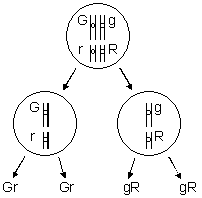
cross: GgRr X ggrr

gametes: GR, Gr, gR, gr X gr
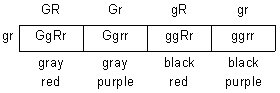
Ratio expected: 1:1:1:1

Example: Linked Genes

Suppose G and R are linked as shown below. If the body color and eye color loci are on the same chromosome, they will not assort independently unless crossing-over occurs frequently.
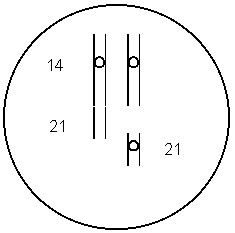
In this case, GgRr can produce only two kinds of gametes: GR and gr.

GgRr X ggrr

gametes: GR, gr X gr
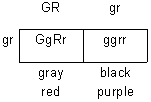
If G and R are linked, then whenever you have a G, you have an R. Any gray, purple offspring (G-rr) would result from crossing over because a Gr gamete is needed.

Suppose out of 100 offspring, you got 46 gray, red, 46 black purple, 4 gray purple and 4 black red.  Eight percent of the offspring resulted from crossing over. These offspring are recombinant.

Crossing Over

Crossing over is more likely to occur between genes that are far apart. The farther apart genes are, the greater the probability that crossing over will occur between them.

In the example above, we had 8% crossing over.

The percent of recombination (crossing over) can beused as a measure of how far apart genes are.   1% crossing over = 1 map unit.

Example

G = gray body

g = black (ebony) body


R = red eyes

r = purple eyes

Suppose that G and R are linked (on the same chromosome) in a particular individual and g and r are also linked

P1 GgRr X ggrr

If there is no crossing-over, possible gametes for the first parent are GR and gr.

If there is crossing-over, possible gametes are gR and Gr.

the following results were obtained:

How far apart are the G and R loci?

Sex Chromosomes

Humans have 23 pairs of chromosomes (46 total) chromosomes. Two of these are called sex chromosomes, the other 44 are called autosomes.

There are two kinds of sex chromosomes, called the X chromosome and the Y chromosome. The X chromosome is larger and contains many genes. The Y chromosome is much smaller and contains very few genes.

Normally, human females have two X chromosomes (XX) and males have one X and one Y chromosome (XY).

Occasionally, an accident happens in which a person is born with too many or too few sex chromosomes. In these cases, the person will be male if they inherit a Y chromosome and female if they do not.

Examples of four different possibilities that produce males are shown below. The last three are abnormal.

XY
XXY
XXXY
XYY

Examples of four different possibilities that produce females are shown below. Normal females are XX.

X
XX
XXX
XXXX

The cross below shows that normal females produce eggs that have one X chromosome. Half of the sperm produced by normal males have an X chromosome and the other half have a Y chromosome.

XX   x   XY

¯
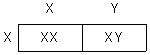
This analysis shows that half of the offspring are expected to be male, half are expected to be female.


Chromosomal Determination of Sex

Males


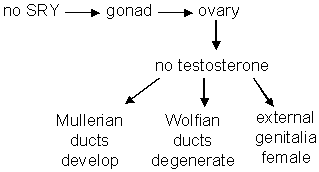
The Y chromosome contains a gene called SRY (for sex-determining region of Y).
 

Females
 

Testicular Feminization


The body cells of people with testicular feminization are insensitive to testosterone and therefore develop the female phenotype even though they have a Y chromosome.

It has an X-linked recessive mode of inheritance.

Guevodoces

Guevodoces refers to a condition in which the male phenotype develops after puberty.

It is due to delayed testosterone production.

X-Linkage

Morgan (Columbia U):

P1      red-eyed X white-eyed

¯

F1            all red-eyed

F2           3:1 (red:white) but all white were male

explanation:

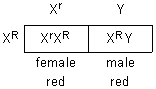
These genes are found on the X chromosome but not on the Y chromosome. An XrY male will therefore have red eyes. Details of this cross are below.

P1     XRXR       X XrY
   female male

gametes: XR (female) and Xr, Y (male)

The offspring produced from the above cross are crossed with each other (below):

F1      XRXr   X   XRY

¯

gametes: XR and Xr (from female); XR and Y (from male)

F2:
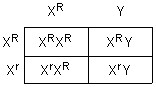
Notice that there are three possible genotypes for females and two possible genotypes for males.

Females Males
Genotypes Phenotypes Genotypes Phenotypes
XRXR red XRY red
XRXr red XrY white
XrXr white

X-Linked Inheritance

Males inherit their X chromosome from their mother. Their Y chromosome comes from their father. A male, therefore, cannot pass an X-linked trait to his sons. Males inherit all of their X-linked traits from their mother.

If a male inherits an X-linked recessive trait, it will be expressed because males do not have a homologous X chromosome.

Females can be carriers of X-linked traits without expressing them because they might carry the dominant allele on the other X chromosome. For example, the following genotype will have a dominant phenotype: XAXa.

Dosage Compensation

Although females have twice as many X-linked genes, the amount of protein produced by these genes is the same in females as it is in males.


Reduced protein production (called dosage compensation) occurs as a result of inactivating one X chromosome by coiling and condensing it. When condensed, it cannot be transcribed, that is, it cannot be used to produce mRNA.

Condensed X chromosomes, called Barr bodies, are visible using ordinary light microscope techniques.

The table below shows the number of Barr bodies in normal cells and in the cells of people with an abnormal number of X chromosomes. Normal males do not have Barr bodies because they only have one X chromosome.

Genetic Condition  

# Barr Bodies per Cell

normal male 0
normal female 1
XXX female 2
XXXX female 3
XXY (Klinefelter male) 1

In summary, one X chromosome remains active, the others are inactivated by forming Barr bodies.


Inactivation


Inactivation occurs early in embryonic development (12-16 days).

In females, each cell normally contains two X chromosomes. The X chromosome that is inactivated is determined randomly.

img006.gif (6009 bytes)


img007.gif (6184 bytes)

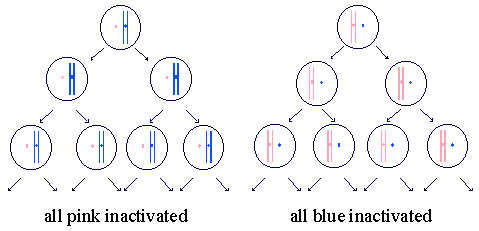
Once inactivation occurs, all daughter cells of a particular cell have the same X chromosome inactivated.

All of the “pink” chromosomes in the drawing below (left side of diagram) have been inactivated. All future cells produced by this cell will have the pink chromosome inactivated. In the diagram on the right, all of the blue chromosomes have been inactivated. All future generations of this cell will have the blue chromosome inactivated.
img008.gif (6206 bytes)

Females are therefore mosaics with respect to the X chromosome. Patches of body cells will have the maternally inherited X chromosome inactivated and other patches will have the paternally inherited one inactivated.


Example of Mosaicism: Calico Cats


A calico cat has patches of orange and patches of black

X = orange

X1 = black

MALES:

XY = orange

X1Y = black

FEMALES:

XX = orange

X1 X1 = black

X X1 = orange or black patches

All cells descended from an X1 cell (X is inactive) are orange-yellow.

All cells descended from an X cell (X1 is inactive) are black.


Human Example – Anhydrotic Dysplasia


Anhydrotic dysplasia is a disease that results in the absence of sweat glands.

It is inherited as an X-linked recessive disease.

Let X = normal sweat glands and X’ = absence of sweat glands. Normal males are XY. Affected males are X’Y and do not have sweat glands.

Normal females are XX, heterozygous females are XX’ and have patches of skin with sweat glands and patches of skin without sweat glands. Females that are X’X’ do not have sweat glands.


Other Information


Should heterozygous females for colorblindness be able to see color?

Suppose: X = color vision

x = colorblind


The Retina of a heterozygous (Xx) female will have some cells with the “X” inactivated and other cells with the “x” inactivated.

A heterozygous carrier of red-green colorblindness has some colorblind cells in her retina. The non-colorblind cells enable her to see color.

Turner’s syndrome is an abnormality in females where there is only one X chromosome; the other is missing.   These people have abnormalities that will be discussed in the next chapter.   Why aren’t Turners syndrome females normal?  Evidence indicates that some genes in the Barr body remain active. Their DNA is uncoiled and extends from the Barr body. If the Barr bodies of a normal female were missing, she would exhibit Turners Syndrome.


Home      General Biology 1      General Biology 2      Human Biology      Anatomy and Physiology

Crayfish Appendage Table

Crayfish Appendage Table

Appendage Function Location Attach Appendage Here
Antennules Senses touch & taste; helps crayfish maintain balance in front of the mouth .
Antenna Senses touch and taste in front of the mouth .
Mandible or jaw Crushes food mouth .
First Maxilla Moves food to the mouth behind the mandibles .
second maxilla moves water in the gill chamber behind the mandibles .
First maxilliped Holds food; Senses touch and taste at ventral and forward part of the thorax region .
Second maxilliped Holds food; Senses touch and taste at ventral and forward part of the thorax region .
Third maxilliped Holds food; Senses touch and taste at ventral and forward part of the thorax region .
Cheliped Grasps food at ventral part of thorax-posterior to the maxillipeds .
walking leg locomotion at ventral part of thorax-posterior to the maxillipeds .
Swimmeret 1st swimmeret in males transfers sperm to female; females use the 2nd-5th swimmerets to hold eggs & young; locomotion abdominal region on the ventral side .
uropod swimming posterior or tail end .
telson swimming posterior or tail end .

BACK

Chromosomes & Human Inheritance Notes


Chromosomes & Human Inheritance
All Materials © Cmassengale


Chromosomes:

  • Thomas Sutton in 1902 proposed that genes are located on chromosomes
  • Called the Chromosome Theory of Inheritance
  • For most of the life of the cell, chromosomes are too elongated to be seen under a microscope & are  called chromatin
  • Before a cell gets ready to divide, each chromosome is duplicated & condenses into short structures
  • Each chromosome is composed of a single, tightly coiled DNA molecule 
  • The two DNA strands are homologous (duplicates) and are held together by the centromere
  • While they are still attached, the duplicated chromosomes are called sister chromatids

  • Fertilization restores the diploid chromosome number and paired condition for alleles in the zygote
  • Chromosomes can be categorized as two types — autosomes & sex chromosomes
  • Autosomes are non-sex chromosomes that are the same number and kind between sexes
  • Sex chromosomes determine if the individual is male or female
  • Sex chromosomes in the human female are XX and those of the male are XY
  • Males produce X-containing and Y-containing gametes; therefore males determine the sex of offspring

Chromosome Numbers:

  • All animals have a characteristic number of chromosomes in their somatic or body cells called the diploid (or 2n) number.
  • The gametes or sex cells (egg & sperm)  contain half the number of chromosomes as a body cell; known as the haploid number (n) of chromosomes


Diploid (2n) numbers of Organisms
Man 46
Dog 78
Fruitfly 8
Crayfish 200
Corn 20


Pedigrees:

  • Also called a family tree
  • Squares represent males and circles represent females
  • Horizontal lines connecting a male and female represent mating
  • Vertical lines extending downward from a couple represent their children
  • A shaded symbol means the individual possess the trait
  • Half-shaded symbols are carriers


Sex Linkage:

  • Thomas Hunt Morgan worked with fruit flies & confirmed that  genes were on chromosomes
    a. Fruit flies are cheaply raised in common laboratory glassware
    b. Females only mate once and lay hundreds of eggs
    c. Fruit fly generation time is short, allowing rapid experiments
  • Experiments involved fruit flies with XY system similar to human system
  • Besides genes that determine sex, sex chromosomes carry many genes for traits unrelated to sex
  • X-linked gene is any gene located on the X chromosome that are missing on the Y chromosome
  • X-linked alleles are designated as superscripts to X chromosome
  • Newly discovered mutant male fruit fly had white eyes


Mutant White-eyed  & Wild, Red-eyed 

  • Cross of white-eyed male with dominant red-eyed female yield expected 3:1 red-to-white ratio; however, all white-eyed flies were males
  • An allele for eye color on the X but not Y chromosome supports the results of the cross
  • Heterozygous females are carriers that do not show the trait but can pass it on
  • Males are never carriers but express the one allele on the X chromosome
  • Red-green color-blindness is X-linked recessive
  • In humans, another well-known X-linked traits is hemophilia (free bleeders that lack clotting factors in their blood)
  • One of the most famous genetic cases involving hemophilia goes back to Queen Victoria who was a carrier for the disorder and married Prince Albert who was normal
  • Their children married other royalty, and spread the gene throughout the royal families of Europe


Royal Pedigree


Example Sex-Linked Problems:

1. What are the results of crossing a colorblind male with a female carrier for colorblindness?


Trait:     Red-Green Colorblindness

Alleles:     XC    normal vision
Xc    colorblindness

XCXc       x    Xc Y

XC Y   Genotypes:    XCXC ,XCY, XCXc, XcY
XC XCXC XCY   Genotypic Ratio: 1:1:1:1
Xc XCXc XcY   Phenotypes:
normal vision female, normal vision male, female carrier, colorblind male


2. What are the results of crossing a colorblind male with a colorblind female?


Trait:     Red-Green Colorblindness

Alleles:     XC    normal vision
Xc    colorblindness

XcXc       x    Xc Y

Xc Y   Genotypes:       XcXc , XcY 
Xc XcXc XcY    Genotypic Ratio: 1:1 ratio
Xc XcXc XcY   Phenotypes:       colorblind female, colorblind male
   Phenotypic ratio:  1:1 ratio


Linked genes:

  • Each chromosomes has 1000’s of genes
  • All genes on a chromosome form a linkage group that stays together except during crossing-over
  • Some genes located on the same chromosome tend to be inherited together
  • Linked genes were discovered by Thomas Hunt Morgan while studying fruit flies
  • Linked alleles do not obey Mendel’s laws because they tend to go into the gametes together
  • Crosses involving linked genes do not give same results as unlinked genes

Chromosome Mapping:

  • Recombinants result from chromosome crossing over during prophase I of meiosis
  • Geneticists can use recombination data to map a chromosome’s genetic loci (position on a chromosome)
  • A genetic map lists a sequence of genetic loci along a particular chromosome
  • Alfred Sturtevant, a student of Morgan, reasoned that different recombination frequencies reflect different distances between genes on a chromosome
  • The farther apart genes are, the greater likelihood of crossing-over
  • The closer together two genes are, the less likely of crossing-over occurring
  • A map unit equals 1% recombination frequency
  • If 1% of crossing-over equals one map unit, then 6% recombinants reveal 6 map units between genes
  • To determine the frequency of recombinants, the following formula is used:
Number of recombinants x 100%
Recombination Frequency =   ———————————————
     Total Number of Offspring


  • Humans have few offspring and a long generation time so biochemical methods are used to map human chromosomes (Human Genome Project)

Chromosome Mutations:

  • Mutations are changes in genes or chromosomes that can be passed on to offspring
  • Mutations increase the number of variations that occur
  • Chromosomal mutations include changes in chromosome number and/or structure
  • Monosomy occurs when an individual has only one of a particular type of chromosome
  • Turner syndrome (X0) is an example of monosomy
  • Trisomy occurs when and individual has three of a particular type of chromosome
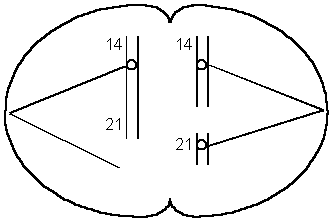
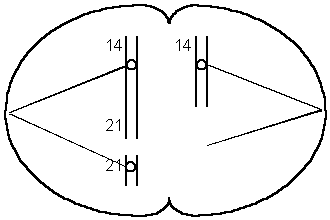
  • Examples of trisomy include Klinefelter’s Syndrome (XXY) and Down Syndrome or Trisomy 21 where the individual has three 21st chromosomes
  • Both monosomy & trisomy result when chromosomes fail to separate during meiosis; called nondisjunction
  • Monosomy and trisomy (aneuploidy) occur in plants and animals and may be lethal (deadly)
  • Polyploidy where the offspring have more than two sets of chromosomes occurs often in plants (3n, 4n …)
  • Environmental factors including radiation, chemicals, and viruses, can cause chromosomes to break causing a change in chromosomal structure
  • Inversion occurs when a piece of a chromosome breaks off & reattaches to the same place but in the reverse order
  • Translocation occurs when a chromosome segment breaks off & attaches to a different chromosome
  • Deletions occur when the end of a chromosome breaks off & is lost
  • Cri du chat syndrome (results in retardation & a cat-like cry) is due to a deletion of a portion of chromosome 5
  • Duplications occur when a section of a chromosome is doubled
  • Fragile X Syndrome caused by an abnormal number of repeats (CCG) results in retardation & long, narrow face becomes more pronounced with age

Gene Mutations:

  •  Change in genes caused by change in structure of the DNA
  • DNA bases may be substituted, added, or removed to cause gene mutation
  • When genes are added or removed, the mutation is called a frame shift mutation

Frame shift mutation

  • Adding or Removing genes is called a point mutation

point mutation

  • Sickle cell anemia (red blood cells are C-shaped so can’t carry as much oxygen) is an example of a gene mutation in African Americans

  • Tay-Sachs (a disorder where the nervous system deteriorates) is a fatal gene mutation in Jewish people of Central European Descent
  • Phenylketonuria or PKU occurs from the inability of a gene to synthesize a single enzyme necessary for the normal metabolism of phenylalanine and results in death