| Mitosis & Meiosis PPT Questions |
|||||||||||||||||||||||||
| 1. From where do new cells arise?
2. Why does the body constantly make new cells?
3. Is cell division the same in all cells? Explain.
4. Why must each new cell get a complete copy of the original cell’s DNA?
5. Copying DNA is known as ____________________. 6. The original cell that divides is called the _____________ cell, while the two, new identical cells are called ______________ cells. Chromosomes 7. Describe the chromosome of a prokaryote like a bacterial cell.
8. About how many chromosomes are in the body cell of eukaryotes? 9. How many chromosomes are in a human body cell? 10. What makes up each chromosome?
11. Chromosomes can only be seen when a cell is __________________. 12. Uncoiled chromosomes are called ____________________. 13. DNA tightly coils by wrapping around what kind of proteins? 14. What are duplicated (doubled) chromosomes called? 15. What holds chromatids together? 16. Sketch & label all parts of sister chromatids.
17. What is a karyotype?
18. Where are autosomes found on a karyotype? 19. Where are sex chromosomes found on a karyotype? 20. What is the genotype for males? For females? 21. The presence of which chromosome determines the sex of the child?
Cell Reproduction22. What is asexual reproduction?
23. Give 2 examples of asexual reproduction. a. b.
24. What is sexual reproduction and give an example? 25. Which process produces identical new cells — mitosis, meiosis, or both? Prokaryotic Cell Division26. Name a prokaryote that reproduces by binary fission. 27. Sketch and explain how binary fission occurs in a bacterial cells.
28. What forms to divide the 2 new bacterial cells?
Cell Cycle29. Name the 5 phases of the cell cycle.
30. What is the longest phase of the cell cycle? the shortest phase? 31. Which phase has 3 stages & name them?
32. Which phase has 4 stages & name them?
33. Describe what occurs in the G1 stage of interphase.
34. When is DNA copied? 35. How do the new copies of DNA compare to the original DNA? 36. What does a cell make during the G2 stage right before mitosis?
37. Name a structure needed for cell division that is made during the G2 stage. In what type of cell is this organelle found?
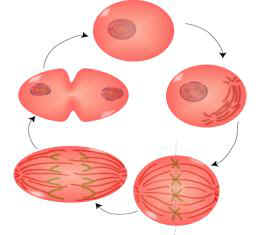
38. Can the nucleus and nucleolus be seen during interphase? 39. Sketch & label all parts of the cell cycle.
Mitosis40. What part of a cell actually divides during mitosis? 41. Give another name for mitosis. 42. In which type of cell does mitosis occur — prokaryote or eukaryote? Explain why.
43. Name a type of cell that doesn’t undergo mitosis. 44. Name, in order, the four stages of mitosis.
45. Name 2 things that happen to a cell during Early Prophase. a.
b. 46. What happens to the nucleus & nucleolus during prophase?
47. Why do chromosomes become visible during prophase?
48. What are kinetochores?
49. Where do kinetochore fibers attach to a chromosome? 50. What finishes forming by the end of Late Prophase?
51. Sketch and label a kinetochore fiber attached to a chromosome.
52. From what does the spindle form in plants? in animals? 53. What are polar fibers? Do they attach to chromosomes?
54. What are asters & where are they in a cell?
55. Where are the poles of a cell? the equator of a cell?
56. Sketch & label the parts of a spindle.
57. What happens to chromosomes during metaphase?
58. During metaphase, where do chromosomes line up & what MOVES them there?
59. Which mitotic phase occurs rapidly? 60. What happens to sister chromatids during anaphase?
61. What pulls sister chromatids apart during anaphase? 62. Where are chromatids located during telophase? 63. What disassembles in telophase? 64. What reforms around each set of sister chromatids during telophase? 65. What organelle reappears inside the nucleus? 66. During telophase as the chromosomes uncoil, they reappear as ____________________. 67. What process or phase follows telophase? 68. What divides during cytokinesis? 69. Explain how cytokinesis occurs in plants.
70. Explain how cytokinesis occurs in animals.
71. How does the chromosome number of the parent cell compare to that of the 2 daughter cells? How do the 3 cells compare in size?
72. What is the first thing the daughter cells must do following cytokinesis?
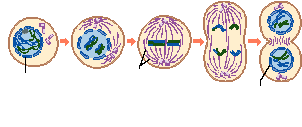
73. If the parent cell has a chromosome number of 2n = 6, what will be the chromosome number of the daughter cells? 74. Label these mitosis diagrams.
75. Label these stages.
76. Eukaryotic cell division is used for _______________ and _____________ of cells. 77. Parent cells before division are diploid or _______ chromosome number. What will be the chromosome number of the two new cells?
78. Name these actual stages of cell division.
TEST YOURSELF ON MITOSIS 79. Identify these stages.
80. Locate the four mitotic stages.
81. Eukaryotic cells before and after mitosis are ________________ or 2n. 82. What happens if mitosis is NOT controlled?
83. What are oncogenes? Meiosis80a. Do chromosomes replicate or double before meiosis? 81a. How many divisions occur in meiosis? Is this the same as mitosis? Explain.
82a. Meiosis is also called _____________________________________. 83. The original cell that divides by meiosis is ________________ or 2n. 84. How many daughter cells can be produced by meiosis? Is this the same as mitosis? Explain.
85. What is the chromosome number of the daughter cells produced by meiosis? How does this compare to the number of chromosomes in the original cell?
86. What are the daughter cells called that are produced by meiosis? Name them.
87. Name the 2 types of meiosis. a. b. 88. Where does spermatogenesis occur? 89. Where does oogenesis occur? 90. In humans, how many chromosomes are in the original that undergoes meiosis? Are they single or double stranded? 91. After one division, how many chromosomes are in the cells? Are they single or double stranded?
92. After the second division, how many chromosomes are in the cells? Are they double or single stranded?
93. Is meiosis sexual or asexual reproduction? 94. Are eggs & sperm haploid or diploid? 95. What process joins the egg & sperm to restore the original chromosome number of the organism?
96. When a sperm fertilizes an egg, a new 2n cell forms called the _____________________. 97. ________________ are pairs of sister chromatids that have the same genes, but may have different alleles. 98. _____________ reduces the chromosome number by half, while ____________ restores it. 99. In Meiosis I, what separates?
100. In Meiosis II, what separates?
101. Name these stages of Meiosis I.
102. Name 2 things that occur in Early Prophase I.
103. Name 3 things that happen in Late prophase I.
104. What is a tetrad? Label the centromere and put a box around a sister chromatid.
105. ____________ is the process in prophase I that forms tetrads. 106. Once tetrads form, what happens to the homologous chromosomes? What is this called?
107. Crossing-over results in genetic ________________ in the offspring. 108. What happens during Metaphase I?
109. Name 2 things that occur in Anaphase I?
110. Name 3 things that occur in Telophase I?
111. At the beginning of Meiosis II, each cell has how many homologs of each chromosome?
112. Sister chromatids carry ____________ genetic information (same genes & same alleles). 113. The gametes at the end of Meiosis II will have how many copies of a gene for a trait?
114. Name the stages in Meiosis II.
115. What happens in Prophase II? 116. Where are the sister chromatids in Metaphase II? 117. What happens to the sister chromatids during Anaphase II?
118. Name 4 things that occur in Telophase II?
119. Meiosis results in __________ haploid cells called _________ that have _______ copy of each chromosome and _________ allele for each gene in different ___________________. Gametogenesis 120. Gametogenesis that produces sperm cells is called ______________________________. 121. Where does spermatogenesis occur? 122. Immature sperm cells are called ___________________. 123. How do mature sperm cells move? 124. Approximately how many sperm do men produce each day? 125. Label the diagram of spermatogenesis.
126. Where does oogenesis occur?
127. Name the 4 cells produced by oogenesis. 128. What happens to the polar bodies & WHY?
129. ________________ are immature eggs. 130. How often do females produce an oocyte & starting at what age? 131. Label the diagram of oogenesis.
Comparing Mitosis & Meiosis 132. Complete the following table comparing mitosis & meiosis.
|
|||||||||||||||||||||||||
 |