Annelids

%CODE1%

Name: 

Annelids


True/False
Indicate whether the sentence or statement is true or false.
1.
Different regions of an annelid’s body specialize for different functions.
2.
Some leeches have become specialized to a parasitic way of life by developing the ability to suck blood from the bodies of other organisms.
 

Multiple Choice
Identify the letter of the choice that best completes the statement or answers the question.
3.
Twisting of the visceral mass of gastropods is called
a.
extension.
c.
torsion.
b.
inversion.
d.
conversion.
4.
Among the various species of gastropods, respiration may take place
a.
with gills.
c.
with lungs.
b.
through the skin.
d.
All of the above
5.
Segmented worms are known as
a.
nematodes.
c.
planarians.
b.
annelids.
d.
arthropods.
6.
Each segment of an annelid
a.
is capable of reproduction.
b.
has a well-developed brain.
c.
has a pseudocoelom.
d.
has a complete set of digestive organs.
7.
The evolution of tremendous diversity in the phylum Annelida is due primarily to
a.
gills.
c.
cephalization.
b.
specialized reproductive organs.
d.
segmented bodies.
8.
A similarity between annelids and arthropods is that they both have
a.
exoskeletons made of chitin.
c.
segmented body patterns.
b.
the ability to fly.
d.
well-developed lungs for respiration.
9.
Segmented worms are known as
a.
nematodes.
c.
planarians.
b.
annelids.
d.
arthropods.
      annelids_files/i0120000.jpg
10.
Refer to the illustration above. Which two organisms in the diagrams have segmented body plans?
a.
Organisms “A” and “C”
c.
Organisms “A” and “D”
b.
Organisms “B” and “D”
d.
Organisms “B” and “C”
11.
Coordinated movements of an annelid’s body segments are possible because of the
a.
development of an advanced brain.
b.
ventral nerve cord and paired segmental ganglia.
c.
presence of a true coelom in the annelid body.
d.
existence of a complete digestive system.
12.
Of the four basic types of tissue, the tissue that is specialized to transmit and receive messages in the body is
a.
epithelial tissue.
c.
muscle tissue.
b.
connective tissue.
d.
nerve tissue.
13.
earthworm movement : circular muscles and setae ::
a.
earthworm digestion : circular muscles and setae
b.
earthworm digestion : sperm receptacles
c.
earthworm reproduction : pharynx
d.
earthworm respiration : skin
14.
The digestive tube of annelids is divided into three regions. Which of the following is not among these regions?
a.
crop
c.
radula
b.
intestine
d.
stomach
15.
The advantage of a closed circulatory system over an open circulatory system is that
a.
blood moves more efficiently through the tubes of a closed circulatory system.
b.
a closed circulatory system prevents blood from leaking out of the body.
c.
blood is able to be pumped by a muscular heart in a closed circulatory system.
d.
lungs are able to function in animals with a closed circulatory system.
16.
Of the following organs, the one that does not exist in annelids is the
a.
heart.
c.
nephridia.
b.
gills.
d.
stomach.
17.
The clitellum of an earthworm
a.
contains the heart.
b.
is associated with reproduction.
c.
acts as a primitive respiratory system.
d.
is necessary for movement.
18.
Earthworms are considered to be beneficial to the environment because
a.
their castings contain nutrients.
b.
they aerate the soil as they move through it.
c.
they break up the soil in which they live.
d.
All of the above
19.
The basic body plan of an annelid
a.
consists of joined legs.
c.
is a tube within a tube.
b.
is similar to a long tube.
d.
can be compared to a corkscrew.
20.
Parapodia are involved in all of the following except
a.
swimming.
c.
burrowing.
b.
gas exchange.
d.
reproduction.


Check Your Work     Reset


AP Chapter 42 RETEST

%CODE1%

Javascript not enabled

Name:     ID: 

Email: 

AP Chapter 42 RETEST
 

Multiple Choice
Identify the choice that best completes the statement or answers the question.
 1.
Organisms in which a circulating body fluid is distinct from the fluid that directly surrounds the body’s cells are likely to have which of the following?
a.
an open circulatory system
b.
a closed circulatory system
c.
a gastrovascular cavity
d.
branched tracheae
e.
hemolymph
 2.
In which animal does blood flow from the pulmocutaneous circulation to the heart before circulating through the rest of the body?
a.
annelid
b.
mollusc
c.
fish
d.
frog
e.
insect
 3.
Which of the following are the only vertebrates in which blood flows directly from respiratory organs to body tissues without first returning to the heart?
a.
amphibians
b.
birds
c.
fishes
d.
mammals
e.
reptiles
 4.
To adjust blood pressure independently in the capillaries of the gas-exchange surface and in the capillaries of the general body circulation, an organism would need a(n)
a.
open circulatory system.
b.
hemocoel.
c.
lymphatic system.
d.
two-chambered heart.
e.
four-chambered heart.
 5.
Diffusion rate is proportional to the square of the distance molecules/ions travel. Which of the following would therefore be preferable for a mid-size multicellular organism?
a.
direct exchange of nutrients with the surrounding medium
b.
a system for bringing nutrients into contact with cells, and another system for bringing to cells
c.
a system to circulate gases, nutrients, and wastes to and from cells
d.
a system for facilitated diffusion to maximize materials that could be exchanged
e.
a system of individualized exchange tubules for each cell group
 6.
An anthropologist discovers fossilized animal remains that give strong evidence that the organism had a large, well-formed, most likely 4-chambered heart, with no connection between the right and left sides. Which of the following could most reasonably be hypothesized from this observation?
a.
that the animal and its relatives had evolved from birds
b.
that the animal had a high energy requirement and was endothermic
c.
that the animal was most closely related to reptiles such as alligators and crocodiles
d.
that the animal was a kind of invertebrate
e.
that the species had little to no need to regulate blood pressure
 7.
Which of the following would be described as a portal system?
a.
an area connecting arterioles to venules
b.
a series of vessels that returns blood to the heart in an animal with an open circulatory system
c.
a space within or between organs where blood is allowed to pool
d.
a slightly muscular vessel that has minimal pumping action in an organism with no heart
e.
a vessel or vessels connecting two capillary beds
 8.
A human red blood cell in an artery of the left arm is on its way to deliver oxygen to a cell in the thumb. From this point in the artery, how many capillary beds must this red blood cell pass through before it returns to the left ventricle of the heart?
a.
one
b.
two
c.
three
d.
four
e.
five
 9.
Which sequence of blood flow can be observed in either a reptile or a mammal?
a.
left ventricle ® aorta ® lungs ®systemic circulation
b.
right ventricle ® pulmonary vein ® pulmocutaneous circulation
c.
pulmonary vein ® left atrium ® ventricle ® pulmonary circuit
d.
vena cava ® right atrium ® ventricle ® pulmonary circuit
e.
right atrium ® pulmonary artery ® left atrium ® ventricle
 10.
A patient has a blood pressure of 120/75, a pulse rate of 40 beats/min, a stroke volume of 70 mL/beat, and a respiratory rate of 25 breaths/min. This person’s cardiac output per minute will be
a.
500 mL.
b.
1,000 mL.
c.
1,750 mL.
d.
2,800 mL.
e.
4,800 mL.
 11.
Damage to the sinoatrial node in humans
a.
is a major contributor to heart attacks.
b.
would block conductance between the bundle branches and the Purkinje fibers.
c.
would have a negative effect on peripheral resistance.
d.
would disrupt the rate and timing of cardiac muscle contractions.
e.
would have a direct effect on blood pressure monitors in the aorta.
 12.
If the atrioventricular node could be surgically removed from the heart without disrupting signal transmission to the Purkinje fibers, what would be the effect?
a.
No apparent effect on heart activity would be observed.
b.
The heart rate would be decreased.
c.
Only the ventricles would contract.
d.
Only the atria would contract.
e.
Atria and ventricles would contract at about the same time.
 13.
A nonfunctional sinoatrial node would
a.
have no adverse effects on heart contraction.
b.
cause the heart to stop beating in an autorhythmic fashion.
c.
result in a block in ventricular contractions.
d.
cause no effects because hormones will take over regulation of the heartbeat.
e.
have little significant effect on stroke volume.
 14.
Which of the following is measured by an electrocardiogram?
a.
impulses from the AV node
b.
impulses of the parasympathetic nervous system that control heart beat
c.
the spread of impulses from the SA node
d.
contraction of the two atria
e.
systole and diastole
 15.
The average resting stroke volume of the heart is 70 mL and it beats ~72 times per minute. This would result in which cardiac output?
a.
5 L/minute
b.
504 mL/minute
c.
0.5 L/minute
d.
50 L/minute
e.
500 L/minute
 16.
Where are semilunar valves to be found in the mammalian heart?
a.
where blood goes from atria to ventricles
b.
on the right side of the heart only
c.
where the pulmonary veins attach to the heart
d.
at the places where blood leaves via the aorta and pulmonary arteries
e.
at the places where the anterior and posterior venae cavae enter
 17.
Why is the velocity of blood flow the lowest in capillaries?
a.
The capillary walls are not thin enough to allow oxygen to exchange with the cells.
b.
Capillaries are far from the heart, and blood flow slows as distance from the heart increases.
c.
The diastolic blood pressure is too low to deliver blood to the capillaries at a high flow rate.
d.
The systemic capillaries are supplied by the left ventricle, which has a lower cardiac output than the right ventricle.
e.
The total surface area of the capillaries is larger than the total surface area of the arterioles.
 18.
The meshwork that forms the fabric of a blood clot consists mostly of which protein?
a.
fibrinogen
b.
fibrin
c.
thrombin
d.
prothrombin
e.
collagen
 19.
Why is gas exchange more difficult for aquatic animals with gills than for terrestrial animals with lungs?
a.
Water is less dense than air.
b.
Water contains much less than air per unit volume.
c.
Gills have less surface area than lungs.
d.
Gills allow only unidirectional transport
e.
Gills allow water to flow in one direction
 20.
Which of the following is an example of countercurrent exchange?
a.
the flow of water across the gills of a fish and that of blood within those gills
b.
the flow of blood in the dorsal vessel of an insect and that of air within its tracheae
c.
the flow of air within the primary bronchi of a human and that of blood within the pulmonary veins
d.
the flow of water across the skin of a frog and that of blood within the ventricle of its heart
e.
the flow of fluid out of the arterial end of a capillary and that of fluid back into the venous end of the same capillary
 21.
Where do air-breathing insects carry out gas exchange?
a.
in specialized external gills
b.
in specialized internal gills
c.
in the alveoli of their lungs
d.
across the membranes of cells
e.
across the thin cuticular exoskeleton
 22.
Air rushes into the lungs of humans during inhalation because
a.
the rib muscles and diaphragm contract, increasing the lung volume.
b.
pressure in the alveoli increases.
c.
gas flows from a region of lower pressure to a region of higher pressure.
d.
pulmonary muscles contract and pull on the outer surface of the lungs.
e.
a positive respiratory pressure is created when the diaphragm relaxes.
 23.
Which of the following occurs with the exhalation of air from human lungs?
a.
The volume of the thoracic cavity decreases.
b.
The residual volume of the lungs decreases.
c.
The diaphragm contracts.
d.
The epiglottis closes.
e.
The rib cage expands.
 24.
Which of the following lung volumes would be different in a person at rest compared with when the person exercises?
a.
tidal volume
b.
vital capacity
c.
residual volume
d.
total lung capacity
e.
All of the above would be different.
 25.
The blood level of which gas is most important in controlling human respiration rate?
a.
nitric acid
b.
nitrogen
c.
oxygen
d.
carbon dioxide
e.
carbon monoxide


         Start Over

GEOLOGY 112

WEST VIRGINIA UNIVERSITY AT PARKERSBURG
GEOLOGY 397 – SPECIAL TOPICS: INTRODUCTION TO PALEONTOLOGY
SYLLABUS
FALL  SEMESTER 2000

NAME OF COURSE: SPECIAL TOPICS: INTRODUCTION TO PALEONTOLOGY

COURSE NO.: Geology 397             CREDIT: 3 Semester Hours

DEPARTMENT: Geology                 DIVISION: Natural Sciences and Mathematics

PROFESSOR:  Dr. Edward L. Crisp
OFFICE: 2307
PHONE:  424-8255
email: ecrisp@alpha.wvup.edu
OFFICE HOURS:   TBA

REQUIRED TEXTS:

Prothero, Donald R.; 1998; BRINGING FOSSILS TO LIFE: AN INTRODUCTION TO PALEOBIOLOGY: WCB/McGraw-Hill Publishers; 457 p

Laboratory Manual to be announced later.
COURSE DESCRIPTION:

Geology 397-Special Topics: Introduction to Paleontology is an introductory course in paleontology.  Paleontology is the study of past life and the interactions of past living organisms with the physical world.  In this course we will trace the evolutionary path and patterns of life from the Precambrian to the present based on evidence from the fossil record.  The course will concentrate on invertebrate fossils (particularly in the laboratory), however, vertebrates and plants will also be covered in the course.  Additionally, the course will study the principles of fossil preservation and taphonomy, systematics and taxonomy of the major fossil groups, morphologic characteristics of the major fossil groups,  the biostratigraphic value of fossils, and the paleoecological, paleoenvironmental, and paleobiogeographical use of fossils in reconstructing ancient environments and geography of the Earth. The laboratory portion of the course will stress the morphological criteria necessary for fossil identification and the systematics and taxonomy of the major invertebrate fossil groups. (The course will consist of two 50 minute lectures per week and one 2 hour laboratory session per week) (Prerequisites: Geology 111, Geology 112, Biology 111, and consent of the instructor)
ATTENDANCE POLICY:

Attendance to all classes is highly recommended.  If you must miss a class, notify the instructor as soon as possible (preferably before you miss) at 424-8255  (if no answer, leave a message).  If you do miss a class it is your responsibility to cover the material, find out about class announcements, etc.  Material that is covered in lecture is not always readily obtained by just reading the text.  A record of attendance will be maintained and, because of the nature of the course, excessive absences may result in a lower grade.
ATTENDANCE IS REQUIRED FOR ALL TESTS!  Preparing make-up material for tests is very time consuming for the instructor.   Make-up will be allowed for valid excuses, such as severe illness, death in the family, or excused university sponsored events.  The student must make arrangements with the instructor before missing or immediately upon returning to class to arrange for a make-up exam, otherwise the grade for the missed exam will be recorded as a zero.  PLEASE DO NOT TAKE THIS POLICY LIGHTLY.

SAFETY RULES FOR THE LABORATORY:

A list of safety rules will be given to the student to follow during laboratory sessions.  In addition these rules will be posted in the laboratory.  Failure to adhere to these rules may result in injury to the student breaking the rules or other students in the laboratory.  Please follow these rules, they are meant for your safety.

All students in the class must receive laboratory safety training.  The instructor will use an announced laboratory time for a laboratory safety training session prior to any use of chemicals in the laboratory.  If for any reason you miss the laboratory safety training session, please contact the instructor as soon as possible for a make-up session on laboratory safety.  A student who misses the laboratory safety training session will not be allowed to continue to participate in laboratory sessions until he/she has received the laboratory safety training.  As a part of laboratory safety procedures, approved eye protective goggles are required for any laboratory procedures involving chemicals or heating procedures.  Students without approved eye protective goggles will not be allowed to participate in lab sessions involving chemicals or heating procedures.  The WVU-P bookstore sells the correct type of eye goggles for the laboratory.

TESTING and EVALUATION:  There will be three major one hour lecture exams (in addition to the final exam) during the semester.  The final exam will be partially comprehensive.  There will be a term paper required.  The term paper will be 6 to 10 pages and will be a review paper of some paleontological topic (topic assigned by instructor or of your choice with instructor’s approval) based on paleontological journal articles (more on this at the first class meeting).  The laboratory portion of the course will account for one third of the grade for the course.  There will be two major laboratory exams in addition to graded weekly laboratory exercises.  There will be a required field trip that may involve more than one day (will be on a weekend).  The field trip may substitute for one or more laboratory sessions.    Following is a breakdown of the basis for the final course grade:
BASIS FOR FINAL COURSE GRADE:

Three major exams during the semester (10% each, 100 Pts. each)…………….30%………..300 Points
Term Paper………………….………………………………………………………………….17%………..170 Points
Laboratory……………………………………………….………………………………….. 33%………..330 Points
Two laboratory exams (100 points each for 200 points)
Thirteen laboratory exercises (10 points each for 130 points)
Final Exam……………………………………………………………………………………..20%………..200 Points

Total…………………………………………………………………………….………………100%………1000 Points

GRADING SCALE:                                               PERCENTILE RANGE           COURSE GRADE

greater than 90%……………………………A
80 through 89%…………………………….B
70 through 79%…………………………….C
60 through 69%…………………………….D
less than 60%……………………………….F
COURSE OBJECTIVES

1.   To increase the ability of the student to think critically.
2.   To practice the scientific method of investigation.
3.   To appreciate and practice experimentation and observation and their importance in scientific investigations.
4.   To practice accurate scientific data collecting techniques and the importance of accurate data collection.
5.   To practice methodical study and work habits.
6.   To understand fossils as ancient organisms and understand the evolutionary and ecological principles which shaped ancient life.
7.   To understand fossils as geological tools for determining geologic time and recognizing paleoenvironments.
8.   To understand how fossils can be used to solve geologic problems.
9.   To learn the basic morphologic characteristics of the major groups of fossils.
10. To understand the systematics and taxonomy of the major groups of fossils.

SPECIAL PROJECTS TO BE INCLUDED IN THE COURSE

1.  Geologic field trips to study local paleontology.
2.  Field trips to museums or other points of paleontologic interest.
3.  Term paper.
NOTE:  THE INSTRUCTOR, DIVISION, OR UNIVERSITY MAY MODIFY ANY OF THE ABOVE IN ORDER TO BETTER SERVE THE OBJECTIVES OF THE COURSE, THE STUDENT, AND THE UNIVERSITY!

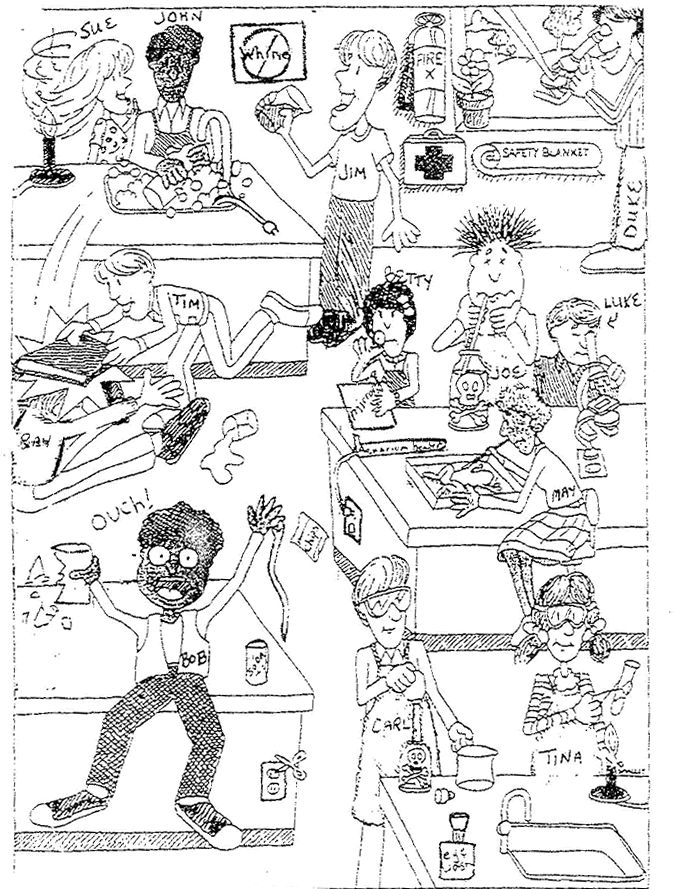
Picturing Lab Safety

Get the Picture?
www.biologycorner.com

View the picture and answer the questions concerning lab safety.

Questions:

1. List 3 unsafe activities shown in the illustration and explain why each is unsafe.


2. List 3 correct procedures depicted in the illustration.

3. What should Bob do after the accident?

4. What should Sue have done to avoid an accident?

5. Compare Luke and Duke’s lab techniques. Who is following the rules?

6. What are three things shown in the lab that should not be there?

7. Compare Joe and Carl’s lab techniques. Who is doing it the correct way?

8. What will happen to Ray and Tim when the teacher catches them?

9. List three items in the illustration that are there for the safety of the students in the lab.


10. What is Betty doing wrong?