Cell Quiz

%CODE1%


Cells!
1. The door to your house is like the ___ of a cell membrane?
phospholipid bilayer
gated channel
receptor protein
recognition protein
2. The phospholipid bilayer of the cell membrane is like a(n):
screen door
plate glass window
hot water heater
oven

3. Facilitated diffusion ____ require energy and uses the help of ______
does, transport proteins
does, cytoplasm
does not, transport proteins
does not, sodium pumps

4. A semi permeable membrane is stretched across a chamber filled with water. The membrane is only permeable to water. 60 mg of salt is added to the left side of the chamber. Which of the following will happen?
water will move toward the right side
salt will move toward the right side
water will move toward the left side
salt will move toward the left side

5. The lipid bilayer keeps the inside of the cell membrane:
bipolar
protein saturated
dry
wet

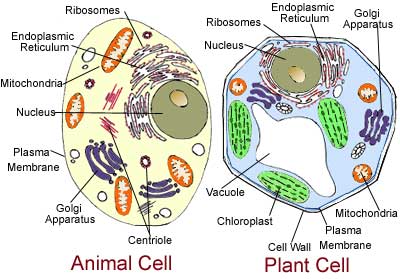
6. Which of the following could be found in BOTH the nucleus and the cytoplasm
nucleolus
ribosomes
RNA
both RNA & ribosomes

7. Amino acid chains built by the ribosomes then move to the:
golgi apparatus
lysosome
endoplasmic reticulum
mitochondria

8. Which of the following structures has a 9 + 2 arrangement?
flagella
ribosome
mitochondria
golgi apparatus

9. The centriole is most like the:
lysosome
flagella
mitochondria
chromatin

10. Which of the following is composed of a large and a small subunit?
golgi apparatus
endoplasmic reticulum
mitochondria
ribosome

11. A cell that is missing lysosomes would have difficulty doing what?
digesting food
storing energy
packaging proteins
moving cytoplasm

12. Which of the following cell parts is described as a “fluid mosaic”?
chloroplast
vacuole
cell membrane
endoplasmic reticulum

13. Some cells take in large molecules through the process of:
protein synthesis
endocytosis
cytoplasmic streaming
ATP

14. Which of the following organelles would NOT be found in a plant cell?
chloroplast
DNA
food vacuole
cell membrane

Score =
Correct answers:


BACK

DNA QUIZ

%CODE1%

DNA QUIZ

1. Name this structure.
deoxynucleic acid
deoxyribonucleic acid
denatured ribonucleic acid
deoxoribonuclear acid2. The process by which RNA is made from DNA:
synthesis
translation
transcription
replication

3. Adenine always pairs with:
thymine
cytosine
guanine
ribose

4. The “rungs” of the DNA ladder are made of:
phosphates and hydrogen
glucose and sugars
sugars and phosphates
base pairs

5. The DNA molecule is held together by:
magnetism
glucose
glue
hydrogen bonds

6. The process by which DNA makes a copy of itself is called:
synthesis
replication
transcription
translation

7. A gene is:
a segment of DNA that codes for a protein
a set of homologous chromosomes
a molecule within DNA
a type of pants

8. The twisted ladder shape of DNA is called a:
hydrogen twist
deoxyribose flip
double helix
double membrane

9. The sugar found in DNA is:
equal
deoxyribose
ribose
glucose

10. Which of the following takes the genetic code to the cytoplasm:
DNA
deoxyribose
tRNA
mRNA

11. The three nucleotide sequence on RNA is called a:
tRNA
codon
triplet
gene

12. Three nucleotides code for:
1 amino acid
3 amino acids
1 protein
3 proteins

13. RNA differs from DNA in that:
it has a different kind of sugar
it is single stranded
it has uracil
all of these

14. DNA is called the “blueprint of life” because:
it is like a fingerprint
it has a blue color
it contains the plans for building an organism
it can relay messages to other molecules

15. The two men who established the structure of DNA were:


Frederick and Alvers
Watson and Crick
Berkely and Fry
Darwin and Lamarke

Score =
Correct answers:

Mammal Quiz

%CODE1%

Mammals
  1. Which of the following pairs is MOST closely related?
    rat & shrew
    dog & cat
    horse & cow
    sea lion & dolphin
  2. What feature(s) do bats and whales share?
    mammary glands
    placenta
    echolocation
    all of these
  3. A sheep belongs to which of the following taxa?
    mammalia
    chordata
    artiodactyla
    all of these
  4. Which of the following groups contains mammals that lay eggs?
    marsupial
    monotreme
    chiroptera
    rodentia
  5. Which of the following is the largest group of mammals?
    rodentia
    chiroptera
    carnivora
    insectivora
  6. Which of the following animals have incisors that continue to grow its entire life?
    elephant
    walrus
    hamster
    lion
  7. All members of the order Carnivora:
    eat meat
    have large canines
    live in Australia
    have blubber
  8. Hair is used primarily for:
    defense
    coloration
    insulation
    sensation
  9. Which of the following belongs to the Order Pinnipedia?
    whale
    cow
    mole
    sea lion
  10. Which of the following belongs to the order Perissodactyla?
    zebra
    horse
    rhino
    all of these

Score =
Correct answers:

Taxonomy Quiz

%CODE1%

Taxonomy
  1.  Which of the following pairs is MOST closely related?
    dog & tapeworm
    tapeworm & bacteria
    mushroom & tree
    ameba & bacteria
  2. Organisms in the Kingdom Animalia are:
    multicellular & heterotrophic
    multicellular & autotrophic
    unicellular & autotrophic
    unicellular & autotrophic
  3. Which of the following groups would contain the largest number of organisms?
    class
    order
    phylum
    family
  4. A scientific name contains information about its:
    family & species
    genus & species
    phylum & order
    class & family
  5. What do plants and animals have in common?
    both are heterotrophic
    both are autotrophic
    both are prokaryotic
    both are eukaryotic
  6. The current classification system was devised by:
    Aristotle
    Plato
    Linnaeus
    Darwin
  7. Instead of phylum, plants use which category?
    division
    subspecies
    class
    subkingdom
  8. If two organisms are in the same phylum, they must also be in the same:
    class
    species
    family
    kingdom
  9. Which kingdom contains “extreme halophiles”?
    eubacteria
    archaebacteria
    fungi
    protista
  10. A dichotomous key is used to:
    locate an organism
    identify an organism
    divide a kingdom
    interbreed species

Score =
Correct answers:

Reptile Quiz

%CODE1%

Reptiles
  1. Which of the following made it possible for reptiles to make a complete transition to land?
    amniote egg
    3 chambered heart
    double loop circulation
    nictitating membrane
  2. Which of the following pairs is most closely related?
    snake & lizard
    crocodile & tuatara
    alligator & komodo dragon
    alligator & alligator snapping turtle
  3. Which part of the amniote egg is responsible for storing waste?
    chorion
    yolk sac
    amnion
    allantois
  4. Sea snakes and turtles breathe:
    with gills
    with lungs
    through their skin
    through their chorion
  5. Turtles and Tortoises belong to the ORDER:
    Squamata
    Crocodilia
    Chelonia
    Rynchocephalia
  6. Which organ on the snake is responsible for detecting odors?
    cloaca
    pit organ
    Jacobson’s organ
    venom gland
  7. Which of the following reptiles is known as a “living fossil”?
    tuatara
    komodo dragon
    sea turtle
    anaconda
  8. The top of a turtle’s shell is called the:
    plastron
    amnion
    carapace
    ventricle
  9. Snakes are thought to have evolved from:
    crocodilians
    lizards
    eels
    salamanders
  10. Ovoviviparous snakes:
    are venomous
    incubate eggs within the body
    lay eggs in nests
    do not have an amnion

Score =
Correct answers: