Sample Abstract

Doolittle, W. Ford.  Uprooting the Tree of Life.  Scientific American, February 2000, pp.90-95.

About 10 years ago, scientists finally worked out the basic outline of how modern life forms evolved.  Now, parts of their tidy scheme are unraveling.  Charles Darwin contended more than a century ago that all modern species diverged from a more limited set of ancestral groups, which themselves evolved from still fewer progenitors and so on back to the beginning of life. In principle, the relationships among all living and extinct organisms could be represented as a single genealogical tree.  Discoveries made in the past few years have begun to cast serious doubt on some aspects of the tree, especially on the depiction of the relationships near the root.

Scientists could not even begin to contemplate constructing a universal tree until about 35 years ago.  From the time of Aristotle to the 1960’s, research deduced the relatedness of organisms by comparing their anatomy or physiology or both.  For complex organisms, scientists were frequently able to draw reasonable genealogical inferences in this manner.  Microscopic single-celled organisms, however, often provided too little information for defining relationships.  In the mid-1960’s, Emile Zuckerland and Linus Pauling of the California Institute of Technology came up with a different strategy other than just comparing anatomy and physiology.  They proposed basing family trees on differences in the building block sequences for genes and proteins.  Their approach is known as molecular phylogeny, and it states that individual genes are composed of unique sequences of nucleotides that typically serve as the blueprint for making specific proteins.  These proteins are in turn composed of particular strings of amino acids.  Consensus holds, that in the universal tree of life, the early descendant’s last common universal ancestor was a small cell without a nucleus.  This ancestor was a prokaryote.

At this same time, Carl R. Woeses of the University of Illinois was turning his attention to a powerful new yardstick for evolutionary distances — a small molecular subunit known as ribosomal RNA.  Higher sections of the universal tree of life have based many of their branching patterns on sequence analysis of rRNA genes.  By the 1960’s, microscopists had determined that the world of living things could be divided into two separate groups —eukaryotes and prokaryotes, depending on the structure of the cells that composed them.  The endosymbiont hypothesis proposes that mitochondria formed after a prokaryote that had evolved into an early eukaryote engulfed and then kept one or more alpha-proteobacteria cell.  Eventually the bacterium gave up its ability to live on its own and transferred some of its genes to the nucleus of the host becoming a mitochondrion. Later, some mitochondrion bearing eukaryote ingested a cyanobacterium that became a chloroplast. Eventually most scientists accepted this hypothesis because the overall structures of certain molecules in archaeal species of bacteria.  Similarly, the archaeal proteins responsible for several crucial cellular processes have a distinct structure from the proteins that do the same tasks in more modern bacteria.

Once scientists accepted the idea of 3 domains of life instead of two, they naturally wanted to know which of the 2 structurally primitive groups — true bacteria or archaic— gave rise to the first eukaryotic cell. In 1989, research groups led by J. Peter Gogarten of the University of Connecticut and Takashi Miyata of the Kyushu University in Japan used sequence information from genes for other cellular components to establish the “root” for the universal tree of life.  Comparisons of rRNA can indicate which organisms are closely related, but for technical reasons, cannot be themselves indicate which groups are the oldest and therefore closest to the root of the tree. DNA sequences encoding 2 essential cellular proteins agreed that the last common ancestor spawned both the true bacteria and archaic bacteria and then the eukaryotes (with a nucleus) branched from the archaic.

Still, as the DNA sequences of complete genomes have become increasingly available, research groups have noticed patterns that are disturbingly at odds with the prevailing beliefs.  If the consensus tree were correct, transferred genes would be ones involved in cellular respiration or photosynthesis and not in other cellular processes. A good number of those bacterial genes though serve nonrespiratory and nonphotosynthetic processes critical to the cell’s survival. This classic tree also indicates that bacterial genes migrated only to a eukaryote, not to any archaic. However, archaic have been found to contain a substantial store of bacterial genes. Quite possibly, the pattern of evolution is not as linear and treelike as Darwin imagined it. Although genes are passed vertically from generation to generation, this vertical inheritance is not the only process that has affected the evolution of the cells.  Lateral or horizontal gene transfer of genes has also profoundly affected evolution.  Such lateral transfer involves the delivery of genes, not from a parent cell to its offspring, but across species barriers. Lateral gene transfer would explain how eukaryotes that supposedly evolved from an archaeal cell obtained to many bacterial genes important to metabolism. The eukaryotes picked up genes from bacteria and kept those that proved most useful.

The “revised” tree of life retains a treelike structure at the top of the eukaryotic domain and acknowledges that eukaryotes obtained mitochondria and chloroplasts from bacteria.  But it also includes an extensive network of untreelike links between branches.  These links have been inserted somewhat randomly to symbolize the lateral gene transfers that occur between unicellular organisms.  This “tree” also lacks a single cell at the root; the three major domains of life probably arose from a population of primitive cells that differed in their genes.




Sample 6B DNA Lab AP


Lab 6B – DNA Fingerprinting

Introduction:
Restriction enzymes are endonucleases that actually cut the phosphodiester bonds on the sides of deoxyribonucleic acid. These endonucleases recognize specific DNA sequences in double-stranded DNA, which is usually a four to six base pair sequence of nucleotides. The endonucleases then digest the DNA at these sites. The resulting product is usually fragments of DNA of various lengths. Some restriction enzymes cut cleanly through the DNA double helix while some produce uneven or sticky ends. By using the same restriction enzyme to cut DNA from different organisms, the sticky ends produced will be complementary and the DNA from the two different sources can be recombined. In humans, no two individuals have the exact same restriction enzyme pattern in the DNA except for identical twins. In DNA, the antiparallel strands are difficult to deal with considering the restriction enzymes cut from opposite directions. This is the reason for the complementary ends. The restriction enzymes are named according to a system of nomenclature. The first letter represents the genus name of the organism. The next two letters come from the species name. If there is a fourth letter, it stands for the strain of the organism. Finally, if there are Roman numerals, it represents whether that particular enzyme was the first or second etc. isolated in that category.
In the electrophoresis chamber, there is placed an agar gel. This gel has wells in it for the samples of DNA to go into. The agarose gel is covered in a buffer so that the DNA is in a neutral pH solution. That way, the DNA moves in the direction its charge forces it. Since the phosphate groups on the skeleton of DNA are negatively charged, the whole molecule takes on the negative charge. So, when the DNA is placed inside the gel and the electricity turned on so that the poles are drawing the DNA toward the positive side, it will move through the gel and separate according to the size of the fragments.


Hypothesis:
By way of electrophoresis, the fragments of DNA of lambda can be separated by the traveling of the fragments through agar gel according to fragment size; DNA fingerprinting has occurred.


Materials:
The materials needed for this lab are the following: an electrophoresis chamber, an agarose gel, lambda DNA digested with endonucleases, tracking dye, micropipette and tips, running buffer, and an electrical supply.


Methods:
Prepare the agar gel for the electrophoresis by microwaving it for the suggested amount of time. When the gel has sufficiently hardened, place it in the chamber, pour the running buffer over the gel and add the DNA samples into the wells with a micropipette. Next, set the correct voltage and turn on the electricity. Allow this to run until the DNA is almost to the end of the gel, but do not let it run all the way out. Next, obtain the stain and a staining tray and let the gel set in the stain for a while. Next, put the gel into distilled water so that the stain can be taken out of the gel itself, leaving the DNA stained a royal blue. Look at and measure the gel over a light box, and put data into the data table.


Data:


Table 6.1


HindIII
Actual base pairing sequence Measured Distance (mm)
23,130 12
9,614 18
6,557 22
4,361 28
2,322 41
2,027 43
570(may not be detected)
125(may not be detected)


Table 6.2


EcoRI

Measured Distance (mm) Interpolated base pairs sequence Actual base pair sequence
Band 1 12 13,500 21,226
Band 2 14 11,000 5,148 or 5,973
Band 3 26 3,700 4,269
Band 4 28 3,150 3,530
Band 5 43 815 2,207
Band 6 47 580 1,904
Band 7 49 500 1,587
Band 8 58 220 1,375


Questions:
Discuss each of the following factors:

Voltage used. If a higher voltage had been used, the DNA would have moved faster through the agar gel, and slower if the voltage was low.


Running time. If allowed to run longer, the DNA would have eventually ended up into the running buffer, and lost to the experiment. If not allowed to run long enough, the bands could merge and be unclear for reading.


Amount of DNA. If more DNA had been used, the bands would have been darker because more of the fragments would have traveled the same distance in the gel. The bands would only have been more distinct and distinguishable.


Reversal of polarity. Had the polarity been reversed, the DNA would have been drawn the other way through the gel, and ended up in the running buffer.


Two small restriction fragments of nearly the same base-pair size appear as a single band, even when the sample is run to the very end of the gel. What could be dome to resolve the fragments? Why would it work? I would take the endonucleases needed to get the two fragment sizes and run an electrophoresis experiment just using those two sizes. It would probably work because these two fragments just by themselves can’t or shouldn’t stay together all the way to the end of the gel.


What is a plasmid? How are plasmids used in genetic engineering? Plasmids are small rings of DNA. They are used in genetic engineering because it is considerably easier to manipulate them into taking up preferred genes than it is to change the DNA sequence of the whole cell.


What are restriction enzymes? How do they work? What are recognition sites? These enzymes are endonucleases that cut the phosphodiether bonds of the DNA. They only cut at specific proteins, the recognition site.


What is the source of restriction enzymes? What is their function in nature? They occur naturally in prokaryotes and are used to cut up invading viral DNA that happens to get through the cell wall and plasma membrane of the bacteria.


Describe the function of electricity and the agarose gel in electrophoresis. The electricity is used to pull the DNA in a certain direction so that it will separate. The gel is helpful because it is like a freeze frame that allows the fingerprinting to be visualized. This could not be done in liquid or any solid.


If a restriction enzyme digest resulted in DNA fragments of the following sizes: 4000, 2500, 2000, and 400 base pairs, sketch the resulting separation by electrophoresis. Show starting point, positive and negative electrodes, and the resulting bonds.


What are the functions of the loading dye in electrophoresis? How can DNA be prepared for visualization? The dye allows the DNA to be more distinct so that accurate measurements can be made in determining the distance traveled and the amount of bands.


Use the graph prepared from the lab data to predict how far (in mm) a fragment of 8000 base pairs would migrate. A piece of DNA of that size would probably run about 17.5 millimeters.


How can a mutation that alters a recognition site be detected by gel electrophoresis? If you ran the normal and the mutant at the same time, you could see the change in the band that would be in a different place because it wouldn’t allow the DNA to be cut in that place.


Error Analysis:
There were not too many errors that could have occurred in this lab, but some of the few include the adding DNA to the agar gel. The person transferring had to have a steady hand and good eyes so that the gel wasn’t poked and the DNA made it into the chamber without problems. The wrong DNA samples were added to the wells, but the right ones were identified and later labeled correctly, out of order.


Conclusion:
In conclusion, DNA fingerprinting, or electrophoresis is used to determine the size of the fragments that are cut by restriction enzymes. Restriction enzymes only cut at their specific protein recognition sites. This is useful because no two restriction enzymes code for exactly the same recognition site, allowing for a “fingerprint” like uniqueness that is only possible with one’s DNA. From the data collected in the electrophoresis experiment, other sizes of parts can be hypothesized by following the size of the base pair to the line of best fit drawn on the log sheet. This tells you about how many millimeters the base pair would probably go if allowed the same circumstances.

BACK


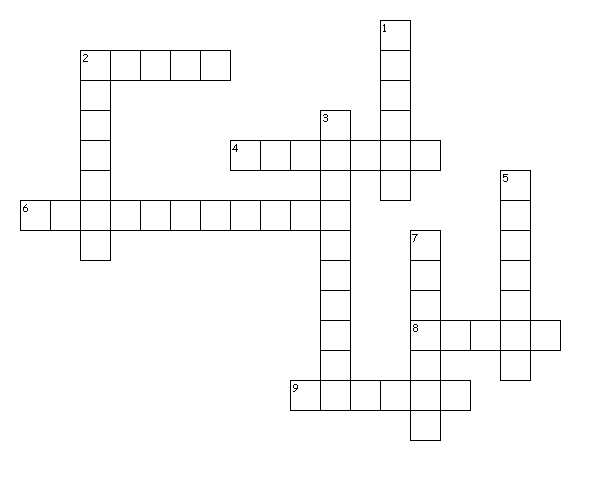
Science Equipment Puzzle


Scientific Equipment


Across 2. holds an object being viewed under the microscope 4. used to ignite a burner 6. used to measure temperature 8. helps dispense known volumes of liquids 9. holds liquids to be heated or stirred Down 1. helps transfer liquids to containers with smaller openings 2. used for cutting specimens being dissected 3. used to enlarge an image 5. protects the eyes 7. used to cap flasks 


Scientific Laws


Scientific Laws, Hypotheses, and Theories


Scientific Theory versus “Just a theory” Layman’s term:

In layman’s terms, if something is said to be “just a theory,” it usually means that it is a mere guess, or is unproved. It might even lack credibility. But in scientific terms, a theory implies that something has been proven and is generally accepted as being true.

Scientific Meanings:

SCIENTIFIC LAW: This is a statement of fact meant to describe, in concise terms, an action or set of actions. It is generally accepted to be true and universal, and can sometimes be expressed in terms of a single mathematical equation. Scientific laws are similar to mathematical postulates. They don’t really need any complex external proofs; they are accepted at face value based upon the fact that they have always been observed to be true. Specifically, scientific laws must be simple, true, universal, and absolute. They represent the cornerstone of scientific discovery, because if a law ever did not apply, then all science based upon that law would collapse.  Some scientific laws, or laws of nature, include the law of gravity, Newton’s laws of motion, the laws of thermodynamics, Boyle’s law of gases, the law of conservation of mass and energy, and Hook’s law of elasticity.

HYPOTHESIS: This is an educated guess based upon observation. It is a rational explanation of a single event or phenomenon based upon what is observed, but which has not been proved. Most hypotheses can be supported or refuted by experimentation.

THEORY: A theory is more like a scientific law than a hypothesis. A theory is an explanation of a set of related observations or events based upon proven hypotheses and verified multiple times by detached groups of researchers. One scientist cannot create a theory; he can only create a hypothesis. Theories may be expanded or modified with further scientific evidence.

Development of a Simple Theory by the Scientific Method:

  • Start with an observation that evokes a question: Broth spoils when I leave it out for a couple of days. Why?
  • Using logic and previous knowledge, state a possible answer, called a Hypothesis: Tiny organisms floating in the air must fall into the broth and start reproducing.
  • Perform an experiment or Test: After boiling some broth, I divide it into two containers, one covered and one not covered. I place them on the table for two days and see if one spoils. Only the uncovered broth spoiled.
  • Then publish your findings in a peer-reviewed journal. Publication: “Only broth that is exposed to the air after two days tended to spoil. The covered specimen did not.”
  • Other scientists read about your experiment and try to duplicate it. Verification: Every scientist who tries your experiment comes up with the same results. So they try other methods to make sure your experiment was measuring what it was supposed to. Again, they get the same results every time.
  • In time, and if experiments continue to support your hypothesis, it becomes a Theory: Microorganisms from the air cause broth to spoil.

BACK


Scientific Method activity

Scientific Method I’m All Thumbs”
Introduction:
What makes a “Class Champion” thumb wrestler? Does thumb diameter, length, or wrist diameter have an effect on the overall chances of winning a thumb wrestling match? In this investigation we will develop a hypothesis based on physical data collected from our classmates. We will then test this hypothesis by conducting a thumb wrestling tournament to determine an overall “Class Champion”.

Materials:
Metric ruler, metric tape measure (see bottom of lab), scissors, string, calculator

Objectives:

  • Students will take and record accurate measurements of their wrist, and their thumb’s circumference and length.
  • Students will analyze the data collected and determine if their hypothesis is correct.
  • Correctly line graph the collected data.
  • Learn the rules of thumb wrestling.
  • Conduct a thumb wrestling tournament.

Procedures:

  • Choose a partner and perform the following measurements using the metric tape measure found at the bottom of this lab. Then have your partner perform them on you.
  • Measure the circumference of the thumb, in centimeters, at its widest point. Record this data on the following line ___________cm. and on the table on the chalk board.
  • Measure the length of the thumb, using the metric ruler in centimeters, from its tip to the end of its second joint. Record this data on the following line ___________cm. and on the table on the chalk board.
  • Measure the circumference of the wrist over the ulnar knob, in centimeters, and record this data on the following line ____________ and on the table on the chalk board.
  • Copy the data, on the board, on to the table in the results section of the lab.
  • The class will form and record a hypothesis based on the collected data.
  • The Hypothesis:
    ______________________________________________________________

        ______________________________________________________________

  • Rules of thumb wrestling: Two players grasp hands shown in the illustration; they touch thumbs to the opposite sides of the other person’s hand three times, then come out wrestling. The object, of course, is to hold the other person’s thumb down, for a count of three, using only your thumb.


  • Boys will wrestle boys and girls will wrestle girls.
  • A tournament schedule will be set up to match opponents.
  • After the completion, a champion will be declared in both categories, (male and female).

Results:
Complete the following data table:


Student Name
Gender (M / F)
Thumb Circumference in cm
Thumb Length in cm
Wrist circumference in cm
Record
( won/ lost)
Optional
1.aaaaaaaaaaaaaaaaa
M / F
2.aaaaaaaaaaaaaaaa
M / F
3.aaaaaaaaaaaaaaaa
M / F
4.aaaaaaaaaaaaaaaa
M / F
5.aaaaaaaaaaaaaaaa
M / F
6.aaaaaaaaaaaaaaaa
M / F
7.aaaaaaaaaaaaaaaa
M / F
8.aaaaaaaaaaaaaaaa
M / F
9.aaaaaaaaaaaaaaaa
M / F
10.aaaaaaaaaaaaaaaa
M / F
11.aaaaaaaaaaaaaaaa
M / F
12.aaaaaaaaaaaaaaaa
M / F
13.aaaaaaaaaaaaaaaa
M / F
14.aaaaaaaaaaaaaaaa
M / F
15.aaaaaaaaaaaaaaaa
M / F
16.aaaaaaaaaaaaaaaa
M / F
17.aaaaaaaaaaaaaaaa
M / F
18.aaaaaaaaaaaaaaaa
M / F
19.aaaaaaaaaaaaaaaa
M / F
20.aaaaaaaaaaaaaaaa
M / F
21.aaaaaaaaaaaaaaaa
M / F
22.aaaaaaaaaaaaaaaa
M / F
23.aaaaaaaaaaaaaaaa
M / F
24.aaaaaaaaaaaaaaaa
M / F


Graph Title: ____________________________________________________________


Analysis and Conclusion :

1. Restate your hypothesis: __________________________________________________

2. Which students won? (male) __________________________ and (female)_____________________

3. What were their measurements:

male: thumb circumference: ____________, thumb length ______________, and wrist circumference ______________;

female: thumb circumference:__________, thumb length _________, and wrist circumference ______________.

4. What was the mean thumb circumference of the class? _____________cm

5. What was the mean wrist circumference of the class? ______________cm

6. Did all those with larger measurements win their matches? ____________.

7. Was you hypothesis correct? ______________.

8. If not, explain what was different. 

_____________________________________________________

_____________________________________________________

_____________________________________________________

9. What is the independent variable? _____________________________________

10. What is the dependent variable? ______________________________________

11. List the controlled variables in this experiment. 

         __________________________________________________

__________________________________________________       

11. Would this be considered a controlled experiment? ____________.

12. Explain your answer.

_____________________________________________________

_____________________________________________________

_____________________________________________________

Here is a sample tournament grid : Cut and turn sideways.

_______________________________________________________________________

_______________________________________________________________________


Cut and use.

________________________________________________________________________

BACK