| Human Hand Adaptation |
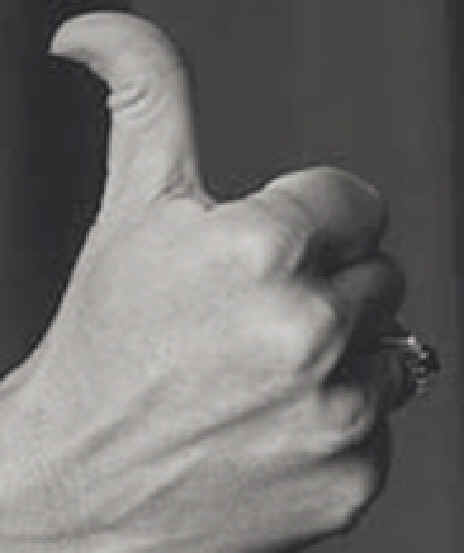
Introduction: Living things have bodies that are adapted for the places they live and the things they do. Fish have gills so that they can remove oxygen that is dissolved in water. Most plants have green leaves which contain chlorophyll so that they can make food. Jellyfish have stinging cells to capture prey. Birds have hollow spongy bones so that they will be light enough to fly. Arctic animals have layers of fat and thick coats of fur to keep warm in the frigid Arctic climate. There are hundreds of examples of ways that organisms are adapted for a successful lifestyle. Humans, too, are adapted for the things they do. One of our adaptations is our hand. Humans, as well as monkeys, gorillas, and other primates, have a hand that can grasp objects. We are able to grasp objects because of our opposable thumb. When students first hear or read about the opposable thumb during discussions of human evolution, they may perceive it as an anatomical fact with little seeming importance. In this activity, students will discover which of their simplest daily activities are possible only because of their opposable thumbs, which activities take longer without the use of an opposable thumb, and what sort of human activities would not be likely in the absence of an opposable thumb. In this lab exercise, you will perform several common actions. Then you will change your hand so that it resembles that of a non-primate animal. You will determine whether or not you can successfully perform the same actions. This will demonstrate how the human hand is adapted for the actions it performs. You will work with a partner to do this exercise. Materials: (per group)
- masking tape
- scissors
- paper clips
- zip-lock storage bag
- plastic fork and knife
- small amounts of food items to be cut
- pencil
- jar with screw-on lid
- paper
- roll of tape
- balloons
- comb
- book
- lace-up shoe
- clock with a second hand
- Piece of yarn or string
- balloon
- clothes with zippers & buttons
Procedure: Using masking tape, have your partner tightly tape each of your thumbs to the palm of the hand. Then, try to complete the tasks that are listed below. Be careful not to use your thumbs. Have your partner record on your data table how long it takes to do each task with your thumb taped and then with your thumb free. If an activity takes longer than 2 minutes, record the event as unsuccessful . After completing each item, write out the answers to the following questions:
- Is the task more difficult with or without an opposable thumb?
- How did you have to change your usual technique in order to complete this task?
- Do you think organisms without opposable thumbs would carry out this task on a regular basis? Why or why not?
Tasks:
- Pick up a single piece of paper. Put it down on your desk.
- Pick up a pen or pencil from the table top. Use it to write your name on the piece of paper.
- Open a book. Turn single pages in the book.
- Unscrew a bottle cap or jar cover.
- Use a fork and knife to cut a food item into small pieces.
- Tear off a small piece of tape.
- Turn on the water faucet. (Complete activity #8!) Turn it off.
- Moisten a paper towel and wash and dry the desktop.
- Sharpen a pencil.
- Cut a circle out of a piece of paper using scissors.
- Pick up all the scraps from activity #10 and throw them into the recycling box.
- Comb your hair.
- Open a door.
- Pick up one paper clip. Clip a pile of papers together.
- Tie your shoelaces.
- Button several buttons.
- Zip up your jacket.
- Blow up a balloon and tie it.
- Tie a knot in a piece of string.
- Close a zip-lock bag.
Data:
| Task | Time Taken for Event: | Task Difficulty With Taped Thumb (More/Less) |
Modification Made to complete Task | |
| Thumb Free | Thumb Taped | |||
| Pick up paper | ||||
| Write name | ||||
| Turn book pages | ||||
| Open jar | ||||
| Use knife & fork | ||||
| Tear off tape | ||||
| Turn faucet on & off | ||||
| Clean desk top | ||||
| Sharpen a pencil | ||||
| Cut out a circle | ||||
| Pick up the scraps of paper | ||||
| Comb hair | ||||
| Open door | ||||
| Clip papers together | ||||
| Tie shoelaces | ||||
| Button & unbutton garment | ||||
| Use zipper | ||||
| Blow up & tie balloon | ||||
| Knot string | ||||
| Close zip-lock bag | ||||
Conclusion: 1. Explain why dog and cat paws are not adapted for doing the six actions you tested. 2. What are cat and dog paws adapted for? 3. Describe how your hand is adapted for doing the actions you tested. 4. You have an opposable thumb. Explain what this means. 5. Why do you feel that human hand adaptations have helped to make humans such a successful species on earth?
 Smithers thinks that a special juice will increase the productivity of workers. He creates two groups of 50 workers each and assigns each group the same task (in this case, they’re supposed to staple a set of papers). Group A is given the special juice to drink while they work. Group B is not given the special juice. After an hour, Smithers counts how many stacks of papers each group has made. Group A made 1,587 stacks, Group B made 2,113 stacks.
 Homer notices that his shower is covered in a strange green slime. His friend Barney tells him that coconut juice will get rid of the green slime. Homer decides to check this out by spraying half of the shower with coconut juice. He sprays the other half of the shower with water. After 3 days of “treatment” there is no change in the appearance of the green slime on either side of the shower.
 he’s been reading too much Radioactive Man). He decides to perform this experiment by placing 10 mice in a microwave for 10 seconds. He compared these 10 mice to another 10 mice that had not been exposed. His test consisted of a heavy block of wood that blocked the mouse food. he found that 8 out of 10 of the micro waved mice were able to push the block away. 7 out of 10 of the non-micro waved mice were able to do the same.
 Krusty was told that a certain itching powder was the newest best thing on the market, it even claims to cause 50% longer lasting itches. Interested in this product, he buys the itching powder and compares it to his usual product. One test subject (A) is sprinkled with the original itching powder, and another test subject (B) was sprinkled with the Experimental itching powder. Subject A reported having itches for 30 minutes. Subject B reported to have itches for 45 minutes.