Category: Resources
Ecosystem Quiz
| Name:
|
|
True/False
Indicate whether the sentence or statement is true or false.
|
||||||||||
| 1. |
Freshwater habitats are independent of terrestrial habitats.
|
|||||||||
| 2. |
An ecosystem consists of biotic and abiotic factors.
|
|||||||||
| 3. |
Clearing a forest would reduce the amount of energy available to the consumers.
|
|||||||||
| 4. |
While an understanding of the interactions between organisms and their environment was very important to early hunter and gatherer humans, it is even more important today because humans are having significant effects on the environment.
|
|||||||||
| 5. |
Cutting down trees in a forest alters the habitat of the organisms living in the forest.
|
|||||||||
| 6. |
An organism’s niche includes its habitat.
|
|||||||||
|
Multiple Choice
Identify the letter of the choice that best completes the statement or answers the question.
|
||||||||||
| 7. |
Abiotic factors affect an ecosystem by all of these except the
|
|||||||||
| 8. |
The most important single factor affecting the biosphere is
|
|||||||||
| 9. |
Which of the following is the smallest ecological unit?
|
|||||||||
| 10. |
Collectively, physical factors such as light, temperature, and moisture that affect an organism’s life and survival are called the
|
|||||||||
| 11. |
The rate of photosynthesis carried on by plants living in a body of water depends upon the
|
|||||||||
| 12. |
Which of the following would not be included in a description of an organism’s niche?
|
|||||||||
| 13. |
Ecology is the study of the interaction of living organisms
|
|||||||||
| 14. |
The destruction of the ozone layer may be responsible for an increase in
|
|||||||||
| 15. |
Ozone in the atmosphere
|
|||||||||
| 16. |
Ecological models are useful for
|
|||||||||
| 17. |
The physical location of an ecosystem in which a given species lives is called a
|
|||||||||
| 18. |
Which of the following is not an adaptation for avoiding unfavorable conditions?
|
|||||||||
| 19. |
Which of the following would not be included in a description of an organism’s niche?
|
|||||||||
  |
|
Chromatography Plant Pigments
| Chromatography of Plant Pigments |
INTRODUCTION:
Chlorophyll often hides the other pigments present in leaves. In Autumn, chlorophyll breaks down, allowing xanthophyll and carotene, and newly made anthocyanin, to show their colors.
The mix of pigments in a leaf may be separated into bands of color by the technique of paper chromatography. Chromatography involves the separation of mixtures into individual components. Chromatography means “color writing.” With this technique the components of a mixture in a liquid medium are separated. The separation takes place by absorption and capillarity. The paper holds the substances by absorption; capillarity pulls the substances up the paper at different rates. Pigments are separated on the paper and show up as colored streaks. The pattern of separated components on the paper is called a chromatogram.
PRELAB PREPARATION:
Gather leaves from several different plants. CAUTION: Avoid poisonous plants. Autumn leaves from deciduous trees are especially interesting. Sort the leaves by kind (maple, etc.) and color. Review a diagram of a plant cell . Find the grana and the chloroplasts of the cell.
MATERIALS:
Safety goggles
Chromatography solvent (92 parts Petroleum ether to 8 parts acetone)
Chromatography paper (or filter paper) about 1 cm x 15 cm
Ethyl alcohol
Fresh spinach
Test tube
Test tube rack
Scissors and Ruler
Fresh leaves of plants
Glass stirring rod
Paper clip
Cork (to fit test tube)
Mortar and pestle
Sand (optional)
10-ml Graduated cylinder
PROCEDURE:
Leaves should be grouped by kind (maple, etc.) and color. Work with a spinach leaf and with one or more other types. CAUTION: Chromatography solvents are flammable and toxic. Have no open flames; maintain good ventilation; avoid inhaling fumes.
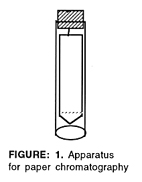
1. Cut a strip of filter paper or chromatography paper so that it just fits inside a 15-cm (or larger) test tube. Cut a point at one end. Draw a faint pencil line as shown in figure 1. Bend a paper clip and attach it to a cork stopper. Attach the paper strip so that it hangs inside the tube, as shown. The sides of the strip should not touch the glass.
2. Tear a spinach leaf into pieces about the size of a postage stamp. Put them into a mortar along with a pinch or two of sand to help with grinding. Add about 5 ml ethyl alcohol to the leaf pieces. Crush leaves with the pestle, using a circular motion, until the mixture is finely ground. The liquid in which the leaf pigments are now for paper chromatography dissolved is called the pigment extract.
3. Use a glass rod to touch a drop of the pigment extract to the center of the pencil line on the paper strip. Let it dry. Repeat as many as 20 times, to build up the pigment spot. NOTE: You must let the dot dry after each drop is added. The drying keeps the pigment dot from spreading out too much.
4. Pour 5 ml chromatography solvent into the test tube. Fit the paper and cork assembly inside. Adjust it so that the paper point just touches the solvent (but not the sides of the tube). The pigment dot must be above the level of the solvent. Watch the solvent rise up the paper, carrying and separating the pigments as it goes. At the instant the solvent reaches the top, remove the paper and let it dry. Observe the bands of pigment. The order, from the top, should be carotenes (orange), xanthophylls (yellow), chlorophyll a (yellow-green), chlorophyll b (blue-green), and anthocyanin (red). Identify and label the pigment bands on the dry strip. Write the species of leaf on the strip as well.
Record the species, external color, and chromatogram pigments in the DATA TABLE of your report sheet.
5. Each pigment has an Rf value, the speed at which it moves over the paper compared with the speed of the solvent.
Rf = Distance moved by the pigment / Distance moved by the solvent
Measure the distance in cm from the starting point (pencil line) to the center of each pigment band. Then measure the entire distance traveled by the solvent. Remember, the starting point for the solvent is also the pencil line and the ending point for the solvent is the top edge of the paper. Do the required divisions and record your Rf values in the DATA TABLE of your report sheet.
6. Wash the mortar and pestle thoroughly, using a little alcohol to remove any remaining pigment.
7. Repeat steps 1 through 6 for each species.
DATA TABLE:
|
Chromatography Data |
||||
| Leaf Type (species) | External color | Chromatogram Pigments | ||
| Colors from the Top | Pigment Names | Rf Values | ||
Chapter 1 Worksheet BI
| Biology – Science of Life |
Section 1-1 Themes of Biology
1. How many species of organisms are estimated to inhabit the Earth?
2. About how many species have actually been identified?
3. When did the first life forms probably arise on Earth?
4. What was the first organism like?
5. What is an organism?
6. Most unicellular organisms can only be seen with a __________________________.
7. Where did these first cells live?
8. Over time, organisms _____________ and new kinds of _______________ arose from ___________ of organisms and came to inhabit every _______________ of the Earth.
9. Define biology.
10. Name several things that the study of biology would include.
11. The study of biology is unified by ___________________________.
12. Name 6 unifying themes of biology.
13. What is a cell? Where are they found?
14. What is the difference between a unicellular & a multicellular organism?
15. Cells are ___________________ but highly _______________________.
16. Are all cells alike? Explain.
17. All cells are surrounded by a ____________ & contain _____________ instructions.
18. Genetic instructions are used by cells to make new __________ and new cell ________________.
19. How do new cells produced by unicellular organisms compare to the parent unicellular organism?
20. How do mature multicellular organisms begin their life?
21. If multicellular organisms begin their life as one cell, how do they have so many cells? Explain.
22. Give an example of an organism maintaining a stable internal environment.
23. Define homeostasis and tell whether it occurs in unicellular&/or multicellular organisms.
24. Genetic information is passed to offspring during _______________________.
25. What molecule contains the cell’s hereditary information?
26. How does DNA exist in multicellular organisms? In unicellular organisms?
27. What is a gene?
28. In multicellular organisms, each body cell has an _____________ copy of its DNA.
29. Does each cell in a multicellular organism use all the genes on its DNA? Explain.
30. Explain sexual reproduction.
31. When a sperm joins with an egg to make a fertilized cell, what happens next to this cell?
32. New organisms from sexual reproduction have _______________ material from both parents.
33. Explain asexual reproduction.
34. Name a unicellular organism that reproduces by asexual reproduction.
35. New cells or organisms from asexual reproduction have ____________ genetic information.
36. What is evolution?
37. Do individuals or populations evolve?
38. What is the driving force for evolution?
39. Explain natural selection and give an example.
40. Competition for what types of resources drives natural selection?
41. Why is it so important to a species for members to survive?
42. Organisms that survive and reproduce are ones with ________________ traits.
43. Define ecology.
44. What are ecosystems and give an example?
45. Name 3 things organisms must get from the environment to survive.
46. What has been the effect of man’s activities on many ecosystems?
47. Living things are _______________ and need a constant supply of _________________.
48. What process supplies energy for organisms on Earth?
49. Define autotroph.
50. Autotrophs trap _________ and use this energy to combine __________ and _________ into__________ and starches.
51. Define heterotrophs.
52. Give an example of an autotroph.
53. Give several examples of heterotrophs.
54. How do heterotrophs get their food?
Section 1-2 World of Biology
55. List 6 characteristics shared by all living things.
56. All living things composed of _________________.
57. Cells may be specialized in _________________ organisms. What does this mean?
58. What is always true about cell size?
59. Living things are organized at what 2 levels?
60. How are cells organized in multicellular organisms?
61. Define metabolism.
62. The energy from metabolism is used for ___________, ___________, and _______________ of organisms.
63. What is homeostasis and give an example?
64. Is growth a characteristic of living and nonliving things? Explain.
65. What 2 things must occur for living things to grow?
66. Define cell division.
67. Define development.
68. Explain why development is necessary for multicellular organisms?
69. Is reproduction essential to the survival of a species? Explain.
70. Sexual reproduction produces offspring ______________________ to the parents.
71. Have all organisms been identified? Explain.
Section 1-3 Scientific Method
72. Scientists solve problems using the ___________________________.
73. The first step of the scientific method is when scientists make ___________________ of the natural world.
74. Define data.
75. What does a scientist usually employ in making their observations?
76. What is quantitative data?
77. What is sampling & why is it used by scientists?
78. What 2 things must be true for samples to be useful?
79. To be useful, data must be _____________________ into ____________________,
______________________, and _____________________, or maps.
80. Once an observation is made, the second thing a scientist must do is to develop a(n) ___________________________.
81. Define hypothesis.
82. All hypotheses must be __________________ to give supporting evidence.
83. What is a prediction & how are they usually written?
84. What is an experiment?
85. Name the 2 groups in a controlled experiment.
86. Both groups in an experiment are identical except for ___________ factor called the
___________________.
87. Name the 2 types of variables in a controlled experiment.
88. After data is collected and organized, it must be __________________ to tell if it is reliable.
89. If experimental data does not support the hypothesis, what should be done?
90. What is a scientific model?
91. What is an inference?
92. How is a theory formed?
93. Define theory.
94. What is the difference between a field biologist and a laboratory biologist? Do they both use the scientific method?
95. What do scientists do with the results of their scientific studies?
Section 1-4 Microscopes & Measurement
96. What is a microscope?
97. What is the difference between resolution & magnification?
98. When would a microscope be used?
99. Do all microscopes have the same magnification & resolution?
100. Draw and label the parts of a light (LM) microscope.
101. Tell the function of each of these parts of an LM — stage, light source, objective lens, ocular lens, & nosepiece.
102. To view specimens with a light microscope, they must be placed on a _______________
and be ________________ so light will pass through to the lenses & your eyes.
103. What is the power of magnification & explain how it is determined?
104. Light microscopes can only magnify up to ______________ before the image becomes blurry.
105. What type of scope is used to view viruses & cell parts?
106. What produces an image with the electron microscope?
107. Name the 2 main types of electron microscopes.
108. What is the highest magnification for the TEM? For the SEM?
109. Can electron microscopes be used to view living cells?
110. What type of scope gives a magnified view of an object’s surface?
111. What is the standard unit of measurement used by scientists?
112. Name the SI base units, what they measure, & give their abbreviations (table 1-1, page 23)
113. The SI system is based on units of __________ with designated _________________.
114. Give the SI prefix for these base units — 1000, .01, .001, .000001, .000000001, & .000000000001.
115. Give the SI unit for area, volume, and time.
Chapter 2 Worksheet BI – Chemistry
| Chemistry Worksheet |  |
Section 2-1 Composition of Matter
1. Define matter.
2. Define mass.
3. Explain the difference between mass & weight.
4. Why do biologists study chemistry?
5. Define element.
6. Name the 4 elements that make up 90% of the mass of living things. Give the symbol for each of these elements.
7. Explain why some elements such as sodium have odd symbols.
8. Sketch a block from the periodic table and label the atomic number, atomic mass, & symbol for the element.
9. Define atom and tell whether they can be seen.
10. What is the center of an atom called & what 2 subatomic particles are found there?
11. How does the charge of a proton differ from the charge of a neutron?
12. Where is most of the mass of an atom concentrated?
13. How is the atomic number of an element determined?
14. What is the charge on an electron?
15. Explain why the overall or net charge on an atom is zero.
16. Where are electrons found in an atom & describe their movement?
17. In which energy levels do the electrons have more energy?
18. How many electrons can these energy levels hold — a. first? b. second?
19. Define compound and write a formula for water, carbon dioxide, & sodium chloride (table salt).
20. Do compounds have the same chemical properties as the elements that compose them?
21. When would an atom be chemically stable (not react)?
22. What occurs in a chemical reaction?
23. What is a covalent bond?
24. Define molecule.
25. Give an example of a gas that exists as a molecule.
26. Define ionic bond.
27. What is an ion?
28. Name a compound formed from — a. covalent bonding? b. ionic bonding?
29. If electrons are shared, a(n) ______________ compound forms.
30. If electrons are transferred, a(n) _____________ compound forms.
31. Forming ionic or covalent bonds helps make atoms more ________________.
Section 2-2 Energy 
32. All living things require _____________ to do work.
33. Energy can’t be created or _____________ in a chemical reaction, but it can be _____________ from one form into another.
34. Name 4 forms of energy important to living things.
35. What is free energy?
36. Give an example of energy changing form in an organism.
37. Atoms & molecules are in constant _______________.
38. Name the 3 main states of matter.
39. Explain how the shape and volume of a solid, liquid, and gas differ.
40. Organisms undergo thousands of ____________ as part of their life processes.
41. Where are the reactants and products in a chemical equation?
42. What does a two-direction arrow mean in a chemical equation?
43. _______________ are broken down in chemical reactions in your body to release ___________ and produce _______________ and ______________.
44. What is the difference between an endergonic & exergonic reaction?
45. What is activation energy?
46. What effect does a catalyst have on activation energy?
47. What are biological catalysts called?
48. Redox is the abbreviation for what type of reaction?
49. Redox reactions involve the transfer of energy and _________ between atoms.
50. What happens during oxidation?
51. What happens during reduction?
52. Give an example of oxidation.
53. Give an example of reduction.
Section 2-3 Solutions
54. Many of the chemical reactions in organisms take place in __________.
55. What is a solution?
56. Give an example of a complex solution in your body.
57. Name & describe the 2 parts of a solution.
58. What is meant by concentration of the solution?
59. How do you get a saturated solution?
60. What are aqueous solutions?
61. Explain dissociation of water molecules.
62. Name and give the charge for the 2 ions formed whenever water dissociates.
63. Write the final equation for the dissociation of water.
64. What is the hydronium ion?
65. How are acidity and alkalinity measured?
66. When would a solution be neutral? Give an example of a neutral solution.
67. When would solutions be considered as acidic?
68. Acids have what taste?
69. Acids form what ion in water?
70. Give an example of an acid in your stomach.
71. When would solutions be considered as a base?
72. What adjective refers to basic solutions?
73. Give an example of a base.
74. What ion forms whenever a base is dissolved in water?
75. How does a base taste and feel?
76. How is soap made?
77. What is the pH scale used for?
78. What is the range for the pH scale?
79. At what pH would you find each of these solutions on a pH scale: a. acids? b. Bases? c. neutral?
80. How many times stronger is a pH of 3 than a pH of 5?
81. A change of one pH unit reflects a __________ change.
82. Why is controlling the pH range important to organisms?
83. How do organisms control their pH levels?
84. What is a buffer?
85. Give an example of a human body fluid that is: a. acidic? b. alkaline?