
Cell Membrane PPT Qs BI


Transport Across Membranes
PowerPoint Questions

Membrane Structure

1. Cell membranes of unicellular organisms are ____________ so the organism can move.

2. What is meant by homeostasis?

3. Homeostasis is also called __________________.

4. How does the plasma membrane help maintain homeostasis?


5. Give 7 functions of the plasma membrane.

    a.

    b.

    c.

    d.

    e.

    f.

    g.

6. What is meant by the term selectively permeable?

7. What are cell junctions?

8. Fluid inside the cell is called _________________.

9. Label the plasma membrane (phospholipids, cholesterol, peripheral proteins, integral proteins, cytoskeleton, glcocalyx…)

10. A ________________ bilayer makes up most of the cell membrane.

11. Are phospholipids heads polar or nonpolar? the tails?

12. How many fatty acid chains are in a phospholipid?

13. Describe the heads of a phospholipid.

14. The __________ _____________ ___________ describes the appearance of the cell membrane.

15. Why is the cell membrane said to act like a fluid?


16. What causes the mosaic pattern of the cell membrane when viewed from above?

17. The phospholipid ____________ of the cell membrane allows ____________ molecules to pass through easily, but _________________ do NOT.

18. Materials soluble in __________ can pass easily through the cell membrane.

19. Because the cell membrane is ___________________, only ___________ molecules and larger _______________ molecules can move through easily.

20. List 3 substances that pass easily through the cell membrane.

21. _________, _____________ molecules larger than water, and large __________ molecules do NOT move easily through the phospholipids of the cell membrane.

Types of Membrane Transport

22. Simple ____________ requires NO energy to move things across the cell membrane.

23. With simple diffusion, molecules move from an area of ________ concentration to an area of ______ concentration.

24.Why is diffusion considered a passive process?

25. With diffusion, molecules move by their own natural __________ energy or energy of motion.

26.  Explain what happens to a drop of food coloring put into a beaker of water.


27. When solutes diffuse through a membrane, they move from __________ to _________ concentration.

28. __________ is the diffusion of _________ across a cell membrane.

29. If water potential is HIGH, solute concentration is __________.

30. If water potential is LOW, solute concentration is ___________.

31. Water moves from _________ water potential to ________ water potential.

32. Water diffuses through the pores called _____________ of the cell membrane.

33. Sketch a picture of a cell in an isotonic environment & show the direction of water movement?


34. What is meant by NO NET movement?

35. Sketch a picture of a cell in an Hypotonic environment & show the direction of water movement?


36. Sketch a picture of a cell in an hypertonic environment & show the direction of water movement?


37. Complete the following table:


Direction of Osmosis
Environmental Condition Net Movement of water What happens to cell
Hypotonic
Hypertonic
Isotonic


38. _____________ occurs whenever water moves out of a cell & the cell shrinks in size.

39. _____________ occurs whenever water moves into the cells causing them to swell and burst.

40. Explain what happens to a red blood cell placed in:

     a. distilled water

     b. a concentrated salt solution

41. Complete the following drawings.

42. Plants prefer ________________ environments, while animal cells do best in _____________ environments.

43. Describe these 3 types of movement across cell membranes.

     a. simple diffusion


     b. facilitated diffusion


    c. active transport


44. Passive transport does _______ require additional energy & moves materials from ________ to _________ concentration.

45. Give 2 examples of passive transport in cells.


46. ___________ diffusion is a type of __________ transport because energy is NOT required.

47. Facilitated diffusion uses _____________ proteins to help move materials from _________ to __________ concentrations.

48. Name 2 materials that move into or out of cells by facilitated diffusion.

49. name 2 types of transport proteins found in cell membranes.

50. Describe channel proteins.

51. How do carrier proteins help move materials across a cell membrane?

52. Channel proteins have an opening or ___________ through which molecules can passively move by _____________ diffusion.

53. Do all carrier proteins extend across the cell membrane?

54. Explain how these carrier proteins move materials across the membrane.


55. Some carrier proteins can change ________ to move materials across the cell membrane.

56. __________ transport requires additional energy to move materials.

57. Active transport uses cellular energy known as _________.

58. Active transport moves materials AGAINST the concentration gradient or from _________ to ___________ concentration.

59. The _______________ pump is an example of active transport.

60. The sodium-potassium pump moves _______ sodium ions out for every ______ potassium ions moved into the cell creating voltage across the cell called the ____________ potential.

61. Moving very large particles out of the cell is called _____________.

62. In exocytosis, wastes are moved out of the cell in ___________ that fuse with the cell membrane.

63. __________ involves moving large particles into the cell.

64. taking in large liquid droplets is called ____________ or “cell drinking”.

65. __________ ____________ endocytosis involves protein ____________ recognizing hormones to help move them into the cell.

66. How does cholesterol get into a cell?

67. “Cell eating” is known as ______________.

68. White blood cells engulfing bacteria is an example of _____________.

69. _____________ is the opposite of exocytosis.


Cell Respiration PPT Q-B1

ADP, ATP, & Cellular Respiration
PowerPoint Question Guide

1. _______ is the energy used by all cells.

2. ATP stands for ________________ ______________.

3. ATP is an ___________ molecule containing high-energy ____________ bonds.

4. The sugar in ATP is ____________, while the nitrogen base is ___________.

5. How many phosphate groups does ATP contain?

6. How do we get energy from ATP?


7. Make a simple sketch of ATP and show the high-energy bond that is broken.


8. To break the last phosphate bond in ATP, _________ must be added.

9. The process is called ___________.

10. What enzyme is used to help weaken & break the last phosphate bond in ATP?

11. Can ATP be remade?

12. When the last phosphate bond of ATP is broken, __________ and a free __________ form.

13. What enzyme can be used to rejoin ADP and a free phosphate to make more ATP?

14. Using ATP’s energy and then remaking it is called the ________________ cycle.

15. In the body, ATP is made during the process of _____________ ________________.

16. Cellular respiration takes place in both ____________ and ____________.

17. Cellular respiration requires the gas ____________.

18. In cellular respiration, _____________ is oxidized (loses electrons) and ___________ is reduced (gains electrons).

19. The breakdown of one glucose molecule results in ________ to _______ ATP molecules of energy.

20. Write the overall equation for cellular respiration.


21. Cellular respiration is an example of a ________ reaction.

22. REDOX stands for _____________-____________ reactions.

23. What are the products of cellular respiration?

24. What carries the energized electrons from glucose in cellular respiration?

25. NAD+_ is a _____________ that forms ____________ when it is reduced (picks up electrons).

26. What does NAD+ stand for?

27. Name a second coenzyme that acts as an energy carrier in cellular respiration.

28. What does FAD+ stand for?

29. FAD+ becomes __________ whenever it is reduced.

30. Cellular respiration like photosynthesis is a _______________ ____________ because it involves many reactions to make or break down carbohydrates.

31. Cellular respiration is an ______________ reaction because it releases energy from glucose.

32. Glucose is broken down into __________ and _________.

33. Is cellular respiration catabolic or anabolic? explain why.


34. Name the 3 stages of cellular respiration.


35. ____________ takes place in the cytoplasm of cells., while the __________ cycle and ETC take place in the _______________.

36. Sketch and label the parts of a mitochondrion.


37. Describe the outer surface of the mitochondria.

38. The inner membrane of the mitochondria is ___________.

39. The folds of the inner mitochondrial membrane are called ___________.

40. The innermost space of the mitochondria is known as the ___________.

41. Using the PowerPoint diagram, answer the following:

a. Glycolysis occurs where?

b. Glycolysis produces what energy molecule?

c. The products of glycolysis enter what other part of a cell?

d. What organic compound enters the Krebs cycle?

e. Electron carriers (NADH & FADH) carry electrons to what?

f. The ETC occurs across what?

g. What is the product at the end of the ETC?

h. What gas is added at the end of the ETC?

i. The Krebs cycle occurs where?

j. What gas is a product of the Krebs cycle?

k. Is ATP made in the Krebs cycle?

l. Is ATP in the ETC?

42. Is glycolysis aerobic or anaerobic? Explain why.


43. Glycolysis requires how much ATP to get started?

44. In glycolysis, glucose is split into two molecules of ______________ or pyruvic _________.

45. Is any CO2 produced during glycolysis?

46. Glycolysis uses 2 ATP and produces ______ ATP.

47. How much NADH (energy carrier) is made during glycolysis?

48. Glycolysis does ______ require oxygen but may occur if _________ is present.

49. If oxygen is NOT present, the products of glycolysis enter a process called _______________.

50. Fermentation is an _____________ process because no ___________ is needed.

51. Name the 2 types of fermentation.


52. Which fermentation occurs in tired muscle cells?

53. _________ acid builds up and makes muscles feel tired.

54. ____________ fermentation in yeasts produces an alcohol called _____________.

55. Fermentation only nets ______ molecules of ATP.

56. Why did Hans Krebs receive the Nobel Prize in medicine in 1953?


57. Why did he have to leave Germany before WWII?

58. Does the Krebs cycle need oxygen?

59. Processes needing oxygen are said to be ____________.

60. How many turns of the Krebs cycle are needed to burn one molecule of glucose?

61. What gas is made during the Krebs Cycle?

62. Where does the Krebs cycle take place?

63. TWO TURNS of the Krebs cycle produces ______ CO2 molecules, ______ NADH, _____FADH, and ____ ATP molecules.

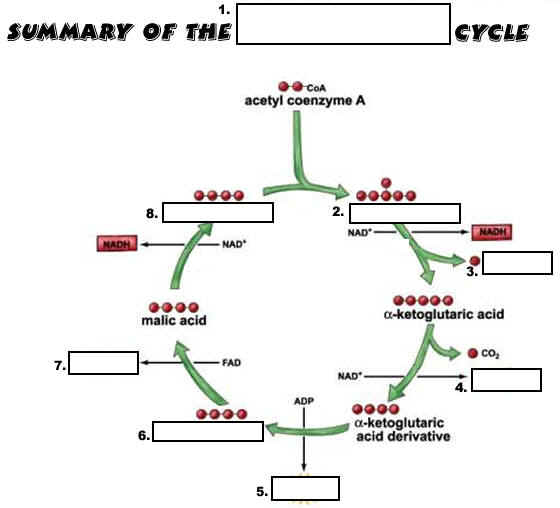
64. Label the parts of the Krebs Cycle.

65. The ETC occurs across the inner membrane of the ____________ and produces ________ as an end product.

66. The ETC uses the energized electrons carried by the coenzymes __________ and ________ to make 34 ATP’s of energy.

67. Each NADH makes _______ ATP’s, while each FADH makes only ______ ATP’s.


CLICK HERE FOR PRINTABLE COPY


Chapter 10 Protein Synthesis PPT Questions


Protein Synthesis
ppt Questions

DNA and Genes

1. What are genes and what do they code for?


2. Proteins are made of chains of _______________.

3. How do cells use proteins?


4. The subunits making up polypeptides are called _________________.

5. How many amino acids exist?

6. Sketch and label the basic structure of an amino acid.


7. The group that makes amino acids different from each other & gives the amino acid its unique properties is called the ___________ group.

8. DNA is found in the ____________ of a cell and begins the process of making a _______________.

9. Where are proteins made?

10. Describe the two types of ribosomes.


11. The first step in making a protein is to make a copy of ___________ in the nucleus.

RNA

12. What nucleic acid contains the master code for making proteins?

13. What nucleic acids acts as a blueprint in copying the master code?

14. Compare and contrast the sugars on DNA and RNA.


15. Compare and contrast the nitrogen bases on DNA and RNA.


16. RNA is made of a ____________ strand, while DNA is a ___________ stranded molecule.

17. What base replaces thymine on RNA?

18. Name the 3 types of RNA molecules.


19. What is the function of mRNA?


20. What is the function of rRNA?


21. What is the function of tRNA?


22. Describe the shape of mRNA.

23. How does mRNA get out of the nucleus once it has copied DNA’s instructions?

24. What bases pair together on RNA?

25. How long is mRNA?

26. What is a codon?


27. Methionine is called the __________ codon & is represented by the bases ________.

28. Name the 3 stop codons.

29. How long in rRNA?

30. What is the shape of rRNA?

31. What two things make up ribosomes?

32. What process occurs at the ribosomes?

33. Each codon stands for an _______________.

34. Can amino acids have more than one codon?

35. There are ______ amino acids and ______ possible codons.

36. How do you read the circular genetic codon table?


37. Use the genetic codon table and name these amino acids:

GGG?
UCA?
CAU?
GCA?
AAA?

38. Name the complementary bases on DNA.


39. Name the complementary bases on RNA.


40. What is the shape of tRNA?

41. What can attach to one end of a tRNA molecule for transport?

42. Opposite the attachment site on tRNA are 3 nucleotide bases called the ______________.

43. Make a sketch of a tRNA molecule with its attachment site and anticodon labeled.


44. A codon on mRNA is complementary to an _____________ on tRNA.

45. What anticodon is complementary to the codon – ACU?

Transcription and Translation

46. Sketch the pathway to making a protein.


47. define protein synthesis.


48. Name the 2 phases of protein synthesis.

49. Before mRNA can leave the nucleus it must be _______________ in order to correctly make proteins.

50. Define transcription and tell where it occurs.


51. What RNA copies DNA?

52. Are both strands of DNA copied?

53. What enzyme is required to copy DNA?

54. The DNA strand that is copied is called the _____________ strand.

55. What would be the complementary RNA sequence for the DNA sequence- 5′- GCGTATG-3′?

56. What enzyme separates the DNA strands in transcription?

57. RNA polymerase adds complementary ____________ to the DNA template strand.

58. ___________ are regions on DNA where RNA polymerase binds to start transcription.

59. The promoter contains a sequence called the _________ box.

60. Other sequences on DNA called __________ signals tell the RNA polymerase when to stop transcribing.

61. Newly made mRNA must be _________ to make the nucleic acid functional.

62. What are introns & what happens to them during mRNA processing?


63. What are exons and what happens to them during mRNA processing?


64. Describe the cap that is added to the new mRNA transcript.


65. What type of tail is added to the mRNA transcript?

66. The new mRNA transcripts is made of _____________ with a 5′ _________ and a 3′ ____________ tail.

67. What happens next to the newly made mRNA?

68. Define translation & tell where it occurs?


69. How do ribosomes read mRNA?

70. Describe the structure of a ribosome.


71. Ribosomes are composed of ________ rRNA and ________ protein.

72. Ribosomes have 2 tRNA sites called _______ and ______ along with an exit site.

73. The first part of translation is called ____________.

74. The small ribosomal subunit attaches to what codon on mRNA?

75. Once the mRNA and small subunit attach, what happens next?

76. Sketch an label a ribosome with both its subunits, its 2 tRNA sites, and the attached mRNA transcript.


77. The ______________ moves along the mRNA strand ________ codon at a time.

78. How many tRNA’s will fit into a ribosome at one time?

79. What happens to the two amino acids carried by the 2 tRNA’s inside a ribosome?

80. The joining of amino acids by ___________ bonds is the second part of translation called ______________.

81. Once an amino acid is joined to the growing polypeptide chain, the tRNA leaves the _______________ to pick up another ________________.

82. When a tRNA leaves the ribosome, the ribosome moves down the _________ strand allowing another ________ and its amino acid to enter.

83. each time the ribosome moves, it moves over _________ codon.

84. The last stage of translation is called _______________.

85. Name the 3 termination codons.

86. The sequence of amino acids in the polypeptide chain is called the ____________ protein structure.


Chapter 10 Questions PPT

DNA & Replication
ppt Questions

History of DNA

1. Early scientists believed that _________ was the genetic material of the cell. Explain why.


2. Proteins are made of 20 different ________________.

3. Long chains of amino acids make up _________________.

4. Fred Griffith worked with what type of bacteria?

5. What did he find to be true after his experiments with the S and R strains of bacteria?


6. This process of picking up DNA from the environment is called ____________________.

7. Did Griffith’s experiment prove DNA was the genetic material?

8. What 2 main things make up chromosomes?

9. What did Hershey and Chase use in their experiments to prove DNA was the cell’s genetic material?

10. Hershey and Chase radioactively tagged the viral DNA with _______________ and the protein capsid with ______________.

11. Which radioactive substance was injected into and took over the host cell’s DNA?

12. What scientists showed the amount of the 4 nitrogen bases present in DNA?

13. Name the bases and their amounts found in somatic or body cells of humans.


14. What bases are complementary (pair with each other) on DNA?

15. What type of bonds join base pairs on DNA?

16. Are these strong or weak bonds?

17. What was Rosalind Franklin’s contribution to finding DNA’s structure?


18. Who built the first model of DNA and what did they use to help get the correct measurements for the molecule?

DNA Structure 

19. DNA is two coiled strands known as a ___________________.

20. What makes up the sides of a DNA molecule?

21. What bonds the deoxyribose sugars to the phosphate groups?

22. Where are the nitrogen bases found on DNA & how are they bonded?

23. Most DNA has a ______________ twist with ________ base pairs in a complete turn.

24. DNA stands for ___________________________.

25. ______________ are the subunits making up DNA.

26. Name the 3 parts of a nucleotide.


27. Why is deoxyribose called a pentose sugar?

28. Sketch a pentose sugar and include the carbons correctly numbered.


29. The sugars on one DNA strand of DNA are from 5′ to _________, while the sugars on the other strand are antiparallel running from _________ to ___________.

30. Double ring nitrogen bases are called ____________, while single ring nitrogen bases are called ________________.

31. Name the purines.

32. Name the pyrimidines.

33. Purines will only pair with ________________.

34. __________ hydrogen bonds are required to join guanine to cytosine, while only ________ bonds join adenine to thymine.

35. If there is 30% adenine, how much cytosine is present?

DNA Replication 

36. Cells must copy their DNA before they do what? Explain why.


37. During what part of the cell cycle is DNA copied?

38. In eukaryotes, where are the copies of DNA made?

39. The process of copying DNA is known as DNA ________________.

40. Replication of DNA begins at points called __________________________.

41. The two DNA strands ______________ at origins of replication forming Y-shaped areas called _______________________.

42. New DNA strands grow at the _____________.

43. As the two strands open at the origins of replication, replication _____________ form.

44. Prokaryotic chromosomes have a ___________ replication bubble, while eukaryotic cells have ___________ bubbles.

45. What enzyme uncoils DNA so it can be replicated or copied?

46. What other job does this enzyme perform?

47. What is the job of single-strand binding proteins?


48. What enzyme relieves stress on the DNA strands at the replication forks?

49. An RNA __________ must be present to start the addition of new nucleotides.

50. What enzyme makes the RNA primer?

51. DNA ______________ is the enzyme that adds new complementary base pairs.

52. DNA polymerase can only add nucleotides to what end of the DNA molecule?

53. Which DNA strand is synthesized continuously as a single strand?

54. The leading strand is made from the ______________ toward the _________________ as it opens.

55. The ____________ strand is synthesized ____________ the overall direction of replication.

56. The lagging strand is made in __________ short segments from the _____________ fork toward the _____________ of replication.

57. The short segments of the lagging strand are called ______________ fragments.

58. What enzyme joins Okazaki fragments together into one strand?

59. Sketch half of a replication bubble. Label the point of origin and the replication fork. Draw two arrows showing the leading strand and the lagging strand.


60. DNA polymerase initially makes how many errors?

61. Proofreading enzymes correct mistakes in DNA to a one in ______________ base pairing errors?

62. Explain the semiconservative model for DNA replication.


63. Who developed this idea about replication?

64. Chemicals and _____________ radiation can damage DNA in our body cells so it must be ________________ repaired.

65. What is excision repair?


66. What 2 enzymes replace damaged sections of DNA and rebind the molecule?

67. What is the complementary DNA strand for: 5′ -CGTATG -3′ ?


Chapter 13 Biotechnology PPT Questions


DNA Technology
ppt Questions

DNA Extraction

1. When cells are treated with certain chemicals, it causes the plasma membrane to __________ or lyse.

2. DNA can be pulled out of cells because it is ________________ and can be ______________.

3. Describe the appearance of DNA spooled from cells.


4. What may be used to cut DNA into smaller pieces?

5. Do all restriction enzymes cut DNA at the same place?

6. What 2 properties can be used to separate DNA fragments?

7. Why does DNA have a negative charge?


8. To separate DNA fragments, it is placed in a ____________ with a current of _____________ running through it.

9. This process is called ____________________.

10. What determines the direction DNA will move in a gel?


11. Which fragments move further and faster?

12. DNA fragments are loaded into depression on the gel called _____________.

13. The DNA gel floats in a chamber covered with a ____________ solution.

14. DNA fragments closest to the wells are ___________ in size, while the __________ DNA fragments are further from the wells.

Steps in DNA Sequencing 

15. Many copies of a ______________ of DNA are placed in a test tube and ________________ is added to begin the process.

16. What else must be added?

17. How are the different nucleotide bases marked or tagged?


18. Dyed and _____________ nucleotides are added, but the large __________ molecules stop the chain from growing producing DNA fragments of _______________ sizes.

19. The fragments make banding patterns on an electrophoresis gel of different _____________ that can be identified.

20. The separated fragments are then read by _____________ from the ________ of the gel to the top.

Copying DNA

21. Define PCR and tell what it stands for.


22. To make many copies of DNA, DNA polymerase is added that can work at very high _______________. 

23. DNA is _____________ to separate the two strands.

24. What is added next to the test tube of DNA and DNA polymerase?

25. What are primers?


26. When the tube is cooled, DNA polymerase adds new ___________ to the separated DNA strands.

27. Even though a small amount of DNA is used to start PCR, ___________ amounts of DNA can be copied.

Cloning

28. What is a clone?


29. Clones may be produced by _____________ reproduction.

30. What two types of cells are combined in order to clone an organism?


31. Once a body cell fuses to an egg cell, the cell divides like a normal _____________.

32. What was the first successfully cloned organism?


Human Genome Project

33.  When was the project started?

34. What is the goal of the project?


35. How many nucleotides approximately make up the human genome?  How many chromosomes?


36. Who is mapping the genes on the human chromosomes?

37. From working on the Human Genome project, scientists have discovered that only about ________ actually codes for proteins; these genes are called _____________.

38. What is the other 98% or non-coding genes of DNA known as?

39. How many genes have been found on DNA?  Is this more or less than the expected number?


40. What are SNP’s that the scientists found?


41. Define proteome.


42. Human Genome researchers discovered transposons.  What are these structures?


43. The Human Genome Project was produced an area of science known as bioinformatics.  how is this helpful in sequencing DNA?


44. Define biotechnology.


45. Give an example of an agricultural crop grown in this area that has been improved by genetic engineering.

46. What product was 1st made in 1982 by genetic engineering to help diabetics?

47. Explain how biotechnology has improved each of these fruits or vegetables:

a. bananas

b. rice

c. garlic

d. potatoes


48. Give 4 ways biotechnology has helped the environment.