ADP, ATP, & Cellular Respiration
PowerPoint Question Guide
1. _______ is the energy used by all cells.
2. ATP stands for ________________ ______________.
3. ATP is an ___________ molecule containing high-energy ____________ bonds.
4. The sugar in ATP is ____________, while the nitrogen base is ___________.
5. How many phosphate groups does ATP contain?
6. How do we get energy from ATP?
7. Make a simple sketch of ATP and show the high-energy bond that is broken.
8. To break the last phosphate bond in ATP, _________ must be added.
9. The process is called ___________.
10. What enzyme is used to help weaken & break the last phosphate bond in ATP?
11. Can ATP be remade?
12. When the last phosphate bond of ATP is broken, __________ and a free __________ form.
13. What enzyme can be used to rejoin ADP and a free phosphate to make more ATP?
14. Using ATP’s energy and then remaking it is called the ________________ cycle.
15. In the body, ATP is made during the process of _____________ ________________.
16. Cellular respiration takes place in both ____________ and ____________.
17. Cellular respiration requires the gas ____________.
18. In cellular respiration, _____________ is oxidized (loses electrons) and ___________ is reduced (gains electrons).
19. The breakdown of one glucose molecule results in ________ to _______ ATP molecules of energy.
20. Write the overall equation for cellular respiration.
21. Cellular respiration is an example of a ________ reaction.
22. REDOX stands for _____________-____________ reactions.
23. What are the products of cellular respiration?
24. What carries the energized electrons from glucose in cellular respiration?
25. NAD+_ is a _____________ that forms ____________ when it is reduced (picks up electrons).
26. What does NAD+ stand for?
27. Name a second coenzyme that acts as an energy carrier in cellular respiration.
28. What does FAD+ stand for?
29. FAD+ becomes __________ whenever it is reduced.
30. Cellular respiration like photosynthesis is a _______________ ____________ because it involves many reactions to make or break down carbohydrates.
31. Cellular respiration is an ______________ reaction because it releases energy from glucose.
32. Glucose is broken down into __________ and _________.
33. Is cellular respiration catabolic or anabolic? explain why.
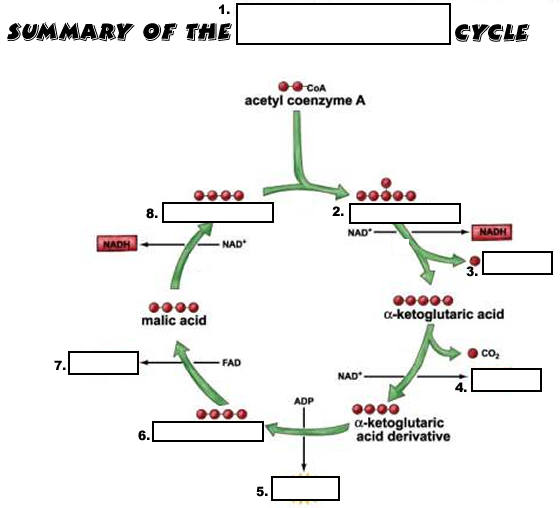
34. Name the 3 stages of cellular respiration.
35. ____________ takes place in the cytoplasm of cells., while the __________ cycle and ETC take place in the _______________.
36. Sketch and label the parts of a mitochondrion.
37. Describe the outer surface of the mitochondria.
38. The inner membrane of the mitochondria is ___________.
39. The folds of the inner mitochondrial membrane are called ___________.
40. The innermost space of the mitochondria is known as the ___________.