
Sponges, Cnidarians, & Ctenophores
Phylum Porifera
Characteristics
- Includes marine & freshwater sponges
- Found in the kingdom Animalia & subkingdom Parazoa
- Sessile as adults
- Simplest of all animals

- Contain specialized cells, but no tissue
- Asymmetrical
- Bodies filled with holes or pores for water circulation
- Marine sponges are larger & more colorful than freshwater sponges
- Range in size from 2 centimeters to 2 meters
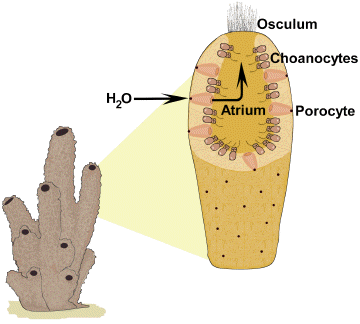
- Osculum is single, large body opening at the top for water & wastes to leave
- Spongocoel is the body cavity of sponges
- Have only 2 cell layers (ectoderm & endoderm) separated by jellylike material
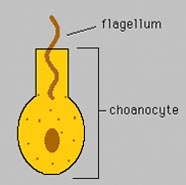
- Flagellated cells called choanocytes or collar cells line their internal body cavity
- Flagella of choanocytes beat & pull in water containing food which the collar traps
- Spongin is a network of flexible, protein fibers making up the sponge’s skeleton
- Spicules are tiny, hard particles shaped like spikes or stars in the skeleton of some sponges
- Spicules are made of calcium carbonate or silica

Feeding
- Sponges are filter feeders that remove plankton (food) from the water that is brought in through pores lined with collar cells
- Flagella pull in bacteria, protozoans, & algae that sticks to collar of choanocytes where it is digested
- Amebocytes are specialized cells in sponges that can roam to pick up food from choanocytes & distribute it to all other parts of the sponge
- Amebocytes also transport carbon dioxide & wastes away from sponge cells
- Excess water & food leaves through the excurrent osculum
Reproduction
- Sponges can reproduce asexually by external buds that break off & form new sponges or stay attached to form sponge colonies
- Gemmules are specialized, internal buds formed by sponges during cold or dry weather that can survive harsh conditions
- Gemmules consist of a food-filled ball of amebocytes surrounded by a protective coat with spicules & released when adult sponge dies
- Gemmules break open when conditions improve & the cells form new sponges

- Sponge can also asexually regenerate missing parts or a new sponge from a small piece of sponge
- Sponges are hermaphrodites (produce both eggs & sperm), but they exchange sperm & cross-fertilize eggs during sexual reproduction
- Planula is the flagellated, free-swimming larva that forms from the zygote
- Planula larva eventually settles to the bottom & attaches to develop into an adult, sessile sponge
Classes of Sponges
- Calcarea are chalky sponges with calcium carbonate spicules
- Hexactinella includes glass sponges & the Venus flower basket with silica spicules
- Demospongiae include horny & bath sponges with only spongin or spongin & silica spicules
- Sclerospongiae are coral sponges & have spongin & silica and calcium carbonate spicules
Phylum Cnidaria
Characteristics
- Includes marine organisms such as jelllyfish, Portuguese man-of-war, coral, sea anemone, & sea fans
- Hydra is a freshwater cnidarian

- All carnivorous
- Have 2 cell layers (epidermis -outer & gastrodermis-inner) with a hollow body called gastrovascular cavity
- Contain a jelly-like layer between epidermis 7 gastrodermis called mesoglea
- Single opening (mouth/anus) to gastrovascular cavity where food & water enter & wastes leave; called two-way digestive system
- Have tentacles around mouth to pull in water & capture food

- Have a simple nerve net with to help with movement & senses
- Sessile members include corals, sea anemones, & sea fans
- Have radial symmetry as adults
- Contain stinging cells called cnidocytes in their tentacles that contain coiled stingers called nematocysts that can shoot out & paralyze prey

Body Forms
- Have 2 basic body forms —polyp & medusa
 MEDUSA |  POLYP |

- Polyp forms are usually sessile with upright tentacles arranged around the mouth at the top and with a thin layer of mesoglea
- Polyps are the asexual stage
- Corals, hydra, & sea anemones exist in the polyp form as adults

CORAL POLYPS
- Medusa forms are usually free-swimming, bell-shaped animals with tentacles that hang down around the mouth and with a thick layer of mesoglea for support
- Medusa are the sexual stage
- Jellyfish & Portuguese man-of-war are medusa form as adults
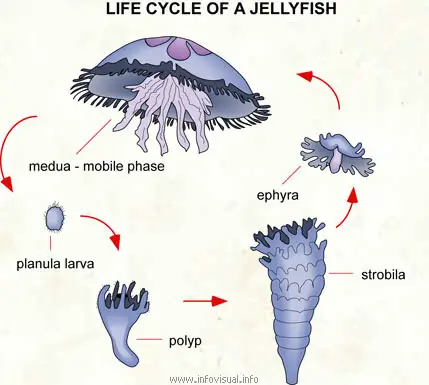
- Some cnidarians are dimorphic or go through both polyp & medusa stages in their life cycle
JELLYFISH LIFE CYCLE
- Some are solitary (Hydra) others are colonial (corals)
- Three classes include Hydrozoa (hydra), Scyphozoa (jellyfish), & Anthozoa (sea anemones & corals)
Hydrozoa
- Includes freshwater, sessile hydra (exists only as polyps)
- Portuguese man-of-war (exists as colony of polyps & medusa)
- Group of cells called basal disk produces sticky secretion for attachment & can secrete gas bubbles to unattach & let hydra float
- Hydra also move by somersaulting (tentacles bend over to bottom as basal disk pulls free)
- Tentacles pull food into gastrovascular cavity where enzymes digest it
- Reproduce asexually by budding during warm weather & sexually in the fall
- Hermaphrodites that release sperm into water to fertilize eggs of another hydra

HYDRA
Scyphozoa
- Includes bell-shaped jellyfish
- Medusa stage is dominant in the life cycle
- Tentacles may be meters in length & carry poisons that cause severe pain or death
- Have both asexual polyps & sexual medusa stages in their life cycles
- Adult medusa stage releases eggs & sperm into water
- Fertilization produces ciliated planula larva that settles to the bottom, attaches, & forms tentacles
- New medusa bud off of reproductive polyps & form adult jellyfish

JELLYFISH
Anthozoa
- Include corals in a limestone case & sea anemones
- Called “flower animals”
- All marine
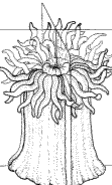
- Sea anemone is a sessile, polyp-form that uses its tentacles to paralyze fish
- Some anemones in the Pacific Ocean live symbiotically with the clownfish sharing food & protecting each other

- Corals are small, colonial polyps living in limestone cases
- Coral reefs form as polyps die & provide a home and protection for other marine animals
- Reefs form in warm, shallow water & only the top layer has living polyps
- Algae may live symbiotically with coral supplying them with oxygen
Phylum Ctenophora
Characteristics
- All marine
- Includes comb jellies

- Have eight rows of fused cilia called “comb rows”
- Largest animal to move by cilia
- Move by beating cilia
- Lack cnidocytes but have cells sticky cells called colloblasts that bind to prey
- Colloblasts located on two ribbon-like tentacles
- Have sensory structure called apical organ to detect direction in the water
- Most are hermaphrodites (make eggs & sperm)
- Produce light by bioluminescence