Web Quest on Genetics

 
Web Quest on Genetics


 Introduction:

Have you ever wondered what your future children will look like? Have you ever wondered if they will be completely healthy? Have you ever thought about having yourself or your children cloned? This will more than likely be different things that you may have to deal with as an adult or parent.

This WebQuest, geared for high school biology students, attempts to explain different genetic disorders by dividing the class into different roles. With several cooperative groups presenting on different disorders, the whole class will be able to see the different types of genetic disorders, if they are treatable, and what we are doing as a human race to try to cure these disorders. 

Task:

As a class you have already done some basic studies on the concepts of genetics. Now we will be embarking on the content of genetic disorders – how people get them, karyotyping of the disorder, types of treatments, and any type of genetic testing that could have been taken advantage of prior to the birth of your child. Lastly, you will want to look at what your ‘child’ will look like.

The class will divide up into groups of 4 students. Within these cooperative groups each student will be given an area of study that they will need to attempt to draw conclusions from.

In the end your group will need to display the information that they find along the way as a class project. Your group will need to create a multimedia presentation that will be shared with the class and graded. You may want to include a suggested list of readings and/or Internet sources that may be of interest to the class.

The Process:

Your group should include 4 students total. One student will be a genetic counselor. One student will be a disorder specialist. Another person will be a perspective parent whose child will have the disorder. The last student will be the human genome specialist.

1. Genetic Counselor – Your role as the genetic counselor is to examine what types of treatment there are for the disorder and how you can advise these perspective parents on the disorder that their child has been exposed to.

2. Disorder Specialist – Your role as the disorder specialist is to karyotype the disorder, find out all of the signs and symptoms of the given disorder, and to find out what different prenatal tests could have been provided to the parent to have found out about this disorder prior to birth.

3. Parent – Your role as the parent is to find out what your child would look like using your own genetic features along with ‘your mate’s’ genetic features. Using Punnett’s squares you need to show what features will show up in your children and what the possibilities are that they will show up. You will also need to show a possible image of the child you and your mate could have.

4. Human Genome Expert – Your goal as the human genome expert is to find out all about the human genome project. What is it? What is their mission? How far along are they? How long has this project been in progress? Why is it important? And any other information that you feel is relevant that you would like to share.

Resources:

Some Internet resources that may be helpful to your groups will include the following:

1. Genetic Counseling: Ask NOAH. This site contains a lot of information about the different types of genetic disorders.

2. Yahoo – Genetic Disorders  This site lists several different disorders and contains several links to all of the different types of genetic disorders.

3. Genetic & Rare Conditions Site  This site lists several links to different types of disorders in alphabetical order.

4. What can our chromosomes tell us?  This is a site that talks about karyotyping and what we can understand due to karyotyping. Newsletter from the Genetics Science Learning Center.

5. A Genetics Glossary This is your basic genetic glossary however you really need to know what you are looking for so that it will be useful.

6. Genetics Education Center  This is a site dedicated to the education of genetics with several links to other sites.

7. The National Human Genome Research Institute . This site tells you all about the human genome project.

8. Department of Energy – Human Genome Project Information  This site also gives a lot of information about the human genome project. It also includes some fact sheets on cloning and gene testing.

9. A Gene Map of the Human Genome  Within this site you can see the mapping of several different chromosomes found within the body.

10. Learning about the Human Genome Project and Genetics through the World Wide Web http://www.kumc.edu/gec/hgpwww.html. This site includes a section on the ethics issues of genetic research that the genetic counselor may want to look at.

11. Understanding Gene Testing This site talks of how genes are linked to disease, how does a faulty gene trigger disease, and much more.

12. Ask Noah : on Birth Defects and Genetics  This site includes information about fetal testing, and different types of birth defects.

13. Basics of DNA Fingerprinting  This site will give you the basic understanding of DNA fingerprinting.

14. What is Genetic Testing?  This site shows the basics of genetic testing and also gets into some of the ethical issues of genetic testing.

15. Human Genetics : Human Karyotype  This site talks about karyotypes, chromosomal abnormalities, and allelic disorders.

Evaluation:


Beginning
5
Developing
10
Accomplished
15
Exemplary
20
Score
 

Quality of Information and ideas

Bare minimums are taken into account. Answered the few questions that were asked in the introduction.
Minimums plus slight extras added. Answered questions from the intro and at least one question posed to them in the process section.
All of the information found from the process section.
Issues addressed that went beyond what was asked in the process and introduction sections.


Amount of Information found


Only accessed 4 suggested web sites and verified in presentation.
At least 8 web sites accessed and verified in presentation.
At least 12 web sites accessed and verified in presentation.
All of the web sites accessed and verified in presentation.


Organization of presentation


Random information is presented by group.
Disorganized at times.
Organized
Organized effectively with easy understanding.


Use of class time


Majority of class time was wasted.
Half of class time was wasted.
Little class time was wasted.
No class time was wasted.

 
Overall PowerPoint Presentation
One slide for each person was made and presented to the class. Very plain text and no graphics.
Basic graphics used on all pages and presentation has some natural flow to it.
Easily understood by all. Includes graphics and data tables of information retrieved.
Information that is presented is aesthetically pleasing to the eye and includes all of the areas covered in this activity.


Conclusion:

Answer the following questions and turn in after your presentation:

  • What have you learned that you didn’t know before?
  • Was this an effective learning experience?
  • How did you like working in a group? Did working in a group add or detract from your learning?
  • How did you determine what information was helpful?
  • If you were to do this project again, what would you do differently and why?
  • Do you have suggestions for anyone else who might be doing this project? If so what are they?
  • Do you have any suggestions for me to change this project to make it more interesting / educational in the future? If so what are they?

Modified from web quest by Michelle Olsham

Water Properties Notes


Water Properties
States of Water
Adhesion and Cohesion
Surface Tension
Capillary Action

The States of Water

Water has three states. Below freezing water is a solid (ice or snowflakes), between freezing and boiling water is a liquid, and above its boiling point water is a gas. There are words scientists use to describe water changing from one state to another. Water changing from solid to liquid is said to be melting. When it changes from liquid to gas it is evaporating. Water changing from gas to liquid is called condensation (An example is the ‘dew’ that forms on the outside of a glass of cold soda). Frost formation is when water changes from gas directly to solid form. When water changes directly from solid to gas the process is called sublimation.

Gas
Liquid
Solid

Most liquids contract (get smaller) when they get colder. Water is different. Water contracts until it reaches 4 C then it expands until it is solid. Solid water is less dense that liquid water because of this. If water worked like other liquids, then there would be no such thing as an ice berg, the ice in your soft drink would sink to the bottom of the glass, and ponds would freeze from the bottom up!

Water is found on Earth in all three forms. This is because Earth is a very special planet with just the right range of temperatures and air pressures.

Adhesion and Cohesion

Water is attracted to other water. This is called cohesion. Water can also be attracted to other materials. This is called adhesion.

The oxygen end of water has a negative charge and the hydrogen end has a positive charge. The hydrogens of one water molecule are attracted to the oxygen from other water molecules. This attractive force is what gives water its cohesive and adhesive properties.

Surface Tension

Surface tension is the name we give to the cohesion of water molecules at the surface of a body of water. Try this at home: place a drop of water onto a piece of wax paper. Look closely at the drop. What shape is it? Why do you think it is this shape?

What is happening? Water is not attracted to wax paper (there is no adhesion between the drop and the wax paper). Each molecule in the water drop is attracted to the other water molecules in the drop. This causes the water to pull itself into a shape with the smallest amount of surface area, a bead (sphere). All the water molecules on the surface of the bead are ‘holding’ each other together or creating surface tension.

Surface tension allows water striders to ‘skate’ across the top of a pond. You can experiment with surface tension. Try floating a pin or a paperclip on the top if a glass of water. A metal pin or paper clip is heavier than water, but because of the surface tension the water is able to hold up the metal.

Surface tension is not the force that keeps boats floating.

Capillary Action

Surface tension is related to the cohesive properties of water. Capillary action however, is related to the adhesive properties of water. You can see capillary action ‘in action’ by placing a straw into a glass of water. The water ‘climbs’ up the straw. What is happening is that the water molecules are attracted to the straw molecules. When one water molecule moves closer to a the straw molecules the other water molecules (which are cohesively attracted to that water molecule) also move up into the straw. Capillary action is limited by gravity and the size of the straw. The thinner the straw or tube the higher up capillary action will pull the water (Can you make up an experiment to test this?).

Plants take advantage of capillary action to pull water from the into themselves. From the roots water is drawn through the plant by another force, transpiration.

Water Properties Prelab


Properties of Water

Pre-Lab Questions:

1. Explain why water is referred to as the universal solvent.


2. What is the overall charge on a molecule of water?

3. Water is a polar molecule (appears to have a charge). Explain why this is so.


4. Which end of a water molecule “acts negative”? Which “acts positive”?

5. Is water the only molecule that is polar?

6. Explain what occurs whenever several water molecules are near each other in a droplet. Include a sketch of this.


7. The property of water molecules being attracted to other water molecules is called ________________.

8. Explain what causes water to have surface tension.


9. Surface tension causes causes water to _____________ on surfaces such as glass.

10. In order to clean a surface, what must happen to surface tension? What type of chemicals can do this? Give an example


11. Besides reducing surface tension, what 4 other things can surfactants perform?


Water Properties Handout

Physical Properties of Water

All of water’s unique physical properties are caused by water’s polarity.

  1. Cohesion: water molecules stick to each other.  This is caused by hydrogen bonds that form between the slightly positive and negative ends of neighboring molecules.  This is the reason why water is found in drops; perfect spheres.  It’s hard to imagine water behaving any other way.

  1. Adhesion: water molecules stick to other surfaces.  This causes water to move upward against gravity in plant stems and to be absorbed by paper towels.  It also causes water to adhere to spider webs.

  1.   Surface Tension: water has the ability to support small objects.  The hydrogen bonds between neighboring molecules cause a “film” to develop at the surface.


Organisms like the water strider can be seen taking advantage of this property.


4.  Water has a high boiling point.  Water is one of the few substances that remain a liquid at such a large range of temperatures (O-100 °C).  A large amount of energy must be invested to overcome the hydrogen bonds in liquid water to change it to the gas phase.


Liquid Water Molecules with hydrogen bonds                              Water Vapor Molecules

5.  Capillary Action: water has the ability to “climb” structures.  Think about what happens when you stick the tip of a straw in a glass of water.

6.  Ability to Dissolve: water is consider to be the universal solvent.  More substances will dissolve in water than any other liquid.  This includes other polar substances (such as sugar) and ionic compounds (such as salt).


When a sugar crystal is placed in water, the slightly positive and negative ends of the water molecule attract the sugar molecules in the crystal (they are also polar) and pull them into solution.


When an salt crystals are placed in water, the slightly positive and negative ends of the water molecules attract the ions in the crystal.  The ionic bonds holding the sodium and chlorine ions together are broken and the ions are pulled into solution.


7. High Heat of Vaporization:

Water Properties


Water Properties
States of Water
Adhesion and Cohesion
Surface Tension
Capillary Action

The States of Water

Water has three states. Below freezing water is a solid (ice or snowflakes), between freezing and boiling water is a liquid, and above its boiling point water is a gas. There are words scientists use to describe water changing from one state to another. Water changing from solid to liquid is said to be melting. When it changes from liquid to gas it is evaporating. Water changing from gas to liquid is called condensation (An example is the ‘dew’ that forms on the outside of a glass of cold soda). Frost formation is when water changes from gas directly to solid form. When water changes directly from solid to gas the process is called sublimation.

Gas
Liquid
Solid

Most liquids contract (get smaller) when they get colder. Water is different. Water contracts until it reaches 4 C then it expands until it is solid. Solid water is less dense that liquid water because of this. If water worked like other liquids, then there would be no such thing as an ice berg, the ice in your soft drink would sink to the bottom of the glass, and ponds would freeze from the bottom up!

Water is found on Earth in all three forms. This is because Earth is a very special planet with just the right range of temperatures and air pressures.

Adhesion and Cohesion

Water is attracted to other water. This is called cohesion. Water can also be attracted to other materials. This is called adhesion.

The oxygen end of water has a negative charge and the hydrogen end has a positive charge. The hydrogens of one water molecule are attracted to the oxygen from other water molecules. This attractive force is what gives water its cohesive and adhesive properties.

Surface Tension

Surface tension is the name we give to the cohesion of water molecules at the surface of a body of water. Try this at home: place a drop of water onto a piece of wax paper. Look closely at the drop. What shape is it? Why do you think it is this shape?

What is happening? Water is not attracted to wax paper (there is no adhesion between the drop and the wax paper). Each molecule in the water drop is attracted to the other water molecules in the drop. This causes the water to pull itself into a shape with the smallest amount of surface area, a bead (sphere). All the water molecules on the surface of the bead are ‘holding’ each other together or creating surface tension.

Surface tension allows water striders to ‘skate’ across the top of a pond. You can experiment with surface tension. Try floating a pin or a paperclip on the top if a glass of water. A metal pin or paper clip is heavier than water, but because of the surface tension the water is able to hold up the metal.

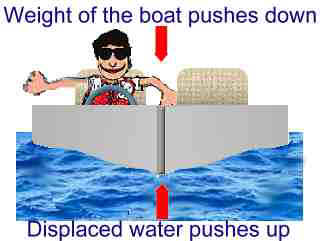
Surface tension is not the force that keeps boats floating. If you want to know why a boat floats look here: Why do boats float?

stability1.jpg (8249 bytes)
The key to floating is that the object must displace an amount of water which is equal to its own weight.

Capillary Action

Surface tension is related to the cohesive properties of water. Capillary action however, is related to the adhesive properties of water. You can see capillary action ‘in action’ by placing a straw into a glass of water. The water ‘climbs’ up the straw. What is happening is that the water molecules are attracted to the straw molecules. When one water molecule moves closer to a the straw molecules the other water molecules (which are cohesively attracted to that water molecule) also move up into the straw. Capillary action is limited by gravity and the size of the straw. The thinner the straw or tube the higher up capillary action will pull the water (Can you make up an experiment to test this?).

Plants take advantage of capillary action to pull water from the into themselves. From the roots water is drawn through the plant by another force, transpiration.