Teddy Graham Natural Selection Lab

Natural Selection in Teddy Grahams

Introduction

You are a bear-eating monster. There are two kinds of bears that you like to eat: happy bears and sad bears. You can tell the difference between them by the way they hold their hands. Happy bears hold their hands high in the air, and sad bears hold their hands down low. Happy bears taste sweet and are easy to catch. Sad bears taste bitter, are devious and hard to catch. Because of this you only eat happy bears. The happy trait in bears is caused by the expression of a recessive allele. The homozygous recessive condition is being happy. The sad trait is caused by a dominant allele. New bears are born every year (when they are hibernating in their den, the cardboard box), and the birth rate is one new bear for every old bear left from last year.

Materials:

Teddy Bear Grahams, lab worksheet, pencil

Procedure:

1. Obtain a population of 10 bears and record he number of happy and sad bears and the total population number. Using the equation for Hardy-Weinberg equilibrium, calculate the frequencies of both the dominant and recessive alleles and the genotypes that are represented in the population. Example: If 5 of the 10 bears are happy, then 10 out of 20 alleles would be happy alleles. Therefore the q2 number would be 0.5. You must then determine the q number by taking the square of 0.5.

2. Now, go hunting! Eat 3 happy bears. (If you do not have 3 happy bears then eat the difference in sad bears.)

3. Once you have consumed the bears obtain a new generation from your den (the box). You should only remove seven additional bears from the den for a total of 14 bears.

4. Repeat the procedures again. Be sure to record the number of each type of bear and the total population.

Table:


Generations P2 (sad) 2pq (sad) q2 (happy) P q
1. Initial
2.
3.
4.


Questions:

1. Describe what is happening to the genotype and allele frequencies in the population of Teddy Grahams?


2. What would you expect to happen if you continued the selection process for additional generations?


3. How would the frequencies change if you were to now select for the sad bears?


4. Why doesn’t the recessive allele disappear from the population? How is it protected?


Thumb Wrestling Lab Sample1 Preap

Scientific Method – “I’m All Thumbs”


Introduction:


What makes a “Class Champion” thumb wrestler? Does thumb diameter, length, or wrist diameter have an effect on the overall chances of winning a thumb wrestling match? If you want to find out the answers to these questions then you have to do some scientific study. Scientific study is not only about plants and animals; it is also about how we function. You will have to use the scientific method to answer thesis questions. Scientific method is the principles and empirical processes of discovery and demonstration considered characteristic of or necessary for scientific investigation, generally involving the observation of phenomena, the formulation of a hypothesis concerning the phenomena, experimentation to demonstrate the truth or falseness of the hypothesis, and a conclusion that validates or modifies the hypothesis.


Hypothesis:


The person with the longest thumb will win the thumb war.


Materials:


The materials that were used for this lab was a metric ruler, metric tape measure, scissors, string, and a calculator.


Methods:


First you should choose a partner. Then measure the circumference of your thumb in centimeters at its widest point. Next you measure the length of your thumb, from the tip to the end of its second joint. Then measure the circumference of the wrist over the ulnar knob. Then you copy all of your information on the board onto the table in the results section of the lab.


Results:


Thumb Circumference Thumb Circumference (cm) Thumb Length (cm) Wrist Circumference (cm) Number of Wins
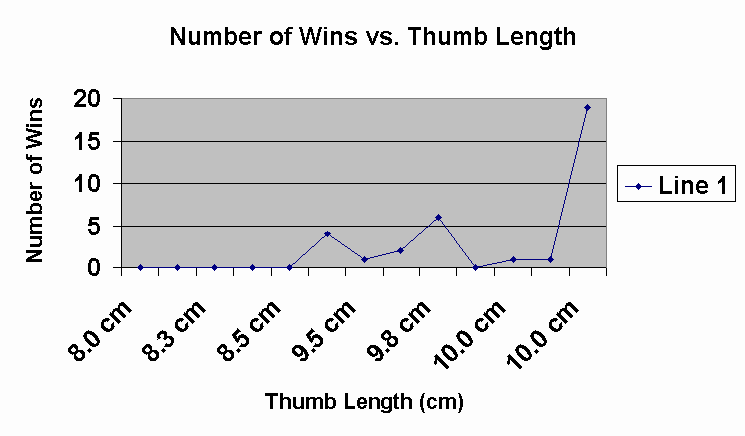
Cason, Drew 8.4 9 21.5 4
Dittrich, Chad 9 10 24 19
Holt, Brad 8 9.5 21 2
Hooker, Chris 7.1 9.3 21 2
Jones, Jett 8.5 9.8 21 6
Lambert, Scott 9.5 8 23 0
Lewis, Cody 8 9.5 20.5 1
Lockwood, Blake 8.3 8.5 21 0
Lorince, Alan 9.4 9.5 24 1
Moore, Clark 8.5 10 20 1
Phillips, Jaylon 9.3 10 24 1
Simpson, Jonathan 8 8.3 20 0
Smith, Zack 8.3 8.4 22.1 0
Williams, Paul 8.4 8 21 0
Yancey, Jey 9 10 22.5 0


Questions:


1. Restate your hypothesis: The person with the longest thumb will win the thumb war.


2. Which student won? Male: Chad Dittrich Female: Ashley Kersieck


3. What were their measurements: Male: thumb circumference-9cm, thumb length -10cm, and wrist circumference-24 cm.

Female Thumb circumference 7.0, thumb length 8.5, and wrist circumference 20.5


4. What was the mean thumb circumference of the class? 21.0


5. What was the mean wrist circumference of the class? 8.1


6. Did all those with larger measurements win their matches? No


7. Was your hypothesis correct? Yes


8. If not, explain what was different. It was right


9. What is the independent variable? Total of each contestant’s wrist and thumb measurements


10. What is the dependent variable? The number of


11. List the controlled variables in this experiment. Compete only in same sex, and follow all rules.


12. Would this be considered a controlled experiment? No


13. Explain your answer. Their were too many variables


Error Analysis:


The people wrestling might not have followed the rules by picking their arm up when they were wrestling or people just not trying would affect the outcome. Also people might have written their measurements in someone else’s place, which would affect the outcome as well.


Discussion and Conclusion:


The male who won the most thumb wrestling matches, nineteen wins, also had one of the longest thumb lengths, 9.0 centimeters. However, three other males with longer thumb lengths, 10.0 centimeters had fewer wins. Therefore the original hypothesis that the person(s) with the longest thumb length would also have the most wins was incorrect. If the measurements for each person were totaled or averaged together, then the persons with the greatest total measurement or highest average would have had the most wins. The current data would support this hypothesis.

BACK


Toothpickase

Toothpick-ase: Introduction to Enzymes

    Enzymes are used in all metabolic reactions to control the rate of reactions and decrease the amount of energy necessary for the reaction to take place. Enzymes are specific for each reaction and are reusable. Enzymes have an area called the active site to which a specific substrate will bond temporarily while the reaction is taking place. Enzymes are proteins that are used as catalysts in biochemical reactions. A catalyst is a factor that controls the rate of a reaction without itself being used up. In biological systems, enzymes are used to speed up the rate of a reaction. However, there are a number of factors that can affect the rate of an enzyme-facilitated reaction, in addition to the presence of the enzyme, amongst them are:

  1. Substrate concentration
  2. Temperature

Here is a set of quick activities designed to simulate how substrate concentration and temperature affect enzyme function. In the activities that follow:

  • One person’s fingers are the enzyme TOOTHPICKASE
  • The toothpicks are the SUBSTRATE
  • Toothpickase is a DIGESTIVE ENZYME. It breaks down toothpicks into two units. To hydrolyse the toothpick, place a toothpick between the thumb and the first finger of each hand. Break the toothpick in two pieces.

Materials:
100 toothpicks per team
bowl
clock/watch with a second hand
Pencil

Procedure:

Part A – rate of Product Formation in an Enzyme-Facilitated reaction
In this activity, the toothpicks represent a substrate and your thumbs and index fingers represent the enzyme, toothpick-ase. When you break a toothpick, the place where the toothpick fits between your fingers represents the active site of the enzyme.

1. Count out 100 unbroken toothpicks into a bowl on your desk.

2. Have one person in the group serve as the timer, have one person serve as the recorder, and have another person in your group act as the enzyme or toothpick-ase.

3. The person acting as the enzyme is to break toothpicks without looking at the bowl and all of its products (broken toothpicks). All broken toothpicks must remain in the bowl along with the unbroken toothpicks, & you cannot re-break a broken toothpick!.

4. The experiment is conducted in 10 second intervals.

5. WITHOUT LOOKING AT THE BOWL, break as many toothpicks as you can in 10 second intervals and record this on the data table. Broken toothpicks should be kept in the bowl with unbroken toothpicks because products & reactants mix in metabolic reactions. DO NOT BREAK TOOTHPICKS ALREADY BROKEN! 

Remember when counting, two halves equal a whole broken toothpick! 

6. Do another 10 seconds of breaking (total of 20 seconds now), and then count & record the number of toothpicks broken.

7. Do another 10 seconds (thirty seconds total now) more of breaking and count and record the number of toothpicks broken.

8. Continue breaking toothpicks for these total time intervals ( 60, 120, and 180 seconds). REMEMBER TO ALWAYS THROW BROKEN TOOTHPICKS BACK IN THE PILE (because products & reactants stay mixed in reactions), BUT DON’T RE-BREAK THEM (the enzyme has already acted on the substrate!  

6. Graph the number of toothpicks broken as a function of time (10, 20, 30, 60, 120, & 180 seconds.) Be sure to title your graph and to label the x and y-axis.

Data Table:


Total Time (seconds) Number of toothpicks broken
10
20
(additional 10 seconds)
30
(additional 10 seconds)
60
(additional 30 seconds)
120
(additional 60 seconds)
180
(additional 60 seconds)


Graph Title: ____________________________________________________________


Materials:
1 box toothpicks per team
100 paper clips
clock/watch with a second hand
Pencil

PART B: EFFECT OF SUBSTRATE CONCENTRATION ON REACTION RATE


  1. Remove the broken toothpicks from the shallow bowl. Place 100 paperclips in the empty bowl. The paper clips represent a “solvent” in which the toothpicks are “dissolved”. Different concentrations are simulated by mixing different numbers of toothpicks in with the paper clips.
  2. For the first trial, place 10 toothpicks in the bowl with the paper clip. Mix them up. The enzyme has 20 seconds to react (break as many toothpicks as possible). Remember the enzyme breaks the toothpicks without looking at the bowl and all of the products (“broken toothpicks”) must remain in the bowl. Remember toothpicks can only be digested once; do not break toothpicks already broken! Record the number broken at a concentration of 10.
  3. Remove the broken toothpicks and repeat with concentrations of 20, 30, 40, 50, 60, 70, 80, 90, and 100 toothpicks, each time mixing them with the 100 paper clips.
  4. Graph the results.
  5. Discuss your results and explain why the rates were different at different concentrations. Summarize the effect of substrate concentration on enzyme action.

Discussion & summary:


Data Table:


Time (seconds) Toothpick Concentration Number of toothpicks broken
20 10
20 20
20 30
20 40
20 50
20 60
20 70
20 80
20 90
20 100


Graph Title: ____________________________________________________________


Materials:
10 toothpicks per team
ice & ice bucket
clock/watch with a second hand
Pencil

PART C: EFFECT OF TEMPERATURE SUBSTRATE CONCENTRATION ON REACTION RATE


  1. Select 10 toothpicks. Time how long it takes to break the 10 toothpicks as fast as you can.
  2. Place your hands in the pail of iced water for 10 minutes. Repeat step 1.
  3. Calculate the rate of enzyme action in toothpicks per second. Compare the two rates.
  4. Discuss your results and explain why the rates were different at different temperatures. Summarize the effect of temperature on enzyme action.

Discussion & summary: 


Analysis & conclusions:

1.What happens to the reaction rate as the supply of toothpicks runs out?


2. What would happen to the reaction rate if the toothpicks were spread out so that the “breaker” has to reach for them?


3. What would happen to the reaction rate if more toothpicks (substrate) were added?


4. What would happen to the reaction rate if there were two “breakers” (more enzymes)?


5. What happens if the breaker wears bulky gloves (active site affected) when picking up toothpicks?


6. Explain what would happen to an enzyme-facilitated reaction if temperature were increased. Be sure to include the effect if temperature were increased to 100°C.


7. What is the optimal temperature (°C) for enzymes functioning in the human body?



  BACK


TRAINING – HOW TO USE SMART BOAR

TRAINING – HOW TO USE SMART BOARDS
http://www.teacheronlinetraining.com/complimentary/ – Online training(60 minutes)
SMART BOARD FORUMS
Learn and share with other educators.
http://smartboardrevolution.ning.com/ – All SMART Board educators, unite! Let’s share ideas, tips, and lesson files and collaborate to maximize our students’ learning.
http://projects.minot.k12.nd.us/groups/smarttechnologies/ – SMART board Technology site: area to share and learn.
LESSONS AND TEMPLATES
http://www1.center.k12.mo.us/edtech/SB/templates.htm – Templates available for K-12 classes. http://eduscapes.com/sessions/smartboard/ – all grades
http://www1.center.k12.mo.us/edtech/resources/SBsites.htm – Interactive sites to use with your SMART board.
GAMES AND QUIZZES
Class Tools – Use this site to create your own interactive games using your curriculum.
http://tinyurl.com/27sbntd – Classroom games and quizzes, and other teacher resources
http://www.jigsawdoku.com/ – Jig Saw Doku http://tinyurl.com/25km2uo – SMART Boards and the Fifty Nifty States and Capitals
SCIENCE
http://www.getbodysmart.com/index.htm – AN ONLINE TEXTBOOK ABOUT HUMAN ANATOMY AND PHYSIOLOGY
SOCIAL STUDIES
http://tinyurl.com/25km2uo – SMART Boards and the Fifty Nifty States and Capitals