| Starfish Dissection |
 |
Introduction:
Echinoderms are radially symmetrical animals that are only found in the sea (there are none on land or in fresh water). Echinoderms mean “spiny skin” in Greek. Many, but not all, echinoderms have spiny skin. There are over 6,000 species. Echinoderms usually have five appendages (arms or rays), but there are some exceptions.
Radial symmetry means that the body is a hub, like a bicycle wheel, and tentacles are spokes coming out of it (think of a starfish). As larvae, echinoderms are bilaterally symmetrical. As they mature, they become radially symmetrical. Most adult echinoderms live on the bottom of the ocean floor. Many echinoderms have suckers on the ends of their feet that are used to capture and hold prey, and to hold onto rocks in a swift current.
Sea Stars
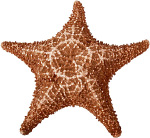 Sea stars (group name Stelleroidea) are sometimes called starfish, though they are not real fish (they lack both vertebrae and fins). There are two sub-types of sea stars:
- Asteroideas are the true sea stars and sun stars.
- Ophiuroideas are brittle stars and basket stars.
The differences between the two sub-types lies in how the arms connect to the central disk. Ophiuroids have arms that do not connect with each other. There is a distinct boundary between arm and central disk. Asteroids have arms that are connected to each other. Also, it is harder to tell with asteroids where the central disk ends and the arms begin. The sea star’s top surface (or skin) looks spiny if you examine it. If you look very closely you will notice that there are different types of growths on the surface. Some bumps are used to absorb oxygen, they are called dermal branchiae. Pedicellaria are pincher-like organs used to clean the surface of the skin. Barnacle larvae could land on a sea star and start growing if it were not for these organs.
How Do Sea Stars Move?
 Each sea star had hundreds of tiny feet on the bottom of each ray. These are tube feet, or podia. These tiny feet can be filled with sea water. The vascular system of the sea star is also filled with sea water. By moving water from the vascular system into the tiny feet, the sea star can make a foot move by expanding it. This is how sea stars move around. Muscles within the feet are used to retract them. Each ray of a sea star has a light sensitive organ called an eyespot. Though it can not see nearly as well as we do, sea stars can detect light and its general direction. They have some idea of where they are going.
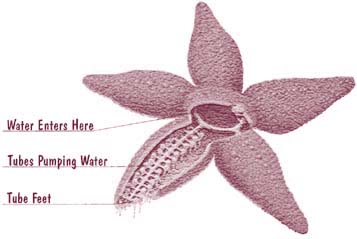
Prelab Questions (click here)
Materials:
Preserved starfish, dissecting pan, scissors, scalpel, forceps, T-pins, pencil, lab apron, safety glasses
Procedure (Aboral Surface):
- Obtain a preserved starfish and rinse off any preservative with water.
- Place the starfish in the dissecting pan with its dorsal or aboral (top) surface upward.
- Observe the starfish and determine its symmetry.
- Locate the central disc in the center of the starfish. Count and record the number of arms or rays the starfish has.
- Locate the small, round hard plate called the madreporite on top of the central disc. Water enters through this into the water vascular system. Label the central disc, arms, and madreporite on Figure 1.
- Feel the upper surface of the starfish for spines. These spines protect the starfish and are part of their internal skeleton. Label these on figure 1.
- Look at the tip of each arm and find the eyespot. Label this on Figure 1.
Figure 1 -Aboral Surface

Procedure (Oral Surface):
- Turn the starfish over to its ventral or oral surface (underside).
- Locate the mouth in the center of the central disc. Find the ring of oral spines surrounding the mouth. Label these on figure 2.
- Find the groove that extends down the underside of each arm. This is called the ambulacral groove. Label this on figure 2.
- Feel the numerous, soft tube feet inside each groove. these are part of the water vascular system & aid in movement and feeding. Label these on Figure 2.
Figure 2 – Oral Surface

Procedure (Internal anatomy):
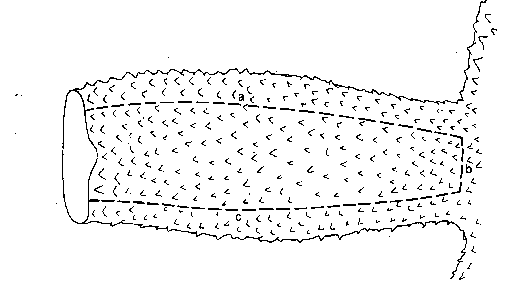
- With the starfish’s aboral surface facing you, cut off the tip of a ray. Cut along lines a, b, and c (Figure 3) and then remove this flap of skin.
Figure 3 – Cuts in Arm
- Inside each arm, locate two long digestive glands called the pyloric caeca. These make enzymes to digest food in the stomach. Label these in Figure 4.
- Cut a circular flap of skin from the central disc. (You will have to also cut around the madreporite in order to remove this flap.) Observe the stomach under the central disc. Label this on Figure 4.
- Remove the pyloric caeca from the dissected ray. Find the gonads (testes or ovaries) underneath. These may be small if the starfish is NOT in breeding season. Label these on figure 4. Remove these to see the rest of the water vascular system.
- Cut off the tip of a ray to observe the parts of the tube feet. Find the zipper-like ridge that extends the length of the ray. The tube feet are attached to these.
- Locate the bulb-like top of a tube foot called the ampulla. This sac works like the top of an eyedropper to create suction. The bottom of the tube foot is a sucker. Label these in Figure 4.
- Embedded in the soft body wall are skeletal plates called ossicles. Locate these and label them in Figure 4.
Figure 4 – Starfish Digestive & Reproductive Systems
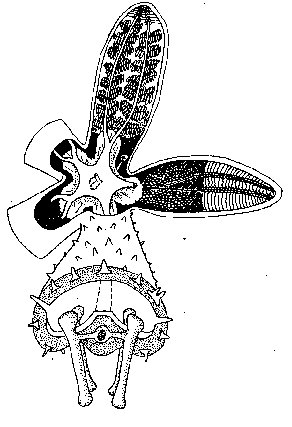
- Running down the center of each arm is a lateral canal to which tube feet are attached. Label this in Figure 5.
- In the central disc the five lateral canals connect to a circular canal called the ring canal. Find this canal & label it on figure 5.
- A short, canal called the stone canal leads from the ring canal to the madreporite where water enters. Find this canal & label the stone canal & madreporite on Figure 5.
- Draw an arrow on Figure 5 tracing the path that water takes when it enters & moves through the starfish.
Figure 5 – Water Vascular System

Starfish Anatomy Questions:
1. What type of symmetry did your starfish have?
2. What is the upper surface of the starfish called?
3. What is the lower surface of the starfish called?
4. On which surface are these parts of a starfish visible:
a. Mouth –
b. Madreporite –
c. Suckers –
d. Oral spines –
e. Eyespots –
d. Ambulcaral groove –
5. In words, trace the path water takes through the water vascular system.
6. What part of the tube foot creates suction to open clams whenever the starfish feeds?
7. Why do the gonads sometimes appear larger?
8. What type of skeleton, endoskeleton or exoskeleton, does the starfish have?
9. What bony plates make up its skeleton?
10. What is the function of the pyloric caeca?
11. where is the stomach of a starfish located? What can the starfish do with its stomach when feeding on clams & oysters?
12. Name the kingdom, phylum, and class for the starfish you dissected.

 Squid Dissection