Preap Photosynthesis Study Guide


Photosynthesis Review  


1. What is the term for the ability to perform work? ______________________.

2. Animals that Cannot make their own food are called  ________________________.

3. Most organisms use an energy storage molecule called ____________________ _______________________ or simply (_______).

4. Light of different colors is different in ______________________  and _________________________.

5. During photosynthesis, a Reduction Reaction _________  ______________ to a molecule.

6. Oxidation is a process that makes a molecule __________________ electrons.

7. Disk-shaped structures with photosynthetic pigments are known as __________________.

8. The process by which autotrophs convert sunlight into energy is called ___________________________.

9. A molecule that can absorb certain light wavelengths and reflect others is a ________________________________.

10. What are the most common group of photosynthetic pigments in plants? ___________________________

11. Stroma are gel-like matrix (a solution) that surrounds the ________________________.

12. Photosynthesis occurs in two stages called:
A.______________________________________________
B.______________________________________________

13. Plants that use only the Calvin Cycle for photosynthesis are called ______________.

14. CAM Plants can survive in dry, hot deserts because they can fix carbon at ____________________________.

15. What substances do Autotrophs or producers use to make food?
A._____________________________________
B._____________________________________
C._____________________________________

16. The addition of an electron to an atom or a molecule is called _________________.

17. The loss of an electron to an atom or a molecule is called ____________________.

18. Organisms that CAN produce their own food are called ______________________.

19. An important waste product of photosynthesis is _______________________.

20. Photosynthesis occurs in what organelle of plants and algae? _________________________.

21. The Thylakoids are surrounded by a gel-like matrix (solution) called __________________.

22. An object that absorbs all colors appears _____________________.

23. What are the light collecting units of the Chloroplast? __________________.

24. Carbon fixing reactions occur in a pathway called the _____________________  _________________.

25. Chlorophyll reflects and transmits what color? _________________________.

26. An object that reflects all colors appears ____________________________.

27. Folded Thylakoids that resemble stacks of pancakes are called ________________________________.

28.The pigments that absorb violet, blue and red light. __________________________

29.The Enzyme that adds a phosphate group to ADP.  _________  __________________ to form _________________.

30. What do we call the component colors of white light? ______________________  ___________________________

31. What clusters of pigments are called. ____________________________

32. A five-carbon carbohydrate in the Calvin cycle. _____________________________

33. A three-carbon molecule in the Calvin cycle.______________________________

34. A Series of linked chemical reactions is called a __________________________  ____________________________.

35. The pigments that absorb blue and green light are called ________________________.

36. The oxygen atoms in the oxygen gas produced in photosynthesis come from ________________________  __________________________.

37.  Both C4 and C3 plants use the ____________________  _________________ for carbon fixation.

38. Where does the energy required for the Calvin cycle originate?  From ______________ and __________________ produced by the ____________________  _____________________.

39.  Protons are move into the thylakoid using energy from ___________________ in the __________________________  __________________________.

40.  At the end of photosystem I transport chain, electrons combine with ______________ to form ______________________.

41. Carbon atoms are fixed into organic compounds in the _____________________  ______________________.

42. To produce the same amount of carbohydrate, C4 plants require less ___________________  ____________________ than C3 plants.

43. Where in the chloroplast do the light reactions occur? ________________________

44. Where in the chloroplast do the reactions of the Calvin cycle occur? ______________________________

45. What product of the light reactions of photosynthesis is released and does not participate further in photosynthesis? _________________________________

46.Which environmental factor will cause a rapid decline in the photosynthesis rate if the factor rises above a certain level? ___________________________________

47. Accessory pigments differ from chlorophyll a in that they are _______________ directly involved in the ___________________  _____________________ of photosynthesis.

48. What structure that is found in the thylakoid membrane is important to chemiosmosis? ___________
_____________________________.

49. _______________________________________________________ is the protein in the _____________________________________ membrane that adds a phosphate group to ADP.

50. Chemiosmosis relies on a(n) ____________________________________________________ of protons across the thylakoid membrane.

51. Write the chemical equation for photosynthesis.____________________________________
_____________________________________________________________________________

52. ATP synthase is a multifunctional protein. By allowing protons to cross the thylakoid membrane, it functions as a(n) _______________________________________________, and by catalyzing the synthesis of ATP it functions as a(n) ______________________________.

53. H+ represents an ion or in photosynthesis a(n) _____________________________________.

DIRECTIONS: Answer the questions below as completely and as thoroughly as possible. Answer the question in essay form (not outline form), using complete sentences. You may use diagrams to supplement your answers, but a diagram alone without appropriate discussion is inadequate.

1. Describe the internal structure and external structure of a chloroplast.

2. Explain what happens to the components of water molecules that are split during the light reactions of photosynthesis? (HINT: Name the three products that are produced when water molecules are split during the light reactions and explain what each product is used for.)

3. Explain the difference between the roles of photosystem I and photosystem II in photosynthesis?

4. Explain why the leaves of some plants look green during the summer then turn yellow, orange, red,
or brown during the fall?

5. What plant structures control the passage of water out of a plant and carbon dioxide into a plant? Explain
how they control the passage of water out of a plant and carbon dioxide into a plant.

6. What happens to the electrons that are lost by photosystem II? What happens to the electrons
that are lost by photosystem I?

7. Photosynthesis is said to be “Saturated” at a certain level of CO2.  Explain what this means?

8. Explain how is ATP synthesized in photosynthesis? What is this process called?

9. What is the fate of most of the PGAL molecules in the third step of the Calvin cycle and Why is this important?
What happens to the remaining PGAL molecules? What organic compound can be made from PGAL?

10. Explain how CAM plants differ from C3 and C4 plants?  How does this difference allow CAM
plants to exist in hot, dry conditions?

11. Define biochemical pathway and explain how the Calvin cycle is an example of a biochemical pathway.
In what part of the chloroplasts does the Calvin cycle take place?

12. Explain how the function of the chloroplasts is related to its structure.

13. What roles do water molecules play in photosynthesis?

14. Describe the structure and function of the thylakoids of a chloroplasts.

15. What role do accessory pigments play in photosynthesis?


PreAP Protozoan Study Guide


Protozoan Review    


1. Protists with animal-like characteristics are called ___________________________.

2. Protozoans are all ______________________ organisms.

3. One convent way to classify protozoans is based on the way they _______________.

4.  _____________________ move by extending their ___________________.  ______________________ propel themselves by ______________________. _____________________ move by hairlike ____________, and _________________________ do ___________ move by themselves at all.

5. Protozoans that move by extending lobes of cytoplasm are called _______________________________.

6. The lobes of cytoplasm that sarcodinians extend are called _____________________ which means “_____________  ________________”.

7. When conditions are unfavorable, many amoebas survive by becoming hard ______________.  The ____________ can withstand drought, heat, or being eaten by other organisms.

8. Not all sarcodinians are soft “Naked”, some have hard shells or  _______________ made of   __________________________________ or _______________________.  They are called ____________________________ and _______________________________.

9. Sarcodinians are protozoans that move by extending lobes of _________________________.

10. ________________________________ are protozoans that move by means of flagella.

11. Some zooflagellates are free-living ________________________ or ____________________ organisms; many can live inside other organisms in _____________________ relationship.  Zooflagellates may have a ________________________ or _________________________________ relationships with other organisms.

12. Which zooflagellate parasite causes African Sleeping Sickness in humans? ____________________________.  The disease is spread by the bite of the __________________  ___________________.

13.  _________________________ are protozoans that have bodies covered with short hairlike projections called _________________.  They beat like ___________ to propel these protists through the water.

14. The ____________________________ is a common freshwater ciliate.

15. Paramecium gathers food with its _____________.  The ____________ sweeps food particles into the ______________  _________________, the Mouth _____________ opens into a ___________________  which pinches off around them to form a ____________________  ______________________.  It ejects wastes through an opening called the ______________________  __________________________.

16. Water is constantly enters the Paramecium cell by _______________________.  They would burst if they did not have a way to get rid of excess water.  ______________________________  _____________________________ collect the excess water and pump it outside.

17. Like all ciliates, Paramecium has ______________ distinct kinds of nuclei, each with a different function.  The ___________________________ controls ongoing functions of the cell and __________________________ reproduction.  Ciliates reproduce _______________________ by cell division.  The _____________________________ is involved in genetic exchange during ___________________________ reproduction.

18. When a Paramecium reproduces sexually, it exchanges genetic information by ________________________________________.

19. The protozoans that have NO structures for movement, and lives by being a parasite in animals are the ______________________________.  They are ____________-__________________ ____________________ protozoans.

20. The protozoan that causes malaria is named ________________________ and is carried within _________________  ____________________.

21. Protozoans can grow and reproduce only in _____________ environments.

22.   _____________________ is a collection of mostly microscopic organisms that float near the surface of the ocean and lakes.

23. Type of sarcodina that moves by pseudopodia is an _________________________.

24. The sporozoan that causes malaria is _______________________________.

25. The ciliophora that moves by cilia ________________________________.

26. Types of sarcodinians that are covered by a protective test are __________________________ and ______________________________.

27. The insect that transmits malaria to humans is the _____________________.

28. The sporozoan that is found in cats is ________________________  _____________________.

29. The zooflagellate that causes Chaga’s disease is ___________________________  _______________________.

30. The zooflagellate that is known to contaminate stream water in the U.S. is _______________________  __________________________.

31.  ________________________ is a process of sexual reproduction in ciliates.

32. Protozoa are thought to have descended from ________________________ Eukaryotes.

33. Protozoan habitats are characterized by the presence of _______________________.

34. An adaptation to extreme environments is called ________________  _______________________________.

35. Sarcodines use their pseudopodia for ________________________________________, _____________________________________, and ________________________________.

36.  Certain sarcodines affect Earth’s geology by having mineralized shells that form __________________________  _________________ after they die.

37. What do trypanosomiasis, Chaga’s disease, leishmaniasis, and giardiasis have in common?  (Hint) They are all caused by __________________________________.

38. Pseudopodia are extensions of a sarcodine’s ____________________________.

39. In Paramecium, the macronucleus contains _______________________  _______________________ of _____________________.

40. What Two terms best describes members of the Kingdom Protista? (Hint) They are _________________________ – _______________ and ____________________________.

41. Most protists are made up of ______________________________ cell(s).

42. Most protists live in a ________________________________ environment.

43. Some protists undergo sexual reproduction only at times of environmental ________________________________.

44. Some protists have __________________________________ that contain light sensitive pigments.

45. Sleeping sickness is caused by a group of ____________________________ called trypanosomes.

46. _________________________________ has been used since the 1600s to relieve the symptoms of malaria.

47. Disease causing protists are transmitted mainly by insects and contaminated ______________________________.

DIRECTIONS: Answer the questions below as completely and as thoroughly as possible. Answer the question in essay form (not outline form), using complete sentences. You may use diagrams to supplement your answers, but a diagram alone without appropriate discussion is inadequate.

1. What kind of organisms are found in the kingdom Protista? What characteristics do they share?

2. Explain how parasitic zooflagellates infect their hosts. Give two examples.

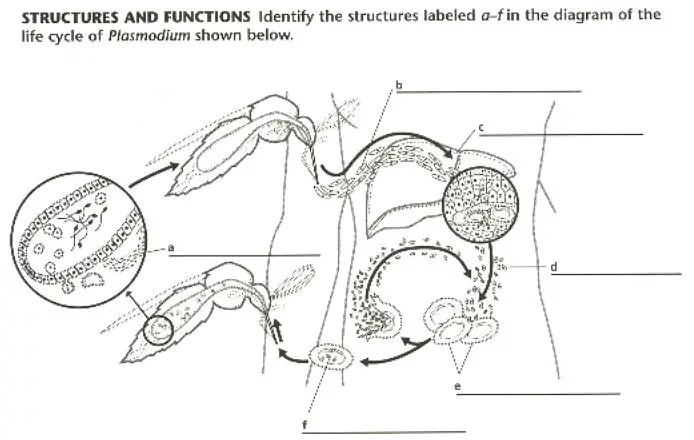
3. Describe the life cycle of Plasmodium. What features typical of sporozoans does this life cycle exhibit.

4.  Describe the four phyla of protozoa.

5. Would a motile or nonmotile protozoan be more likely to be free-living? Explain your answer.

6. Distinguish between the terms Protist and Protozoan.

7. What is conjugation? How is this process advantageous for ciliates, such as Paramecium?

8. Describe the process of ameboid movement and how it helps with the amoeba’s nutrition.

9. What are pseudopodia? What functions do they serve in sarcodines?

10. Describe Three means of locomotion among protozoa.

11. What is a cyst? Under what conditions might certain protozoa form cysts?

12. Explain how Conjugation in protozoa (Paramecium) differs from conjugation in bacteria?

13. Explain the role of protozoa in aquatic ecosystem food chains?

14. How have sarcodines built geological features of the environment?

15. What adaptive significance does the contractile vacuole have in fresh water sarcodine?

16. What Kinds of diseases can zooflagellates cause in humans?


Properties of Water


Properties of Water


Introduction:

Water’s chemical description is H2O. As the diagram to the left shows, that is one atom of oxygen bound to two atoms of hydrogen. The hydrogen atoms are “attached” to one side of the oxygen atom, resulting in a water molecule having a positive charge on the side where the hydrogen atoms are and a negative charge on the other side, where the oxygen atom is. This uneven distribution of charge is called polarity. Since opposite electrical charges attract, water molecules tend to attract each other, making water kind of “sticky.” As the right-side diagram shows, the side with the hydrogen atoms (positive charge) attracts the oxygen side (negative charge) of a different water molecule. (If the water molecule here looks familiar, remember that everyone’s favorite mouse is mostly water, too). This property of water is known as cohesion.

All these water molecules attracting each other mean they tend to clump together. This is why water drops are, in fact, drops! If it wasn’t for some of Earth’s forces, such as gravity, a drop of water would be ball shaped — a perfect sphere. Even if it doesn’t form a perfect sphere on Earth, we should be happy water is sticky. Water is called the “universal solvent” because it dissolves more substances than any other liquid. This means that wherever water goes, either through the ground or through our bodies, it takes along valuable chemicals, minerals, and nutrients.
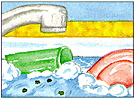
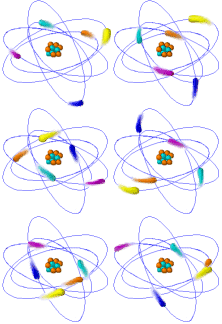
Water, the liquid commonly used for cleaning, has a property called surface tension. In the body of the water, each molecule is surrounded and attracted by other water molecules. However, at the surface, those molecules are surrounded by other water molecules only on the water side. A tension is created as the water molecules at the surface are pulled into the body of the water. This tension causes water to bead up on surfaces (glass, fabric), which slows wetting of the surface and inhibits the cleaning process. You can see surface tension at work by placing a drop of water onto a counter top. The drop will hold its shape and will not spread.

In the cleaning process, surface tension must be reduced so water can spread and wet surfaces. Chemicals that are able to do this effectively are called surface active agents, or surfactants. They are said to make water “wetter.” Surfactants perform other important functions in cleaning, such as loosening, emulsifying (dispersing in water) and holding soil in suspension until it can be rinsed away. Surfactants can also provide alkalinity, which is useful in removing acidic soils.

Pre-Lab Questions (Click here)

Materials:

Box of small paper clips, small plastic container, eyedropper, cup, stirring rod, water, liquid soap, plastic tray

Procedure (Part A) Cohesiveness of Water:

  1. Estimate how many paper clips will fit into a completely full cup of water. Record this number in data table 1.
  2. Place your small container on a tray to contain any water that may spill.
  3. Fill a plastic cup with tap water.
  4. Pour tap water from your cup into your small container.
  5. Continue to add water by eyedropper until the top surface appears rounded.
  6. Slowly add paper clips one at a time to the cup keeping count of all paper clips that you add.
  7. Stop adding paper clips to the container whenever water spills from the top.
  8. Record your paper clip count. Compare the actual number of paper clips to the estimated number.

Procedure (Part B) Soap’s effect on Surface Tension:

  1. Again estimate how many paper clips will fit into a completely full cup of soapy water. Record this number in data table 2.
  2. Place your small container on a tray to contain any water that may spill.
  3. Fill a plastic cup with tap water.
  4. Add several drops of liquid soap & use a stirring rod to mix.
  5. Pour soapy water from your cup into your small container.
  6. Continue to add soapy water by eyedropper until the top surface appears rounded.
  7. Slowly add paper clips one at a time to the cup keeping count of all paper clips that you add.
  8. Stop adding paper clips to the container whenever water spills from the top.
  9. Record your paper clip count. Compare the actual number of paper clips to the estimated number.

Data:

Table 1


Cohesiveness of Tapwater
Estimated Number of Paper Clips Actual Number of paper Clips Difference


Table 2


Cohesiveness of Soapy water
Estimated Number of Paper Clips Actual Number of paper Clips Difference


Questions: 

1. How did your estimated number compare to your actual number?

2. What happened to the surface of the water as more clips were added?


3. What property of water was shown in Part A?

4. How is this property of water used in nature?

5. Explain why water shows surface tension.


6. Explain why water is a polar molecule and include a diagram of several water molecules in a drop of water.


7. In order to clean a surface, what must happen to surface tension?


8. What is the job of a surfactant?


9. Name a surfactant used in Part B?

10. Using your data from Part B, explain what proof you gathered in Part B to support your answer to question 9.


Preap Chemistry Study Guide


Chemistry Review   


1. Everything in the universe is made of __________________________________.

2. The measurement of the amount of matter in an object is called ___________________.

3. What are the Three States of matter?
A.____________________________________
B.____________________________________
C.____________________________________

4. Charged particles that move around an atom’s nucleus are called ________________________.

5. Chemical bonds are broken, atoms are rearranged, and new bonds are formed during _______________________________  ______________________________.

6. Atoms with filled outermost energy levels tend _____________ to participate in chemical reactions.

7. A pure substance that cannot be broken down is called an _____________________.

8. The simplest part of an element is an ____________________.

9. The central core of an atom is called the _____________________________.

10. In an ionic bond, __________ atoms of ________________ charge are held together by _________________________ attraction.

11. The part of an atom that has a neutral charge is a _______________________.

12. Most of the mass of an atom is found in the _____________________.

13. A pure substance made up of atoms of one or more elements is called a ____________________________.

14. Most atoms tend to undergo ____________________  _________________, combining in ways that cause their atoms to become more ____________________.

15.When two atoms share one or more electrons, it is called ____________________________  ______________________.

16. A bond formed by electrical attraction between two opposite charged ions is called ______________________  ____________________.

17. The ability to do work or cause change is _____________________.

18. A redox reaction involves the _____________________ of ___________________ between atoms.

19. The amount of energy needed to start a chemical reaction is the reaction’s _________________________  ___________________.

20. A substance that neutralizes small amounts of acids or bases added to a solution is a _______________________.

21. A chemical reaction that can proceed forward or backward is a ______________________  ______________________.

22. Sodium chloride (table salt) is an example of a compound formed by ______________ _________________.

23.The positive charge part of an atom is called a ___________________________.

24. A particle composed of one or more atoms is a ________________________.

25. Chemical reactions that release free energy are called ____________________________ ____________________________.

26. Chemical reactions that absorb free energy are called ____________________________ _______________________________.

27. The loss of one or more electrons is called ______________________.

28. The gaining of one or more electrons is called _______________________.

29. The breaking apart of water molecules into two ions of opposite charge is called ___________________________________.

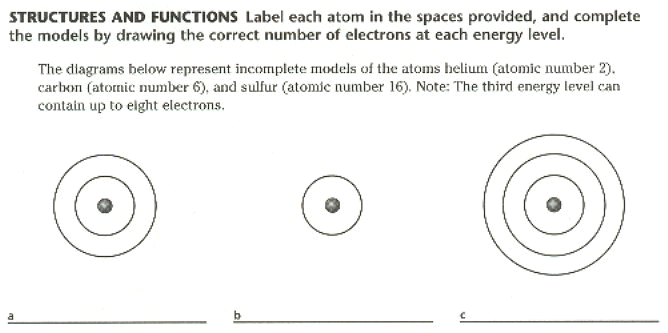
30. An atom has six electrons, what is it atomic number? ____________  Name?___________  It is a stable or unstable atom? _________________.

DIRECTIONS: Read Chapter 2, Chemistry, and Answer the questions below as completely and as thoroughly as possible. Answer the question in essay form (not outline form), using complete sentences. You may use diagrams or pictures to supplement your answers, but a diagram or picture alone without appropriate discussion is inadequate.

1. Describe the dissociation of water.

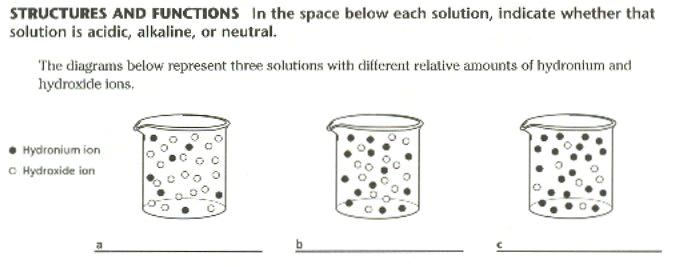
2. Define acid and base. What is a buffer?

3. List TWO characteristics of Acids and TWO Characteristics of Bases.

4. Describe the relationship between the solute, the solvent, and the concentration of a solution.

5. How does an ionic bond differ from a covalent bond?

6. Why is it necessary for oxidation and reduction reactions to occur in pairs?

7. Define the Three States of Matter?

8. State the difference between endergonic and exergonic reactions.

9. What is the role of enzymes in chemical reactions occurring in living things? Explain how a catalyst affects a reaction.
10.  What is the pH Scale, and what does its range of values mean?
11.  Draw and Label a model of a Chlorine (Cl) atom. Is this atom stable? Why or Why not?
12. Describe the difference between an oxidation and reduction reaction.

13. An oxygen atom has six electrons in its outermost energy level. Explain why two oxygen atoms must share four electrons when they form a covalent bond.


Preap Homeostasis Study Guide


Homeostasis & Transport Review  


1. A type of transport in which water moves across and down its concentration gradient is called ______________________________________.

2. Net movement of water across a cell membrane occurs from a ___________________ solution to a ________________________ solution.

3. A _____________________  ___________________ only allows certain molecules to pass thorough.

4. A __________________________  _____________________ is the concentration difference across space.

5. A structure that can move excess water out of a unicellular organism is a __________________________  ______________________.

6. The movement of some substances, without any input of energy by the cell, is called ________________________   ________________________.

7.  The process of diffusion requires________________________________________________
___________________________________________________________________________.

8. If the molecular concentration of a substance is the same throughout space, the substance is in ____________________________________.

9. All forms of passive transport depend on the ___________________  ________________ of molecules.

10.  The movement of molecules from an area of higher concentration to an area of lower concentration is called ______________________________.

11.  Sodium-potassium pumps move ___________________ ions _______________ of the cell and ___________________________ ions ___________________ the cell.  This causes the inside of the cell to have what type of charge? __________________________.

12.  Most of the time, the environment that plant cells live in is ________________________.

13.  Plasmolysis of a human red blood cell would occur if the cell were in a(n) ____________________________  ____________________________.

14.  The bursting of cells is called _____________________________.

15.  The pressure that water molecules exert against a cell wall is called ___________________  _________________________________.

16.  A membrane bound organelle used in endocytosis is called a _______________________.

17.  A relatively high solute concentration is called _____________________________.

18.  The uptake of large particles is called ________________________________.

19. The shrinking of cells is called _____________________________________.

20.  A relatively low solute concentration is called ___________________________.

21.  The uptake of solutes or fluids is called ________________________________.

22.  Molecules always diffuse ___________________ their concentration gradient.

23.  The diffusion of water across a membrane is called __________________________.

24.  In an ________________________  _____________________ the concentration of solutes outside and inside the cell are equal.

25. Transport that requires the cell to expend energy is called _____________________  ________________________________.

26. Which type of molecule forms a bilayer within a cell membrane? __________________________________

27.  Most food and wastes materials that move into and out of a cell go through ____________________________  ________________________________.

28. Glucose molecules cross the cell membrane by means of ______________________________ _______________________________.

29. Ridding the cell of material by discharging it from sacs (vesicles) at the cell surface is called ____________________________________________________.

30. Molecules that are too large to be moved across a cell membrane can be removed from the cell by ________________________________________________.

31. A substance that dissolves in another substance is called a (n) _________________________________________.

32. The diffusion of ___________________________ through the cell membranes is called osmosis.

33. When water enters the cell, it creates pressure. This pressure is called _____________________________  _______________________________________________.

34. A cell does not expend __________________________ when diffusion takes place.

35. __________________________ is the most common solvent in cells.

36. A cell membrane is said to be _______________________________________ permeable because it allows  the passage of some solutes and not others.

37. Facilitated diffusion and active transport are two types of ________________________________ transport.

38. __________________________ _______________________________ allows a cell to stockpile substances in far greater concentrations that they occur outside the cell.

39. Active transport systems are a form of cell transport that requires energy from molecules of __________________________________________________.

40. The process in which an amoeba engulfs its prey and takes it in is known as _______________________________________________________________.

For each of the following, Identify the transport type:

a) A cell membrane encloses and takes in a droplet of fluid.______________________________
b) Carrier proteins use energy and act as a pump to move nutrients into a root cell. ____________________________________________
c) Carrier proteins take sugar (glucose) into a cell without requiring energy input. ____________________________________________
d) Water diffuses across a cell membrane from a region of high concentration to a region of low concentration. _______________________________________
e) Mucus and waste products packaged by Golgi apparatus are secreted by a cell. ________________________________________
f) A cell membrane encloses and takes in food particles. ________________________________

DIRECTIONS: Read Chapter 5, Homeostasis and Transport, and Answer the questions below as completely and as thoroughly as possible. Answer the question in essay form (not outline form), using complete sentences. You may use diagrams to supplement your answers, but a diagram alone without appropriate discussion is inadequate.

1. Name and Describe Three types of passive transport AND Three types of active transport.

2. How do ions cross the lipid bilayer of the cell membrane?

3. Toward what condition does diffusion eventually lead, in the absence of other influences?

4. Explain the difference between pinocytosis and phagocytosis.

5. What is the fundamental difference between carrier proteins that participate in facilitated diffusion and carrier proteins that function as pumps.

6. Explain the difference between passive transport and active transport.

7. Describe what would happen to the molecules in a drop of ink dropped into a beaker of water.  What is this process called?

8.  What would happen to a freshwater unicellular organism if its contractile vacuole stopped functioning? Explain your answer.

9. How is osmosis related to diffusion?

10.  Contrast endocytosis with exocytosis.

11. Define a hypotonic, hypertonic and isotonic solution.

12. Describe the action of the sodium-potassium pump.

13.  Three red blood cells are placed in hypertonic, hypotonic, and isotonic solutions.  Compare the behavior of the three cells. Explain your answer on the basis of concentration gradients, diffusion, and give the name of the effects.