
| Elements in Living Things |
Now write the symbol for each element in the proper place on the periodic table.
|
|||||||||||||||||||||||||||||||||||||||||||||||||||||||||||||||||||||||||||||||||||||||||||||||||||||||||||||||||||||||||||||||||||||||||||||||||||||||||||||||||||||||||||||||||


| Elements in Living Things |
Now write the symbol for each element in the proper place on the periodic table.
|
|||||||||||||||||||||||||||||||||||||||||||||||||||||||||||||||||||||||||||||||||||||||||||||||||||||||||||||||||||||||||||||||||||||||||||||||||||||||||||||||||||||||||||||||||
| ELECTRICITY | .gif) |
 Standards: Standards:
|
| Osmosis through the Cell Membrane of an Egg |  |
Introduction:
Transport can be either passive or active. Passive transport is the movement of substances across the membrane without any input of energy by the cell. Active transport is the movement of materials where a cell is required to expend energy. In the case of this lab the discussion will be centered on passive transport.
The simplest type of passive transport is diffusion. Diffusion is the movement of molecules from an area of higher to an area of lower concentration without any energy input. Diffusion is driven by the kinetic energy found in the molecules. Diffusion will eventually cause the concentration of molecules to be the same throughout the space the molecules occupy, causing a state of equilibrium to exist.
Another type of passive transport is that of osmosis. Osmosis is the movement of water across a semi-permeable membrane. The process by which osmosis occurs is when water molecules diffuse across a cell membrane from an area of higher concentration to an area of lower concentration. The direction of osmosis depends on the relative concentration of the solutes on the two sides. In osmosis, water can travel in three different ways.
If the molecules outside the cell are lower than the concentration in the cytosol, the solution is said to be hypotonic to the cytosol, in this process, water diffuses into the cell until equilibrium is established. If the molecules outside the cell are higher than the concentration in the cytosol, the solution is said to be hypertonic to the cytosol, in this process, water diffuses out of the cell until equilibrium exists. If the molecules outside and inside the cell are equal, the solution is said to be isotonic to the cytosol, in this process, water diffuses into and out of the cell at equal rates, causing no net movement of water.
In osmosis the cell is selectively permeable, meaning that it only allows certain substances to be transferred into and out of the cell. In osmosis, the proteins only on the surface are called peripheral proteins, which form carbohydrate chains whose purpose is used like antennae for communication. Embedded in the peripheral proteins are integral proteins that can either be solid or have a pore called channel proteins. Channel proteins allow glucose, or food that all living things need to live, pass through.
Hypothesis:
In the syrup solution, there will be a net movement of molecules out of the egg, and in the water solution, the molecules will diffuse in and out of the cell at equal rates.
Materials:
The materials used in this lab were 2 fresh eggs in the shell, an overhead marker, 400 ml of water, graduated cylinder, 1 large beaker, 2 medium beakers, 1 small beaker, white vinegar, Karo syrup, distilled water, pencil, paper, lab apron, lab goggles, saran wrap, masking tape, plastic tray, tongs, electronic balance, osmosis lab sheet, and computer.
Methods:
On day 1, measure the masses of both the eggs with the shell. Label 1 beaker vinegar, and then use the graduated cylinder to measure 400 mL of vinegar to put in the labeled beaker. Place both eggs in the solution (place a small beaker on top of the eggs, if necessary) then cover. Let the eggs stand for 24 hours or more to remove the shell.
On day 2, record the observations of what happened to the eggs in the vinegar solution. Carefully, remove the eggs from the vinegar, gently rinsing the eggs off in water. Clean the beakers used for the vinegar solution preparing them for the syrup solution, and then label the 2 medium beakers syrup. Before the eggs are placed in the syrup solution record the mass of both eggs then put it on the datasheet. After that has been done, place the eggs in the beaker, pouring enough syrup to cover the eggs, cover them loosely and let them stand for 24 hours.
On day 3, record the observations of the egg from the syrup solution. Carefully, remove the eggs from the beakers, gently rinsing the syrup off of the eggs. Pour the remaining syrup in the container provided by the teacher. Clean the two beakers used in the syrup solution, preparing them for the water solution. Before the eggs are placed in the water solution record the mass of both eggs then put it on the datasheet. After that has been done, using a graduated cylinder, measure out 200 mL of water for each beaker. Place the eggs in the water solution, cover and let stand 24 hours.
On day 4, record the observations of the egg from the water solution. Carefully remove the eggs from the beakers, gently rinsing them off. Mass both of the eggs. After the teacher has came and looked at the eggs, discard in the proper place.
Results:
| Isotonic Solution | Hypotonic (Vinegar is acid in Water) |
 |
 |
| Hypertonic | |
 |
|
Table 1- Egg 1 Data
|
Egg mass before added into the solution (g) |
Egg mass after added into the solution (g) |
Observations |
|
|
Vinegar |
70.8 g (with shell) | 98.0 g (without shell) | Before the egg was added into the vinegar, it was large, but the after effect was that the egg increased in size and had become hard. After two days, the shell was completely removed. |
|
Syrup |
98.0 g | 65.0 g | When the egg was removed from the syrup, it had shrunk and it was softer than before it was added into the solution |
|
Water |
65.0 g | 105.3 g | When the egg was removed out of the water, the color looked of a pale yellow. The water had diffused into the egg, because the egg was larger in size before it was added into the water. |
Table 2- Egg 2 Data
|
Egg mass before added into the solution (g) |
Egg mass after added into the solution (g) |
Observations |
|
|
Vinegar |
71.6 g (with shell) | 99.1 g (without shell) | Egg 2s’ mass was greater than egg 1s’ mass before and after it was added into the vinegar solution. The mass had increased some 20 grams with the shell off. |
|
Syrup |
99.1 g | 64.0 g | The mass of the egg had decreased some 30 grams after it the egg was removed from the syrup solution. The mass of the egg 2 was smaller than the mass of egg1. |
|
Water |
64.0 g | 105.2 g | The mass of egg 2 had increased some 50 grams after being added into the water solution. The mass of egg 1, though, was larger than the mass of 2 by 1 gram. If the egg would have remained in the water a little while longer, the egg would have probably went through cytolysis. |
1. When the egg was placed in the water in which direction did the water molecules move? The water molecules moved in the egg.
2. On what evidence do you base this? The molecules moved in, because the size of the egg increased
3. How do you explain the volume of liquid remaining when the egg was removed from the syrup? Since, the cell is selectively permeable, it only allowed a certain amount of the syrup to be present in the cell, just enough to shrink it and also equilibrium was reached..
4. When the egg was placed in the water after being removed from the syrup in which direction did the water move? The water moved in.
5. Why did the water molecules travel better inside the cell than the syrup molecules? The water molecules traveled better into the cell because smaller molecules travel better than other larger molecules.
6. What was the purpose of placing the egg in vinegar? The vinegar solution was only used to remove the shell off the egg.
Error Analysis:
A possible error in this lab occurred by having to leave the egg in vinegar for two days instead of one to remove the shell. This caused the egg to initially take in more water.
Discussion and Conclusion:
Based on the data collected and the results of the experiment, the hypothesis was correct. The egg appeared shriveled after removing it from the syrup because of the movement of water out of the egg. The syrup solution was hypertonic so water moved out of the egg from an area where water was more concentrated to the outside of the egg where water was less concentrated due to the high amount of sugar or solute. The acetic acid in vinegar did remove the shell from the egg, because the egg required two days to completely remove the shell, some water did move into the egg causing its initial mass without the shell to be higher than the egg’s mass with its shell. Whenever the egg was transferred from the syrup to the distilled water, the concentration of water outside the shriveled egg was greater than the water concentration inside the egg; therefore, water moved into the egg until equilibrium was reached. At that point, movement into and out of the egg continued with no net movement of water molecules.
Additional research to see if the egg would have went through cytolysis in another 24 or more hours in the water solution would have been interesting.
| BACK |
Osmosis through the Cell Membrane of an Egg

Introduction:
The cell or plasma membrane is made up of phospholipids and different types of proteins that move laterally. These include peripheral proteins, which are attached to the interior and exterior surface of the cell membrane. Integral proteins are embedded in the lipid bilayer. Attached to these integral proteins are carbohydrate chains. These carbohydrates may hold adjoining cells together, or act as sites where viruses or chemical messengers such as hormones can attach. Cell membranes are selectively permeable. They allow some substances to pass through, but not others. Small molecules that are usually nonpolar, such as oxygen, water, and carbon dioxide, easily move through the lipid bilayer. Larger molecules, such as glucose, the food for all living things, must seek aid from the carrier proteins in a process called facilitated diffusion. Facilitated diffusion is a process used for molecules that cannot diffuse rapidly through cell membranes. Integral proteins are used by calcium, potassium, and sodium ions to move through the cell membrane. The muscles and nerves use these ions.
Diffusion is the movement of molecules from an area of higher concentration to an area of lower concentration. This difference in the concentration of molecules across a space is called a concentration gradient. Diffusion is a type of passive transport, meaning it does not require energy input by the cell. This type of transport and osmosis are the two processes used in this lab. Osmosis is the process by which water molecules diffuse across a cell membrane from an area of higher concentration to an area of lower concentration. When the concentration of the solute is higher outside of the cell, it is known as a hypertonic solution. When the concentration of the solute is lower outside of the cell, it is known as a hypotonic solution.
Hypothesis:
The substance, syrup, which has a higher solute concentration than the interior of the eggs, will cause water to leave the eggs’ membrane; the other substance, distilled water, which has a lower solute concentration than the eggs’ interior, will cause liquid to enter the eggs’ membrane.
Materials:
The materials necessary for this lab are: two fresh eggs in their shells, a felt tip marker, 200mL graduated cylinder, five jars, clear Saran wrap, white vinegar, clear sugar syrup (Karo), distilled water, tap water, pencil, paper, eraser, computer, electronic scale, and a plastic tray.
Methods:
Day One: On day one, label the five jars, with the felt tip marker: one labeled vinegar, two labeled syrup, and two labeled distilled water. Also put the group number on each jar. Find the mass of each egg and record this information in the data table. Place the two eggs in the jar labeled vinegar. Add vinegar until both eggs are submerged by it. Cover the jar with the clear Saran wrap. Place the jar on the plastic tray and allow to set for 24 hours.
Day Two: On day two, observe what has happened to your eggs. Record this in a data table. Now that the eggs’ shells are dissolved, gently remove the eggs from the vinegar. Rinse each egg with tap water. Pat the eggs dry with paper towels and mass them separately on the electronic balance. Record this in the data table. Place the eggs in the jars labeled syrup. Add syrup to each jar (labeled egg 1 or egg 2) until the eggs are submerged in syrup. Loosely cover each jar with Saran wrap. Place the jars on the tray and allow them to soak for 24 hours.
Day Three: On day three, observe what has happened to the eggs and record this information in the data table. Carefully remove the eggs from the syrup and rinse them with tap water. Pat dry with paper towels. Using the electronic balance, find the mass of each egg separately and record these masses in the data table. Place the eggs in the jars labeled distilled water (labeled egg 1 and egg 2). Add distilled water to each jar until the eggs are covered. Cover the jars with the Saran wrap and allow them to sit on the tray for 24 hours.
Day Four: On day four, remove the eggs from the jars and record the eggs’ appearance. Mass each egg on the electronic balance. Record this in the data table. Dispose of the eggs in the container provided by the teacher.
Results:
Egg 1 Data Table
| Substance egg submerged in | Egg’s mass before placed in substance | Egg’s mass after removed from substance | Observations of egg before placed in solution | Observations of egg after removed from substance |
| Vinegar | 59.2 g | 86.0 g | The egg’s shell is intact and is included in the first mass. | The egg’s shell dissolved and wasn’t included in the 2nd mass. |
| Syrup | 86.0 g | 53.2 g | The egg is swollen and soft, yet firm to touch. | The liquid inside the egg diffused into the syrup. |
| Distilled Water | 53.2 g | 86.5 g | The egg has lost some of its firmness. | The water diffused into the egg, increasing the egg’s mass. |
Egg 2 Data Table
| Substance egg submerged in | Egg’s mass before place in substance | Egg’s mass after removed from substance | Observations of egg before placed in solution | Observations of egg after removed from substance |
| Vinegar | 58.8 g | 85.6 g | The egg’s shell is intact and is included in the first mass. | The egg’s shell is mostly dissolved and so wasn’t included in 2nd mass. |
| Syrup | 85.6 g | 52.2 g | The egg is rough to touch and feels rather sturdy. | The liquid inside the egg diffused into the syrup. |
| Distilled Water | 52.2 g | 88.9 g | The egg feels more fragile and lighter in weight. | The water diffused into the egg increasing the egg’s mass. |
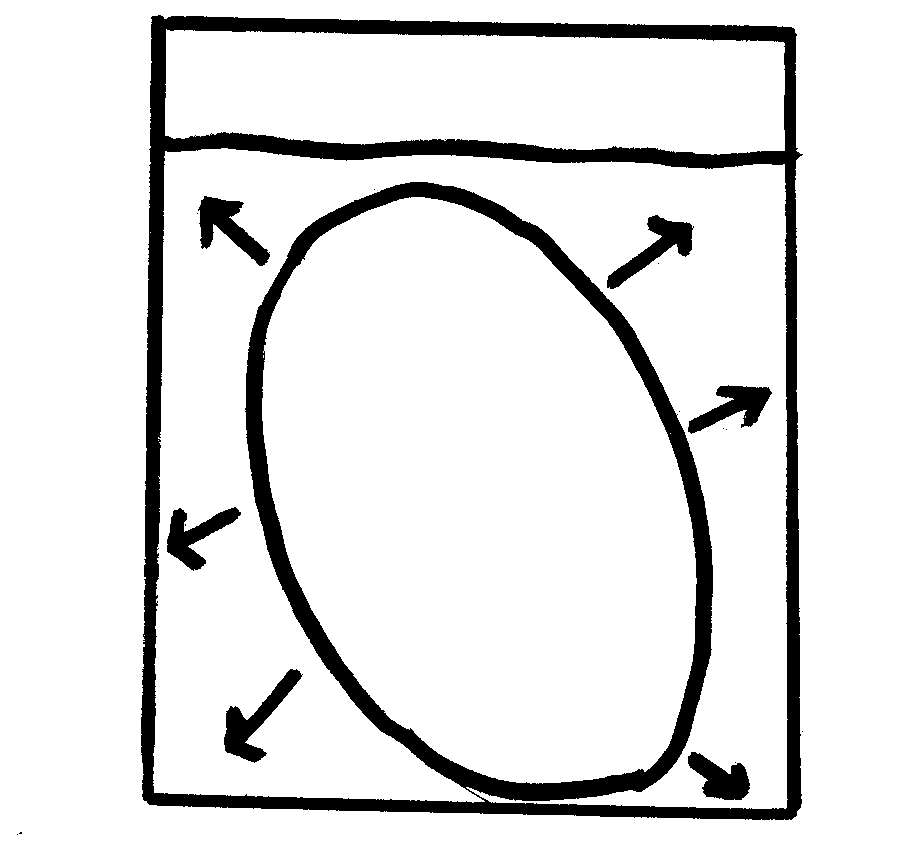
| Egg in Hypotonic Solution of Vinegar & Plasmolyzed Egg in Distilled Water | Egg in Hypertonic Solution of Syrup |
 |
 |
1. When the egg was place in the water, in which direction did the water molecules move? The water moved into the eggs from the surrounding environment.
2. On what evidence do you base this? The eggs’ masses had increased from the time they were placed in the water to when the eggs were removed.
3. How do you explain the volume of liquid remaining when the egg was removed from the syrup? The volume of the liquid remaining when the egg was removed from the syrup must have increased because the eggs’ masses had decreased. The liquid within the eggs left the eggs and diffused into the surrounding syrup.
4. When the egg was place in the water after being removed from the syrup, in which direction did the water move? The water moved into the eggs.
Error Analysis:
Several errors may have occurred during this lab. When finding the eggs’ masses, on each occasion, an error may have occurred. Mistakes may have been made when recording these masses on the data table. Some of the eggs’ shell may have been left on the eggs’ membranes and changed the outcome of this lab. When the eggs were rinsed, after being placed in the vinegar and syrup, a small amount of water could have entered through the membranes of the eggs, effecting their masses. These are just a few of the errors that may have taken place throughout the lab.
Discussion and Conclusion:
The hypothesis was correct. When the eggs were placed in the syrup, their masses decreased greatly. This shows that the interior of the eggs must have had a lower solute concentration than their surrounding environment of syrup. The water within the eggs left through the membrane and diffused into the syrup, decreasing its solute concentration. When the eggs were placed in the distilled water, their masses greatly increased. This shows that the interior of the eggs must have had a higher solute concentration than their surrounding environment of distilled water. The distilled water diffused into the eggs’ membrane, decreasing the interior of the eggs’ solute concentration.
 |
Back |
| “How Good Is Your Enzymatic Detergent? |
Introduction:
In nature there are enzymes called proteases that “digest” or degrade proteins. Some of these enzymes have been genetically engineered and added to our laundry detergents in the hope that they will “digest” the protein off of our clothing. Do they work? Do they assist in cleaning? In this experiment you can compare different detergents and their ability to “digest” protein.
What is gelatin? Gelatin consists of protein chains that are easily digested into their amino acid components. Gelatin is prepared from collagen, a protein found in animal tendons and skin and taken out during the meat rendering process. Boiling collagen reduces the weight by about one-third and separates the protein strands by breaking bonds. When the boiled collagen is cooled, it does not revert back to collagen but sets to a gel we know as gelatin.
Purpose :
To test the effectiveness of laundry detergent brands (and their enzymes) to digest protein (in the form of gelatin)
Hypothesis: ____________ will decompose more gelatin in millimeters than ______________.
Materials:
Gelatin in 4 test tubes Wax Pencil/ Permanent marker
3 detergent brands
Distilled water
Test tube rack
Parafilm®
Ruler
Procedure:
Day 1
1. Pour 5 ml of melted gelatin into 4 test tubes. Let the gelatin solidify.
2. Make 10% solutions of the five non-liquid detergents selected for testing. (Mix 10 g of detergent in 90 mL of distilled water). Label the solutions carefully and note whether enzymes are listed as a component of each.
3. Mark the top level of the gelatin with a permanent marker. Add 15 drops of each detergent solution to the top surface of the hardened gelatin in a test
tube. To one tube add 15 drops of distilled water. Label carefully.
Day 2
4. After 24 hours examine the test tubes. Notice that the gelatin has been liquefied in some tubes. Use a ruler to measure the depth of the liquefication. Measure from the mark where the hardened gelatin started down to where it is still hard. Measure to the nearest mm. Record.
Day 3
5. Measure the depth of liquefication again after 48 hours.
Data 1 data table, 1 graph (time vs. mm. liquefied)
| Enzymes listed? | Liquefied After 24 hours (mm.) | Liquefied After 48 hours (mm.) | |
| Distilled Water | |||
| Detergent 1 ? | |||
| Detergent 2 ? | |||
| Detergent 3 ? |

Conclusion:
1. What is the job of enzymes?
2. Why do laundry detergents often contain enzymes?
3. Why was gelatin used in this lab?
4. How is gelatin made?
5. Name each of the laundry detergents you used and describe the effect each one had on the gelatin.
6. Did any of the laundry detergents contain enzymes? If so, which one(s)?
7. Was your original hypothesis correct? Explain.