Water Properties


Water Properties
States of Water
Adhesion and Cohesion
Surface Tension
Capillary Action

The States of Water

Water has three states. Below freezing water is a solid (ice or snowflakes), between freezing and boiling water is a liquid, and above its boiling point water is a gas. There are words scientists use to describe water changing from one state to another. Water changing from solid to liquid is said to be melting. When it changes from liquid to gas it is evaporating. Water changing from gas to liquid is called condensation (An example is the ‘dew’ that forms on the outside of a glass of cold soda). Frost formation is when water changes from gas directly to solid form. When water changes directly from solid to gas the process is called sublimation.

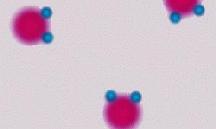
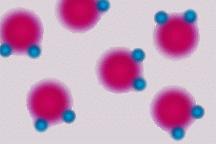
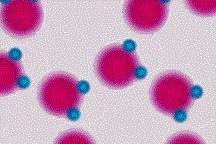
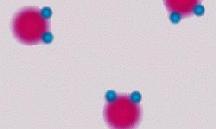
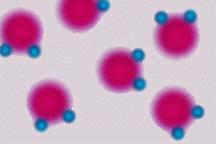
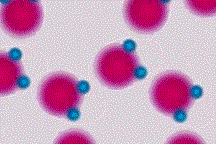
Gas
Liquid
Solid

Most liquids contract (get smaller) when they get colder. Water is different. Water contracts until it reaches 4 C then it expands until it is solid. Solid water is less dense that liquid water because of this. If water worked like other liquids, then there would be no such thing as an ice berg, the ice in your soft drink would sink to the bottom of the glass, and ponds would freeze from the bottom up!

Water is found on Earth in all three forms. This is because Earth is a very special planet with just the right range of temperatures and air pressures.

Adhesion and Cohesion

Water is attracted to other water. This is called cohesion. Water can also be attracted to other materials. This is called adhesion.

The oxygen end of water has a negative charge and the hydrogen end has a positive charge. The hydrogens of one water molecule are attracted to the oxygen from other water molecules. This attractive force is what gives water its cohesive and adhesive properties.

Surface Tension

Surface tension is the name we give to the cohesion of water molecules at the surface of a body of water. Try this at home: place a drop of water onto a piece of wax paper. Look closely at the drop. What shape is it? Why do you think it is this shape?

What is happening? Water is not attracted to wax paper (there is no adhesion between the drop and the wax paper). Each molecule in the water drop is attracted to the other water molecules in the drop. This causes the water to pull itself into a shape with the smallest amount of surface area, a bead (sphere). All the water molecules on the surface of the bead are ‘holding’ each other together or creating surface tension.
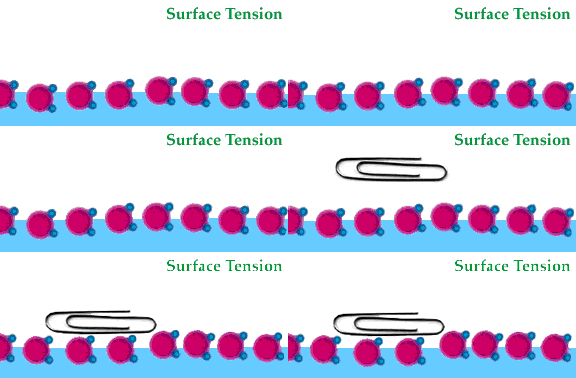
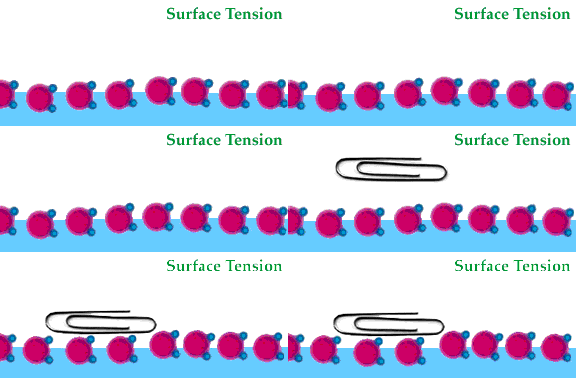
Surface tension allows water striders to ‘skate’ across the top of a pond. You can experiment with surface tension. Try floating a pin or a paperclip on the top if a glass of water. A metal pin or paper clip is heavier than water, but because of the surface tension the water is able to hold up the metal.

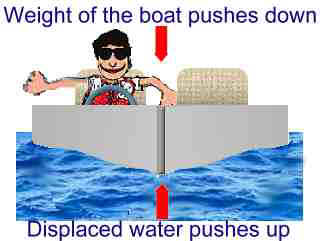
Surface tension is not the force that keeps boats floating. If you want to know why a boat floats look here: Why do boats float?

stability1.jpg (8249 bytes)
The key to floating is that the object must displace an amount of water which is equal to its own weight.

Capillary Action

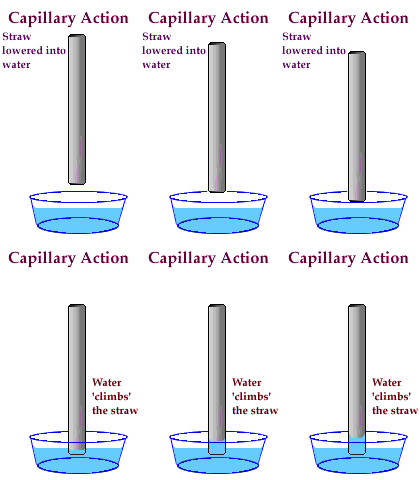
Surface tension is related to the cohesive properties of water. Capillary action however, is related to the adhesive properties of water. You can see capillary action ‘in action’ by placing a straw into a glass of water. The water ‘climbs’ up the straw. What is happening is that the water molecules are attracted to the straw molecules. When one water molecule moves closer to a the straw molecules the other water molecules (which are cohesively attracted to that water molecule) also move up into the straw. Capillary action is limited by gravity and the size of the straw. The thinner the straw or tube the higher up capillary action will pull the water (Can you make up an experiment to test this?).

Plants take advantage of capillary action to pull water from the into themselves. From the roots water is drawn through the plant by another force, transpiration.

Water Properties Handout

Physical Properties of Water

All of water’s unique physical properties are caused by water’s polarity.

  1. Cohesion: water molecules stick to each other.  This is caused by hydrogen bonds that form between the slightly positive and negative ends of neighboring molecules.  This is the reason why water is found in drops; perfect spheres.  It’s hard to imagine water behaving any other way.

  1. Adhesion: water molecules stick to other surfaces.  This causes water to move upward against gravity in plant stems and to be absorbed by paper towels.  It also causes water to adhere to spider webs.

  1.   Surface Tension: water has the ability to support small objects.  The hydrogen bonds between neighboring molecules cause a “film” to develop at the surface.


Organisms like the water strider can be seen taking advantage of this property.


4.  Water has a high boiling point.  Water is one of the few substances that remain a liquid at such a large range of temperatures (O-100 °C).  A large amount of energy must be invested to overcome the hydrogen bonds in liquid water to change it to the gas phase.


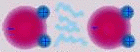
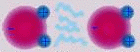
Liquid Water Molecules with hydrogen bonds                              Water Vapor Molecules

5.  Capillary Action: water has the ability to “climb” structures.  Think about what happens when you stick the tip of a straw in a glass of water.

6.  Ability to Dissolve: water is consider to be the universal solvent.  More substances will dissolve in water than any other liquid.  This includes other polar substances (such as sugar) and ionic compounds (such as salt).


When a sugar crystal is placed in water, the slightly positive and negative ends of the water molecule attract the sugar molecules in the crystal (they are also polar) and pull them into solution.


When an salt crystals are placed in water, the slightly positive and negative ends of the water molecules attract the ions in the crystal.  The ionic bonds holding the sodium and chlorine ions together are broken and the ions are pulled into solution.


7. High Heat of Vaporization:

Water Properties Prelab


Properties of Water

Pre-Lab Questions:

1. Explain why water is referred to as the universal solvent.


2. What is the overall charge on a molecule of water?

3. Water is a polar molecule (appears to have a charge). Explain why this is so.


4. Which end of a water molecule “acts negative”? Which “acts positive”?

5. Is water the only molecule that is polar?

6. Explain what occurs whenever several water molecules are near each other in a droplet. Include a sketch of this.


7. The property of water molecules being attracted to other water molecules is called ________________.

8. Explain what causes water to have surface tension.


9. Surface tension causes causes water to _____________ on surfaces such as glass.

10. In order to clean a surface, what must happen to surface tension? What type of chemicals can do this? Give an example


11. Besides reducing surface tension, what 4 other things can surfactants perform?


Volume of Irregular Object Sample Lab 1


Volume of an Irregular Object


Introduction

Everything is made of matter, and matter has both chemical and physical properties. Physical properties of matter are observable and include mass, volume, and density. Mass is the amount of matter in an object and can be found by using an electronic balance or scale. Volume is the amount of space an object occupies and can be determined by measuring the amount of water that a submerged object displaces. The formula for determining density is:

Density = Mass of the object / Volume of the object

Hypothesis

Determining the volume of an irregularly shaped object can help determine its density.

Materials

The materials used in this lab included a rubber stopper, small rock, shell, 100 ml graduated cylinder, electronic balance, water, paper, and pencil.

Methods

Obtain three, irregularly shaped objects — a rubber stopper, a shell, and a rock. Estimate the volume and mass of each object and record this in the data table. Use an electronic balance to mass each object and record the masses in the data table. Fill a graduated cylinder approximately half way with water and record this initial volume. Place one of the objects into the graduated cylinder and record the final volume. Subtract the initial volume of the water from the final volume of water to find the volume of the water the object displaced. Record this as the object’s volume in the data table. Remove the first object and repeat this process of determining volume for the other two objects. Determine each object’s density by dividing their mass by their volume. Record each density in the data table.

Results


Data Table
Object estimated mass (g) estimated volume (ml) actual mass (g) initial volume of water (ml) final volume of water (ml) volume of object (ml) density (g/ml)
Rubber stopper 19.3 10 9.3 50 56 6 1.55
Shell 6.0 2 3.3 50 51.5 1.5 2.2
Rock 10.0 5 9.3 50 55 5 1.86


Discussion and Conclusion

Objects that are irregular in shape can have their volume determined by measuring the amount of water that they displaced when submerged in a known amount of water. The increase in volume from the initial water level to the final water level is the volume of the object. Once the volume is determined and the actual mass measured then the object’s density can also be determined. The formula for finding density is the mass of the object divided by the volume of the object. For example, since the rock had a mass of 9.3 grams and a volume of 5 ml, the density of the rock was determined to be 1.86 grams/ millimeters.

BACK


Water Properties Notes


Water Properties
States of Water
Adhesion and Cohesion
Surface Tension
Capillary Action

The States of Water

Water has three states. Below freezing water is a solid (ice or snowflakes), between freezing and boiling water is a liquid, and above its boiling point water is a gas. There are words scientists use to describe water changing from one state to another. Water changing from solid to liquid is said to be melting. When it changes from liquid to gas it is evaporating. Water changing from gas to liquid is called condensation (An example is the ‘dew’ that forms on the outside of a glass of cold soda). Frost formation is when water changes from gas directly to solid form. When water changes directly from solid to gas the process is called sublimation.

Gas
Liquid
Solid

Most liquids contract (get smaller) when they get colder. Water is different. Water contracts until it reaches 4 C then it expands until it is solid. Solid water is less dense that liquid water because of this. If water worked like other liquids, then there would be no such thing as an ice berg, the ice in your soft drink would sink to the bottom of the glass, and ponds would freeze from the bottom up!

Water is found on Earth in all three forms. This is because Earth is a very special planet with just the right range of temperatures and air pressures.

Adhesion and Cohesion

Water is attracted to other water. This is called cohesion. Water can also be attracted to other materials. This is called adhesion.

The oxygen end of water has a negative charge and the hydrogen end has a positive charge. The hydrogens of one water molecule are attracted to the oxygen from other water molecules. This attractive force is what gives water its cohesive and adhesive properties.

Surface Tension

Surface tension is the name we give to the cohesion of water molecules at the surface of a body of water. Try this at home: place a drop of water onto a piece of wax paper. Look closely at the drop. What shape is it? Why do you think it is this shape?

What is happening? Water is not attracted to wax paper (there is no adhesion between the drop and the wax paper). Each molecule in the water drop is attracted to the other water molecules in the drop. This causes the water to pull itself into a shape with the smallest amount of surface area, a bead (sphere). All the water molecules on the surface of the bead are ‘holding’ each other together or creating surface tension.

Surface tension allows water striders to ‘skate’ across the top of a pond. You can experiment with surface tension. Try floating a pin or a paperclip on the top if a glass of water. A metal pin or paper clip is heavier than water, but because of the surface tension the water is able to hold up the metal.

Surface tension is not the force that keeps boats floating.

Capillary Action

Surface tension is related to the cohesive properties of water. Capillary action however, is related to the adhesive properties of water. You can see capillary action ‘in action’ by placing a straw into a glass of water. The water ‘climbs’ up the straw. What is happening is that the water molecules are attracted to the straw molecules. When one water molecule moves closer to a the straw molecules the other water molecules (which are cohesively attracted to that water molecule) also move up into the straw. Capillary action is limited by gravity and the size of the straw. The thinner the straw or tube the higher up capillary action will pull the water (Can you make up an experiment to test this?).

Plants take advantage of capillary action to pull water from the into themselves. From the roots water is drawn through the plant by another force, transpiration.