Vertebrate Notes


Vertebrate Chordates
Animals with a Backbone


All Materials © Cmassengale 

The vertebrates comprise a large group of chordates, and are subdivided into seven classes (3 classes of fish, amphibians, reptiles, birds, and mammals). Vertebrates have an internal skeleton of cartilage or bone, with vertebrae surrounding the dorsal nerve cord.

Subphylum Vertebrata

The subphylum Vertebrata consists of about 43,700 species of animals with backbones. Vertebrates exhibit all three of the chordate characteristics at some point during their lives. The embryonic notochord is replaced by a vertebral column in the adult. The vertebral column is made of individual hard segments (vertebrae) surrounding the dorsal hollow nerve cord. The nerve cord is the one chordate feature present in the adult phase of all vertebrates. The vertebral column, part of a flexible but strong endoskeleton, is evidence that vertebrates are segmented. The vertebrate skeleton is living tissue (either cartilage or bone) that grows as the animal grows.

The endoskeleton and muscles form an organ system  that permits rapid and efficient movement. The pectoral and pelvic fins of fishes evolved into jointed appendages that allowed vertebrates to move onto land. The skull, the most anterior component of the main axis of the vertebrate endoskeleton, encases the brain. The high degree of cephalization in vertebrates is accompanied by complex sense organs concentrated in the head region. Eyes developed as outgrowths of the brain. Ears were equilibrium devices in aquatic vertebrates that function as sound-wave receivers in land vertebrates. Vertebrates have a complete digestive system and a large coelom. Their circulatory system is closed, with respiratory pigments contained within blood vessels. Gas exchange is efficiently accomplished by gills, lungs, and in a few cases, moist skin. Kidneys are efficient in excretion of nitrogenous waste and regulation of water. Reproduction is usually sexual with separate sexes.

Classification of the Vertebrata

The first vertebrates were fishlike. Fishes are aquatic, gill-breathing vertebrates that usually have fins and skin covered with scales. The larval form of a modern-day lamprey, which looks like a lancelet, may resemble the first vertebrates: it has the three chordate characteristics (like the tunicate larva), as well as a two-chambered heart, a three-part brain, and other internal organs that are like those of vertebrates.

Small, jawless, and finless ostracoderms were the earliest vertebrates. They were filter feeders, but probably were also able to move water through their gills by muscular action. Ostracoderms have been found as fossils from the Cambrian through Devonian periods, when the group finally went extinct. Although extant jawless fishes lack protection, many early jawless fishes had large defensive head shields.

Class Lampreys

These long, eel-like, jawless fish are free-swimming predators on other fish. Lampreys hatch in freshwater and many live their lives entirely in freshwater. Some lampreys migrate to the sea, but must return to freshwater to reproduce. Lampreys have a sucker-like mouth that lacks a jaw.


Lampreys

Sea lamprey on lake trout


Sea lamprey mouth

Class Myrini, Hagfish

Members of the class Myxini have a partial cranium (skull), but no vertebrae. Their skeleton is made of of cartilage, as is that of sharks. Hagfish lack jaws, and for this reason used to be classified with the lampreys in a group called the Agnatha (“no jaws”) or the Cyclostomata (“round mouth”).


Hagfish

Fish: Vertebrates With Jaws

The fish first appeared during the Cambrian Period. Whether fish first evolved in fresh or salt water is unclear from the fossil record. The jawless fish are the most primitive group, although they were a very important group during the Silurian and Devonian periods. Hagfish and lampreys are the only living members of this class today. They have long, cylindrical bodies with cartilage skeletons and no paired fins.

The first jawed fish were the Placoderms, an extinct group of Devonian-aged jawed fishes. Placoderms were armored with heavy plates and had strong jaws and paired pectoral and pelvic fins. Paired fins allow fish to balance and to maneuver well in water, which facilitate both predation and escape.


The fossil is a cast of the placoderm, Bothriolepis

.

The evolution of jaws is an example of evolutionary modification of existing structures to perform new functions. Jaws are modified gill arches, and allowed the exploitation of new roles in the habitats: predators with powerful jaws. There are two classes of jawed fish: the cartilaginous fish and the bony fish.


Steps in the evolution of jaws by modification of gill arches.

Class Chondrichthyes: Cartilaginous Fish

The class Chondrichthyes contains approximately 850 species of skates, rays, and sharks. They have jaws, lots of teeth, paired fins, and a cartilage endoskeleton. Cartilaginous fish first appeared during the Devonian Period and expanded in diversity during the Carboniferous and Permian before nearly disappearing during the great extinction that occurred near the end of the Permian. A large group of cartilagenous fish still survives today and is an important part of the marine fauna.

These fish have five to seven gill slits on both sides of the pharynx, and lack the gill covers found in bony fish. The chondrichthyian body is covered epidermal placoid (or toothlike) scales. Developmental studies show the teeth of sharks are enlarged scales.

The largest sharks are filter feeders, not the predators of Hollywood movies. Basking and whale sharks eat tons of crustaceans (small krills, etc.) filtered from the water. Most sharks are fast-swimming, open-sea predators. The great white shark feeds on dolphins, sea lions and seals (and people sometimes). In other words, anything is WANTS to!


Shark and Ray

Rays and skates live on the ocean floor; their pectoral fins are enlarged into winglike fins; they swim slowly. Stingrays have a venomous spine. The electric ray family can feed on fish that have been stunned with electric shock of over 300 volts. Sawfish rays have a large anterior “saw” that they use to slash through schools of fish.

Class Osteichthyes, the Bony Fish

There are about 20,000 species of bony fish, found both in marine and freshwater, comprising the class Osteichthyes. This class is divided into two groups: the lobe-finned (Sarcopterygii) and ray-finned fish (Actinopterygii). The bony fish have a bony skeleton. Most species in this class are ray-finned with thin, bony rays supporting the fins. A few fishes are lobe-finned and are thought to be related to the ancestors of amphibians.


Cross section of a fish

Ray-finned Fish (Actinopterygii)

The ray-finned fish include familiar species such as tuna, bass, perch, and trout. Ray-finned fish are the most successful and diverse of the vertebrates (more than half of all vertebrate species belong to this group). Thin, bony supports with radiating bones (hence the term ray-finned) hold the fins away from the body. Ray-finned fish obtain their food by filter feeding and by preying on insects and other animals. Their skin is covered by scales formed of bone. These scales are homologous to our own hair (and the feathers of birds), being derived from the same embryonic tissues. The gills in this group of fish do not open separately and are covered by an operculum. Ray-finned fish have a swim bladder, a gas-filled sac, that regulates buoyancy and depth. Sharks lack this feature, which enables fish to “sleep” without sinking. The swim bladder acts much the way a ballast tank does on a submarine to control buoyancy.

Salmon, trout, and eels can migrate from fresh water to salt water, but must adjust kidney and gill function to the tonicity of their environments. In freshwater, the fish is hypotonic relative to its aqueous (watery) environment. Water is constantly flooding into the fish, and must be removed by the fish’s excretory system. In seawater, the fish is now hypertonic or isotonic relative to the seawater, requiring conservation of body water.

Bony fishes depend on color vision to detect both rivals and mates. Sperm and eggs are released into the water, with not much parental care for the newborn. Most fish have fertilization and embryonic development taking place outside the female’s body.

Lobe-finned Fish (Sarcopterygii)

This group includes six species of lungfishes and one species of coelacanth that has muscular fins with large, jointed bones attaching the fins to the body. Lobe-finned fish have fleshy fins supported by central bones, homologous to the bones in your arms and legs. These fins underwent modification, becoming the limbs of amphibians and their evolutionary descendants such as lizards, canaries, dinosaurs, and humans.

The lungfish are a small group found mostly in freshwater stagnant water or ponds that dry up in Africa, South America, and Australia.


Australian lungfish

Coelacanths live in deep oceans. They were once considered extinct, although more than 200 have been captured since 1938. Mitochondrial DNA analysis supports the hypothesis that lungfish are probably the closest living relatives of amphibians.


Coelacanth, a living fossil.

The crossopterygian fish (represented by the marine extant deep-living coelacanth and extinct freshwater forms) are regarded as ancestors of early amphibians. Extinct crossopterygians had strong fins, lungs, and a streamlined body capable of swimming as well as traveling short distances out of water.


Comparison of the skeletons of a crossopterygian lobe-finned fish and an early amphibian.

The “Tetrapods”

The term “tetrapod” (meaning four-limbed or four-footed) has historically been applied to the land vertebrates (amphibians, reptiles, dinosaurs, birds, and mammals). All other animals from this point have four limbs and are called tetrapods.

Most zoologists would accept that the Devonian lobe-finned fishes were ancestral to the amphibians. Animals (both vertebrate as well as many invertebrates such as insects) that live on land use limbs to support the body, especially since air is less buoyant than water. Lobe-finned fishes and early amphibians also had lungs and internal nares to respire air.

Two hypotheses have been proposed to explain the evolution of amphibians from lobe-finned fishes.

  1. Lobe-finned fishes capable of moving from pond-to-pond had an advantage over those that could not.
  2. The supply of food on land, and the absence of predators, promoted adaptation to land.

The first amphibians diversified during Carboniferous Period (commonly known as the Age of Amphibians).  

Class Amphibia: Animals Move Ashore

This class includes 4000 species of animals that spend their larval/juvenile stages in water, and their adult life on land. Amphibians must return to water to mate and lay eggs. Most adults have moist skin that functions in helping their small, inefficient lungs with gas exchange. Frogs, toads, newts, salamanders, and mud puppies are in this transitional group between water and land.

Amphibian features not seen in bony fish include:

  • Limbs with girdles of bone that are adapted for walking on land.
  • A tongue that can be used for catching prey as well as sensory input.
  • Eyelids that help keep the eyes moist.
  • Ears adapted for detecting sound waves moving through the thin (as compared to water) medium of the air.
  • A larynx adapted for vocalization.
  • A larger brain than that of fish, and a more developed cerebral cortex.
  • Skin that is thin, smooth, non-scaly, and contains numerous mucous glands; the skin plays an active role in osmotic balance and respiration.
  • Development of a lung that is permanently used for gas exchange in the adult form, although some amphibians supplement lung function by exchange of gases across a porous (moist) skin.
  • A closed double-loop circulatory system that replaces the single-loop circulatory path of fish.
  • Development of a three-chambered heart that pumps mixed blood before and after it has gone to the lungs.

Reproduction involves a return to the water. Ther term “amphibian” refers to two life styles, one in water, the other on land. Amphibians shed eggs into the water where external fertilization occurs, as it does in fish. Generally, amphibian eggs are protected by a coat of jelly but not by a shell. The young hatch into aquatic larvae with gills (tadpoles). Aquatic larvae usually undergo metamorphosis to develop into a terrestrial adult.

Amphibians, like fish, are ectothermic; they depend upon external heat to regulate body temperatures. If the environmental temperature becomes too low, ectotherms become inactive.

Salamanders more likely resemble earliest amphibians due to their S-shaped movements. Salamanders practice internal fertilization; males produce a spermatophore that females pick up. Frogs and toads are tailless as adults, with their hind limbs specialized for jumping.


Frogs

Class Reptilia: Reproducton Without Water

This class of 6000 species includes the snakes, lizards, turtles, alligators, and crocodiles. Reptiles that lay eggs lay an egg surrounded by a thick protective shell and a series of internal membranes. Reptiles have internal fertilization: their gametes do not need to be released into water for fertilization to occur.

The amniotic egg is a superb adaptation to life on land. While amphibians need to lay their eggs in water, their descendants (reptiles) were not as strongly tied to moist environments and could truly expand into more arid areas. Reptiles were the first land vertebrates to practice internal fertilization through copulation and to lay eggs that are protected by a leathery shell with food and other support for the growing embryo.

The amniote egg contains extra-embryonic membranes that are not part of the embryo and are disposed of after the embryo has developed and hatched. These membranes protect the embryo, remove nitrogenous wastes, and provide the embryo with oxygen, food, and water. The amnion, one of these extra-embryonic membranes, creates a sac that fills with fluid and provides a watery environment in which the embryo develops. The embryo develops in a “pond within the shell”.


Structure of the amniote egg


Evolutionary History of Reptiles

Reptiles first evolved during the Carboniferous time and partly displaced amphibians in many environments. The first reptiles (often referred to as the stem reptiles) gave rise to several other lineages, each of which adapted to a different way of life. Reptilian success was due to their terrestrial (amniotic) egg and internal fertilization, as well as their tough leathery skin, more efficient teeth and jaws, and in some, bipedalism (traveling on their hind legs, allowing the forelimbs to grasp prey or food, or become wings). One group, the Pelycosaurs (fin-backed or sail lizards) are related to therapsids, mammal-like reptiles ancestral to mammals. Other groups returned to aquatic environments. Ichthyosaurs were fishlike (or dolphin-like) free-swimming predators of the Mesozoic seas. The plesiosaurs had a long neck and a body adapted tp swimming though use of flippers (legs that evolutionarily reverted to a flipper-like shape). These free-swimmers also adapted to live birth of their young (since they could not return to the land to lay eggs). Thecodonts were the reptiles that gave rise to most of the reptiles, living and extinct. Pterosaurs were flying reptiles that dominated the Mesozoic skies. They had a keel for attachment of flight muscles and air spaces in bones to reduce weight.

Dinosaurs (descended from some thecodonts) and mammal-like reptiles’ had their limbs beneath the body providing increased agility and facilitating gigantic size. Lizards have their elbows out (like you do when you do a push-up). By having their elbows in, dinosaurs and mammals place more of the weight of the body on the long bones instead of the elbows, ankles, and knees.

Relationship between limbs and body. Note that reptiles have their upper limbs jutting out from the body, while mammals have their limbs in line with the body, supporting and more easily raising the body mass off the ground.


Reptiles dominated the earth for about 170 million years during the Mesozoic Era. The mass extinction of many reptile groups at the close of the Mesozoic (the Cretaceous Period) has been well documented and the subject of many hypotheses. The 1980 hypothesis by Luis and Walter Alvarez and others proposes the impact of a large meteorite at the end of the Cretaceous period caused a catastrophic environmental collapse that led to the extinction of nearly 50% of all species of life on Earth. The survivors, birds and mammals, reaped the spoils and diversified during the Cenozoic Era. Three groups of reptiles remain: turtles, snakes/lizards, and crocodiles/alligators.

About 6,000 species of reptiles comprise the Class Reptilia. Most live in tropics or subtropics. Lizards and snakes live on land, while turtles and alligators live in water for much of their lives. Reptiles have a thick, scaly skin that is keratinized and impermeable to water. This same keratin is a protein found in hair, fingernails, and feathers. Protective skin prevents water loss but requires several molts a year. Reptilian lungs are more developed than those of amphibians. Air moves in and out of the lungs due to the presence of an expandable rib cage in all reptiles except turtles. Most reptiles have a nearly four-chambered heart. The crocodile has a completely four-chambered heart that more fully separates oxygen-rich blood from from deoxygenated or oxygen-poor blood. The well-developed kidneys excrete uric acid; less water is lost in excretion. Reptiles are ectothermic; they require a fraction of the food per body weight of birds and mammals, but are behaviorally adapted to warm their body temperature by sunbathing.


Photograph of a lizard (L) and a gavial (R)

Snakes and lizards live mainly in the tropics and desert. Lizards have four clawed legs and are carnivorous; marine iguanas on the Galapagos are adapted to spend time in the sea; frilled lizards have a collar to scare predators, and blind worm lizards live underground. Snakes evolved from lizards and lost their legs as an adaptation to burrowing. Their jaws can readily dislocate to engulf large food. The snake’s tongue collects airborne molecules and transfers them to the Jacobson’s organ for tasting. Some poisonous snakes have special fangs for injecting their venom.

Turtles have a heavy shell fused to the ribs and thoracic vertebrae; they lack teeth but use a sharp beak; sea turtles must leave the ocean to lay eggs onshore.

Galapagos tortoises

Crocodiles and alligators are largely aquatic, feeding on fishes and other animals. They both have a muscular tail that acts as a paddle to swim and a weapon. The male crocodile bellows to attract mates. In some species the male also protects the eggs and young.

The Archosauria: Birds, Dinosaurs, and More

Cladistic analyses place the birds, alligators, and dinosaurs in the same clade, the Archosauria (or “ruling reptiles”). This group is a major group of diapsids (vertebrates that have two openings in their skulls) that have single openings in each side of the skull, in front of the eyes (antorbital fenestrae), among other characteristics. This helps to lighten the skull, provides more room for muscles and other tissues, and allows more skull flexibility when eating. Other typical archosaurian characteristics include another opening in the lower jaw (the mandibular fenestra), a high narrow skull with a pointed snout, teeth set in sockets, and a modified ankle joint.

The ancestral archosaurs probably originated some 250 million years or so ago, during the late Permian period. Their descendants (such as the dinosaurs) dominated the realm of the terrestrial vertebrates for a most of the Mesozoic Era. The birds and crocodilians are the last living groups of archosaurs.

Class Aves: Birds of a Feather

The class Aves (birds) contains about 9000 species. Birds evolved from either a dinosaurian or other reptilian group during the Jurassic (or possibly earlier). The earliest bird fossils, such as the Jurassic Archaeopteryx or Triassic Protavis, display a mosaic of reptilian and bird features (teeth in the bill, a jointed tail, and claws on the wing are reptilian; feathers and hollow bones are bird-like).


Archaeopteryx, once considered the first bird.The fossil is from the Solenhoefen Limestone (Jurassic) of Germany


The distinguishing feature of birds is feathers: which provide insulation as well as aid in flight.


Structure of a feather

Hummingbird Feather


Remember, not all animals that fly have feathers, but all almost every endothermic animal (warm-blooded) has a covering of hair or feathers for insulation. The recent (1999) discovery of a “feathered” dinosaur adds credence to this speculation. The dinosaur could not fly, so of what use would feather be but insulation (or possibly mating).

Modern birds appeared during the early Tertiary, and have adapted to all modes of life: flying (condors, eagles, hummingbirds), flightless-running (ostriches, emus), and swimming (penguins). Birds exhibit complex mating rituals as well as social structure (a pecking order!).


Mallard Hen


Bald Eagle


Class Mammalia: Got Milk?

Class Mammalia contains around 5000 species placed in 26 orders (usually). The three unifying mammalian characteristics are:

  1. hair
  2. the presence of three middle ear bones
  3. the production of milk by mammary glands

Milk is a substance rich in fats and proteins. Mammary glands usually occur on the ventral surface of females in rows (when there are more than two glands). Humans and apes have two mammary glands (one right, one left), while other animals can have a dozen or more. All mammals have hair at some point during their life. Mammalian hair is composed of the protein keratin. Hair has several functions: 1) insulation; 2) sensory function (whiskers of a cat); 3) camouflage, a warning system to predators, communication of social information, gender, or threats; and 4) protection as an additional layer or by forming dangerous spines that deter predators. Modifications of the malleus and incus (bones from the jaw in reptiles) work with the stapes to allow mammals to hear sounds after they are transmitted from the outside world to their inner ears by a chain of these three bones.

Mammals first evolved from the mammal-like reptiles during the Triassic period, about the same time as the first dinosaurs. However, mammals were minor players in the world of the Mesozoic, and only diversified and became prominent after the extinction of dinosaurs at the close of the Cretaceous period.

Mammals have since occupied all roles once held by dinosaurs and their relatives (flying: bats; swimming: whales, dolphins; large predators: tigers, lions; large herbivores: elephants, rhinos), as well as a new one (thinkers and tool makers: humans). There are 4500 species of living mammals.

Mammalian Adaptations

  • Mammals developed several adaptations that help explain their success.
  • Teeth are specialized for cutting, shearing or grinding; thick enamel helps prevent teeth from wearing out.
  • Mammals are capable of rapid locomotion.
  • Brain sizes are larger per pound of body weight than most other animals’.
  • Mammals have more efficient control over their body temperatures than do birds.
  • Hair provides insulation.
  • Mammary glands provide milk to nourish the young.

Mammalian Classification

Subclass Prototheria: Order Monotremata: Monotremes (typified by the platypus and echinda) lay eggs that have similar membranes and structure to reptilian eggs. Females burrow in ground and incubates their eggs. Both males and females produce milk to nourish the young There are two families living today and quite a few known from the fossil record of Gondwana. Monotremes are today restricted to Australia and New Guinea. The earliest fossil monotreme is from the early Cretaceous, and younger fossils hint at a formerly more widespread distribution for the group. While their fossil record is scarce, zoologists believe that monotremes probably diverged from other mammals during the Mesozoic. Monotremes have many differences with other mammals and are often placed in a separate group, the subclass Prototheria. They retain many characters of their therapsid ancestors, such as laying eggs, limbs oriented with humerus and femur held lateral to body (more lizard-like), a cloaca, skulls with an almost birdlike appearance, and a lack of teeth in adults. This suggests that monotremes are the sister group to all other mammals. However, monotremes do have all of the mammalian defining features of the group.


Platypus


Echidna


Subclass Metatheria: Marsupials (such as the koala, opossum, and kangaroo) are born while in an embryonic stage and finish development outside the mother’s body, often in a pouch. Marsupial young leave the uterus, crawl to the pouch, and attach to the nipple of a mammary gland and continue their development. Marsupials were once widespread, but today are dominant only in Australia, where they underwent adaptive radiation in the absence of placental mammals. The Metatheria contains 272 species classified in several orders. Metatheres diverged from the lineage leading to the eutherian (placental) mammals by the middle of the Cretaceous period in North America. The earliest marsupial fossils resemble North American opossums. Marsupial fossils are found on other northern hemisphere continents, although they seem not to have been prominent elements of those faunas. On the other hand, in South America and Australia, marsupials continued to be dominant faunal elements. The marsupials of South America began to go extinct in the late Miocene and Early Pliocene (Cenozoic era) when volcanic islands grew together and formed the Isthmus of Panama, allowing North American placental mammals to cross into South America. Australian marsupials remain diverse and dominant native mammals of the fauna. During the Cenozoic Era many marsupials in South America and Australia underwent parallel (or convergent) evolution with placental mammals elsewhere, producing marsupial “wolves”, “lions”, and saber-toothed marsupial “cats”.


Red Kangaroo with its joey


Koala

Tasmanian Devil


Subclass Eutheria: There are 4000 described species of placental mammals, a group that includes dogs, cats, and people. The subclass is defined by a true placenta that nourishes and protects the embryos held within the mother’s body for an extended gestation period (nearly two years for an elephant, and nine very long months for a human). The eutherian placenta has extraembryonic membranes modified for internal development within the uterus. The chorion is the fetal portion of placenta, while the uterine wall grows the maternal portion. The placenta exchanges nutrients, oxygen, and wastes between fetal and maternal blood.

There are 12 orders of placental mammals. Classification is based on the mode of locomotion and methods of obtaining food. Prominent orders include the bats (order Chiroptera), horses (order Perissodactyla), whales (order Cetacea), mice (order Rodentia), dogs (order Carnivora), and monkeys/apes/humans (order Primates).


Bengal Tiger

Drill


Virus


Viruses
All Materials © Cmassengale

Discovery of Viruses

  • Beijerinck (1897) coined the Latin name “virus”  meaning poison for  the substance infecting tobacco plants
  • Wendell Stanley (1935) crystallized sap from tobacco leaves infected with Tobacco Mosaic Virus (TMV) & found virus was made of nucleic acid & protein


Wendell Stanley Tobacco Leaf with Virus


  • Edward Jenner developed smallpox vaccine using milder cowpox viruses
  • Virology – study of viruses
  • Deadly viruses are said to be virulent
  • Viruses couldn’t be seen until electron microscope invented

Viral Characteristics

  • Not living organisms
  • Noncellular
  • Consist of a nucleic acid core (DNA or RNA) and a protein coat called the capsid
  • Capsid made of protein subunits called capsomeres
  • Cannot grow or replicate on their own (inactive particles)


  • Can only reproduce inside of a living host cell using its raw materials & enzymes
  • Lack ribosomes & enzymes needed for protein synthesis or metabolism
  • Are extremely small particles ranging from 20 – 400 nanometers on average
  • Largest virus is 1000 nanometers in dimension
  • Some can cause disease (smallpox, measles, mononucleosis, influenza, colds, AIDS, Ebola

Ebola Picture
Ebola Virus

  • Some may also cause cancers such as leukemias
  • Virus free cells are rare
  • Highly host specific (only infect certain cells)
  • Referred to as phages
  • Viruses are classified into 2 main groups by their nucleic acid — DNA or RNA Viruses
  •  DNA & RNA viruses are subdivided by capsid shape & whether they do or don’t have an envelope

Viral Structure

  • DNA or RNA core surrounded by protein sheath called capsid
  • Nucleocapsid  includes the viral nucleic acid & its capsid
  • Some form lipid rich covering around capsid called the envelope
  • Envelope usually formed from host cell membrane
  • Envelope may have spikes to help chemically recognize & attach to the host cell
  • Shaped determined by the arrangement of proteins making up the capsid
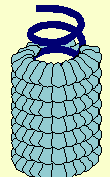
  • TMV is rod shaped

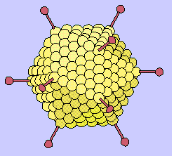
  • Adenovirus & polio viruses are icosohedral (20 sided)

Virus Structure

  • Measles & rabies viruses are helical
  • T -phages have a head & tail

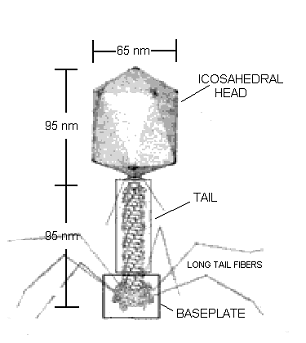
Bacteriophage Structure

Bacteriophages or T-Phages

  • Among the most complex viruses
  • Attack bacterial cells
  • Composed of a icosohedral head, tail, base plate, & tail fibers
  • Long DNA molecule is inside the head 
  • Tail helps inject the viral DNA into host cell
  • Tail fibers used to attach to host

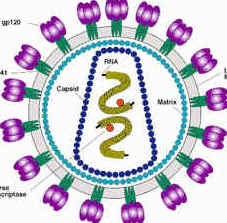
Retroviruses

  • Contain RNA
  • Have an enzyme called reverse transcriptase which helps use the RNA to make DNA
  • Use the host cell’s ribosomes & raw materials to make viral proteins
  • Cause some cancers & AIDS


HIV Virus

Viroids

  • Smallest particle able to replicate
  • Made of a short, single strand of RNA with no capsid
  • Cause disease in plants


Viroid Attack on Potatoes

Prions

  • No nucleic acid or capsids
  • Made of protein particles that have folded incorrectly
  • Attacks the central nervous system
  • Cause animal diseases in cows (Mad Cow disease), sheep, & humans

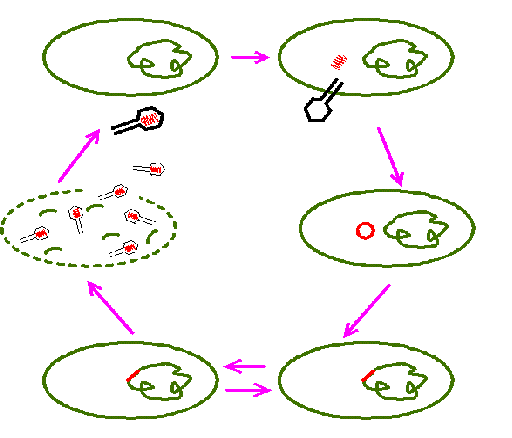
Lytic Cycle

  • Viral replication that rapidly kills the host cell causing it to lyse or burst
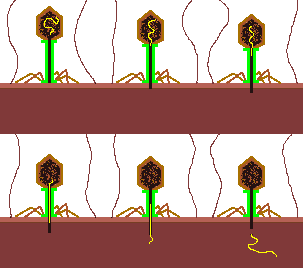
  • Involves 5 steps —– Adsorption, Injection, Replication, Assembly, & Lysis
  • Adsorption — phage attaches to cell membrane of host
  • Injection — nucleic acid (DNA) of virus injected into host cell
  • Replication — viral DNA inactivates host cell’s DNA & uses host’s raw materials & ribosomes to make viral DNA, capsids, tails, etc.
  • Assembly — new viral parts are combined to make new phages
  • Lysis — enzymes weaken & destroy the cell membrane causing it to lyse releasing new viruses that infect other cells


Phases of the Lytic Cycle of a Virulent Virus:

  • Absorption:
    1. Virus attaches itself to the cell.
  • Entry:
    1. Enzymes weaken the cell wall and nucleic acid is injected into the cell, leaving the empty caspid outside the cell. Many viruses actually enter the host cell intact.
  • Replication:
    1. Viral DNA takes control of cell activity.
  • Assembly:
    1. All metabolic activity of the cell is directed to assemble new viruses.
  • Release:
    1. Enzymes disintegrate the cell in a process called

lysis

    , releasing the new


Source: http://science.howstuffworks.com/virus-human.htm

Lysogenic Cycle

  • Replication in which the virus stays inactive inside of the host cell & doesn’t immediately kill it
  • Viruses are called temperate phages
  • Lysogenic steps include adsorption, injection, recombination, cell reproduction, activation, replication, assembly, & lysis
  • Recombination —Viral DNA joins with host cell DNA forming an inactive prophage
  • Host cell reproduces  normally until activated by an external stimuli 
  • External stimuli unknown, but could be ultraviolet radiation, carcinogens, etc.
  • Once activated, prophage forms new viruses & destroys host cell
  • HIV is an example of a temperate phage


The Lysogenic Cycle of a Temperate Virus:

  • The virus attaches itself and injects its DNA into the cell.
  • The viral DNA attaches itself to the host DNA, becoming a new set of cell genes called a prophage.
  • When the host cell divides, this new gene is replicated and passed to new cells. This causes no harm to the cell, but may alter its traits.
  • Now there are two possibilities:
    • The prophage survives as a permanent part of the DNA of the host organism.
    • Some external stimuli can cause the prophage to become active, using the cell to produce new viruses.


Source: http://science.howstuffworks.com/virus-human.htm

Viral Control

  • Interferon are proteins made by cells to fight viruses
  • Two types of viral vaccines exist — inactivated & attenuated
  • Inactivated virus vaccines don’t replicate in the host’s system
  • Attenuated viral vaccines have been genetically altered so they can’t cause disease
  • Antiviral drugs (AZT, acyclovir, & azidothymidine) interfere with viral DNA synthesis
  • Protease Inhibitors interfere with viral capsid production
  • New viruses emerge as rain forests are cleared (Ebola virus)
Back

Virus Model Instructions

Virus Models

Use viral pictures from your textbook or from a website to construct a 3-dimensional model of a virus. Your model must meet the following criteria:

  • Must be 3-dimensional
  • Must show the two main parts of the virus — nucleic acid core & protein coat or capsid
  • Model must have string attached & be ready to hang
  • Must include a label with your the name of the virus, your name, & class period

The following rules for constructing you model must also be followed:

  • Must be light enough & small enough to hang and not “bump” other students heads
  • Must be sturdy (use plenty of glue & securely attach your string)
  • Can’t be made out of food products
  • May not have sharp points (no toothpicks)
  • May not be made of anything flammable (no matches)
  • Should be made of inexpensive materials

Types of viruses that make good models:


Bacteriophage


Retrovirus


HIV Organisation of the HIV-1 Virion


Rabies


Tobacco Mosaic Virus


Adenovirus


Models will be graded based on the following:

  • Level of difficulty (will receive the most weight in grading)
  • Accuracy
  • Colorfulness
  • Creativity of building materials
Back


Vertebrate Traits


Vertebrate Class Adaptations

Traits  Osteichthyes (fish)
Amphibia


Reptilia

Aves (birds)


Mammalia


Circulation
(How many heart chambers do they have & draw them)


Respiration
(What organs work as gas exchange organs?)


Excretion
(What are the excretory structures & what nitrogenous waste is excreted: ammonia, urea, or uric acid?)


Fertilization
(Where and how does fertilization take place: Internal or External? Courtship behavior?)


 Reproduction (What kind of eggs do they lay? Are they egg or live birth?)  


Integument (covering)


Care of Young
(Give numbers of young had and then amount of care given.)


Limbs and Stance

(Draw from the front view how the fins or limbs come out of the animals and what angle they are to the ground.


Virus PPT Questions

Viruses, Viroids, & Prions
ppt Questions

Living or Nonliving?

1. Why might some people consider viruses alive?


2. Can viruses be “killed”?

3. Can a virus maintain homeostasis like cells?

4. Are viruses cellular or noncellular?


5. Define virus.


6. Name the 2 main things that make up a virus.

Viral History

7. Who coined the term virus and what does it mean?

8. Explain how viruses were first discovered.


9. What discovery did Wendell Stanley make about viruses? What type of virus was he studying?


10. __________ is an example of a viral disease.

11. Who found the vaccine against this viral disease? What milder virus was used to make the vaccine?

12. What is meant by a virulent virus?

13. Smallpox has been ________________ in the world today. What does this mean?


14. How does the size of a virus compare with that of a cell?

15. What metric units are used to measure the size of viruses?

16. What technology had to be developed before viruses can be seen?

17. Give the size of these viruses.

     a. bacteriophage

     b. polio virus

     c. adenovirus

     d. Ebola virus

Viral Structure 

18. Are viruses made of cells? Are they living?

19. What covers the outside of a virus and what is it called?

20. What is in the core of a virus?

21. When & how can a virus reproduce?

22. What protective covering is around the capsid of some viruses?

23. What is the purpose of spikes and do all viruses have them?


24. Viruses only attack ___________ host cells.

25. Sketch and label the parts of a virus.


26. Describe the capsid of viruses.


27. What are capsomeres?

28. Are all viruses the same shape?

29. Outside of a host cell, viruses are ______________.

30. Do viruses have ribosomes like cells?

31. Do viruses have enzymes like cells?


32. Viruses use the _________ __________ and ____________ of its host cell to be able to ________________.

33. Does the HIV virus have spikes for attachment?

34. Besides smallpox and AIDS, name 6 other viral diseases.


35. Name a type of cancer thought to be caused by viruses.

36. What is the shape of each of these viruses:

     a. ebola?

     b. influenza?

37. Label the parts of these viruses.


Taxonomy of Viruses 

38. Family names for viruses end in what suffix?

39. Genus names for viruses end in ___________.

40.What is meant by a viral species?


41. ____________ names are used for different species of viruses.

42. How is the subspecies for a virus designated?

43. Give the family, genus, and species for the HIV and Herpes viruses.


44. What virus causes blisters that may appear around the mouth?

45. What virus is responsible for the common cold?

46. What virus causes warts?

47. Name 4 things used to identify viruses.

     a.

     b.

     c.

     d.

Bacteriophages

48. What is a bacteriophage?

49. Give 3 characteristics of T-phages.

     a.

     b.

     c.

50. What are the most commonly studied T-phages?

51. T-phages often attack what bacterial cell? Where is the host cell found?


52. How does a bacteriophage attach to its host cell?


53. What is the only part of the virus that actually enters the host cell?

54. What is the shape of the bacterial host cell that bacteriophages attack?

55. How many sides does the head or capsid of a bacteriophage have? 

56. T-bacteriophages have what nucleic acid at their core?

57. What are the head and tail fibers made of?

Retroviruses

58. What nucleic acid do retroviruses contain?

59. What enzyme do retroviruses contain that let them make DNA from RNA?

60. What 2 things do retroviruses inject into their host cells when they attack them?

61. Give an example of a retrovirus.

Viroids and Prions

62. What is a viroid? 

64. What is the host for viroids?

65. Viroids are responsible for causing what major problem in Europe?

66. Viroids resemble ____________ pieces of DNA that are cut out because they do not code for any proteins.

67. Prions are infectious pieces of _____________.

68. Describe how prions occur.


69. Do prions have a nucleic acid core?

70. What protein is responsible for most mammalian prion diseases?

71. What happens when prions get into the brain?


72. What does BSE stand for and what is the common name for this prion disease?


73. Explain the prion disease caused kuru.


Viral Replication

74. Viruses are host specific. What does this mean?


75. Do the viruses that attack most animals also attack most humans?

76. What is the envelope of viruses often made from? What is the function of an envelope?


77. List the 5 steps of the Lytic cycle in viruses.

     (1)

     (2)

     (3)

     (4)

     (5)

78. What structures help a virus attach to a host cell?

79. What does the virus inject into its host?

80. What viral parts are made inside a cell? where do the raw materials come from?


81. What is meant by cell lyses?

82. Place these steps of the lytic cycle in order: maturation, penetration, release, biosynthesis, and attachment.


83. Label the stages of the lytic cycle. Also label the capsid, host cell, and DNA.
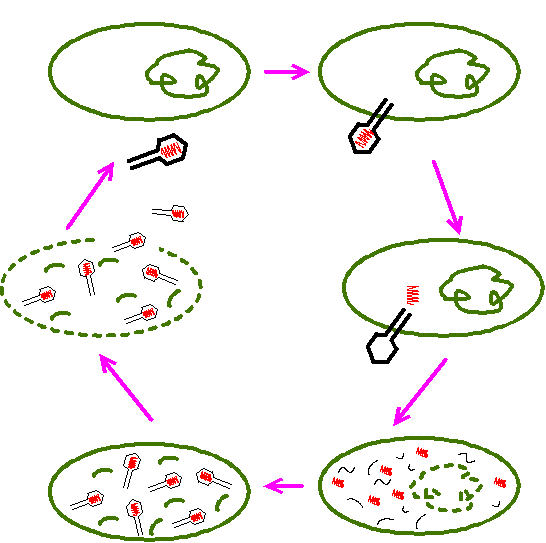
 

84. What are latent viruses?

85. How long can a latent virus remain inactive?

86. what activates latent viruses?

87. Give 2 examples of latent viruses.

88. During the lysogenic cycle of a virus, what happens to the viral nucleic acid after it is injected into the host cell?


89. What is a prophage?


90. What causes the phage or viral DNA to start replicating?


91. Does the prophage start replicating right after it is injected into the host cell? Explain.


92. Viral DNA along with the host cell DNA is replicated during each ___________ ___________.

93. After a long period of time, __________ cells form that contain ________________.

94. Once a prophage cell is activated, what happens?


95. Once a prophage is active, the host cell is ______________ making the virus deadly or _______________.

96. Label the viral DNA, host DNA, prophage, bacteriophage, host cell, lytic cycle, and lysogenic cycle.
 

97. Give an example of a virus that remains dormant in the nervous system tissues for many years.

98. This virus may reappear later in life as a disease called ___________. Describe the disease.


99. ___________ infections also remain dormant in the nervous system.

100. How long does a herpes infection last?

101. Genital herpes is called Herpes ______________, while cold sores or fever blisters are known as Herpes ______________.

102. Viruses make us sick because they ___________ healthy host cells.

Treatment for Viral Disease

103. What is an attenuated virus?


104. How are viruses attenuated?

105. How are some viral vaccines made?


106. How does an attenuated virus help protect us from disease?


107. What proteins do our cells make to help protect us from viruses?

108. What is AZT?

109. How do protease inhibitors work to stop viruses?