Vertebrate Worksheet


Vertebrate Worksheet


1. In what phylum & kingdom are the vertebrates found?

2. List the classes of vertebrates.


3. Discuss the characteristics of chordates & vertebrates.


4. What were the 1st vertebrates & describe them?


5. Sketch a lamprey & describe the characteristics of this fish. Where are they found?


6.  Describe a hagfish.


7. In what group are lampreys & hagfish found & why?


8. Do agnathans have paired fins?


9. What were the 1st jawed fish & describe them.


10. What are the 2 classes of jawed fish?

11. What is in the class Chondrichthyes & what traits do they have in common.


12. Sketch & describe sharks.


13. Sketch a ray or skate & describe them.


14. Name the class for bony fish.


15. Name the 2 groups of bony fish.


16. Give several examples of ray-finned fish & describe them.


17. Name 2 lobe-finned fish & describe both of them.


18. What was the 1st group of vertebrates to move onto land? What is in this group?


19. Describe characteristics of amphibians.


20. Amphibians are ectotherms. What does this mean?


21. How are amphibians still linked to water?


22. What is in the class Reptilia?


23. Reptiles do not need water for reproduction. Explain why this is true.


24. Describe the amniote egg of reptiles. Include a labeled sketch of the egg.


25. What reptile group is thought to be the ancestors of mammals?


26. What were pterosaurs?


27. What 3 groups of retiles are still alive today?


28. Describe characteristics of the reptiles.


29. How can snakes swallow such large prey?


30. What is the purpose of the Jacobson’s organ in snakes?


31. What takes the place of teeth in turtles?


32. Describe crocodiles & alligators & tell some of their habits.


33. What class contains birds?

34. From what did birds probably evolve?

35. What are the distinguishing features of birds?


36. Sketch & label the parts of a feature.


37. Birds are endotherms. What does this mean?


38. Name some flightless birds.


39. Name some swimming birds.


40. What are the 3 main characteristics of all mammals?


41. What in female mammals produces milk?

42. What is mammalian hair made of & give its 4 functions.


43. What bones are modified in mammals to help them hear sounds?

44. Name a flying mammal.

45. Give examples of mammals that are herbivores.

46. Give examples of mammals that are carnivores.

47. What mammal is a thinker & toolmaker?

48.Name 7 adaptations of mammals.


49.Give examples of monotremes & tell their characteristics. Tell where they are found.


50. Give examples of marsupials & tell their characteristics. Tell where most of them are found.


51. Most mammals are placentals. What does this mean?


52. What is gestation? Do all mammals have the same gestation period?


53. What is the purpose of the chorion?


54.Name the 12 orders of placental mammals & give an example of an animal in each order.


Unsegmented Worm

Unsegmented Worms

All Materials © Cmassengale

Phylum Platyhelminthes
Characteristics

  • Called flatworms because bodies are flattened dorso-ventrally

  • Acoelomate – solid bodies without a lined body cavity
  • Have 3 body layers — outer ectoderm, middle mesoderm, & inner endoderm
  • Bilaterally symmetrical
  • Show cephalization (concentration of sensory organs at anterior or head end)
  • Body cells exchange oxygen & carbon dioxide directly with environment by diffusion
  • Single opening into gastrovascular cavity; two-way digestive tract
  • Some are parasites & others are free-living
  • Parasitic worms have thick cell layer called tegument covered with a nonliving cuticle covering their bodies as protection inside hosts
  • Includes 3 classes — Turbellaria (planarians), Trematoda (parasitic flukes), & Cestoda (parasitic tapeworms

Class Turbellaria

  • Most are marine but includes freshwater planarian (Dugesia)

Planarians

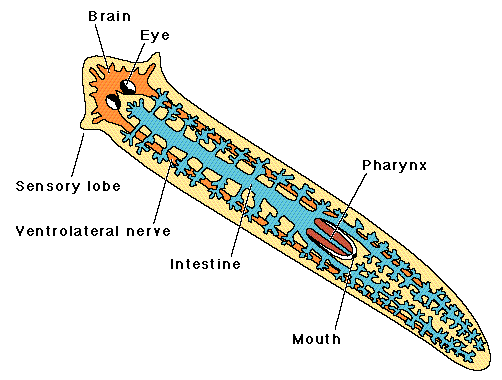
  • Spade-shaped at the anterior end & have two, light-sensitive eyespots
  • Can sense light, touch, taste, & small
  • Have 2 clusters of nerve cells or ganglia to form a simple brain
  • Nervous system composed of a nerve net
  • Capable of simple learning
  • Move by tiny hairs or cilia over a mucus layer that they secrete
  • Feed by scavenging or protozoans
  • Have a single opening or mouth located at the end of a muscular tube called the pharynx which can be extended when feeding
  • Flame cells help remove wastes to excretory pores

  • Hermaphrodites that cross-fertilize eggs that are then deposited into a capsule until hatching in 2-3 weeks
  • Reproduce asexually by fragmentation

Class Trematoda

  • Includes parasitic flukes
  • About 1 cm long & oval shaped

  • Require a host to live
  • Have both oral & ventral suckers to cling to host & suck blood, cells, & body fluids
  • Oral sucker around mouth at anterior end sucks blood
  • May be endoparasites (live inside a host) or ectoparasites (live on the outside of host
  • Covered in tough, unciliated tegument
  • Nervous & excretory systems like turbellarians
  • Hermaphrodites
  • Have a long, coiled uterus that stores & releases 10,000+ eggs
  • Eggs released through genital pore & develop into larva
  • Show complex life cycles
  • Life cycle of sheep liver fluke:
    * Adult liver flukes live in sheep liver & gall bladder where they mate & form eggs
    * Eggs enter intestines, pass out with feces, & hatch in water
    * Larva enter snails, asexually multiply, then leave snail & form cysts
    * Cysts (dormant larva with hard, protective covering) clings to grass
    * Sheep ingest cysts when they eat grass
    * Cysts hatch in digestive tract & bore through intestines into bloodstream
    * Mature & reproduce in the liver

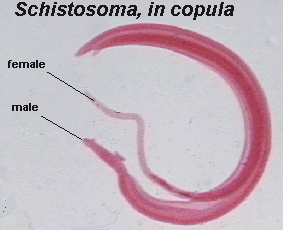
  • Schistosomiasis (disease caused by parasitic blood flukes) infects people in Asia, Africa, & South America causing intestinal bleeding & tissue decay that can result in death

Class Cestoda

  • Includes tapeworms
  • Adapted for parasitic life
  • Tough outer tegument prevents being digested by host
  • Anterior end called scolex contains hooks & suckers for attachment to intestine of host

  • Long, ribbon-like bodies up to 12 m in length
  • Nervous system extends length of body but lacks sense organs
  • Lacks mouth & digestive tract but absorbs digested nutrients from host
  • Grows by making body segments called proglottids
  • Each proglottid produces eggs & sperm that cross-fertilize with other segments & also self-fertilize (hermaphrodites)
  • Oldest, mature proglottids containing eggs at posterior end break off & pass out with feces
  • Life cycle of beef tapeworm:
    * Cattle eat grass with proglottids containing fertilized eggs
    * Eggs hatch into larva & bore through cow’s intestine into bloodstream
    * Larva burrow into cow’s muscle & form cysts
    * Humans eat beef (muscle) & cysts travels to intestines
    * Cyst breaks open & adult beef tapeworm forms


BEEF TAPEWORM LIFE CYCLE

Phylum Nematoda
Characteristics

  • Called roundworms
  • Includes Ascaris, hookworms, Trichinella, & pinworms
  • Pseudocoelomates have fluid-filled body cavity partially lined with mesoderm
  • Pseudocoelom contains the body organs & provides hydrostatic skeletal support for muscles
  • Have long slender bodies that taper at both ends

  • Covered with flexible cuticle
  • Digestive tract with anterior mouth & posterior anus; called one-way digestive tract
  • Separate sexes in most species
  • Most are free living
  • Some are parasites on plants & animals
  • Ascaris is a parasitic roundworm living in the intestines of pigs, horses, & humans
  • Ascaris life cycle:
    * Enter body in contaminated food or water & hatch in intestines
    * Larva bore into bloodstream & carried to lungs & throat
    * Larva coughed up, swallowed, & return to intestines to mature & mate
    * Block the intestine causing death

  • Hookworm eggs hatch in moist soil & larva bore through bare feet of new host 
  • Trichinella are human parasites caused by eating undercooked pork containing the cysts
    * Cause disease called trichinosis
    * Cysts cause muscle pain & stiffness


 CYSTS IN CONTAMINATED PORK

Phylum Rotifera
Characteristics
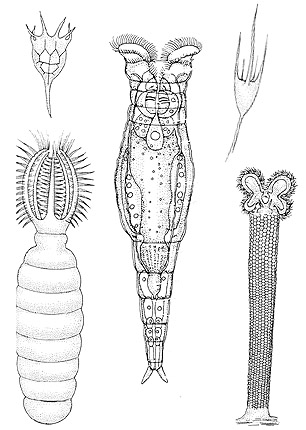
  • Known as rotifers or wheel animals
  • Transparent, free-swimming microscopic animal
  • Freshwater & marine
  • Have a ring of cilia around mouth that rotates like a wheel to bring in food
  • Feed on unicellular algae, bacteria, & protozoa
  • Have a muscular organ called the mastax behind the pharynx to chop food
  • Nervous system composed of anterior ganglia & 2 long nerve cords
  • Show cephalization (head end)
  • Have 2 anterior, light-sensitive eyespots

Back


Taxonomy

Taxonomy
All Materials © Cmassengale


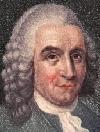
Carolus Linnaeus

Taxonomy – study of classifying organisms

  • Taxonomists are scientists who study classifying
  • Taxon ( taxa-plural) is a category into which related organisms are placed

Reasons to Classify:

  • Shows evolutionary relationships
  • Accurately & uniformly names organisms
  • Prevents misnomers such as starfish & jellyfish that aren’t really fish
  • Uses same language (Latin) for all names
  • Prevents duplicated names because all names must be approved by International Naming Congresses (International Zoological Congress)
  • Naming rules are followed called the International Code for Binomial Nomenclature

Early Taxonomy:

  • Aristotle was the first taxonomist dividing organisms into land, sea, & air dwellers
  • John Ray was the first to use Latin for naming
  • Linnaeus developed the modern system of naming known as binomial nomenclature, a two-word name (Genus & species)
  • Scientific names should be italicized in print or underlined when writing
  • Always capitalize the genus name, but write the species in lower case
  • The scientific name for man is Homo sapiens
  • The genus name may be abbreviated, but not the species (H. sapiens)

Taxonomic categories:

  • Linnaeus placed organisms into related groups called taxa (taxon-singular) based on their morphology (similar structure & function)
  • The broadest taxon is called the kingdom
  • Linnaeus put all organisms into one of two kingdoms — Plantae or Animalia
  • The other six taxa from broadest to most specific are — Phylum, Class, Order, Family, Genus, & species
  • A sentence to help remember these taxa is — “King Phillip Came Over For Gooseberry Soup.”
  • Each taxa is a proper noun &should be capitalized except species
  • Each level or taxon groups together organisms that share more characteristics than the level above

  • Botanists use the term division instead of phylum for classifying plants
  • Plant species are subdivided into varieties, while bacteria are subdivided into strains

Basis for Modern taxonomy:

  • Modern taxonomists classify organisms based on their evolutionary relationships
  • Homologous structures have the same structure, but different functions & show common ancestry
  • The bones in a bat’s wing, human’s arm, penguin’s flipper are the same (homologous), but the function is different

  • Analogous structures have the same function, but different structures & do not show a close relationship (insect wing & bird’s wing)
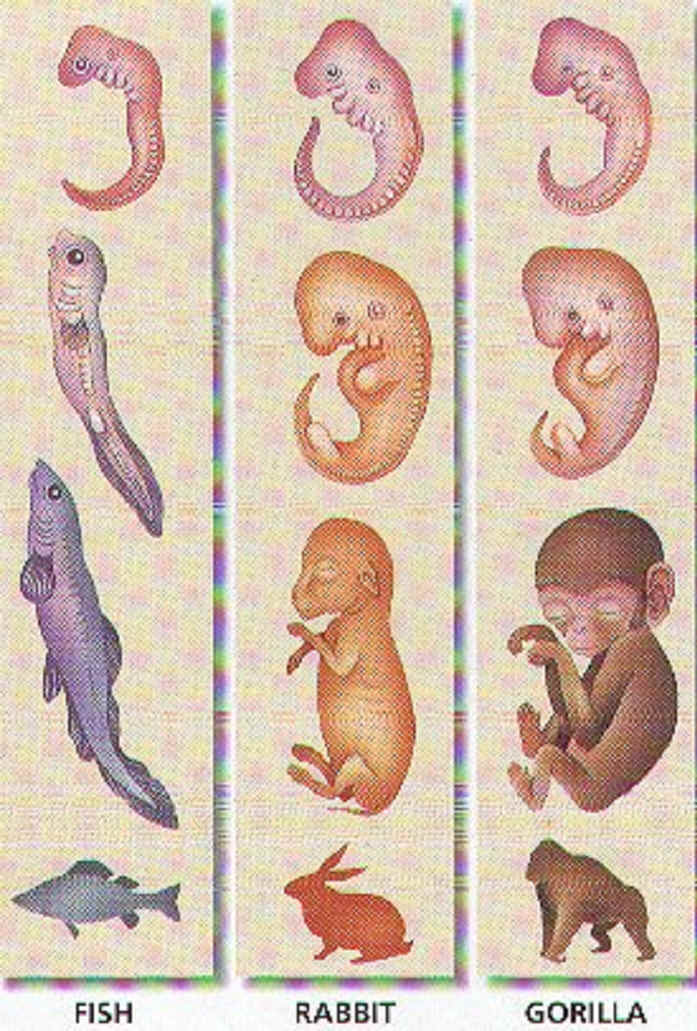
  • Similarity in embryo development shows a close relationship (vertebrate embryos all have tail & gill slits)

  • Similarity in DNA & amino acid sequences of proteins show related organisms

Modern Taxonomic System:

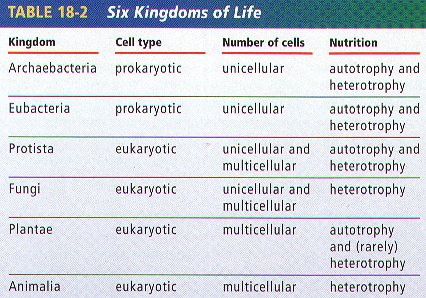
  • Modern taxonomy uses six kingdoms — Archaebacteria, Eubacteria, Protista, Fungi, Plantae, & Animalia
  • Archaebacteria & Eubacteria are unicellular prokaryotes lacking a nucleus, while Protista, Fungi, Plantae, & Animalia are all eukaryotes with a nucleus & membrane-bound organelles
  • All members of Plantae & Animalia are multicellular organisms
  • Fungi & Animalia are heterotrophs, while Plantae are all autotrophs capable of making their own food
  • Archaebacteria live in harsh environments like very salty lakes; intestines of mammals; and hot, sulfur springs & may be autotrophs or heterotrophs
  • Eubacteria are true bacteria some of which cause disease
  • Protista are mainly unicellular with a few multicellular organisms and may be autotrophic (Euglena) or heterotrophic (Ameba)
  • Fungi include multicellular mushrooms, mold, unicellular yeast, etc. & are absorptive heterotrophs (digest food & then absorb it)
  • Animalia are ingestive heterotrophs that take in food & then digest it inside their multicellular bodies.
  • Plantae includes all plants & are the only all multicellular, autotrophic kingdom

Phylogeny (evolutionary history):

  • Phylogenetic trees are branching diagrams showing how organisms are related
  • Also called family trees
  • Fossil records help establish relationships on a phylogenetic tree
  • Organizes living things based on their evolution (systematics)
  • Common ancestor is shown at the base of the tree
  • Most modern organisms shown at tips of branches
  • Each time a branch divides into a smaller branch, a new species evolves

  • Cladograms shows how organisms are related based on shared, derived characteristics such as feathers, hair, scales, etc.

Three Domain System:

  • Based on comparing sequences of ribosomal RNA in different organisms to determine ancestry
  • All organisms placed into three broad groups called domains
  • Domain Archaea (kingdom Archaebacteria) contains chemosynthetic bacteria living in harsh environments
  • Domain Bacteria (kingdom Eubacteria) contains all other bacteria including those causing disease
  • Domain Eukarya (kingdoms Protista, Fungi, Plantae, & Animalia) contains all eukaryotic organisms

BACK


Taxonomy PPT Questions

Taxonomy
ppt Questions

Classification

1. How many known species are there?

2. What percent of all organisms that have ever lived is this?

3. Are all organisms on Earth today identified?

4. Define classification.


5. What is another term for classification?

6. What do you call scientists that study classification?

7. Classifying organisms makes naming organisms more _____________ and _____________.

8. Classifying prevents ____________ or inaccurate naming.

9. Give two examples of misnomers and explain why they aren’t correct.


10. What language is used for scientific naming?

11. Sometimes, scientific names may be ___________ instead of Latin.

12. Why don’t scientists around the world just use more simple, common names for organisms?


13.What language is universally used by scientists for naming?

14. Who was the first taxonomist and what two groups did he place organism in?


15. How did Aristotle subdivide his two groups?


16. Who was first to use Latin for scientific naming?

17. What was the problem with Ray’s names?

18. What 18th century taxonomist developed the naming system still used today?

19. How did Linnaeus group his organisms?

20. Who is the “father of taxonomy”?

Binomial Nomenclature

21. What is Linnaeus’s naming system called?

22. Explain binomial nomenclature.


23. Besides Latin, what other language is sometimes used for scientific names?

24. How do scientific names appear in print?

25. What must be done to a scientific name when you are writing it?

26. Give an example of a common and scientific name for an animal.


27. Where can you find the rules for naming organisms?

28. All scientific names must be approved by ________________ ___________ ______________.

29. Why do naming congresses have to approve names?


Taxonomic Groups

30. What is a taxon?


31. What is plural for taxon?

32.There is a ______________ of groups that goes from the broadest grouping to the most _____________ grouping.

33. Name the 8 taxon in order from broadest to most specific.


34. What is the NEWEST and BROADEST taxon?

35. Instead of the taxon phylum, what other taxon is used for plants at this level?

36. What is the most specific taxon?

37. Write the sentence used to help remember the 8 most important taxonomic levels.


38. Complete the following taxonomic table:


Classification for Humans
Taxonomic Level Taxon
Domain
Kingdom
Phylum
Class
Order
Family
Genus
Species


Domains of Organisms

39. How many domains are there?

40. Name the 3 Domains.


41. What are the main characteristics of Archaea and Eubacteria?


42. What are the main characteristics of the Domain Eukarya?


43. What Domain of organisms probably evolved first?

44. Where do Archaea live? Give some examples.


45.Name an Archaean.

46. Where are eubacteria found?


47. Some bacteria cause ______________ but many act as decomposers & are important to the ______________.

48. Some members of eubacteria live in the __________ of animals.

Kingdoms

49. The Domain Eukarya is divided into how many kingdoms?

50. List the 4 kingdoms of Eukarya and tell what organisms are in each group.


51. Which 2 kingdoms contain all multicellular members?

52. List the main characteristics of the Kingdom Protista.


53. Microscopic organisms found in pond water are most likely in the kingdom _______________.

54. All members of the Kingdom Fungi are _____________ except for unicellular ____________.

55. What type of heterotrophic organism are fungi?

56. Explain what it means to be an absorptive heterotrophic.


57. The cell walls of fungi are made of ______________.

58. Members of the kingdom Plantae are all ________________ and _____________.

59. What do plants use as their energy to make food?

60. Name the food making process of plants.

61. Plant cell walls are made of _______________.

62. Members of the Kingdom Animalia contain all of the multicellular _____________ on Earth.

63. Animals are ______________ heterotrophs that feed on __________ or other __________.

64. Define ingestive heterotroph.


65. Complete the following table for characteristics of each kingdom:

Kingdom Organization Type of Nutrition Examples
Protista
Fungi
Plantae
Animalia

66. A Genera may contain a number of different ___________.

67. What Genera is an exception to this?

68. Which Kingdom has the largest number of different kinds of organisms?

69. What two groups are in the plant kingdom?


Basis for Modern Taxonomy

70. List three examples of things used as a basis for modern taxonomy.

     a.

     b.

     c.

71. What are homologous structures?


72. What is an embryo?

73. At the molecular level, similarities in ___________, __________, or the __________ __________ sequence of proteins can be a basis for grouping organisms together.

74. Give an example of homologous structures show similarities among organisms in the same taxon.


75. Name 5 organisms that have similar embryonic development. To what taxon do these organisms belong?


76. What is a cladogram?


77. Using the following cladogram, name the organisms that share 4 of the 5 characteristics.

78. What characteristic(s) do the grouper and lamprey share?


79. What characteristic is found in all the animals EXCEPT the lancelet?

80. What is a dichotomous key?


81. When using a dichotomous key, you should make sure you ___________ both characteristics and either ____________ the organism OR go to ____________ set of characteristics.


82. Use the following dichotomous key to identify the picture of each organism.


1a Tentacles present – Go to 2
1b Tentacles absent – Go to 6
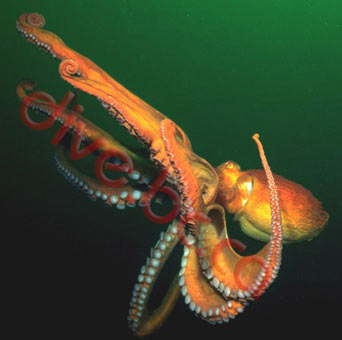
2a Eight Tentacles – Octopus
2b More than 8 tentacles – 3
3a Tentacles hang down – go to 4
3b Tentacles upright–Sea Anemone
4a Balloon-shaped body–Jellyfish
4b Body NOT balloon-shaped – 5


Sponge & Cnidarian Study Guide

Study guide for Sponge, Cnidarians, & Ctenophores

·         Know relatives of the jellyfish
·         How are sponges different from other animals
·         Know characteristics of all invertebrates
·         Know characteristics of sponges
·         What is the function of collar cells in sponges
·         What are spicules
·         Know characteristics of adult sponges
·         Be able to explain skeletal support of sponges
·         How do sponges obtain their food
·         What helps draw water into a sponge
·         What is the function of amebocytes in sponges
·         How does excess water leave a sponge
·         What is the purpose of gemmules in sponges
·         What is a hermaphrodite
·         How can sponges reproduce
·         Know animals that capture prey by using nematocysts
·         What are the 2 distinct life stages of cnidarians
·         Describe nematocysts
·         What organisms have tentacles with stinging cells
·         Know examples of cnidarians
·         Describe the life of a planula larva
·         Know the life stage that is dominant in sea anemones
·         What organisms would be anthozoans
·         Know the dominant life stage of jellyfish
·         Know the main characteristics of ctenophores

BACK