Introduction to Animal

Introduction to Animals

All Materials © Cmassengale

Characteristics

  • All multicellular (metazoans) & eukaryotic
  • Cells lack cell walls & come in a variety of shapes
  • Ingestive heterotrophs (take in food & internally digest it)
  • Store food reserves temporarily as glycogen in the liver
  • Have some type of skeletal support
  • Exoskeletons found in arthropods cover the outside of the body but limit size
  • Endoskeletons found in all vertebrates are found inside the body & are made of cartilage &/or bone
  • Worms have fluid-filled internal cavities giving them skeletal support
  • Sponges have the simplest skeleton 
  • May be sessile (attached & non-moving) or motile (able to move around)
  • Muscular tissue provides energy for movement
  • Reproduce sexually
  • Show levels of organization including cell, tissue, organ, & system
  • Most show division of labor among cells
  • Cells are specialized for particular functions
  • Cell junctions hold individual cells in a tissue together
  • Most vertebrates have a backbone or spine made of repeating bones called vertebrae that protect the spinal cord
  • Some show cephalization (have a head with sensory organs concentrated there)

Invertebrate Groups

  • Simplest animals
  • Contains the greatest number of animal species
  • Most found in water
  • Do not have an backbone
  • Includes sponges, cnidarians, flatworms, roundworms, annelids (segmented worms), mollusks, arthropods, & echinoderms

Vertebrate Groups

  • More complex animals
  • Most have a backbone
  • Includes fish, amphibians, reptiles, birds, & mammals

Body Areas

  • Dorsal is the back or upper surface
  • Ventral is the belly or lower surface
  • Anterior head or front end
  • Posterior is the tail or hind end opposite the head
  • Oral surface in echinoderms is where the mouth is located (underside)
  • Aboral surface in echinoderms is the surface opposite the mouth (top side)

DORSAL

ANTERIOR POSTERIOR


VENTRAL

Body Symmetry

  • Symmetry is the arrangement of body parts around a central plane or axis
  • Asymmetry occurs when the body can’t be divided into similar sections (sponges)
  • Radial symmetry occurs when similar body parts are arranged around a central point like spokes on a wheel (echinoderms)
  • Most animals with radial symmetry are sessile (attached) or sedentary (move very little)
  • Bilateral symmetry occurs when animals can be divided into equal halves along a single plane (right & left sides that are mirror images)
  • Animals with bilateral symmetry are more complex, usually motile organisms, such as worms, arthropods, and all vertebrates
  • Animals with bilateral symmetry show cephalization & have anterior & posterior ends


RADIAL SYMMETRY BILATERAL SYMMETRY


Segmentation

  • Occurs whenever animal bodies are divided into repeating units or segments
  • Found in more complex animals
  • Earthworms show external segmentation, while humans show internal segmentation (vertebrae of the backbone)
  • Segments may be fused together such as cephalothorax covering chest & head of a crayfish

Tissue Development

  • All animals reproduce sexually, but some also reproduce asexually (sponges bud & flatworms fragment)
  • Zygote is the fertilized egg all animals form from
  • Zygote undergoes rapid cell divisions known as cleavage to become hollow ball of cells called blastula
  • Blastocoel is the central cavity of the blastula
  • Blastula invaginates (folds inward at one point) to form an opening & two cell or germ layers; process called gastrulation
  • New cup-shaped structure with 2 cell layers is called the gastrula
  • Archenteron is the deep cavity of the gastrula that forms the primitive gut
  • Inner germ layer called endoderm & outer germ layer called ectoderm
  • Opening may become the mouth or the anus
  • Protostomes (mollusks, arthropods, & annelids) develop mouth from blastopore, while deuterostomes (echinoderms & vertebrates) develop an anus from blastopore
  • Some animals form a third germ layer in the middle called mesoderm
  • Cells differentiation during development changing their shapes to fit their function ( neurons or nerve cells become long to conduct messages)

Cleavage

  • Protostomes have spiral cleavage in which embryonic cells divide in a spiral arrangement
  • Deuterostomes have radial cleavage or embryonic cell division parallel or perpendicular to the vertical axis of the embryo

  • Protostomes have determinate cleavage ( embryonic cells can’t form a new organism if separated)
  • Deuterostomes have indeterminate cleavage ( embryonic cells can form other organisms if separated such as identical twins)

Germ Layers

  • Form the tissues, organs, & systems of an animal
  • Found in the embryo of all animals except sponges (have specialized cells but no tissues)
  • Ectoderm (outer) forms skin, nerves, & sense organs
  • Endoderm (inner) forms the digestive & respiratory organs & systems
  • Mesoderm (middle) forms muscles, circulatory system, reproductive & excretory systems

germ layers

Larval Forms

  • Some animals have indirect development & go through an immature larval form that does not resemble the adult
  • Planula is the larva of cnidarians (jellyfish, corals, & sea anemones)
  • Trochophore is the larva of mollusks (squid & octopus)
  • Dipleurula is the larva of echinoderms (starfish & sea urchins)

Metamorphosis

  • May be complete or incomplete
  • Usually found in arthropods
  • Incomplete metamorphosis (egg –> nymph –> adult)
  • Complete metamorphosis ( egg –> larva –> pupa –> adult)


INCOMPLETE

COMPLETE


Body Cavities

  • Coelom is an internal body cavity lined with mesoderm

  • Animals with a coelom are called coelomate animals (annelids, mollusks, arthropods, & vertebrates)
  • Acoelomate animals do not have a body cavity but have solid bodies (sponges, flatworms, & cnidarians )
  • Pseudocoelomate animals have a body cavity only partially lined with mesoderm (roundworms)

  • Schizocoely occurs in protostomes where the coelom develops when mesoderm masses split
  • Enterocoely occurs in deuterostomes

Body Layers

  • Sponges have specialized cells but no tissues or organs
  • Cnidarians (jellyfish, coral, sea anemone) have 2 body layers (ectoderm & endoderm) with a jellylike layer called mesoglea between for support
  • Cnidarians have one body opening into a large cavity called gastrovascular cavity
  • All worms, mollusks, arthropods, echinoderms, & vertebrates have 3 cell layers (ectoderm, mesoderm, & endoderm)

Mouth & Anus Development

  • Blastopore is the opening in the gastrula formed when blastula folds inward
  • Protostomes are animals that the blastopore develops into the mouth ( earthworms, mollusks, arthropods)
  • Deuterostomes are animals that the blastopore develops into the anus (echinoderms & vertebrates)

Support Systems

  • Sponges are supported by spicules, while limestone cases support corals

  • Hydrostatic skeletons in worms consist of a fluid-filled body cavity surrounded by muscles
  • Arthropods have external exoskeletons that prevent water loss but must be molted for growth to occur
  • Echinoderms & vertebrates have internal endoskeletons that grow with the organism

Digestive Systems

  • All animals are heterotrophs
  • Sponges have specialized cells to capture & digest their food
  • Cnidarians have one opening into their gastrovascular cavity where food enters & wastes leave; called a two-way digestive system
  • Annelids, arthropods, & vertebrates have a one-way digestive system in which food enters the mouth, is digested,  & wastes leave through the anus

Circulatory System

  • Transports oxygen and nutrients to cells & carbon dioxide and wastes away from cells
  • Sponges, cnidarians, & flatworms don’t have a circulatory system
  • In closed systems, blood remains in blood vessels at all times until it reaches cells (earthworms & vertebrates)
  • In open systems, blood isn’t always contained in blood vessels (arthropods)

Respiratory System

  • Oxygen is needed & carbon dioxide must be eliminated
  • Sponges, cnidarians, flatworms, & roundworms exchange gases by diffusion
  • Mollusks & fish use gills to exchanges gases, while terrestrial vertebrates use lungs

Nervous System

  • Cephalization occurs in animals that have a distinct head at the anterior end where sensory organs are concentrated
  • Cephalization is found in more complex animals 
  • Sponges have specialized nerve cells, while cnidarians & flatworms have a nerve net
  • Ganglia are clusters of nerve cells found in more complex animals
  • Nerve cells may specialize to detect, light, sound, etc.
  •  Brain interprets nerve impulses & sends a response

Body Coverings

  • Integument is the outer covering of an animal
  • Terrestrial vertebrates have water-tight outer coverings
  • Integuments of amphibians allow gas exchange through the skin
  • Adaptations of integuments include scales, fur, hair, & feathers to protect and insulate the body

Excretory System

  • Rid animals of wastes, help conserve water, & filter wastes from the blood
  • Ammonia is a toxic waste that must be gotten rid of by an animal’s body
  • Kidneys filter blood in vertebrates

Reproductive System

  • All animals reproduce sexually, but some also use asexual reproduction
  • Budding is asexual reproduction in which an outgrowth on the parent organism breaks off to form a new individual (hydra)

hydra with bud 3.JPG (83198 bytes)

  • Sponges, flatworms, & cnidarians asexually reproduce by fragmentation (separating into pieces & each piece making a new organism)
  • Some insects develop from unfertilized eggs by parthenogenesis
  • Hermaphrodites are animals that produce both sperm & eggs (earthworms – cross fertilize & tapeworms self fertilize)
  • Echinoderms, arthropods, mollusks, & vertebrates have separate sexes & exchange sperm
  • Internal fertilization occurs inside the body of the female & larger numbers of sperm & eggs are produced
  • External fertilization occurs inside the body of the female & fewer eggs & sperm are produced
Back


Insect

Insects   All Materials © Cmassengale  

Phylum Arthropoda        Subphylum Uniramia          Class Insecta

Characteristics

  • Largest arthropod group
  • Found in freshwater & terrestrial habitats, especially tropical areas
  • Legs, mouthparts, & antenna jointed
  • Body segmented into three sections — head, thorax, & abdomen
  • Six legs & up to two pairs of wings located on thorax
  • Have compound & simple eyes
  • One pair of antennae on head
  • Abdomen has 11 segments
  • Exoskeleton, covering & protecting body, is made of chitin & must be molted to grow
  • Elaborate mouthparts include:
         *  Mandibles – jaws
    *
       Maxillae – paired sensory structures that move food to mouth
      Labium – lower lip
      Labrum – upper lip
      Palpi – used for tasting
  • Known as mandibulates
  • Spiracles on abdomen open into tracheal tubes for oxygen & carbon dioxide exchange
  • Tympanic membranes on 1st abdominal segment aid in hearing
  • Thorax divided into 3 sections — prothorax, mesothorax, & metathorax
  • One pair of legs on each thoracic segment
  • Wings located on mesothorax & metathorax
  • Ovipositor located on the end of the abdomen in female insects & used to dig hole & lay eggs

Common Insect Orders

  • Orthoptera – grasshoppers, crickets, & cockroaches 2 pairs of straight wings & chewing mouthparts)
  • Isoptera – termites (feed on wood)
  • Dermaptera – earwigs (pincers on end of abdomen)
  • Anoplura – sucking lice (wingless parasites)
  • Hemiptera – true bugs (have triangular-shaped scutellum & last 1/3 of wings membranous)
  • Homoptera – aphids & cicadas (membranous wings held roof-like over body
  • Ephemeroptera – mayflies (have 2 cerci on tail, membranous wings, & nonfunctional mouthparts in adults)
  • Odonata – dragonflies & damselflies (2 pairs of equal size, membranous wings, strong fliers, feed on other insects)
  • Neuroptera – Dobson flies &  lacewings (2 pairs of membranous wings)
  • Coleoptera – beetles (hard forewings or elytra, membranous hindwings)
  • Lepidoptera – butterflies & moths (powdery scales covered wings
  • Diptera – flies & mosquitoes (one pair of wings, 2nd pair modified into balancing structure called halteres)
  • Siphonaptera – fleas (parasites on birds & mammals, wingless as adults)
  • Hymenoptera – bees, ants, & wasps (stinger on abdomen for protection, may live together in groups, pollinators)

     Click Here for Pictures of Insect Orders


Success of Insects

  • Found everywhere except in deep part of ocean
  • Very short life span & rapidly adapt to new environments
  • Small size helps minimize competition in habitats
  • Flight helps escape predators & move into other environments

Environmental Impact

  • Pollinate almost 2/3’s of all plants
  • Serve as food for fish, birds, & mammals
  • Help recycle materials (termites recycle wood)
  • Make useful byproducts such as silk & honey
  • Some spread disease
  • Agricultural pests

Grasshoppers

External Structure

  • Head with antenna, compound eyes, & chewing mouthparts
  • Walking legs on prothorax & mesothorax; jumping legs on metathorax
  • Tarsus are lower leg segments with spines, hooks, & pads
  • Leathery, protective forewings on mesothorax & membranous hindwings for flight on metathorax
  • Covering over thorax called pronotum

Internal Structure
Digestive & Excretory Systems

  • Cutting & chewing mouthparts (labium, labrum, mandibles, & maxillae)
  • Saliva added to food in mouth
  • Esophagus carries food to crop for temporary storage
  • Gizzard has chitinous plates to grind food
  • Midgut (insect’s stomach) has gastric caeca (pouches) to secrete digestive enzymes to break down food
  • Food is absorbed into the body cavity or coelom in the hindgut (composed of the colon & rectum)
  • Malpighian tubules filter chemical wastes from the blood & deposit them in the rectum where they leave through the anus

Circulatory System

  • Open circulation of blood
  • Aorta is the largest blood vessel carrying blood to the body cells
  • Hearts are muscular regions of the aorta in the posterior end of the abdomen that pump blood toward head
  • Blood flows back toward abdomen carrying digested food & re-enters the aorta through openings called ostia

Respiratory System

  • Air enters through openings called spiracles along the sides of the abdomen & enters into tracheal tubes that branch into smaller tracheoles where gas exchange with body cells occurs 
  • Tracheal tubes carry oxygen to body cells & return carbon dioxide to leave the body though spiracles

Nervous System

  • Simple brain, nerve cords, & ganglia 
  • Three simple eyes or ocelli (detect light) & a pair of compound eyes (can detect movement but not images)
  • Tympanic membrane on 1st abdominal segment
  • Pair of antenna contains sense organs for touch, taste, & smell detects sound
  • Sensory hairs found on parts of the body
  • Palpi for taste

Reproductive System

  • Reproductive organs (ovaries & testes) located  in abdomen
  • Male deposits sperm into female’s seminal receptacle
  • Stored sperm fertilizes eggs as they  are released by female
  • Ovipositor on tip of female’s abdomen is used to lay eggs
  • Separate sexes
  • Lay large number of eggs to ensure survival

Development

  • Most insects go through changes in form & size called metamorphosis
  • Some insects such as silverfish don’t go through metamorphosis
  • Incomplete metamorphosis goes from egg to nymph (immature form that looks like adult but without fully developed wings) to adult (3 stages)
  • Instars are growth periods between molts of nymphs & larva
  • Grasshoppers, termites, & true bugs go through incomplete metamorphosis


HEMIPTERAN (TRUE BUG) NYMPH

  • Complete metamorphosis goes from egg to larva (segmented & wormlike) to pupa  to adult (4 stages)


BUTTERFLY LARVA (CATERPILLAR)

  • Butterflies, beetles, & flies go through complete metamorphosis
  • In pupal stage, larval tissues break down & cells called imaginal disk develops into tissues of the adult
  • Cocoon or chrysalis is a protective case formed around the pupa


BUTTERFLY COCOON

  • Metamorphosis controlled by hormones
    * Brain hormone stimulates the release of molting hormone (ecdysone)
    * When juvenile hormone level high, larva molts
    * When juvenile hormone level low, larva pupates
    * When juvenile hormone absent, adult emerges from pupal case
  • Different stages of metamorphosis eliminates competition between larva & adults for food & space
  • Multi-stage life cycle helps insects withstand harsh weather
  • Different stages have different functions (caterpillar/growth & adult/reproduction)

Defense Mechanisms

  • Bombardier beetle sprays noxious chemical


BOMBARDIER BEETLE

  • Wasps & bees can sting
  • Some insects use camouflage to blend into their environments
  • Some insects taste bad & have warning colorations 


PAPER WASP

  • Mullerian mimicry – poisonous or dangerous species have similar patterns of warning coloration so predators avoid all the species (black & yellow stripes on bees & wasps)
  • Batesian mimicry – species that are nonpoisonous or not bad tasting have colorations that mimic other poisonous or bad tasting species (Viceroy butterfly mimics bad tasting Monarch)

Insect Communication

  • Insects may communicate with each other using sound (cricket chirps), light (firefly), or “dances” (honeybee)
  • Pheromones are chemicals released by some insects to attract mates or mark trails

Insect Behavior

  • Insects may be solitary or social
  • Social insects (bees, ants, & some wasps) live together in groups & share work (division of labor)
  • Social insects have a caste system with different individuals doing different jobs
  • Honeybee caste system:
    * Workers
    – sterile females
    – care for queen & feed her honey and pollen
    – make beeswax for hive
    – fan wings to cool hive
    – eat honey
    – collect nectar, pollen, & royal jelly
    – live about 6 weeks
    – nurse bees care for larva
    – secrete royal jelly to feed new queen
    * Drones
    – males
    – mate with queen
    – feed by workers
    – driven out of hive to conserve food during winter
    * Queen
    – reproductive female
    – mate only once but store sperm for up to 5 years in seminal receptacles
    – feed by workers
    – secretes chemical called queen factor that prevents other females from sexually maturing
    – leaves hive with 1/2 the workers if there is overcrowding


HONEYBEE HIVE

BACK


Pig Heart Dissection


Heart Dissection

Introduction
Mammals have four-chambered hearts and double circulation. The heart of a bird or mammal has two atria and two completely separated ventricles. The double-loop circulation is similar to amphibians and reptiles, but the oxygen-rich blood is completely separated from oxygen-poor blood. The left side of the heart handles only oxygenated blood, and the right side receives and pumps only deoxygenated blood. With no mixing of the two kinds of blood, and with a double circulation that restores pressure after blood has passed through the lung capillaries, delivery of oxygen to all parts of the body for cellular respiration is enhanced. As endotherms, which use heat released from metabolism to warm the body, mammals require more oxygen per gram of body weight than other vertebrates of equal size. Birds and mammals descended from different reptilian ancestors, and their four-chambered hearts evolved independently – an example of convergent evolution.

Objective
Using a pig heart, students will observe the major chambers, valves, and vessels of the heart and be able to describe the circulation of blood through the heart to the lungs and back and out to the rest of the body. (The pig heart is used because it is very similar to the human heart in structure, size, & function.)

Materials
Dissecting pan, dissecting kit, safety glasses, lab apron, pig heart, & gloves

Procedure – External Structure

  1. Place a heart in a dissecting pan & rinse off the excess preservative with tap water. Pat the heart dry.
  2. Examine the heart and locate the thin membrane or pericardium that still covers the heart. The pericardium or pericardial sac, is a double-layered closed sac that surrounds the heart and anchors it.  The pericardium consists of two tissues layers – the visceral pericardium that covers the surface of the heart & the parietal pericardium covering the inner surface of the parietal sac. These two tissue layers are continuous with each other where the vessels enter or leave the heart. The slender gap between the parietal & visceral surfaces is the pericardial cavity & is filled with fluid to reduce friction between the layers as the heart pumps.
  3. After examining the pericardium, carefully remove this tissue. Located below the pericardium is the muscle of your heart called the myocardium. Most of the myocardium is located in the lower two chambers of the heart called ventricles.
  4. Locate the tip of the heart or the apex. Only the left ventricle extends all the way to the apex.
  5. Place the heart in the dissecting pan so that the front or ventral side is towards you ( the major blood vessels are on the top and the apex is down). The front of the heart is recognized by a groove that extends from the right side of the broad end of the heart diagonally to a point above & to your left of the apex.


Front or Ventral Side of the Heart

  1. The heart is now in the pan in the position it would be in a body as you face the body. Locate the following chambers of the heart from this surface:
    • Left atria – upper chamber to your right
    • Left ventricle – lower chamber to your right
    • Right atria – upper chamber to your left
    • Right ventricle – lower chamber to your left

pig heart dissection

  1. While the heart is still in this position in the dissecting pan, locate these blood vessels at the broad end of the heart:
  • Coronary artery – this blood vessel lies in the groove on the front of the heart & it branches over the front & the back side of the heart to supply fresh blood with oxygen & nutrients to the heart muscle itself.
  • Pulmonary artery – this blood vessel branches & carries blood to the lungs to receive oxygen & can be found curving out of the right ventricle (upper chamber to your left)
  • Aorta – major vessel located near the right atria & just behind the pulmonary arteries to the lungs. Locate the curved part of this vessel known as the aortic arch. Branching from the aortic arch is a large artery that supplies blood to the upper body.
  • Pulmonary veins – these vessels return oxygenated blood from the right & left lungs to the left atrium (upper chamber on your right)
  • Inferior & Superior Vena Cava – these two blood vessels are located on your left of the heart and connect to the right atrium (upper chamber on your left).  Deoxygenated blood enters the body through these vessels into the right receiving chamber.  Use your probe to feel down into the right atrium. These vessels do not contain valves to control blood flow.


Procedure – Internal Anatomy:

  1. Use scissors to cut through the side of the pulmonary artery and continue cutting down into the wall of the right ventricle. Be careful to just cut deep enough to go through the wall of the heart chamber. (Your cutting line should be above & parallel to the groove of the coronary artery.)
  2. With your fingers, push open the heart at the cut to examine the internal structure. If there is dried blood inside the chambers, rinse out the heart.
  3. Locate the right atrium. Notice the thinner muscular wall of this receiving chamber.
  4.  Find where the inferior & superior vena cava enter this chamber & notice the lack of valves.
  5. Locate the valve that between the right atrium and right ventricle. This is called the tricuspid valve. The valve consists of three leaflets & has long fibers of connective tissue called chordae tendinae that attach it to papillary muscles of the heart. This valve allows blood flow from the right atrium into the right ventricle during diastole (period when the heart is relaxed). When the heart begins to contract (systole phase), ventricular pressure increases until it is greater than the pressure in the atrium causing the tricuspid to snap closed.


Tricuspid Valve

  1. Use your fingers to feel the thickness of the right ventricle and its smooth lining. Also note the network of irregular muscular cords on the inner wall of this chamber.
  2. Find the septum on the right side of the right ventricle. This thick muscular wall separates the right & left pumping ventricles from each other.
  3. Inside the right ventricle, locate the pulmonary artery that carries blood away from this chamber. Find the one-way valve called the pulmonary valve that controls blood flow away from the right ventricle at the entrance to this blood vessel.
  4. Using your scissors, continue to cut open the heart.  Start a cut on the outside of the left atrium downward into the left ventricle cutting toward the apex to the septum at the center groove. Push open the heart at this cut with your fingers & rinse out any dried blood with water.
  5. Examine the left atrium. Find the openings of the pulmonary veins form the lungs. Observe the one-way, semi-lunar valves at the entrance to these veins.
  6. Inside this chamber, look for the valve that controls blood flow between the upper left atrium and lower left ventricle. This valve is called the bicuspid or mitral valve. This valve consists of two leaflets & blood flows from the left atrium into the left ventricle during diastole.


The mitral valve
Bicuspid or Mitral Valve

  1. Examine the left ventricle. Notice the thickness of the ventricular wall. This heart chamber is responsible for pumping blood throughout the body.
  2. Using your scissors, cut across the left ventricle toward the aorta & continue cutting to expose the valve.
  3. Count the three flaps or leaflets on this valve leading from the left ventricle into the aorta and note their half-moon shape. This is called the aortic valve.
  4. Using scissors, cut through the aorta and examine the inside. Find the hole or coronary sinus in the wall of this major artery. This leads into the coronary artery which carries blood to and nourishes the heart muscle itself.
  5. Answer the questions on your lab report.

Click here for questions

When you have finished dissecting the heart, dispose of the heart as your teacher advises and clean, dry, and return all dissecting equipment to the lab cart. Wash your hands thoroughly with soap.

BACK

Gastric Bacteria


The Nobel Prize in Physiology or Medicine for 2005

jointly to

Barry J. Marshall and J. Robin Warren

for their discovery of

“the bacterium Helicobacter pylori and its role in gastritis and peptic ulcer disease”


 Introduction

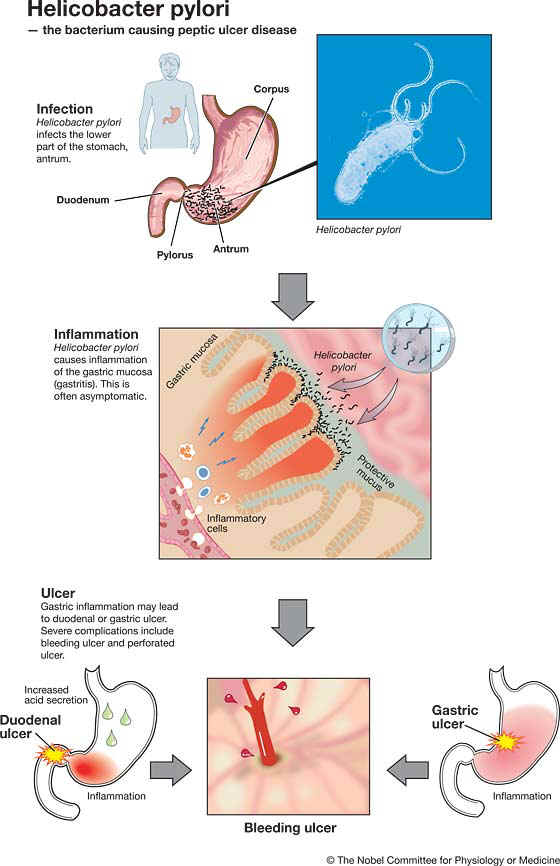
This year’s Nobel Laureates in Physiology or Medicine made the remarkable and unexpected discovery that inflammation in the stomach (gastritis) as well as ulceration of the stomach or duodenum (peptic ulcer disease) is the result of an infection of the stomach caused by the bacterium Helicobacter pylori.

Robin Warren (born 1937), a pathologist from Perth, Australia, observed small curved bacteria colonizing the lower part of the stomach (antrum) in about 50% of patients from which biopsies had been taken. He made the crucial observation that signs of inflammation were always present in the gastric mucosa close to where the bacteria were seen.

Barry Marshall (born 1951), a young clinical fellow, became interested in Warren’s findings and together they initiated a study of biopsies from 100 patients. After several attempts, Marshall succeeded in cultivating a hitherto unknown bacterial species (later denoted Helicobacter pylori) from several of these biopsies. Together they found that the organism was present in almost all patients with gastric inflammation, duodenal ulcer or gastric ulcer. Based on these results, they proposed that Helicobacter pylori is involved in the aetiology of these diseases.

Even though peptic ulcers could be healed by inhibiting gastric acid production, they frequently relapsed, since bacteria and chronic inflammation of the stomach remained. In treatment studies, Marshall and Warren as well as others showed that patients could be cured from their peptic ulcer disease only when the bacteria were eradicated from the stomach. Thanks to the pioneering discovery by Marshall and Warren, peptic ulcer disease is no longer a chronic, frequently disabling condition, but a disease that can be cured by a short regimen of antibiotics and acid secretion inhibitors.

Peptic ulcer – an infectious disease!

This year’s Nobel Prize in Physiology or Medicine goes to Barry Marshall and Robin Warren, who with tenacity and a prepared mind challenged prevailing dogmas. By using technologies generally available (fibre endoscopy, silver staining of histological sections and culture techniques for microaerophilic bacteria), they made an irrefutable case that the bacterium Helicobacter pylori is causing disease. By culturing the bacteria they made them amenable to scientific study.

In 1982, when this bacterium was discovered by Marshall and Warren, stress and lifestyle were considered the major causes of peptic ulcer disease. It is now firmly established that Helicobacter pylori causes more than 90% of duodenal ulcers and up to 80% of gastric ulcers. The link between Helicobacter pylori infection and subsequent gastritis and peptic ulcer disease has been established through studies of human volunteers, antibiotic treatment studies and epidemiological studies.

Helicobacter pylori causes life-long infection

Helicobacter pylori is a spiral-shaped Gram-negative bacterium that colonizes the stomach in about 50% of all humans. In countries with high socio-economic standards infection is considerably less common than in developing countries where virtually everyone may be infected.

Infection is typically contracted in early childhood, frequently by transmission from mother to child, and the bacteria may remain in the stomach for the rest of the person’s life. This chronic infection is initiated in the lower part of the stomach (antrum). As first reported by Robin Warren, the presence of Helicobacter pylori is always associated with an inflammation of the underlying gastric mucosa as evidenced by an infiltration of inflammatory cells.

The infection is usually asymptomatic but can cause peptic ulcer!

The severity of this inflammation and its location in the stomach is of crucial importance for the diseases that can result from Helicobacter pylori infection. In most individuals Helicobacter pylori infection is asymptomatic. However, about 10-15% of infected individuals will some time experience peptic ulcer disease. Such ulcers are more common in the duodenum than in the stomach itself. Severe complications include bleeding and perforation.

The current view is that the chronic inflammation in the distal part of the stomach caused by Helicobacter pylori infection results in an increased acid production from the non-infected upper corpus region of the stomach. This will predispose for ulcer development in the more vulnerable duodenum.

Malignancies associated with Helicobacter pylori infection

In some individuals Helicobacter pylori also infects the corpus region of the stomach. This results in a more widespread inflammation that predisposes not only to ulcer in the corpus region, but also to stomach cancer. This cancer has decreased in incidence in many countries during the last half-century but still ranks as number two in the world in terms of cancer deaths.

Inflammation in the stomach mucosa is also a risk factor for a special type of lymphatic neoplasm in the stomach, MALT (mucosa associated lymphoid tissue) lymphoma. Since such lymphomas may regress when Helicobacter pylori is eradicated by antibiotics, the bacterium plays an important role in perpetuating this tumour.

 Disease or not – interaction between the bacterium and the human host

Helicobacter pylori is present only in humans and has adapted to the stomach environment. Only a minority of infected individuals develop stomach disease. After Marshall’s and Warren’s discovery, research has been intense. Details underlying the exact pathogenetic mechanisms are continuously being unravelled.

The bacterium itself is extremely variable, and strains differ markedly in many aspects, such as adherence to the gastric mucosa and ability to provoke inflammation. Even in a single infected individual all bacteria are not identical, and during the course of chronic infection bacteria adapt to the changing conditions in the stomach with time.

Likewise, genetic variations among humans may affect their susceptibility to Helicobacter pylori. Not until recently has an animal model been established, the Mongolian gerbil. In this animal, studies of peptic ulcer disease and malignant transformation promise to give more detailed information on disease mechanisms.

Antibiotics cure but can lead to resistance

Helicobacter pylori infection can be diagnosed by antibody tests, by identifying the organism in biopsies taken during endoscopy, or by the non-invasive breath test that identifies bacterial production of an enzyme in the stomach.

An indiscriminate use of antibiotics to eradicate Helicobacter pylori also from healthy carriers would lead to severe problems with bacterial resistance against these important drugs. Therefore, treatment against Helicobacter pylori should be used restrictively in patients without documented gastric or duodenal ulcer disease.

Microbial origin of other chronic inflammatory conditions?

Many diseases in humans such as Crohn’s disease, ulcerative colitis, rheumatoid arthritis and atherosclerosis are due to chronic inflammation. The discovery that one of the most common diseases of mankind, peptic ulcer disease, has a microbial cause, has stimulated the search for microbes as possible causes of other chronic inflammatory conditions.

Even though no definite answers are at hand, recent data clearly suggest that a dysfunction in the recognition of microbial products by the human immune system can result in disease development. The discovery of Helicobacter pylori has led to an increased understanding of the connection between chronic infection, inflammation and cancer.

Source: http://nobelprize.org/nobel_prizes/medicine/laureates/2005/press.html


Fungi


Fungi
All Materials © Cmassengale

Characteristics

  • Eukaryotic 
  • Do not contain chlorophyll
  • Nonphotosynthetic
  • Absorptive heterotrophs – digest food first & then absorb it into their bodies
  • Release digestive enzymes to break down organic material or their host
  • Store food energy as glycogen
  • Most are saprobes – live on other dead organisms
  • Important decomposers & recyclers of nutrients in the environment
  • Most are multicellular, but some unicellular like yeast
  • Some are internal or external parasites; a few are predators that capture prey
  • Nonmotile
  • Lack true roots, stems, & leaves
  • Cell walls are made of chitin (a complex polysaccharide)
  • Grow as microscopic tubes or filaments called hyphae that contain cytoplasm & nuclei
  • Hyphal networks are called mycelium
  • Some are edible
  • Reproduce by sexual & asexual spores
  • Antibiotic penicillin comes from Penicillium mold
  • Classified by their sexual reproductive structures
  • Grow best in warm, moist environments preferring shade
  • Mycology – study of fungi
  • Fungicide – chemicals used to kill fungi
  • Includes yeasts, molds, mushrooms, ringworm, puffballs, rusts, smuts, etc.
  • Fungi may have evolved from prokaryotes by endosymbiosis

Vegetative (nonreproductive) Structures of Fungi

  • Body of a fungus made of tiny filaments or tubes called hyphae
  • Hyphae contain cytoplasm & nuclei and has a cell wall of chitin


HYPHAE

  • Each hyphae is one continuous cell
  •  Hyphae continually grow & branch
  • Septum (septa-plural) are cross walls with pores to allow the movement of cytoplasm in hyphae
  • Hyphae with septa are called septate hyphae
  • Hyphae without septa are called coenocytic hyphae

  • Tangled mats of hyphae are known as mycelium
  • All hyphae within a mycelium share the same cytoplasm so materials move quickly
  • Hyphae grow rapidly from the tips by cell division
  • Stolon is a horizontal hyphae that connects groups of hyphae to each other
  • Rhizoids are rootlike parts of hyphae that anchor the fungus

Reproductive Structures

  • Most fungi reproduce asexually & sexually
  • Asexual reproduction produces genetically identical organisms & is the most common method used
  •  Sexual reproduction in fungi occurs when nutrients or water are scarce
  • Fruiting bodies are modified hyphae that make asexual spores
  • Fruiting bodies consist of an upright stalk or sporangiophore with a sac containing spores called the sporangium


SPORANGIOPHORES

  • Types of fruiting bodies include basidia, sporangia, & ascus
  • Spores – haploid cells with dehydrated cytoplasm & a protective coat capable of developing into new individuals
  • Wind, animals, water, & insects spread spores
  • When spore lands on moist surface, new hyphae form

Asexual Reproduction in Fungi

  • Fungi reproduce asexually when environmental conditions are favorable
  • Some unicellular fungi reproduce by mitosis
  • Yeast cells reproduce by budding where a part of the cell pinches off to produce more yeast cells

  • Athlete’s foot fungus reproduce by fragmentation from a small piece of mycelium
  • Most fungi reproduce asexually by spores
  • Penicillium mold produces spores called conidia without a protective sac on the top of a stalk called the conidiophore

Sexual Reproduction in Fungi

  • Fungi reproduce sexually when environmental conditions are unfavorable
  • No male or female fungi
  •  Two mating types — plus (+) and minus (-)
  • Fertilization occurs when (+) hyphae fuse with (-) hyphae to form a 2N or diploid zygote
  • Some fungi show dimorphism (ability to change their form in response to their environmental conditions)

Classification of Fungi

  • Fungi are classified by their reproductive structures
  • The 4 phyla of fungi are Basidiomycota, Zygomycota, Ascomycota, & Deuteromycota

Zygomycota

  • Called sporangium fungi or common molds
  • Includes molds & blights such as Rhizopus stolonifer (bread mold)

  • No septa in hyphae (coenocytic)
  • Asexual reproductive structure called sporangium & produces sporangiospores
  • Rhizoids anchor the mold, release digestive enzymes, & absorb food
  • Asexual reproductive structure called sporangium & produces sporangiospores
  • Sexual spore produced by conjugation when (+) hyphae & (-) fuse is called zygospore
  • Zygospores can endure harsh environments until conditions improve & new sporangium


Basidiomycota

  • Called club fungi
  •  Includes mushrooms, toadstools, puffballs, bracket fungi, shelf fungi, stinkhorns, rusts, & smuts
  • Some are used as food (mushroom) & others cause crop damage (rusts & smuts)
  • Seldom reproduce asexually
  • Basdiocarp made up of stalk called the stipe & a flattened cap
  • Stipe may have a skirt like ring below cap called the annulus
  • Gills are found on the underside of the cap & are lined with basidia
  • Basidium – sexual reproductive structure that make basidiospores
  • Basidiospores are released from the gills & germinate to form new hyphae & mycelia
  • Vegetative structures found below ground & include rhizoids (anchor & absorb nutrients), hyphae, & mycelia

Ascomycota

  • Called sac fungi
  • Includes yeast, cup fungi, truffles, powdery mildew, & morels

  • Some are parasites causing Dutch elm disease & chestnut blight
  • Sac Fungi can reproduce both sexually and asexually
  •  Yeast reproduce asexually by budding (form small, bud-like cells that break off & make more yeasts)
  • Asexual spores called conidia form on the tips of specialized hyphae called condiophores
  • Ascocarp – specialized hyphae formed by parent fungi during sexual reproduction
  • Ascus – sacs within the ascocarp that form spores called ascospores

Lichens

  • Symbiotic association between a sac fungus & a photosynthetic green algae or cyanobacteria
  • Both organisms benefit (algae makes food & fungus supplies moisture, shelter, & anchorage)
  • Grow on rocks, trees, buildings, etc. & help form soil
  • Crustose lichens grow on rocks & trees; fructose lichens grow shrub-like; foliose lichens grow mat-like on the soil

Mycorrhizae

  • Symbiotic association of a fungus living on plant roots
  • Most plants have mycorrhizae on their roots
  • Fungus absorbs sugars made by plant
  • Plants absorb more water & minerals with aid of the fungus

Importance of Fungi

  • Fungal spores cause allergies
  • Molds, mildew, rusts, & smuts damage crops
  • Yeasts are used to make beer & bread
  •  Antibiotic penicillin
  • Decomposers & recyclers of nutrients
  • Mushrooms eaten as food
  • Help form blue cheeses
  • Aspergillus is used to make soy sauce
  • Cause athlete’s foot & ringworm
  • Amanita is poisonous mushroom
  • Can cause yeast infections