Fish

Fish

All Materials © Cmassengale
  

Kingdom – Animalia
Phylum – Chordata
Subphylum – Vertebrata

Vertebrates:

Include fish, amphibians, reptiles, birds, & mammals
Have a notochord (slim, flexible rod) present in early stages that may be replaced by backbone in adults
Contain a dorsal, hollow bundle of nerves called the nerve or spinal cord
Respire through pharyngeal or gill pouches during early development
Have post-anal tail in early stages
Endoskeleton made of bone &/or cartilage
Anterior head with well developed brain & sensory organs (Cephalization)
Closed circulatory system

Taxonomy of Vertebrates:

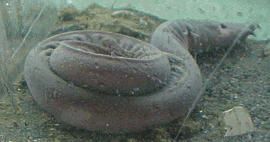
Agnatha include hagfish & lamprey with long, eel-like bodies without jaws or paired fins & cartilage skeletons

Chondrichthyes include sharks, rays, & skates with cartilage skeletons, paired fins, & jaws

Osteichthyes are bony fish with jaws, paired fins, & bone and cartilage in their skeletons
Amphibia include frogs, toads, & salamanders that go through an aquatic larval or tadpole stage
Reptilia include snakes, turtles, lizards, & alligators that live on land, are covered with scales, & lay a tough, protective amniote egg
Aves are birds covered with feathers, adapted for flying, & with hollow bones
Mammalia have hair or fur & females have mammary or milk-producing glands

Evolution:

Fossil record shows jawless fish without paired fins appeared first about 550 million years ago
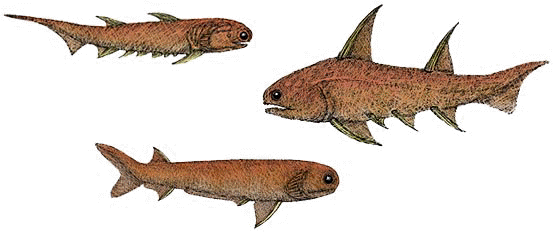
Ostracoderm was a jawless, bottom-feeding ancestor to the agnathans (modern jawless fish)

Development of jaws & paired fins allowed better movement & increased ability to capture prey
Extinct acanthodians or spiny fish were first jawed fish with paired fins

Jaws probably developed from gill arches (bone that supports the pharynx)

Characteristics of  Fish:  

Streamlined body & muscular tail for swimming
Most with paired fins for maneuvering
Body covered with protective scales & mucus layer to reduce friction when swimming
Have less dense body tissues & store less dense lipids to help them float
Respire through gills
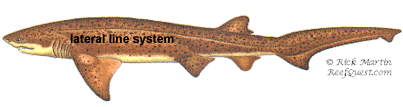
Most have a lateral line system or a row of sensory structures running down each side of the organism to detect changes in water temperature, pressure, current, etc.

Most with well-developed sense of sight & smell
Some can detect electrical currents
Ectotherms (adjust body temperature to environment)
Two chambered heart (upper atrium receives blood & lower ventricle pumps blood)

Agnatha (Jawless Fish):

Hagfish (live in oceans) & lampreys (found in marine & freshwater)
Circular mouths
Sharp teeth & strong rasp-like tongue to tear hole in prey & suck out blood & body fluids

Known as cyclostomes
Eel-shaped body
Mucus covers body
Skeleton made of cartilage
No paired fins
Gills without bony cover (called operculum)
Retain their notochord throughout their life
Hagfish are bottom dwellers in cold marine waters that burrow in mud, scavenge on dead & dying fish, & have tentacles around their mouth
Lampreys are usually parasites with a keen sense of smell to locate prey, lay their eggs in freshwater streams, & are covered with a poisonous slime

Chondrichthyes

Includes sharks, rays, & skates
Endoskeleton of cartilage
Hinged jaws & paired fins
Placoid scales & tooth-like dermal spines on scales

Marine
Carnivorous
Sharks are torpedo shaped

Rays & skates have broad, flat bodies with wing-like fins and a tail

Shark Characteristics:

Fast swimmers
Large, oily liver (20% of body weight) makes them buoyant
Tough, leathery skin
Fierce predators
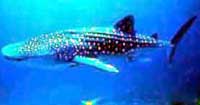
Whale shark is largest & filter feeds on plankton

Ventral mouth with 6-20 rows of sharp, replaceable teeth
Short, straight intestine with spiral valve to slow food movement
5-7 pairs of gills for gas exchange
Kidneys remove wastes & maintain water balance
Electroreceptors on head help find prey & navigate
Lateral line along side of body contains sensory cells to detect vibrations & pressure
Separate sexes with external fertilization

Ray & Skate Characteristics:

Usually harmless to humans
Broad, wing-like pectoral fins used to glide through water
Flattened bodies with ventral mouth
Both eyes on top of head
Have protective coloration (darker on top & lighter on bottom)
Feed on fish & invertebrates
Stingray with poison spine by tip of tail

Electric ray gives off strong, electric shock
Manta ray is largest

Traits of Bony Fish (Osteichthyes)

Skeleton made of bone
Hinged jaws
Paired fins
Gills for gas exchange
Lateral line
Body covered with scales & mucus coating
Includes lobe-finned, ray-finned, and lung fish

Lobe-finned Fish:

Muscular, paddle-like fins supported by bone
Gills
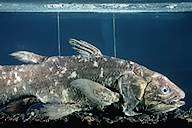
Known as coelacanths

Thought to be extinct until 1938 when species found in Africa
Live in deep oceans

Lungfish:

Use lungs & gills
Eel-shaped body

Live in shallow, tropical rivers of Africa, Australia, & South America
Come to surface & gulp air when oxygen level is low
Form mud cocoon & become dormant if stream dries up

Ray-finned Fish:

Fan-like fins supported by rays
Includes salmon, perch, catfish, tuna, etc.
Body covered with round, overlapping cycloid or ctenoid scales & mucus

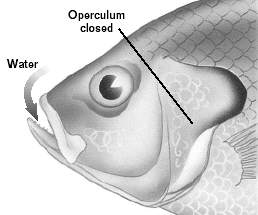
Four sets of gills covered by bony operculum

Have movable fins
Dorsal fin(s) located on top keep fish upright & used for defense
Caudal fin or tail moves side to side to help steer
Pectoral fins (paired) on each side behind the operculum
Pelvic fins (paired) on ventral surface near the head
Anal fin (single) behind anus

Swim bladder is thin-walled sac in abdomen that creates buoyancy from diffusion of dissolved gas from blood


Kidneys filter the blood & help maintain water balance
Ectothermic – body temperature regulated by the environment
Keen sense of smell (nostrils) & have chemical receptors over the body
Can detect the earth’s magnetic field as a guide to navigate oceans
Have separate sexes with external fertilization
Eggs hatch into fry

Salmon Life Cycle:

Migrate up to 3200 kilometers following magnetic cues in the ocean
Follow mucus trails when navigating rivers
Return to birthplace to spawn
Males change color & jaw lengthens & develops a hook

Female uses her tail to build gravel nest & lays up to 10,000 eggs 
Male deposits sperm over eggs
Adults usually die after spawning
Pacific salmon return to sea when 15 cm long; while Atlantic salmon may stay in river up to 7 years
Secrete mucus coating in river as return to sea
May stay in ocean 6 months to 5 years


Eye Model Labeled

External Right Eye Model


1. Frontal Bone 9. Superior Rectus
2. Nasal Bone 10. Trochlea of Superior Oblique
3. Maxillary Bone 11. Lacrimal Gland
4. Lacrimal Bone 12. Sclera
5. Zygomatic Bone 13. Iris
6. Inferior Rectus 14. Pupil
7. Inferior Oblique 15. Nasolacrimal Duct
8. Lateral Rectus 16. Lacrimal Punctum


BACK

Frog Dissection

Frog Dissection
Pictures:  Modern Biology, Holt

Background:
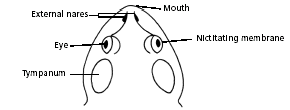
As members of the class Amphibia, frogs may live some of their adult lives on land, but they must return to water to reproduce. Eggs are laid and fertilized in water. On the outside of the frog’s head are two external nares, or nostrils; two tympani, or eardrums; and two eyes, each of which has three lids. The third lid, called the nictitating membrane, is transparent. Inside the mouth are two internal nares, or openings into the nostrils; two vomerine teeth in the middle of the roof of the mouth; and two maxillary teeth at the sides of the mouth. Also inside the mouth behind the tongue is the pharynx, or throat.

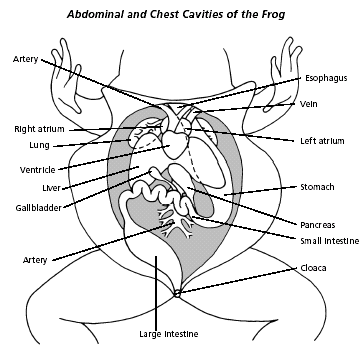
In the pharynx, there are several openings: one into the esophagus, the tube into which food is swallowed; one into the glottis, through which air enters the larynx, or voice box; and two into the Eustachian tubes, which connect the pharynx to the ear. The digestive system consists of the organs of the digestive tract, or food tube, and the digestive glands. From the esophagus, swallowed food moves into the stomach and then into the small intestine. Bile is a digestive juice made by the liver and stored in the gallbladder. Bile flows into a tube called the common bile duct, into which pancreatic juice, a digestive juice from the pancreas, also flows. The contents of the common bile duct flow into the small intestine, where most of the digestion and absorption of food into the bloodstream takes place.

Indigestible materials pass through the large intestine and then into the cloaca, the common exit chamber of the digestive, excretory, and reproductive systems. The respiratory system consists of the nostrils and the larynx, which opens into two lungs, hollow sacs with thin walls. The walls of the lungs are filled with capillaries, which are microscopic blood vessels through which materials pass into and out of the blood. The circulatory system consists of the heart, blood vessels, and blood. The heart has two receiving chambers, or atria, and one sending chamber, or ventricle. Blood is carried to the heart in vessels called veins. Veins from different parts of the body enter the right and left atria. Blood from both atria goes into the ventricle and then is pumped into the arteries, which are blood vessels that carry blood away from the heart.

The urinary system consists of the frog’s kidneys, ureters, bladder, and cloaca. The kidneys are organs that excrete urine. Connected to each kidney is a ureter, a tube through which urine passes into the urinary bladder, a sac that stores urine until it passes out of the body through the cloaca. The organs of the male reproductive system are the testes, sperm ducts, and cloaca. Those of the female system are the ovaries, oviducts, uteri, and cloaca. The testes produce sperm, or male sex cells, which move through sperm ducts, tubes that carry sperm into the cloaca, from which the sperm move outside the body. The ovaries produce eggs, or female sex cells, which move through oviducts into the uteri, then through the cloaca outside the body.

The central nervous system of the frog consists of  the brain, which is enclosed in the skull, and the spinal cord, which is enclosed in the backbone. Nerves branch out from the spinal cord. The frog’s skeletal and muscular systems consist of its framework of bones and joints, to which nearly all the voluntary muscles of the body  are attached. Voluntary muscles, which are those over which the frog has control, occur in pairs of flexors and extensors. When a flexor of a leg or other body part contracts, that  part is bent. When the extensor of that body part contracts, the part straightens.

Objectives:
Describe the appearance of various organs found in the frog.
Name the organs that make up various systems of the frog.

Purpose:
In this lab, you will dissect a frog in order to observe the external and internal structures of frog anatomy.

Materials:
• safety goggles, gloves, and a lab apron
forceps
preserved frog
dissecting pins (6–10)
dissecting tray and paper towels
plastic storage bag and twist tie
scissors
marking pen
dissecting needle

Procedure:

  1. Put on safety goggles, gloves, and a lab apron.
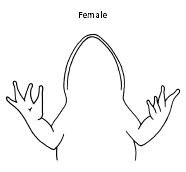
  2. Place a frog on a dissection tray. To determine the frog’s sex, look at the hand digits, or fingers, on its forelegs. A male frog usually has thick pads on its “thumbs,” which is one external difference between the sexes, as shown in the diagram below. Male frogs are also usually smaller than female frogs. Observe several frogs to see the difference between males and females.
  1.  Use the diagram below to locate and identify the external features of the head. Find the mouth, external nares, tympani, eyes, and nictitating membranes.

  1. Turn the frog on its back and pin down the legs. Cut the hinges of the mouth and open it wide. Use the diagram below to locate and identify the structures inside the mouth. Use a probe to help find each part: the vomerine teeth, the maxillary teeth, the internal nares, the tongue, the openings to the Eustachian tubes, the esophagus, the pharynx, and the slit-like glottis.

  1. Look for the opening to the frog’s cloaca, located between the hind legs. Use forceps to lift the skin and use scissors to cut along the center of the body from the cloaca to the lip. Turn back the skin, cut toward the side at each leg, and pin the skin flat. The diagram above shows how to make these cuts
  2. Lift and cut through the muscles and breast bone to open up the body cavity. If your frog is a female, the abdominal cavity may be filled with dark-colored eggs. If so, remove the eggs on one side so you can see the organs underlying them.
  3. Use the diagram below to locate and identify the organs of the digestive system: esophagus, stomach, small intestine, large intestine, cloaca, liver, gallbladder, and pancreas.

  1. Again refer to the diagram below to identify the parts of the circulatory and respiratory systems that are in the chest cavity. Find the left atrium, right atrium, and ventricle of the heart. Find an artery attached to the heart and another artery near the backbone. Find a vein near one of the shoulders. Find the two lungs.

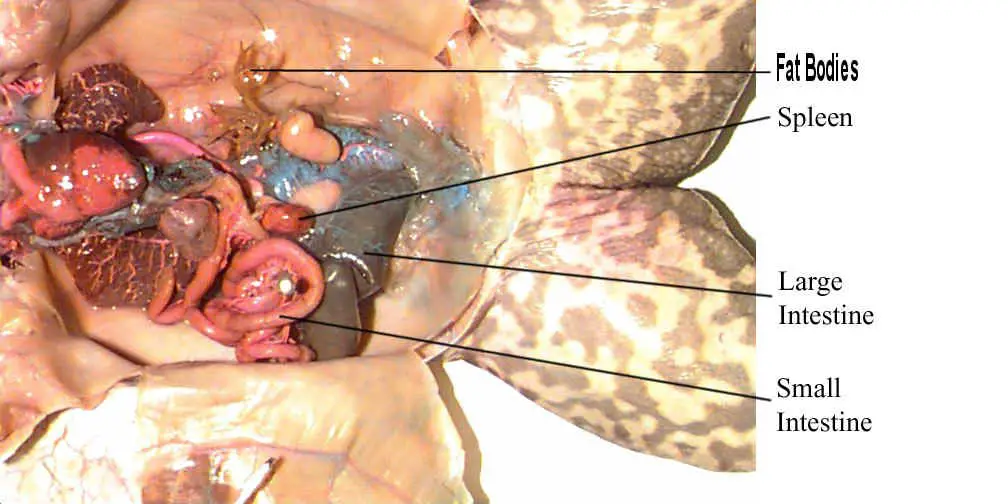
  1. Use a probe and scissors to lift and remove the intestines and liver. Use the diagram on the next page to identify the parts of the urinary and reproductive systems. Remove the peritoneal membrane, which is connective tissue that lies on top of the red kidneys. Observe the yellow fat bodies that are attached to the kidneys. Find the ureters; the urinary bladder; the testes and sperm ducts in the male; and the ovaries, oviducts, and uteri in the female.

  1. Remove the kidneys and look for threadlike spinal nerves that extend from the spinal cord. Dissect a thigh, and trace one nerve into a leg muscle. Note the size and texture of the leg muscles.
  2. Dispose of your materials according to the directions from your teacher.
  3. Clean up your work area and wash your hands before leaving the lab.
Click here for worksheet

BACK

Frog Dissection Worksheet


Frog Dissection Worksheet
    1. What do you think is the function of the nictitating membrane, and why?
    2. A frog does not chew its food. What do the positions of its teeth suggest about how the frog uses them?
    3. Trace the path of food through the digestive tract.
    4. Trace the path of blood through the circulatory system, starting at the right atrium.
    5. Trace the path of air through the respiratory system.
    6. Trace the paths of sperm in a male and eggs in a female.
    7. Trace the path of urine in both sexes.
    8. Which parts of the frog’s nervous system can be observed in its abdominal cavity and hind leg?
    9. Suppose in a living frog the spinal nerve extending to the leg muscle were cut. What ability would the frog lose? Why?
    10. The abdominal cavity of a frog at the end of hibernation season would contain very small fat bodies or none at all. What is the function of the fat bodies?


  1.  Structures of an animal’s body that fit it for its environment are adaptations. How do the frog’s powerful hind legs help it to fit into a life both in water and on land?
  2. During one mating of frogs, the female lays some 2,000 to 3,000 eggs in water as the male sheds millions of sperm over them. How do these large numbers relate to the frog’s fitness for life in water?
BACK

Earthworm Facts

earthworm facts

How long do  worms live?
How many young are produced per year?   
Do earthworms have eyes?

How do earthworms breathe?
Can earthworms smell?
Do worms have eyes?
What do earthworms eat and how much can they eat in one day?
Can earthworms freeze?
What is the “bump” in the middle of the earthworm?
How can you determine if an earthworm is sexually mature?
Can earthworms lose their clitellum?
How do earthworms mate? 
How are cocoons produced?
How long does it take worms to hatch?
How many young worms are produced per year?
How long does it take earthworms to mature?
Can different species of worms mate creating a hybrid worm?
How long do earthworms live?
How do earthworms move?
What characteristics are used to identify earthworms?
What enemies do earthworms have?
Can earthworms regenerate themselves?
How can you distinguish the head of an earthworm from the tail?
How do earthworms obtain their food?
How big do earthworms get?

Read Our Q&A About Earthworm Facts

Q. How long do dew worms live?

A. Dew worms can live for approximately six and a half years.

Q. How many young are produced per year?

A. It is estimated that sexually mature dew worms (about one year old) produce about two cocoons per year with 1-2 young each (more research under field and laboratory conditions required).

Q. Do earthworms have eyes?

A. They do not have eyes but they do possess light- and touch-sensitive organs (receptor cells) to distinguish differences in light intensity and to feel vibrations in the ground.

Q. How do earthworms breathe?

A. Earthworms respire through their skin, and therefore require humid conditions to prevent drying out. They coat themselves in mucus to enable the passage of dissolved oxygen into their bloodstream.

Q. Can earthworms smell?

A. Worms have specialized chemoreceptors or sense organs (“taste receptors”) which react to chemical stimuli. These sense organs are located on the anterior part of the worm.

Q. What do earthworms eat and how much can they eat in one day?

A. Earthworms derive their nutrition from many forms of organic matter in soil, things like decaying roots and leaves, and living organisms such as nematodes, protozoans, rotifers, bacteria, fungi. They will also feed on the decomposing remains of other animals. They can consume, in just one day, up to one third of their own body weight.


Q. Can earthworms freeze?

A. Like all invertebrates their body processes or metabolism slow down with falling temperatures. They will hibernate at near freezing temperature. If frozen they will die. They react to advancing colder winter weather by burrowing deep (up to two meters) in the soil to avoid the extreme cold.

Q. What is the “bump” in the middle of the earthworm?

A. The bump is the clitellum, the saddle shaped swollen area 1/3 of the way back containing the gland cells which secrete a slimy material (mucus) to form the cocoon which will hold the worm embryos.

Q. How can you determine if an earthworm is sexually mature?

A. If the worm has a clitellum, it is sexually mature.

Q. Can earthworms lose their clitellum?

A. The answer is yes! During periods of drought, when soils dry up, some species of earthworms do in fact temporarily lose all secondary sexual characters such as the clitellum. When conditions become favorable, it comes back. The clitellum can also disappear at the onset of old age or senescence.

Q. How do earthworms mate?


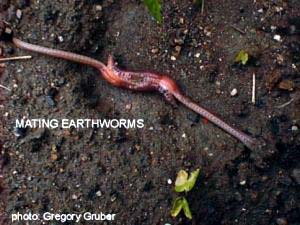
A. Earthworms are hermaphroditic meaning each worm has organs of both sexes. The male gonopores are usually within the first 12-15 segments, and the female gonopores are further back, close to the clitellum (the swollen area in adult worms). One worm has to find another worm and they mate juxtaposing opposite gonadal openings exchanging packets of sperm, called spermatophores. Some species also appear to be either parthenogenetic (females producing all females, “virgin birth”) or may be able to self-fertilize.


Q. How are cocoons produced?

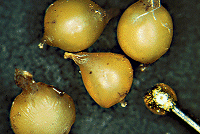
A. The clitellum produces a mucous sheath and nutritive material, and as the sheath slides forward, it picks up ova from the earthworm’s ovaries then packets of sperm that had been transferred to the worm from another worm during mating. As the sheath slides off the worm’s head, the ends are sealed to form the cocoon. Initially, the cocoon is quite soft but soon after it is deposited in the soil it becomes slightly amber in color, leather-like and very resistant to drying and damage. Earthworm eggs
Dendrobaena rubidus cocoons (relative to a pin head).

The ova within each cocoon are fertilized, and the resulting embryos grow inside the sealed unit, much like a chick developing inside an egg. When the embryos have consumed all the nutritive material, they completely fill the lemon shaped cocoon and are ready to hatch out one end.

Q. How long does it take worms to hatch?

A. Young worms hatch from their cocoons in three weeks to five months as the gestation period varies for different species of worms. Conditions like temperature and soil moisture factor in here…if conditions are not great then hatching is delayed.

Q. How many young worms are produced per year?

A. Earthworms can produce between 3 and 80 cocoons per year depending on the species. The deeper-dwelling species don’t have to produce as many cocoons because they are protected much better from predation than surface dwelling species which tend to produce many more cocoons. The number of fertilized ova or eggs within each cocoon ranges from one to twenty. This depends on the species and also factors such as nutrition of the adults laying them and environmental conditions with soil moisture being most important. Usually, though, only few to several young worms will ever successfully emerge from each cocoon.

Q. How long does it take earthworms to mature?

A. Worms mature in 10 – 55 weeks depending on the species.

Q. Can different species of worms mate creating a hybrid worm?

A. No, this does not usually occur; hybrids can usually only occur between very closely related species and their offspring would likely be infertile.

Q. How long do earthworms live?

A. Earthworm longevity is species dependent. Various specialists report that certain species have the potential to live 4-8 years. In protected culture conditions (no predators, ideal conditions) individuals of Allolobophora longa have been kept up to 10 1/4 years, Eisenia foetida for 4½ years and Lumbricus terrestris for 6 years.

Worms continue to grow once they reach sexual maturity but once at this stage there is a much slower increase in weight until the disappearance of the clitellum indicates the onset of old age or senescence. During this period there is a slow decline in weight until the death of the worm.

Q. How do earthworms move?

A. Earthworms have bristles or setae in groups around or under their body. The bristles, paired in groups on each segment, can be moved in and out to grip the ground or the walls of a burrow. Worms travel through underground tunnels or move about on the soil surface by using their bristles as anchors pushing themselves forward or backward using strong stretching and contracting muscles.

Q. What characteristics are used to identify earthworms?

A. The external body characters used in identifying different species of earthworms are: the segmental position of the clitellum on the body, body length, body shape (cylindrical or flattened), number of body segments, type and position of body bristles or setae, the description of the tongue-like lobe, the prostomium, projecting forward above the mouth, type of peristomium or first body segment, external position and morphology of genital apertures or opening and type of glandular swellings on the clitellum. The shape and the relationship of various internal organs are also used to identify some species of worms.

Q. What enemies do earthworms have?

A. Snakes, birds, moles, toads and even foxes are known to eat earthworms. Beetles, centipedes, leeches, slugs and flatworms also feed on earthworms. Some types of mites parasitize earthworm cocoons and the cluster fly (Pollenia rudis) parasitizes worms of the species Eisenia rosea.

Q. Can earthworms regenerate themselves?

A. Yes, but only the front or head end of the earthworm will survive and the amputated tail portion will die. This remaining front portion must also be long enough to contain the clitellum and at least 10 segments behind the clitellum. This makes up about half the length of the worm. The new posterior segments grown will be slightly smaller in diameter than the original segments and sometimes a bit lighter in color.

Q. How can you distinguish the head of an earthworm from the tail?

A. The head of the worm is always located on the end of the worm closest to the clitellum and has some differentiated structures if you can view with magnification. Even though worms can move both frontward and backward they tend to travel forward more. Place a worm on a rough piece of paper and observe which direction it travels. They usually extend their “head” first when crawling.

Q. How do earthworms obtain their food?

A. Earthworms possess very strong mouth muscles – they do not have teeth. Dew worms or nightcrawlers often surface at night to pull fallen leaves down into their burrow. When the leaf decomposes or softens a little they pull small bits off at a time to munch on. They also “swallow” soil as they burrow and extract nutrients from it.

Q. How big do earthworms get?

A. Size depends on the species of worm, it’s age, diet and environmental conditions like moisture, temperature and soil conditions. Lumbricus terrestris (Nightcrawler, Dew worm) is one of North America’s largest and ranges in size from 9-30 cm with a diameter of 6-10 mm. The largest L. terrestris we’ve collected was close to 30 cm long (stretched out), weighed 11.2 g and was collected in a no-till, soybean field in Ontario up near Georgian Bay, Ontario.

The largest tropical species (Glossoscolex and Megascolides) are up to 120 cm long and the largest in the world are some Australian forms which may reach 300 cm in length. Bimastos parvus (American bark worm) is quite small at less than 2 cm long.


BACK