Chordates

Chordates
All Materials © Cmassengale  

Characteristics of Chordates

  • All chordates have a notochord, dorsal nerve cord, pharyngeal pouches, & postanal tail at some time in their life
  • Notochord is a firm, flexible rod of tissue located on the dorsal side of the body that becomes part of the endoskeleton in vertebrates
  • Dorsal nerve cord is a hollow tube lying dorsal to the notochord that becomes the brain & spinal cord in vertebrates
  • Pharyngeal pouches are small outpockets of the anterior part of the digestive tract that become gills in aquatic chordates & jaws, inner ear, & tonsils in terrestrial chordates
  • Postanal tail consists of muscle tissue & lies behind the posterior opening of the digestive tract

Subphyla of Chordates

  • The Phylum Chordata  includes all of the vertebrates, as well as two groups of marine animals that lack backbones and are called invertebrate chordates
  • The phylum is divided into three subphyla, determined by the development of the notochord
  • Subphylum Cephalochordata contains about 24 species of blade-shaped animals known as lancelates that retain the notochord, dorsal nerve chord, pharyngeal pouches, and postanal tail throughout their life
  • Subphylum Urochordata  contains 2,000 species commonly called tunicates because their bodies are covered by a tough covering, or tunic
    * Called sea squirts because they shoot out a stream of water when touched
    *Sessile, barrel-shaped, filter feeding animals that live on the sea bottom
    *Adults have a pouch-like pharynx with slits
    *Adults do not have a notochord, dorsal nerve cord, or postanal tail
  • Subphylum Vertebrata is the largest subphylum in which the notochord is replaced with vertebrae
    *  Skeletons consist of bone &/or cartilage
    * Brain is protected by a cranium
    * Well developed 4 chambered heart with a closed circulatory system
    * Includes fish, amphibians, reptiles, birds, & mammals

Fish, Amphibians, Reptiles, Birds, and Mammals
BACK

Chimpanzee Webquest

Life of the Chimpanzee

Introduction  |  Task  |  Process  |  Evaluation  |  Conclusion 

Introduction

Chimpanzees are primates that live in forest regions of Africa.  They are genetically very similar to humans, sharing 98% of the same genes.  Because of their similarities, Chimpanzees can reveal much about ourselves and how we learn.  Chimpanzees have evolved over time to the most sophisticated primates other than humans.  They have a very complex social structure, and even know how to use “tools” to make a task easier.  In this web quest, you will learn all about chimpanzees, their common connection with humans, and how they have evolved to survive.

Task

Your task is to use the internet to research chimpanzees.  After researching, you will use a poster board to make a Venn diagram that outline the similarities and differences of humans and chimpanzees.  After making your diagram, you will present it to the class, explaining the similarities. In addition, you will explain what specific characteristics chimps and humans share that allow them to survive. This will be a group project.  An illustration of the Venn diagram is shown below.  Group A will be human characteristics,  group B will be chimpanzee characteristics, and group C will be the shared traits of humans and chimps.  Before beginning the process, skip down and read the Evaluation Rubric so you will know what your grade is based on.

Process

  1.  First, you will watch and take notes on the video, Jane Goodall’s Wild Chimpanzees.  The movie will give you some background knowledge on what scientists know about chimps and their behavior.
  2.  After watching the movie, you will choose a partner to help do research on chimpanzees.  This research will be used to construct your Venn diagram and to make a presentation ( PowerPoint – 15 slides ) which you and your partner will give to the class.
  3.  Use the following links to initially research chimpanzees.  If you wish to do your own customized search, use the Google Search Engine and keywords.  Hint: to get the most out of research, divide up the responsibilities and have each person research a different aspect of chimpanzees.

Encyclopedia Entry:  Chimpanzee

   Jane Goodall Institute

   Enchanted Learning:  Chimpanzees

   Save the Chimps:  Fact Sheet

  1. During your research, be sure to record any similarities and differences between chimps and humans.  After your research is completed, you will consolidate all of your findings into the diagram.
  2.  After each group member is done researching, come together as a group and complete your Venn diagram.  Remember to include both unique and shared characteristics of humans and chimpanzees.  Remember also to include shared adaptations that allow chimps and humans to survive.  Write these adaptations below the diagram.
  3.  After each group has completed the diagram, you will present your Venn diagram to the class, explaining your findings using  a PowerPoint presentation. 


Evaluation:

You will be evaluated based on the following rubric:  (CLICK HERE FOR PRINTABLE COPY)


Oral Presentation Rubric Possible Points Self-Assessment Teacher Assessment
Complete Venn diagram with unique adaptations listed at bottom. 25
PowerPoint Presentation well-designed and with 15 slides 25
Presentation was well planned and coherent. (Evidence of rehearsal) 10
Poster board  (helpful, neat) 10
Teamwork:  Every member of group played a role 10
Presentation shows evidence of research on Chimpanzees (good understanding of similarities and differences) 10
Communication Skills (eye contact, posture, clear voice, appropriate volume, transitions between speakers smooth, and all members presented) 10
Total Possible Points 100

Note that half of your grade is based on the completion of the Venn diagram and PowerPoint, while the other half is distributed among different presentation aspects.  Teamwork is a part of your grade as well.  Make sure that each member plays a role in research and presentation.

Conclusion:

Chimpanzees and Humans are very different in many ways.  Humans are much more advanced in thought and practical skills.  Yet, there are still many shared characteristics, such as a complex social hierarchy, ability to use “tools”, and communication.  These adaptations have allowed both humans and chimpanzees to survive, each in their respective habitat.  Understanding chimpanzee behavior can help us understand our own evolution, where we came from, and perhaps where we are going.

BACK

Chlorophyll Fluorescence


Chlorophyll Fluorescence

INTRODUCTION

When a pigment absorbs light, electrons of certain atoms in the pigment molecules are boosted to a higher energy level. The energy of an absorbed photon is converted to the potential energy of the electron that has been raised to an excited state. In most pigments, the excited electron drops back to its ground-state, or normal orbit, and releases the excess energy as heat. Some pigments, including chlorophyll, emit light as well as heat after absorbing photons.
In the chloroplast, these excited electrons jump from the chlorophyll molecule to a protein molecule in the thylakoid membrane, and are replaced by electrons from the splitting of water. The energy thus transferred, is used in carbohydrate production.
This release of light is called fluorescence. Chlorophyll will fluoresce in the red part of the spectrum, and also give off heat. In this lab, you will observe this fluorescence by separating the chlorophyll from the thylakoid membrane.

MATERIALS


Spinach leaves Flashlight or small lab light
Mortar and pestle Test tube
Acetone Filter paper
25-mL graduated cylinder Funnel
Ring stand or funnel rack Safety goggles

PROCEDURE

1. Grind the spinach leaves using a mortar and pestle.

2. Add acetone to the ground leaves, using enough acetone and spinach leaves to get between 10 and 15 mL of extract.

3. Set up your filtering apparatus, and using proper filtering technique, filter the extract to a test tube. NOTE: Use a small amount of acetone to wet the filter paper, to hold it into place, instead of water.

4. Shine a flashlight, or other similar light source, through the test tube and extract.

5. Observe the fluorescence of the chlorophyll at a 90 degree angle to the flashlight.


Chromatography Lab

Chromatography Lab

Problem:  How do you separate the different pigments in a plant?

Materials:

Cone-type (size 4) coffee filter paper (or Whatman #1 chromatography paper)
large glass jars
acetone
distilled water
capillary tubes
fresh spinach
mortar and pestle
clean sand

Introduction:

In this activity you will be experimenting with a technique called chromatography which will allow you to visually demonstrate that the pigment in leaves is a combination of several different colored pigments.

This technique is useful in that it can separate and identify the various components of mixtures, such as those contained in plant pigments. A pigment is a substance that absorbs light at specific wavelengths, chlorophyll is one of these pigments. Its green-yellow in color is due to the absorption of red, orange, blue, and violet wavelengths and the reflection of the green and yellow wavelengths.   This occurs when white light (containing all of the light wavelengths, or the entire spectrum of colors) shines on the leaf surface, all of the wavelengths are absorbed except for the ones you see, which are green-yellow, those are the portions of the spectrum being reflected.

If the conditions are identical, the relative distance moved by a particular compound is the same from one mixture to another. This is why chromatography can be used to identify a compound. The actual identification requires a simple calculation as shown below:

Rf = distance moved by compound from original spot divided by the distance moved by solvent from original spot

It is important to remember that several factors can influence the reliability of the Rf value, these include humidity, temperature, solvent, pigment extract preparation, and the amounts of the material present.  Values are comparable only when the extracts are prepared in the same way and the chromatograms are prepared identically and developed together in the same container.

Acetone is flammable (even the amount found in nail polish remover), keep it away from sparks or open flames. Wear eye protection, especially if using pure acetone.

Procedure

1.   Each lab group (or individual if not working in groups) will need 4 strips of filter paper, approximately 6 inches long and 1 inch wide, 2 chromatography development containers (500 ml beakers or large fruit jars work well), 2 large rubber bands (able to stretch around the vessels from the mouth to the bottom of the vessel), 2 solvents, water and either pure acetone, or nail polish remover.

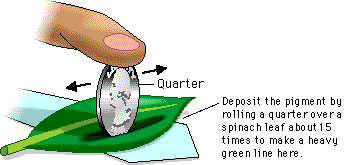
2.   Do the following with both fresh spinach leaves; tear leaf material and place in a glass container, cover with acetone (this should be done the day before the actual lab activity). An alternative pigment extraction technique is to use a
mortar and pestle. Place plant material the vessel, add a little clean sand, some acetone and then grind until a dark green liquid appears.    Both techniques yield very dark pigments with which to work. Be certain to keep the pigments apart throughout the entire activity.

3.   Place one of each solvents (water and acetone, or nail polish remover) in the chromatography vessels and stretch a rubber band length-wise around each vessel. The rubber band will be the mechanism for hanging the chromatography strips.

4.   Make a pencil mark on each of the 2 chromatography strips, in the center, directly above the point of the strip, about 1 inch from the tip of the paper. Using a capillary tube, or tooth pick, apply the plant pigment to each filter paper strip. This is done by touching the tooth pick or capillary tube which has been dipped in the pigment, to the pencil mark. Make an application, then wave the paper gently to dry it a little before the next application. Be patient, you will need 12 to 15 applications.

5.   By now you should have 2 strips with spinach pigment.  Suspend one of each in each of the chromatography development vessels. You can attach them with paper clips, or simply fold over a portion of the end and it should hang in place. The tip of each strip should just touch the solvent.

6.   Wait 20 to 30 minutes for the chromatograms to develop. Remove the chromatograms. Mark with a pencil (NOT a pen) where the solvent stopped as it moved up the chromatogram. This is called the solvent front. Mark also where each pigment stopped moving up the chromatogram. Using the equation below, determine a reference number for each pigment on the chromatograms. Depending on which chromatogram you are viewing, you should see greens, yellow/yellow orange, and red. All measurements should be in mm. (Any material which did not move from the
pencil dot is insoluble).

Rf = distance moved by compound from original spot divided by the
distance moved by solvent from original spot

Note: each pigment has a special name,
green = chlorophyll a or b
yellow/yellow orange = carotene
red = anthocyanin
brown = xanthophyll

The reference numbers for the chlorophylls in this activity are:
0.28 = chlorophyll a, 0.18 = chlorophyll b (spinach). You need these
numbers so that you can determine one chlorophyll from the other.
Calculate reference fronts for all of your pigments.

See if your calculations come close to those above for chlorophyll a and b.

Note:  You can use different solvents such as mixtures involving petroleum ether
to do this sort of paper chromatography.

To view notes and a graphic showing a separation of plant pigments involving
paper chromatography, click here.  Can you calculate the Rf values for the
pigments separated in this graphic?

Conclusion Questions

1.  What reference numbers (Rf) did you calculate for chlorophyll a and chlorophyll b?
2.  With what you have discovered about pigments, what conclusions can you
make regarding the changing color of leaves in autumn?
3.  What adaptive purpose do different colored pigments serve for a plant?
4.  Why do some pigments move farther up the chromatogram than others?
5.  What are some possible sources of error in this lab?

Paper chromatography is a technique used to separate a mixture into its component molecules. The molecules migrate, or move up the paper, at different rates because of differences in solubility, molecular mass, and hydrogen bonding with the paper.

For a simple, beautiful example of this technique, draw a large circle in the center of a piece of filter paper with a black water-soluble, felt-tip pen. Fold the paper into a cone and place the tip in a container of water. In just a few minutes you will have tie-dyed filter paper!
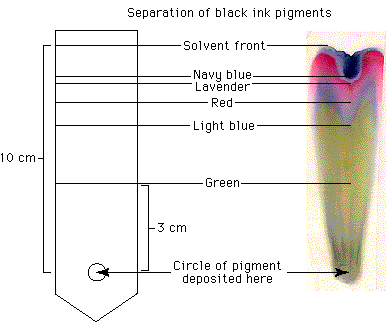
Separation of black ink pigments

The green, blue, red, and lavender colors that came from the black ink should help you to understand that what appears to be a single color may in fact be a material composed of many different pigments —and such is the case with chloroplasts.

chromatography setup


In paper chromatography the pigments are dissolved in a solvent that carries them up the paper. In the ink example, the solvent is water. To separate the pigments of the chloroplasts, you must use an organic solvent
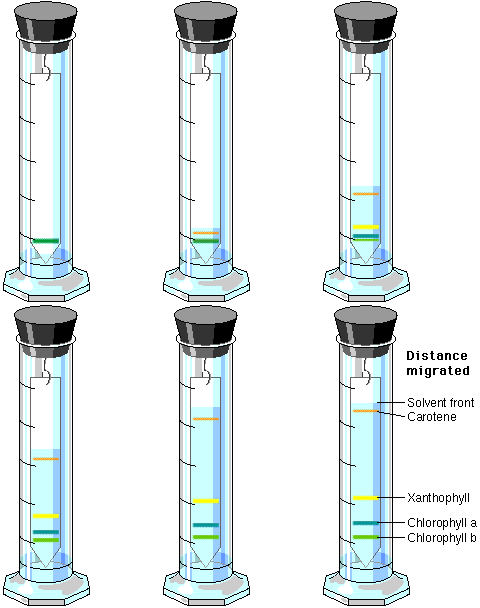


pigment separation


pigment separation


Analysis of Results I

If you did a number of chromatographic separations, each for a different length of time, the pigments would migrate a different distance on each run. However, the migration of each pigment relative to the migration of the solvent would not change. This migration of pigment relative to migration of solvent is expressed as a constant, Rf (Reference front). It can be calculated by using the formula:


 

Chromatography of Plant Pigments 3


Chromatography of Plant Pigments


Introduction:


Can chromatography be used to separate mixtures of chemical substances? The purpose of this experiment is to answer this question. In paper chromatography, a liquid sample flows down a vertical strip of absorbent paper, on which the components of a mixture are deposited in specific directions and locations. Chromatography is a tool used to examine and separate mixtures of chemical substances. Chromatography is essential to the separation of pure substances from complex mixtures. Separation results in a chromatographically pure substance. Chromatography allows you to determine the properties of chemical substances.

The relationship between the chromatography paper, mixture, and the solvent is very important in all chromatographic separations. The solvent has to dissolve the mixture that should be separated. The paper must also absorb the components of the mixtures selectively and reversibly. The substances making up the mixture must be evenly dispersed in the water. Chromatography is a simple and inexpensive tool for separating and identifying chemical mixtures if all these things are done.


Hypothesis:


Paper can be used to separate mixed chemicals.


Materials:


The materials used in this lab are filter paper, test tube, rubber stopper, paper clip, metric ruler, black felt-tip pen, pencil, calculator, and water.


Methods:


First, bend a paper clip so that it’s straight with a hook at one end. Push the straight end of the paper clip into the bottom of a cork stopper. Then, hang a thin strip of filter paper on the hooked end of the paper clip and insert the paper strip into the test tube. The paper should not touch the sides and should almost touch the bottom of the test tube. Next, remove the paper strip from the test tube. Now draw a solid 5-mm-wide band about 25 mm from the bottom of the paper, using a black felt tip pen. After this, use a pencil to draw a line across the paper strip 10 cm above the black band. Then, put the filter paper back into the test tube with the bottom of the paper in the water and the black band above the water. Observe what happens as the liquid travels up the paper and record the changes you see. When the solvent has reached the pencil line, remove the paper from the test tube. Let the paper dry on the desk. Finally, with a metric ruler, measure the distances from the starting point to the top edge of each color. Record the data in a data table and calculate a ratio for each color by dividing the distance, the color traveled by the distance the solvent traveled.


Results:


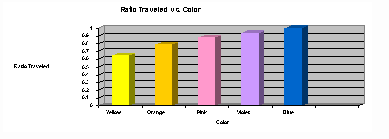
The results of the chromatography experiment are shown in a chart and a graph.


Color of ink (list in order) Distance traveled by each color (mm) Distance solvent traveled (mm) Ratio traveled = distance color moved divided by distance solvent moved
Yellow 70 108 0.65
Orange  

85


108


0.79

Pink 95  

108


0.88

Violet 102  

108


0.94

Blue 108  

108


1.00


Questions:

1. How many colors separated from the black ink? Five colors separated from the ink: yellow, orange, pink, violet, and blue.


2. What served as the solvent for the ink? Water served as the solvent for the ink.


3. As the solvent traveled up the paper, which color of ink appeared first? Dark blue appeared first.


4. List the colors in order from top to bottom that separated from the black ink? The colors separated in the order of: blue, violet, pink, orange, and yellow.


5. In millimeters, how far did the solvent travel? The solvent traveled 108 mm.


6. From your results, what can you conclude is true about black ink? Black ink is a mixture of several different colors.


7. Why did the inks separate? The inks separated because black ink is a mixture of different pigments that are soluble in water, have different molecular characteristics, and travel different distances.


8. Why did some inks move a greater distance? Some inks move a greater distance because molecules in ink have different characteristics, like how readily they are absorbed by paper. This means that the ink least readily absorbed by paper will travel farthest from the starting mark and the ink most readily absorbed by paper will be the closest to the starting mark. All of the different color inks that were separated were different in how readily they are absorbed by paper.

Error Analysis:


There are a few errors that could have changed the results. First, there could be inaccurate measurements of how far every color traveled or how far the water traveled up the filter paper. Another error could occur when calculating the ratio traveled, Rf value. Also, a longer test tube could have been used by different groups which would make the filter strip longer. This means that a group could have detected another color because they had more room on their filter paper. This also could have affected the ratios. Finally, the groups could have put different amounts of black ink on the filter paper.


Conclusion:


The hypothesis that paper can be used to separate mixed chemicals was correct. The different colored inks mixed together give the black its color. The five colors that separated from the black ink were blue, violet, pink, orange, and yellow. Blue appeared first and then was followed by violet, pink, orange, and yellow. The colors separated the way they did because they have different molecular characteristics, like how readily they were absorbed by the paper and their solubility in water. Blue was most readily absorbed by the paper and soluble by water, while yellow was the least.

BACK