Antibiotic Resistant Lab

Antibiotic resistance of bacteria

Procedure Using a sterile loop, pick an isolated colony from you bacterial plate. Try to find one that grew well but is all by itself. Move the colony (don’t scoop up the agar) to a new plate. Using a moist, sterile, cotton swab, spread the bacteria around on the plate.
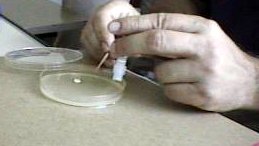
The goal is to get an complete, even, coverage of bacterial growth on the plate (called a “lawn”). Remember to open the plate only minimally, using the lid as an “umbrella” to prevent contamination (see image below). Label each plate on the bottom (agar contaning side) and store it for examination during next week’s lab.Each new prepared plate will receive four paper discs containing antibiotics. We will be using several different types of Antibiotics and/or antimicrobials.

(please fill in which antibiotics you used below)

  • 1
  • 2
  • 3
  • 4

The antibiotic discs come in a little tube-like dispenser. To remove the discs take a sterile toothpick and push out a disc into your plate. Use the toothpick to gently press the disc onto the agar. Once you have added the five antibiotic discs to your plates, make sure the plates are labelled and store them in the back of the lab until next week.
If the bacteria are susceptible to the antibiotic a zone of inhibited growth will be evident next week. Measuring the size of this zone is a relative indication of the effect of the antibiotic on the particular bacteria.

Bacteria possess several characteristics that enable them to become resistant to antimicrobial drugs:

  • Asexual reproduction
  • Short generation times
  • High mutation rates

Some Information on Antibiotics

Questions

1. Name two ways (1. and 2. ) that common human practices towards antimicrobials aids bacteria in becoming resistant.


2. Name two reasons your Physician will perform cultures such as the ones you have done in this lab.


4. How are materials are collected for cultures?


5. Why is neccesary to use sterile technique when obtaining cultures?


Alien Invasion


Alien Invasion

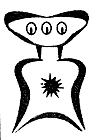
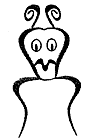
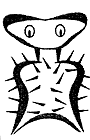
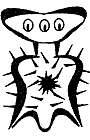
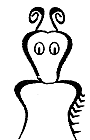
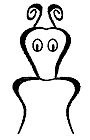
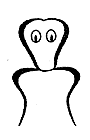
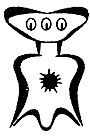
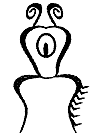
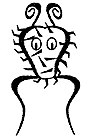
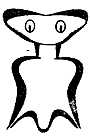
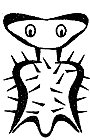
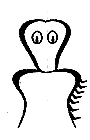
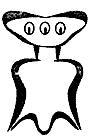
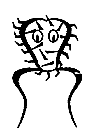
Help! Aliens have landed on Earth from another planet. Before scientists can release the aliens, they want to identify and classify them. Use the dichotomous key on the next page to identify these creatures.


1.
2.
3.
4.
5.
6.
7.
8.
9.
10.
11.
12.
13.
14.
15.
16.
17.
18.
19.
20.


   A Key to Alien Creatures:


1. a. The creature has a large wide head…………………………………….go to 2
b. The creature has a small narrow head……………………………….go to 11
2. a. It has 3 eyes ……………………………………………………………………………..go to 3
b. It has 2 eyes …………………………………………………………………………….go to 7
3. a. There is a star in the middle of its chest………………………….go to 4
b. There is no star in the middle of its chest ………………………go to 6
4. a. The creature has hair spikes ………………………………………..Broadus hairus
b. The creature has no hair spikes…………………………………………..go to 5
5. a. The bottom of the creature is arch-shaped ……………Broadus archus
b. The bottom of the creature is M-shaped ……………….Broadus emmus
6. a. The creature has an arch-shaped bottom ……………….Broadus plainus
b. The creature has an M-shaped bottom……………………Broadus tritops
7. a. The creature has hairy spikes ……………………………………………go to 8
b. The creature has no spikes…………………………………………………go to 10
8. a. There is a star in the middle of its body ………………..Broadus hairystarus
b. The is no star in the middle of its body ………………………..go to 9
9. a. The creature has an arch shaped bottom ……………….Broadus hairyemmus
b. The creature has an M shaped bottom ……………………Broadus kiferus
10. a. The body is symmetrical ………………………………………………Broadus walter
b. The body is not symmetrical……………………………………….Broadus anderson
11. a. The creature has no antennae ……………………………………….go to 12
b. The creature has antennae …………………………………………….go to 14
12. a. There are spikes on the face ………………………………….Narrowus wolfus
b. There are no spikes on the face ………………………………….go to 13
13. a. The creature has no spike anywhere ……………………Narrowus blankus
b. There are spikes on the right leg ………………………..Narrowus starboardus
14. a. The creature has 2 eyes…………………………………………………go to 15
b. The creature has 1 eye……………………………………………Narrowus cyclops
15. a. The creature has a mouth……………………………………………..go to 16
b. The creature has no mouth…………………………………………..go to 17
16. a. There are spikes on the left leg ………………………..Narrowus portus
b. There are no spikes at all ………………………………….Narrowus plainus
17. a. The creature has spikes ………………………………………………go to 18
b. The creature has no spikes ……………………………..Narrowus georginia
18. a. There are spikes on the head …………………………………..go to 19
b. There are spikes on the right leg……………………..Narrowus montanian
19. a. There are spikes covering the face ……………….Narrowus beardus
b. There are spikes only on the outside edge of head ……Narrowus fuzzus


Return to Earth

Alien Taxonomy Project


Alien Taxonomy


In the year 2525:

Humans, after hundreds of years of constant effort, have successfully polluted all bodies of water on Earth. As a result, almost all previously known species of plants, animals, and other life forms have become extinct. Through natural selection, genetic engineering, and selective breeding programs, a portion of the Earth has been successfully repopulated. The following organisms are all that remain:

  1. Photosynthetic humanoids with green chlorophyll-containing hair (autotrophs)
  2. Chemosynthetic dolphin-like organisms who derive their energy for food production from the contaminants in the water (autotrophs)
  3. Aquatic humanoids who work on the dolphin’s aquaculture farms (heterotrophic)
  4. Aqua wheat, a heterotrophic crop grown by the dolphins that feeds on bacteria
  5. Legless, photosynthetic humanoid space travelers with arm-like tentacles that visit the Earth every 6 weeks
  6. Anaerobic humanoids designed for space living, but when on Earth for space training, they must wear deoxygenated space suits (heterotrophs)
  7. Cockroach-like organisms that feed on humanoid and dolphin excrement (Decomposers)
  8. Heterotrophic giant squids that feed on humanoids & dolphins
  9. Green-skinned, photosynthetic rats
  10. Parasitic mosquitoes that feed on humanoids

Your Assignment:

As an alien taxonomist, it is your responsibility to classify these existing organisms.

  1. Create Latin-sounding Genus and species names for each organism. Remember that the species name should reflect a characteristic of the organism.
  2. Create a taxonomic scheme for each organism including a kingdom, phylum, and the genus and species name you created. Use only two kingdoms that you create. Be sure to also include the number of the organism with the scheme
  3. Illustrate your interpretation of each organism’s appearance including all the characteristics given to you.  All illustrations should be numbered and colored on a single sheet of unlined paper.
  4. Prepare a dichotomous key using the scientific names for these organisms so that your fellow aliens can also identify them when they come to Earth for summer vacations. 
  5. Make a cover sheet with your name, date, and period and paper clip your sheets together.


CLICK HERE FOR PRINTABLE COPY OF ACTIVITY & WORKSHEET

BACK