Cell Respiration Worksheet Ch 7 BI


Cellular Respiration


Section 7-1 Glycolysis & Fermentation

1. What organisms trap sunlight & store it in carbohydrates?

2. What 2 organisms break down carbohydrates to release energy from cells?

3. What is the main energy currency of a cell?

4. Define cellular respiration.

5. What process begins cellular respiration & does it produce much ATP?

6. If there is no oxygen in cells, the products of glycolysis enter ________________________
pathways that yield no additional ______________________.

7. Fermentation is __________________________ because no oxygen is used.

8. If oxygen is present in cells, the glycolysis products enter the ______________________
respiration pathway.

9. Does aerobic respiration produce much ATP?

10. What simple sugar starts glycolysis?

11. In glycolysis, glucose is broken into 2 molecules of _______________________ acid
in the ______________________ of the cell.

12. In which part of the cell does fermentation occur? Is oxygen involved?

13. Name the 2 types of fermentation.

14. __________________________ acid fermentation helps make cheese & yogurt and also
occurs in _______________________ cells during heavy exercise.

15. What effect does lactic acid have on muscle cells?

16. Yeasts carry on what type of fermentation?

17. What alcohol is made in alcoholic fermentation?

18. Table _____________________________ and ____________________ are made by yeasts
during alcoholic fermentation.

19. One molecule of sugar produces _________________ kilocalories of energy.

20. _______________________________ respiration, like glycolysis, produces less energy than
____________________________ respiration of pyruvic acid.

Section 7-2 Aerobic Respiration

21. Aerobic respiration requires what gas?

22. How much more ATP does aerobic respiration produce than glycolysis alone?

23. Name the 2 major stages of aerobic respiration.

24. What is completed in the Krebs cycle?

25. The energy carrier NAD+ is reduced to what substance?

26. Which part of aerobic respiration makes most of the ATP (cell’s energy)?

27. Where does aerobic respiration take place in prokaryotes?

28. Where do these reactions take place in eukaryotes?

29. What is the mitochondrial matrix & what product of glycolysis diffuses into this matrix?

30. What is found inside the mitochondrial matrix to help catalyze the reactions of the Krebs cycle?

31. What is acetyl CoA & to what does it combine?

32. Define Krebs cycle.

33. The first acid produced in the Krebs cycle is _________________ acid. (Diagram p. 135)

34. Two energy carriers are reduced in the Krebs cycle; ________________becomes NADH
and _________________ becomes FADH.

35. Is any ATP made in the Krebs cycle?

36. What gas is a waste product produced in the Krebs cycle?

37. The _________________________________ is the second part of aerobic respiration.

38. Where does the ETS take place in eukaryotic cells?

39. _________________________ is made in the ETS when NADH and FADH2 release
______________________ ions.

40. What gas serves as the final acceptor of electrons in the ETS (electron transport system)?

41. Write the equation for this gas accepting electrons at the end of the ETS (see page 137).

42. What is the final product of the ETS?

43. How many ATP’s of energy are made during glycolysis?

44. How many ATP’s of energy are made during the Krebs cycle?

45. Each FADH can generate how many ATP’s of energy?

46. Each NADH can generate how many ATP’s of energy?

47. _______________________ NADH molecules & ______________________ FADH
molecules are made by aerobic respiration.

48. How many ATP molecules are made by the electron transport system?

49. What is the maximum number of ATP molecules that can be produced from each glucose molecule?

50. Write the summary equation for cellular respiration.


Calorimetry lab

Calorimetry – Measuring the energy in Foods

Introduction:
There are two processes that organisms use to make usable energy. The process by which autotrophs convert sunlight to a usable form of energy is called photosynthesis. Photosynthesis supports all life on earth. Products from photosynthesis include food, textiles, fuel, wood, oils, and rubber. During photosynthesis, light energy is used to make organic compounds from inorganic water and carbon dioxide. Photosynthesis goes through light dependent reactions and the light independent reactions which include the Calvin cycle.
The process where heterotrophs break down food molecules to release energy for work is called cellular respiration. Cellular respiration is the reverse of photosynthesis; the reactants of one are the products of the other. The reactants of cellular respiration are glucose and oxygen, and the products are carbon dioxide, water, and energy.  Cellular respiration breaks down glucose to form carbon dioxide and water, while releasing energy usable by the cells. The first step, glycolysis is the process  that converts glucose to pyruvate and releases a small amount of cellular energy.  The second step may be aerobic or anaerobic depending on the amount of oxygen available.  Aerobic respiration is the breakdown of pyruvate in the presence of oxygen.  A larger amount of cellular energy or ATP is produced during the Kreb’s cycle and electron transport chain. Anaerobic respiration is the breakdown of food molecules in the absence of oxygen. Less ATP is produced by anaerobic respiration or fermentation.

Hypothesis:
If the heat given off by a burning pecan is measured by how much the temperature increases in a given amount of water, then the number of calories of energy stored in the nut during photosynthesis can be determined.

Materials:
Items needed for the lab included a large paper clip, a 100 ml graduated cylinder, thermometer, 2 soft drink cans, electronic balance, butane lighter, plastic tray, scissors, paper, and pencil.

Procedure:
Use a graduated cylinder to measure 100 ml of water and add this to an empty soft drink can. Cut holes on two sides of a second soft drink can so there is room to place a large bent paper clip.  Measure and record the mass of one pecan using the electronic balance. Bend a large paper clip to make a “nut stand” and measure and record  the mass of this clip. Place the pecan on the nut stand and put the stand inside the cut-out drink can.  Use a thermometer to measure and record the temperature of the water in the second can.  Place this can on top of the can with the nut. Use a butane lighter to ignite the nut. Record the temperature of the water when the nut is completely burned. Complete the data table by calculating the  the total calories in the pecan.

Data:    

Data Table 1

Before Burning After Burning Difference
Mass of Nut 1.7 g 0.1g 1.6g
Temperature of Water 20 40.1 20.1
Mass of Paper Clip 1.4g 1.4g 0g


Data Table 2
Mass of pecan 0.1 g
Temperature change of 100 ml of water 20.1
Calories required to produce temperature change in 100 ml water 2010
Calories per gram contained in the pecan 1182.4

Error Analysis:
Errors may have occurred in several ways during this experiment. One error that may have occurred is that some of the energy may have been lost during the burning. Some of the pecan’s energy was lost as light instead of heat energy. Also some of the heat measured in the water could have been due to the butane lighter used to ignite the pecan.

Conclusion:
The temperature of the 100 ml of water in the can above the burning pecan was changed by the energy given off by the pecan when it was burned.  The energy given off by the burning pecan was great enough to increase the water temperature by 20.1 degrees Celsius. The mass of the unburned pecan was 1.7g. It takes 100 calories to raise the temperature of 1 ml of water by 1 degree Celsius. The temperature of 100 ml of water was recorded to have increased by 20.1 degrees Celsius; therefore, the total number of calories in the pecan equals 20.1 x 100 or 2010 calories. Since the nut had a mass of 1.7g, the number of calories per gram equals 2010 divided by 1.7 or 1182.4 calories per gram.
The increase of temperature in the water showed that energy had been stored in the pecan. In this experiment, the amount of calories of heat energy stored in a pecan during photosynthesis was measured by a process known as calorimetry.


Carbon Dioxide Use in Plants


Do Plants Consume or Release CO2?


Introduction

The rate of photosynthesis can be determined by measuring the rate of production of sugar or oxygen or by measuring the rate of decrease in carbon dioxide concentration. A common aquarium plant called, Elodea,  can be used to show fast carbon dioxide is being removed from the water in which the Elodea is submerged.

6CO2 + 12H2O + light energy —> C6H12O6 + 6O2 + 6H2O


In this lab, you will use phenol red as an indicator to show whether CO2 is being consumed or produced in a reaction. It is well known that in the presence of light, plants perform photosynthesis. At the same time, plants are also performing cell respiration. To demonstrate this, we will determine whether CO2 is consumed or produced as Elodea is placed in either a light or dark environment. The change in CO2 will be detected by the pH indicator phenol red. Phenol red is yellow under acidic conditions (high H+ ion concentration), pink to magenta under basic or alkaline conditions (low H+ ion concentration), and orange under neutral conditions. A change in the amount of CO2 will cause a directly proportional change in H+ ion.

If the CO2 concentration decreases, the H+ ion concentration will also decrease, and the solution will change to pink, becoming basic.

If the CO2 concentration increases, the H+ ion concentration will also increase, and the solution will change to yellow, becoming acidic.

Neutral solutions of phenol red will be orange.

Materials:

phenol red solution,  4 sprigs of Elodea, soda straw, 4 test tubes, labeling marker, 100 ml graduated cylinder, beaker, aluminum foil

Procedure:

  1. Create a solution of phenol red by adding concentrated phenol red to about 100 ml of water in a beaker. The phenol red may change color as a result of adding water (depending on how acidic your tap water is). Your goal is to make your solution a neutral orange color. You can do this by gently blowing into the solution with a straw.
  2. Label 4 test tubes 1, 2, 3, and 4.
  3. Once you have the solution at an orange color, transfer it to 4 test tubes (they should be filled about 2/3 full with your orange solution).
  4. Place a cut piece of Elodea (cut end up) into tubes 2 and 4 and tightly cap.
  5. Test tubes 3 and 4 will not have Elodea. Cap and then cover these tubes with aluminum foil so no light can enter.
  6. Place tubes 1 and 2 in bright light.
  7. Place tubes 2 and 4 in the dark.
  8. After 24 hours, uncover and examine all 4 test tubes and record the results.

Data:


Test Tube # Contents of Tube Initial Color Final Color
1
2
3
4


Conclusion:

1. What test tubes served as the controls in this experiment. Why?


2. What was the dependent variable?


3. Do you think there would have been any change in any of the test tubes if they were left for 48 or 72 hours? Explain.


4. Describe and explain what happened in the test tubes.


5. Why did the color change occur?


6. Where does the carbon dioxide that is removed from the solution go?


7. What other process goes on in plant cells that requires oxygen and produces carbon dioxide?


8. What was the purpose in tightly capping all four test tubes?


Cell Cycle & Division


Cell Cycle & Division
All Materials © Cmassengale


Cell Division:

  • All cells are derived from preexisting cells (Cell Theory)
  • Cell division is the process by which cells produce new cells
  • Cell division differs in prokaryotes (bacteria) and eukaryotes (protists, fungi, plants, & animals)
  • Some tissues must be repaired often such as the lining of gut, white blood cells, skin cells with a short lifespan 
  • Other cells do not divide at all after birth such as muscle & nerve 

Reasons for Cell Division:

  • Cell growth
  • Repair & replacement of damaged cell parts
  • Reproduction of the species

Copying DNA: 

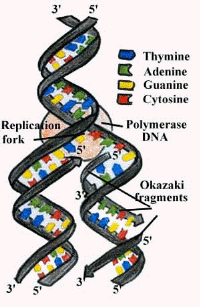
  • Since the instructions for making cell parts are encoded in the DNA, each new cell must get a complete set of the DNA molecules
  • This requires that the DNA be copied (replicated, duplicated) before cell division

Replication process

Chromosomes & Their Structure:

  • The plans for making cells are coded in DNA
  • DNA, deoxyribose nucleic acid, is a long thin molecule that stores genetic information
  • DNA in a human cell is estimated to consist of six billion pairs of nucleotides
  • DNA is organized into giant molecules called chromosomes
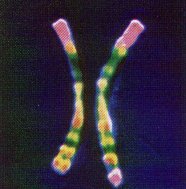
  • Chromosomes are made of protein & a long, single, tightly-coiled DNA molecule visible only when the cell divides
  • When a cell is not dividing the DNA is less visible & is called chromatin
  • DNA in eukaryotic cells wraps tightly around proteins called histones to help pack the DNA during cell division
  • Nonhistone proteins help control the activity of specific DNA genes
  • Kinetochore proteins bind to centromere and attach chromosome to the spindle in mitosis
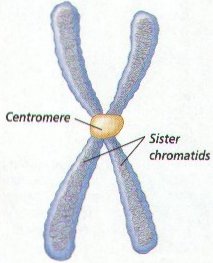
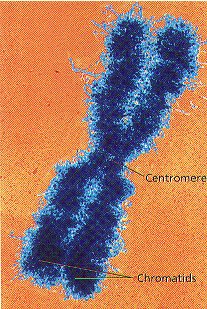
  • Centromeres hold duplicated chromosomes together before they are separated in mitosis
  • Telomeres are the ends of chromosomes which are important in cell aging
  • When DNA makes copies of itself before cell division, each half of the chromosome is called a sister chromatid

  • DNA of prokaryotes (bacteria) is one, circular chromosome attached to the inside of the cell membrane

Chromosome Numbers:

  • Humans somatic or body cells have 23 pairs of chromosomes or 46 chromosomes (diploid or 2n number)
  • The 2 chromatids of a chromosome pair are called homologues (have genes for the same trait at the same location)


Homologs

  • Human reproductive cells or gametes (sperms & eggs) have one set or 23 chromosomes (haploid or n number)
  • Every organism has a specific chromosome number


Organism Chromosome Number (2n)
Human 46
Fruit fly 8
Lettuce 14
Goldfish 94


  • Fertilization, joining of the egg & sperm, restores the diploid chromosome number in the zygote (fertilized egg cell)
  • Sex chromosomes, either X or Y, determine the sex of the organism
  • Two X chromosomes, XX, will be female and XY will be male
  • All other chromosomes, except X & Y, are called autosomes
  • Chromosomes from a cell may be arranged in pairs by size starting with the longest pair and ending with the sex chromosomes to make a karyotype
  • A human karyotype has 22 pairs of autosomes and 1 pair of sex chromosomes (23 total)


Human Male Karyotype

Genes:

  • A section of DNA which codes for a protein is called a gene
  • Each gene codes for one protein
  • Humans have approximately 50,000 genes or 2000 per chromosome
  • About 95% of the DNA in chromosome is “junk” that does not code for any proteins

Cell Cycle:

  • Cells go through phases or a cell cycle during their life before they divide to form new cells 
  • The cell cycle includes 2 main parts — interphase, and cell division
  • Cell division includes mitosis (nuclear division) and cytokinesis (division of the cytoplasm)
  • Interphase is the longest part of a cell’s life cycle and is called the “resting stage” because the cell isn’t dividing
  • Cells grow, develop, & carry on all their normal metabolic functions during interphase
  • Interphase consists of 3 parts — G1, S, & G2phases

Interphase:

  • G1 or 1st Growth Phase occurs after a cell has undergone cell division
  • Cells mature & increase in size by making more cytoplasm & organelles while carrying normal metabolic activities in G1 
  • S or Synthesis Phase follows  G1  and the genetic material of the cell (DNA) is copied or replicated 

  • G2 or 2nd Growth Phase occurs after S Phase and the cell makes all the structures needed to divide

Cell division in Prokaryotes:

  • Prokaryotes such as bacteria do not have a nucleus
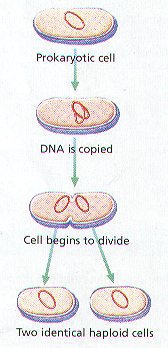
  • Prokaryotes divide into two identical new cells by the process of binary fission
  • Binary fission is an asexual method of reproduction
  • In binary fission,  the chromosome, attached to cell membrane, makes a copy of itself and the cell grows to about twice its normal size
  • Next, a cell wall forms between the chromosomes & the parent cell splits into 2 new identical daughter cells (clones)


Cell Division in Eukaryotes:

  • Eukaryotes have a nucleus & membrane-bound organelles which must be copied exactly so the 2 new cells formed from division will be exactly alike
  • The original parent cell & 2 new daughter cells must have identical chromosomes
  • DNA is copied in the S phase of the cell cycle & organelles, found in the cytoplasm,  are copied in the Growth phases
  • Both the nucleus (mitosis) and the cytoplasm (cytokinesis) must be divided during cell division in eukaryotes

Stages of Mitosis:

  • Division of the nucleus or mitosis occurs first
  • Mitosis is an asexual method of reproduction
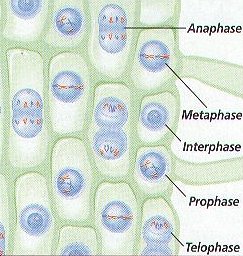
  • Mitosis consists of 4 stages — Prophase, Metaphase, anaphase, & Telophase

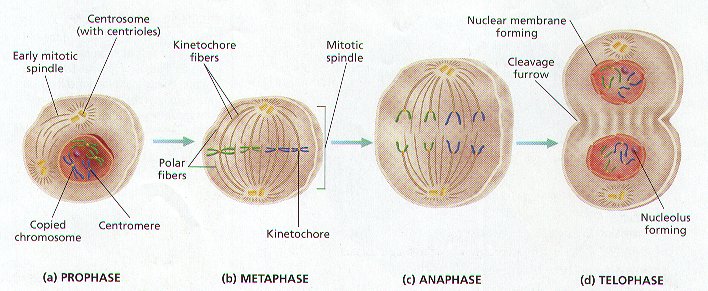
  • Prophase:
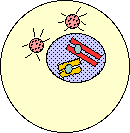
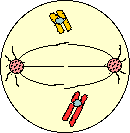
    • Chromosomes become visible when they condense into sister chromatids
    • Sister chromatids attach to each other by the centromere
    • Centrioles in animal cells move to opposite ends of cell
    • Spindle forms from centriole (animals) or microtubules (plants)
    • Kinetochore fibers of spindle attach to centromere
    • Polar fibers of spindle extend across cell from pole to pole
    • Nuclear membrane dissolves
    • Nucleolus disintegrates
  • Metaphase:
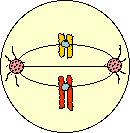
    • Chromosomes line up in center or equator of the cell attached to kinetochore fibers of the spindle
  • Anaphase:
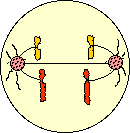
    • Kinetochore fibers attached to the centromere pull the sister chromatids apart
    • Chromosomes move toward opposite ends of cell
  • Telophase:
    • Nuclear membrane forms at each end of the cell around the chromosomes
    • Nucleolus reform
    • Chromosomes become less tightly coiled & appear as chromatin again
    • Cytokinesis begins

Cytokinesis:

  • Cytoplasm of the cell and its organelles separate into 2 new daughter cells
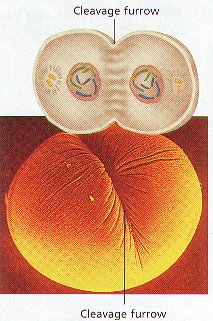
  • In animals, a groove called the cleavage furrow forms pinching the parent cell in two

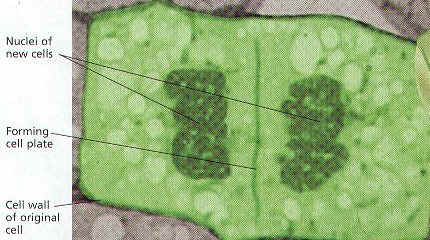
  • In plants, a cell plate forms down the middle of the cell where the new cell wall will be

Summary of Mitosis:


 Interphase


  1. Cell matures & carries on normal activities
  2. DNA copied & appears as chromatin
  3. Nucleolus visible
 Early Prophase  


  1. Chromosomes condense & become visible
  2. Centrioles separate & spindle starts forming
 
 Late Prophase

  1. Spindle forms with aster at each pole
  2. Nuclear membrane & nucleolus disintegrate
  3. Centromere of chromosomes attaches to spindle fibers
 Metaphase

  1. Chromosomes line up at the equator of the cell attached to kinetochore fibers of spindle
 Anaphase

  1. Centromeres split apart
  2. Homologs move to opposite poles of the cell
 Telophase/Cytokinesis  

  1. Nuclear membrane & nucleolus reform
  2. Cell pinches into 2 cells in animals
  3. In plants, a cell plate separates the 2 new cells


Cancer is Uncontrolled Mitosis:

  • Mitosis must be controlled, otherwise growth will occur without limit (cancer)
  • Control is by special proteins produced by oncogenes
  • Mutations in control proteins can cause cancer

Meiosis & Sexual Reproduction

  • Reduces the number of chromosomes in new cells to half the number in the original cell
  • New cells have a single copy of chromosomes (23 total) but are not identical to each other or the original parent cell
  • Used for making gametes ( sperm and eggs) with the haploid or n number
  • In meiosis, cells divide twice after a single DNA duplication
  • Meiosis I separates homologs & the Meiosis II separates sister chromatids
  • Meiosis I stages are Prophase I, Metaphase I, Anaphase I, & Telophase I
  • Meiosis II stages are Prophase II, Metaphase II, Anaphase II, & Telophase II
  • Produces 4 haploid cells or gametes
  • When a sperm fertilizes an egg to form a zygote, the diploid number of chromosomes is restored (23 + 23 = 46)
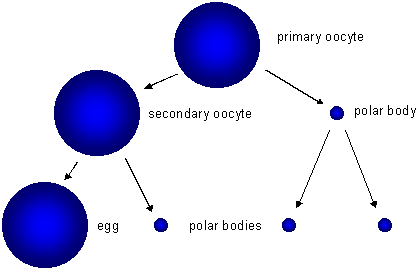
  • Egg cells or ova (ovum, singular) are larger , nonmotile cells
  • Gametoogenesis is meiosis producing eggs & occurs in the female’s ovaries


Oogenesis

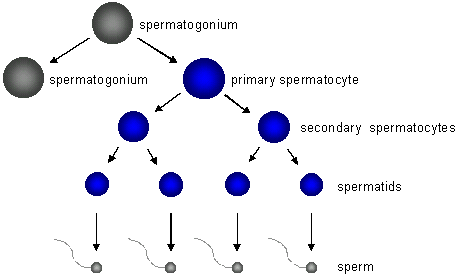
  • Sperms contain less cytoplasm so they’re smaller & have a flagellum to swim to the egg
  • Spermatogenesis is meiosis producing sperm cells & occurs in the testes


Spermatogenesis

Meiosis I:

  • The cell that undergoes Meiosis I is a primary spermatocyte or oocyte
  • Prophase I:
    • Chromosomes coil tightly & are visible
    • Nuclear membrane & nucleolus disintegrate
    • Spindle forms
    • Synapsis (joining) of homologous chromosomes occurs making tetrads
    • Kinetochore fiber forms on each chromosome
    • Chromosomes in tetrad exchange fragments by a process called crossing over

  • Metaphase I:
    • Tetrads become aligned in the center of the cell attached to spindle fibers
  • Anaphase I:
    • Homologous chromosomes separate
  • Telophase I:
    • May not occur in all species
    • Cytokinesis occurs producing 2 cells
    • In females,  2nd cell in females is called the 1st Polar Body
    • 1st Polar Body dies due to uneven splitting of the cytoplasm

  • Prophase II:
    • Cells called Secondary Spermatocytes or oocytes
    • DNA is not copied before cell divides
    • Chromatids attach to spindle fiber
  • Metaphase II:
    • Chromosomes become aligned in the center of the cell attached to spindle fibers
  • Anaphase II:
    • Sister chromatids separate randomly
    • Called independent assortment
  • Telophase I:
    • Cytokinesis occurs producing 4 cells in males called spermatids
    • Spermatids mature & form flagellum to become sperm
    • Cytokinesis in females produces a 2nd Polar Body that dies and an ootid 
    • Ootids mature to become ovum or egg

Asexual & Sexual reproduction:

  • Evolution is the slow process of change in living populations over time
  • Variations are differences that occur due to crossing-over among members of a sexually reproducing population
  • Variations are important to the survival of individuals in a population (some must survive to reproduce)
  • Asexually reproducing organisms rarely show variations because the organisms have identical genes

Cell Division Worksheet Ch 8 BI


Cell Division


Section 8-1 Chromosomes


1. What molecule in cells stores the genetic information?

2. DNA is built of billions of subunits called __________________________.

3. What are chromosomes, & when can they be seen?

4. What is the shape of chromosomes, & what 2 things are they made of?

5. Each chromosome is a single ________________ molecule with ____________________.

6. What is the purpose of histones?

7. What is the purpose of nonhistone proteins?

8. Chromosomes consist of two identical _____________________ called _________________.

9. What is a centromere?

10. Draw and label the parts of a chromosome.

11. Chromatids _______________________ during cell division so the two new cells will each
receive _________________ chromatid.

12. How does DNA appear in a cell between cell divisions?

13. What is chromatin & when does it exist in cells?

14. How many chromosomes do prokaryotes have?

15. How many chromosomes do each of these organisms have:
a. humans?
b. dog?
c. fruit fly?

16. What are the two categories of chromosomes?

17. Give 2 functions of the sex chromosomes.

18. Name the 2 sex chromosomes & tell what combination determines a male and a female organism.

19. What are autosomes & how many autosomes are in human cells?

20. What are homologous chromosomes & how do they compare to each other?

21. What is a karyotype?

22. In a human karyotype, where would each of these be found:
a. sex chromosomes?
b. longest homologs?
c. autosomes?

23. What is the main difference between diploid & haploid cells?

24. What type of cells in human would be diploid? Haploid?

25. How are diploid cells abbreviated? Haploid cells?

26. When a haploid (1n) ______________________ cell combines with a haploid
_______________________ cell, the new cell will be ______________________
or ____________________________.


Section 8-2 Cell Division


27. All cells are derived from ___________________________________.

28. What is cell division?

29. Define binary fission.

30. Describe the stages in binary fission of a prokaryote.

31. How do the two new cells compare to each other after binary fission? How do they compare to the original cell?

32. What two main cellular parts must be divided in eukaryotic cell division?

33. Name the 2 types of cell division in eukaryotes.

34. Define mitosis.

35. What type of cell uses mitosis?

36. What effect does meiosis have on the chromosome number of a cell?

37. How do the cells produced by meiosis reestablish a complete set of chromosomes?

38. What is the cell cycle?

39. Draw & label all parts of the cell cycle. (Figure 8-5, page 149)

40. What is the time between divisions in the life of a cell called?

41. How many phases is interphase divided into? Cell division?

42. Name the 2 parts of cell division.

43. What happens to the cell in each of these two parts of cell division?

44. In what stage do cells spend most of their time?

45. What is the size of cells immediately following cell division?

46. Name the 1st stage of interphase & tell what happens to the cell.

47. What stage of interphase do cells enter once they become mature?

48. What happens to a cell during the S phase of interphase?

49. What is the last stage of interphase called & what is happening to the cell?

50. What is the Go phase and what type of human cells are in this phase?

51. Name the 4 stages of mitosis in order.

52. What cellular part actually divides during mitosis?

53. Describe everything that happens to a cell during prophase.

54. Sketch and label a picture of a cell in prophase.

55. What are centrosomes & when do they appear?

56. What type of cell has centrosomes?

57. What is found inside centrosomes?

58. Are centrioles found in both plant & animal cells? Explain.

59. What forms from centrioles & what is their function?

60. Name the 2 types of fibers that make up the mitotic spindle & describe each one.

61. Describe everything that happens to a cell during metaphase.

62. Sketch & label a cell during metaphase.

63. Describe everything that happens to a cell during anaphase.

64. Sketch and label a cell during anaphase.

65. Describe everything that happens to a cell during telophase.

66. Sketch & label an animal cell during telophase.

67. Mitosis is division of the _______________________, while ________________________
is the division of the cytoplasm.

68. Define cytokinesis.

69. Describe how cytokinesis occurs in animal cells & include a drawing (figure 8-7, page 151)

70. The ____________________ pinches a dividing animal cell into two new cells by the action
of ______________________________.

71. How does the cell plate from during cytokinesis of a plant cell?

72. Sketch and label a plant cell during cytokinesis (figure 8-8, page 151)

73. How do the new cells formed after mitosis & cytokinesis compare in size & chromosome number to each other and the original cell that divided?

74. The original cell that divides is called the _______________________ cell, while the
two new cells are called ____________________ cells. (from lecture)


Section 8-3 Meiosis


75. What is meiosis?

76. What type of cell undergoes meiosis?

77. Meiosis produces ___________________ reproductive cells called ____________________.

78. Name the 2 human gametes & tell their chromosome number.

79. What is the chromosome number for humans?

80. The fusion of a _________________ and an _____________ produces a
________________ with 46 (2n) chromosome number.

81. Cells starting mitosis & meiosis begin with a ____________________ set of chromosomes.

82. How many times do cells divide during meiosis?

83. What are the stages of meiosis called?

84. Explain what happens during Meiosis I to each of these structures:
a. chromosomes?
b. spindle?
c. nucleus?
d. nucleolus?

85. What is synapsis & when does it occur?

86. What is a tetrad?

87. How are genes aligned on homologous chromosomes?

88. Explain what happens during crossing-over?

89. Sketch and color a picture of chromosomes during crossing-over. (Figure 8-10, page 154)

90. What type of material is exchanged during crossing-over?

91. Crossing over results in genetic _______________________________.

92. Draw a cell during anaphase I and explain what is occurring.

93. What is independent assortment & what result does it produce?

94. Name 2 things that occur during telophase I.

95. How many cells are formed at the end of Meiosis I & how many copies of chromosomes does each cell have?

96. Is DNA copied before Meiosis II?

97. How many cells form at the end of Meiosis II and how many chromosomes do they contain?

98. In humans, meiosis occurs in the ___________________ and in the __________________
producing cells called ________________________.

99. Define spermatogenesis & tell where it occurs.

100. Sketch spermatogenesis (Figure 8-12a, page 155).

101. What are spermatids & how many form from meiosis?

102. Define oogenesis & tell where it occurs.

103. Sketch oogenesis (Figure 8-12B, Page 155).

104. Mature egg cells are called ___________________.

105. Explain how only one egg cell is formed instead of four from meiosis.

106. What are the 3 other products of meiosis called?

107. Define asexual reproduction.

108. Name 2 types of asexual reproduction.

109. Name a type of asexual reproduction in unicellular organisms.

110. How do the offspring of asexual reproduction compare to their parents?

111. Define sexual reproduction.

112. How do offspring from sexual reproduction compare to their parents?

113. Is there ever a case in sexual reproduction where offspring can be genetically alike? Explain.

114. What is the evolutionary advantage of sexual reproduction?

BACK