Lab: Oil Degrading Process
 |
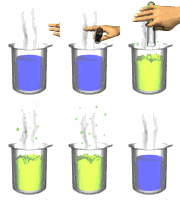 |
Introduction:
Oil spills are very hazardous to the environment and wildlife. Photographs of oil drenched birds and various sea animals are all in the back of our minds. Oil spills have become a greater problem as off shore drilling takes place. Studies show that about 5-10 million tons of oil is spilled every year. There are several sources for these oil spills and they include: cargo tanker spills at sea, waste oil pumping at sea, in port oil losses, and tanker accidents.
Cargo tanker washings at sea take place when the tankers use seawater as ballast to stabilize the craft after they have discharged their oil. This oil-contaminated water is then discharged back onto the ocean when the tanker is refilled. Waste oil pumping at sea takes place when dumping by ships other than tankers contributes an estimated 500,000 tons of oil annually. In port oil losses are attributed to collisions in ports and to procedures during loading and unloading of oil. This adds about 1 million tons of oil to sea pollution. Tanker accidents on the high seas or near the shore recently have added to the problem and have received great amounts of public attention. The Exxon Valdez the largest oil spill in history was carrying 1.2 million barrels of oil when in it ran into a reef off the coast of Alaska. Exploration losses occur during the search for and production of oil due to blowout of wells and accidental damage due to offshore drilling platforms. Oil can also leak form the 200,000 miles of pipeline that crosses waterways from cracks, punctures or corrosion in the pipes.
Two million barrels of motor oil are estimated to be lost every tear. Much of this oil ends up in coastal waters and shores. When one gallon of oil spilled in the ocean it can spread out for four acres. However 25% of spilled away is lost through evaporation. The remaining oil causes large amounts of oil to the marine life in the area that it was spilled. This oil will form a highly viscous material that sticks to every thing as it finds it way to the sea floor including: bird, fish, and marine mammals. Microorganisms and photo oxidation will break down the oil that does not this thick sticky substance. However oil spills that take place near shore have many different effects because the oil does not have enough time to break down. This causes many animals and much of the coastline to be covered with a very sticky black layer of oil.
When oil is spilled the short-term effects of the spill receive the most attention. The light intensity below an oil slick can be reduced by 90%. Oil films slow the amount of oxygen that is taken up by water. Polluted water has lower dissolved oxygen level than clean water. Birds that rely on the ocean for their survival are often greatly affected by spills. When oil forms a coat around the bird’s feathers it reduces the bird’s ability to fly, float and reduces the bird’s insulation ability. This causes many birds to doe from the cold, or their capability to get food. Compounds in oil such as benzene, toluene, xylene, naphthalene, and phenanthrene are toxic to man and animals. As a result many marine animals are killed as a result of an oil spill.
The long-term effects of an oil spill are not as easily seen as the short term effects. After oil has been in the water for a period of time it begins to affect many chemical messengers that animals rely on to survive such as finding food or escaping from predators. Oil is also incorporated into the animals’ body, as it becomes a part of the environment. Some marine animals that humans eat have fractions of oil in them, which can serve as a growing medium for many poisons.
Many methods have been developed to clean up oil spills. Skimmers are used to remove oil from the surface of the water. Skimmers work by skimming a thin of water and oil form the surface. Booms are used to contain the oil before it is skimmed. Clay, sawdust, straw, chopped corn and other absorbents have used to absorb spilled oil. Solvents have also been used to break the oil down. Burning the oil has even been attempted but it fails to completely break the oil down and makes a toxic smoke that contains carcinogenic compounds.
Oil is composed of many compounds that contain many hydrocarbons. The hydrocarbons of oil are broken down by fractional distillation. Since each compound of oil has different boiling points the compounds can be separated and collected by boiling the oil. Gasoline is distilled from below twenty degrees Celsius. Petroleum ether is separated from oil between twenty and sixty degrees. Ligroin is removed from the oil between sixty and one hundred degrees. Kerosene is removed form oil between 175 and 325 degrees. Many of these carbon compounds are cyclic compounds, which mean their atoms are attached to form rings.
In recent oil spills it has been learned that mechanically cleaning up the spill can be very complex, ineffective, and expensive. Mechanically cleaning up a spill depends upon the equipment available, workers and available, and normally it can only recover 10%-30% of the oil.
Biologically cleaning up oil spills is a great alternative to mechanical cleanup. Using microorganisms to clean up a spill is environmentally friendly and allows more of the spill to be cleaned up. This process involves seeding the oil spill with oil hungry microorganisms, bacteria yeasts, and fungi, and fertilizer to brake the oil down into masses of food and nontoxic cells that are absorbed into the food chain. These marine microorganisms naturally depend on hydrocarbons for survival so this is a natural alternative to mechanical methods. Fertilizers are spread out over the spill to promote the microorganism’s growth. Within days of when the organisms were applied to the spill changes in the oil can be seen. The oil noticeably is beginning to be broken down into fragments and other compounds. The remaining oil fractions become intermixed with and consumed by high forms of marine life.
This must all take place aerobically in the presence of oxygen. This explains why oil is able to be unchanged while it is underground. When oil is biologically broken down it products are acetate units, which are oxidized to carbon dioxide through the Krebs Cycle.
An aliphatic hydrocarbon is a compound that consists of carbon atoms joined together to form an open chain. Aliphatic compounds are oxidized into a two-carbon molecule, acetyl CoA that is catalyzed by a monooxygenase. The initial step of the oxidation of aliphatic hydrocarbons requires oxygen to serve as a reactant. The oxygen molecule is incorporated into the oxidized hydrocarbons and monoxygeneses are generally involved.
Investigation 1
Hypothesis:
In this investigation the bacteria Pseudomonas and the fungi Penicillium will break down the refined oil in the test tubes. The Pseudomonas species will brake the oil down more than the Penicillium species causing the water in test tube one to have a higher turbidity.
Materials:
The materials used in this investigation are as follows: 2 test tubes with caps, 60 mL of distilled water, one density test indicator strip, one test tube rack, Pseudomonas species culture, Penicillium species culture, a syringe, two 1 mL pipettes, and refined oil.
Procedure:
Begin by obtaining two tubes and labeling them tube # 1 pseudomonas, and tube #2 Penicillium. Add approximately 5 mL of distilled water to each tube. Next, place 4-5 drops of the refined oil to each test tube. Make sure to take notes of the general appearance of the color and texture of the oil. Record thee results from tube one in table one under day 0. Record the results from tube two in table two under day zero. Next, team member one in the group needs to inoculate tube one with the Pseudomonas, while team member two inoculates tube two with the Penicillium species. Do this by using a sterile pipette to add .5 mL of the assigned culture to the right tube. After completing this screw the cap on each tube tightly and invert the tube several times to mix; this mimics the wave action that would occur in the ocean. Then, place the tubes in an incubator set at thirty degrees Celsius for twenty-four hours. Make sure the cap on each tube is loosened one half turn. Make sure to invert the tubes once daily to increase the dissolved oxygen concentration in each tube. Also observe the tubes ever twenty-four hours for 3-4 days and make careful observations of the general appearance and characteristics of the oil. Also using an indicator measure the turbidity of the water in the tube every day. Record the results from tube one in table one and the results form tube two in table two.
Results:
Observations: Pseudomonas Species Application
Table 1
|
General Appearance
Characteristic of oil |
Color of
oil |
Turbidity of water |
| Day 0 |
The oil forms a thin uniform layer across the surface of the |
Amber |
0 |
| Day 1 |
The oil is lighter in color and has begun to brake into tiny fragments. There is a clear ring in the middle |
Light Yellow |
0 |
| Day 2 |
The oil has broken down significantly. It is fragmented and is cloudy in appearance |
Cloudy with a hint of yellow |
0 |
| Day 3 |
The oil is almost gone. A small ring is around the edge of the tube. |
Murky yellow ring |
0 |
| Day 4 |
The oil can be barely seen in very small fragments |
Clearish coudy |
0 |
Observations: Penicillium Species Application
Table 2
|
General Characteristics of oil |
Color of oil |
Turbidity of water |
| Day 0 |
The oil forms a thin uniform layer over the surface of the water. |
Amber |
0 |
| Day1 |
Oil has become lighter in color. The oil appears to becoming frothier in nature. |
Light yellow |
0 |
| Day 2 |
The oil is fragmenting. A white cloudy ring has formed. A growth has developed on the sides of the tube. |
Whitish cloudy with a yellow hue |
0 |
| Day 3 |
The oil has fragmented and broken down significantly. The ring now only is along the edge of the tube. |
Cloudy whitish yellow |
0 |
| Day 4 |
Oil is not detectable. Colonies fading. |
Not available |
0 |
Describe the physical characteristics and appearance of oil on day 0.
The oil on day 0 was amber yellow in color. The oil formed a thin uniform layer over the surface of the water.
Describe any changes in the physical characteristics and appearance of the oil on Day 1 and beyond, and discuss causes for such changes.
On day 1 the oil became a light yellow. On day two the oil had began to fragment and was a more whitish color. On day three the oil broken down more into more droplike fragments. A faint ring formed around the edge of the tube. On day 4 the oil was completely broken down.
Is there a difference in the rate of oil degradation between the bacterial and fungal culture?
Yes the fungal culture slightly broke the oil down quicker.
What does turbidity indicate?
Turbidity indicates the amount of oil being broken down and becoming part of the water.
What is the turbidity level of your culture after 4 days of incubation? How long do you think your culture will continue to grow?
The turbidity was 0. I believe the culture will continue to grow for a day or two at the most because the oil is almost completely degraded.
What is the limiting growth factor in your test tubes?
The amount of oil and the lack of space in the test tube.
Research the nutritional requirements and environmental conditions that promote the growth of bacteria and fungi. Suggest optimum conditions to culture bacteria and fungi.
Bacteria and fungi grow the best in a warm damp environment.
Investigation 2
Hypothesis:
The fertilizer in the jars and the amount of space in the jars will promote more bacterial and fungal growth causing the oil to broken down quicker than in the tubes. The Pseudomonas species will brake the oil down faster than the Penicillium species.
Materials:
The materials needed for this investigation are 2 clear plastic jars with screw caps, 400 mL of distilled water, a density indicator strip, 2 grams of nutrient fertilizer, a sterile pipette, Pseudomonas species bacteria, and Penicillium species fungi.
Procedure:
Begin the investigation by pre-labeling the jars #1 Pseudomonas species, and jar 2 Penicillium species. Next, fill the jars half full with water. Using a pipette add 15-20 drops of oil, to form a thin layer in order to simulate an oil spill. Make sure to make an initial observation of the general appearance and characteristics of the oil and record the results from jar one in table 3 and the results from jar two in table 4. Then, using your fingers sprinkle a fine layer of fertilizer over the entire layer of oil. Using another pipette inoculate jar # 1 with 1.25 mL of Pseudomonas species medium and jar # 2 with 1.25 mL of Penicillium species liquid medium. Place the jars in an incubator set at thirty degrees Celsius and make sure the lids on the jars are loose to let oxygen in. Make sure to observe the jars once every 24 hours for 4 days. Record your observations in tables 3 and 4. Using a pipette, once a day blow bubbles into the liquid in the jars to increase oxygen content in the water.
Results
Observations: Pseudomonas Species Application
Table 3
|
General appearance characteristics of oil |
Color of oil |
Turbidity of water |
| Day 0 |
Oil forms a thin uniform layer over the surface of the water. |
Amber |
0 |
| Day 1 |
The oil remains mostly the same except for a few beads in the middle. |
Goldish amber |
0 |
| Day 2 |
The oil is swirly. It is braking up into a very few new fragments. |
Cloudy whitish in color |
4 |
| Day 3 |
The oil is more beaded and does not cover as much of the water. |
Whitish cloudy |
5 |
| Day 4 |
The oil has broken up into very small traces. The colonies are larger and noticeable. |
Cloudy/ Clear |
5 |
Observations: Penicillium Species Application
Table 4
|
Characteristics appearance of oil |
Color of Oil |
Turbidity |
| Day 0 |
Oil forms a thin uniform layer over the water |
Amber |
0 |
| Day 1 |
Oil now is swirly and cloudy |
Goldish Yellow |
0 |
| Day 2 |
Swirly, beady and breaking up, not covering all the water |
Cloudy white |
0 |
| Day 3 |
Broken down more and beady, whitish blob formed in middle |
Whitish |
0 |
| Day 4 |
Beaded more but oil still remains |
Whitish |
0 |
Describe what happens to the oil after several days of microbial degradation. Are the microbes breaking up the oil? Can you detect an increase in microbial growth?
After several days the oil has broken into many fragments and does not completely cover the surface of the water. Yes the microbes are braking up the oil. Yes I can detect an increase in microbial growth.
Is the oil over the surface completely degraded? Can you still see any remaining oil on the surface? If so, explain.
Yes, a light swirl of oil remains over the top of the water. The swirl is cloudy white. This oil still has not been completely broken down.
What happens to oil when it is biologically degraded in the ocean?
It is broken down and absorbed by the water, the bacteria, and other marine animals. This causes it to become part of the natural environment.
What is the purpose of the nutrient fertilizer used over the oil spill?
The fertilizer speeds up the growth of the bacteria and fungus. The bacteria and fungi are the in turn able to degrade more oil.
Are there any adverse effects of using fertilizer over an actual oil spill to enhance indigenous microbial growth?
Yes fertilizer can pollute the water and can cause harmful effects to marine and plant life in the ocean.
Did you observe an increase in turbidity over time? Which of the two simulations was more turbid? Explain.
Yes there was an increase in turbidity over time. The jar containing the Pseudomonas species of bacteria was more turbid. The oil in this jar had been broken down more causing the water to be darker.
Did you observe fungal and bacterial growth in the test tubes or jars? Explain.
The jars had more fungal growth because a larger amount of oil was degraded due to the jars excess space and the nutrient fertilizer used.
Based on the information provided, do you think that the microorganisms would be effected by water temperature? Would they follow the floating oil or be dissipated by shifting winds or currents? And if they did eat the oil, would the residue damage marine life?
Yes water temperatures could affect the microorganisms. The organisms would follow the oil. Finally, no the oil residue would not damage any marine life.
Based on the physical characteristics of oil and water discuss possible resulting problems associated with oil spills.
Since oil does not mix with water the oil forms a thick sledge on top of the water that sunlight can not penetrate. This harms the many plants near the spill that depend on sunlight to carry out photosynthesis. The thick oil also gets into birds feathers that can prevent a bird from flying and insulating itself. Fish can also get the thick sludge on them affecting their gills.
In this investigation, we evaluated the ability of microbes to degrade oil under optimum conditions. Based on your findings, discuss possible environmental limitations in using such a method over an actual oil spill in the ocean.
Possible environmental limitations that could prevent this technique form being used is temperature which effects the growth of the bacteria and fungus. Shifting of bacteria by waves can also propose a threat. The natural occurrence of oil becoming thicker and sinking to the ocean floor also proposes a problem.
If you had to describe which clean up method to use in actual oil spill, would you use such a bioremediation method or use a mechanical method described in the introduction? Explain your decision.
I would use biological remediation because it is able to clean up more of the oil, is possibly cheaper, and is more environmentally friendly.
Assuming that you need 10-6 lbs. of highly concentrated cell mass mixed with nutrient fertilizer for the degradation of oil covering 0.022 sq. ft, as in the simulated oil spill, estimate the amount of cell mass and fertilizer mixture in pounds that would be needed to degrade the oil covering 1 square mile of an ocean. Assume there is the same amount of oil relative to the area.
Investigation 3
Hypothesis:
The bacteria and fungus will brake down the oil in the dish but not as well as the previous two because of the sand interfering with the degradation.
Materials:
The materials used in this investigation are 2 petri dishes, 60 mL distilled water, 2 grams of nutrient fertilizer, Pseudomonas and Penicillium cultures, and a sterile pipette.
Procedure:
Begin by pre-labeling two petri dishes #1 Pseudomonas and #2 Penicillium. Then, remove the lids and line each of the petri plates with a layer of sand. Make sure to spread the sand evenly over the plate. Next to simulate the shore conditions moisten the sand with distilled water until a thin layer of residual layer of water forms over the sand. Add 15-20 drops of refined oil throughout the surface, enough to form a thin layer to simulate an oil spill. Allow the oil to spread over the whole surface. Make initial observations of the condition of the oil and place results in tables five and six. Then using your thumb, sprinkle a fine layer of fertilizer over the oil. Using the pipette add 1.25 mL of the Pseudomonas culture to dish one and 1.25 mL of the Penicillium culture to dish 2. Place the lids on the dishes and store them in an incubator set at thirty degrees Celsius. Finally once a day for four days make observations of the oil.
Results
Observations: Pseudomonas Species Application
Table Five
|
General Appearance characteristics of oil |
Color of oil |
Turbidity of water |
| Day 0 |
Oil spread evenly over the surface of the sand and water creating a uniform layer |
Amber |
0 |
| Day 1 |
Oil remains similar darker in some parts than others |
Golden yellow |
0 |
| Day 2 |
Oil clear and yellow tanish parts have tiny beads |
Yellow |
0 |
| Day 3 |
Broken down a little more than day 3 into a few more beads |
Yellow |
0 |
| Day 4 |
Not available. |
N/A |
N/A |
Observations: Species Penicillium Species Application
Table Six
|
General Characteristics of oil |
Color of oil |
Turbidity |
| Day 0 |
Oil spreads out over the surface of the water forming a thin uniform layer |
Amber |
0 |
| Day 1 |
Oil remains similar, but darker in some places than others |
Amber |
0 |
| Day 2 |
Oil amounts have decreased. Some may soaked into sand. |
Yellow |
1 |
| Day 3 |
The oil not detectable. A dime size black spot in the center of dish identified as mold |
N/A |
N/A |
| Day 4 |
Oil characteristics N/A. Large black colony of fungus growing in the middle of container |
N/A |
N/A |
Describe the physical and chemical changes of the oil after several days of microbial degradation.
Day 1 the is darker in some parts than others. Day 2 oil is tanish and has no beads. Day 3 the oil in parts is beady. On day 4 the oil had disappeared probably sinking into the sand.
How effective do you think such a method is when in an actual oil spill on the shore? What happens to the degraded oil and the resultant microbial mass?
This method is less effective than it is in the open ocean because the oil can soak into the sand, but it is more effective than mechanical methods. The degraded oil and microbial mass either stay in the sand or are washed out to sea.
Discuss the limitations of using a mechanical method to clean up a spill on the shore. What are the limitations of using a remediation method? Which of the two methods would be the most efficient and economical to clean up oil spills.
For the mechanical methods the water has to be smooth and still. For the remediation the bacteria do not grow as well in the sand. The remediation is more effective and economical than mechanical methods.
Discuss the effect of an oil spill on the shore would have on plant life along the shoreline protists, and other larger animals.
The oil could get on the plants preventing them from absorbing sunlight. The oil could poison protists or get on them and prevent them from moving. Larger animals could get oil in their fur and prevent them form insulating themselves. It could prevent birds form both flying and insulating themselves.
In the Alaskan oil spill chemical detergents wee not used. Why? Explain the use of detergents.
Detergents weren’t to because of the cold temperatures. Detergents are used to help break the oil down by making water a better solvent. Detergents work the best in warm water.
Discuss the potential of bioremediation procedures in detoxifying the air, water, soil, and waste materials.
In the same way it is used in an oil spill bioremediation can be used to break down harmful waste products such as sewage. Factories could use remediation to clean the air before emitting it into the environment. When an hazardous chemicals pollute the soil remediation could be used to make the soil safer. Water could be treated with bioremediation after it is used and before it is pumped into streams, rivers, and oceans.
What can be done to prevent oil spills.
Better training tanker ship captains to avoid running into obstacles that could rip into the tanker. Keeping better maintenance on the pipelines that are used to transport oil. Being careful to prevent the leakage of motor oil from cars and other machines.
How are we affected by oil spills? Discuss the physical and economic consequences of oil spills.
Oil spills prevent from enjoying the marine life of the ocean, beaches, and the ocean itself. Fish we eat can be contaminated with oil compounds. Oil spills require a lot of money to clean up so normal people usually carry this burden.
Research other energy sources that can be used to cut our dependence on oil.
The use of electric cars could lower our dependence of oil. The development of hydrogen powered fuel cell that uses water for energy could also cut our dependence on oil. Using solar power could also cut our dependence on oil.
Error Analysis:
In investigation one not properly inverting the tubes every day could have caused the results received to be inaccurate. In investigation two not evenly spreading the fertilizer completely over the oil could have caused certain regions to have more growth than others causing false results. On investigation three using the slant to attain the Pseudomonas and Penicillium instead of the liquid culture may have caused false results.
Conclusion:
Using bioremediation is clearly a great alternative that is more cost effective, environmentally friendly, and productive than mechanical methods to clean up an oil spill. Bioremediation works best when mixed with a fertilizer to promote microorganism growth and spread over the open water. When bioremediation is used on coastal areas it productivity is reduced because the oil can sink into the sand and into the ground. When used without fertilizer in the open water bioremediation is not as effective because the microorganism growth is not enhanced. All in all bioremediation is very effective in cleaning up an oil spill.



