Potato Osmosis Bi Lab


Potato Osmosis


Introduction:

A shipwrecked sailor is stranded on a small desert island with no fresh water to drink. She knows she could last without food for up to a month, but if she didn’t have water to drink she would be dead within a week. Hoping to postpone the inevitable, her thirst drove her to drink the salty seawater. She was dead in two days. Why do you think drinking seawater killed the sailor faster than not drinking any water at all? Today we explore the cause of the sailor’s death. We’ll prepare solutions of salt water to represent the sea, and we’ll cut up slices of potato to represent the sailor. Potatoes are made of cells, as is the sailor!

Objective:

The concentration of solute in a solution will affect the movement of water across potato cell membranes.

Materials:

potato, corer, 3 plastic cups, marker, salt, sugar, distilled water, paper, pencil, electronic balance, clock with second hand or timer, metric ruler, small ziplock plastic bag, foil or plastic wrap

Procedure:

Day 1

  1. Use a knife to square off the ends of your potato. Your potato’s cells will act like the sailor’s cells.
  2. Stand your potato on end & use your cork borers to bore 3 vertical holes.
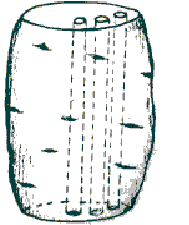
  1. Remove the potato cylinders from the cork borer & measure their length in centimeters.
  2. Cut the 3 potato cylinders to the same length (about 4 -5 centimeters long).
  3. Record the length & turgidity of the potato cylinders in your data table (day 1).
  4. Place the 3 potato cylinders in a small ziplock bag to prevent them from dehydrating before they’re used.
  5. Take 3 plastic cups and label them with the solution that will be placed in each one — sugar, salt, distilled water.
  6. Prepare a saturated solution of salt by mixing as much salt as you can with water.
  7. Repeat this step by making a saturated sugar solution.
  8. Now fill each cup 2/3’s full of the correct solution —- sugar water, salt water, or distilled water.
  9. Mass each of the potato cylinders & record this mass in grams on your data table.
  10. Place one of your potato cylinders into each cup and cover the top of the cup with foil or plastic.
  11. Leave the potato cylinders in the solution for 24 hours.

Day 2

  1. Carefully remove the potato cylinder from the distilled water solution & pat it dry on a paper towel.
  2. Measure the length of the potato cylinder & record this length & the appearance of the cylinder on your data table. (day 2)
  3. Measure & record the mass of this cylinder.
  4. Repeat steps 13-15 for the potato cylinders in the salt solution & the sugar solution.
  5. Clean up your equipment & area and return materials to their proper place.

Data:


Results of Osmosis in Potato Cells
Solution Initial length
cm
(day1)
Final length
cm
(day2)
Change in length
cm
Initial Mass
g
(day1)
Final Mass
g
(day2)
Change in mass
g
Initial Turgidity
(flaccid or crisp)
Final Turgidity
(flaccid or crisp)
Tonicity of Solution
(iso-, hypo-, or hpertonic)
Distilled water
Salt Solution
Sugar Solution


Results & Conclusions:

1. Did any of the potato cylinders change in their turgidity (flexibility), and if so, which ones changed?


2. Explain why the flexibility of the potato slices changed.


3. Define isotonic, hypotonic, & hypertonic solutions.


4. If potato slices changed in length or turgidity, what process was responsible for this?


5. Make a sketch of your potato cylinder in the distilled water and use arrows to show the direction of water movement across the potato cell membranes.


6. What type of solutions were the salt & sugar solutions. Explain how you know this.


7. Which solution served as the control for this experiment & why?


8. In which solutions was their a greater solute concentration outside of the cells?


9. In which direction did water move through these cell membranes?


10. In what type of solution do plant cells do best & why?


11. Using the information you’ve discovered from this experiment, explain why the sailor died that drank saltwater.



BACK

Preap Cell Study Guide


Cell Structure & Function  Review   


1. The first Person to describe microscopic organisms and living cells was
________________________________.

2. The maximum size to which a cell may grow is limited mainly by the cell’s ___________________________  ____________________________.

3. Short, hair-like organelles that can move and may cover a unicellular organism or line the respiratory tract are called ______________________________________.

4. Some Ribosomes are free in the cytoplasm, while others line the membrane of the
_________________  __________________  __________________________.

5. Everything between the cell membrane and the nucleus, is the cell’s
____________________________________.

6. All cells, from all organisms, are surrounded by a _______________   _____________________.

7. Membranes are _______________________ and have the consistency of vegetable oil.

8. The organelle that stores DNA and synthesizes RNA _________________________.

9. The organelle that processes and packages substances produced by the cell ______________________  _________________________.

10. The ____________________________ is the control center of the cell.

11. The DNA in the form of a long strand is called ______________________________.

12. Cytoplasm consists of two main components:  ____________________________ and
______________________________.

13. The cell membrane functions like a ______________________, controlling what
__________________ and _______________________ the cell.

14. A lipid is a simple form of ________________________________.

15. There are many kinds of ______________________ in cell membranes; they help to move material into and out of the cell.

16. Scientist call the modern view of the cell membrane structure the
______________________________ ____________________ _________________.

17. The nucleus is surrounded by a double layer membrane called the
__________________________  _________________________________.

18. During cell division, _________________________ strands coil and condense into thick structures called _____________________________________.

19. The nucleoli make ___________________________. Which in turn build proteins.

20. Membranes are made mostly of ___________________  and  ______________________.

21. The _________________ is the smallest unit that can carry out all of the processes of life.  The basic unit of life.

22. The maximum size to which a cell may grow is limited mainly by the cell’s ___________________  ____________________.

23. The discovery of cells is linked most directly the development of the __________________________.

24. Organisms whose cells never contain a membrane bound nucleus are called _____________________________________.

24. Suspended in the cell’s cytosol are tiny ___________________________________.

25. Cell membranes consist of two phospholipid layers called a ___________________.

26. The chromosomes in the nucleus contain coded _____________________ that control all cellular activity.

27. When a cell prepares to reproduce the _______________________ disappears.

28. Cytosol is a jelylike mixture that consists mostly of _____________________.

29. The nucleus is one ______________________________.

30. In Eukaryotic cells, most organelles are surrounded by a _____________________.

31. Organisms whose cells always or usually contain a nucleus or nuclei are called
____________________________________.

32.  ________________________ are structures that carry out specific functions in the cell.

33. Most cells have a single ______________________; some cells have more than one.

34. Unicellular organisms such as bacteria and their relatives are ___________________________.

35. The Fluid Mosaic Model presents the modern view of a
__________________  ___________________________.

36. The “Blueprints” in a Cell that controls all its activity are the ___________________.

37. Where are poisons and waste detoxified in a cell? _________________________ _________________________________.

38. A cell synthesizes protein by using organelles called _______________________________.

39. The Mitochondria of a cell contain an inner membrane called _____________________________.

40. What are the membrane-bound sacs that package and secrete cell products?
___________________________ ___________________________.

41. Unlike animal cells, plant cells have ______________  ________________.

42. A Chloroplast can convert _________________, __________________________, and ____________________________ into ________________________.

43. What are Flagella? ___________________________________________________.

44. In animal cells, the Cytoskeleton maintains three-dimensional structure and helps the cell ___________________________.

45. The organelle that digest molecules, old organelles, and foreign substances in the cell   _______________________________________.

46. A pigment that absorbs energy in sunlight ________________________________.

47. The organelle that prepares proteins for export and synthesizes steroids is  ________________________  ________________________.

48. Ribosomes differ from most organelles because they have no ___________________________.

49. What type of cells would you expect to find large numbers of mitochondria?  _______________________  _________________.

50. The “Powerhouse” of the cell _______________________________.

51. Short, hairlike organelles that can move and may cover a unicellular organism or line the respiratory tract are called _______________________________.

52. The first cells on Earth were likely _______________________ that did __________ make their own _________________.

53. Microfilaments and microtubules function in cell _______________________ and ____________________________.

54. What is the correct order of structures in living things, from simplest to the most complex? ______________________, __________________________, ______________________________, ______________________________.

55. The is the organelle that transfers energy in ATP _______________________________.

56. What word means “Water Fearing”? ____________________________.

57.  What word means “Water Loving”? _____________________________.

58. What is cell specialization? Give an example.
59. Distinguish between the structure of rough ER and that of smooth ER.

60. Explain how ribosomes, endoplasmic reticulum, Golgi apparatus function together in protein synthesis.

61. Explain the difference between a tissue and an organ.

62.  Why is the cell membrane said to be selectively permeable?

63.  If a cell has a high energy requirement, would you expect it to have many or few mitochondria? Explain your answer.

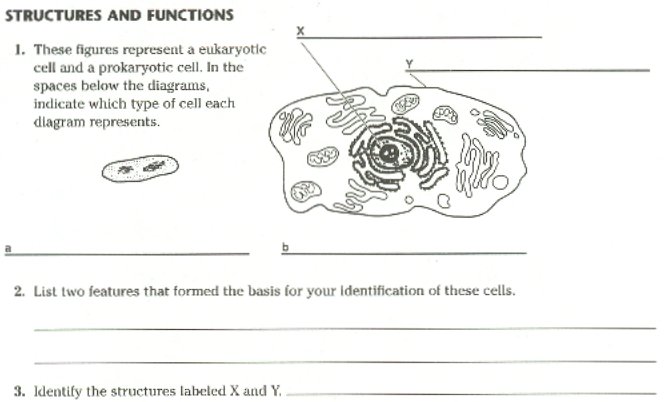
64. Describe TWO differences between prokaryotic cells and eukaryotic cells.

65. How can you determine whether a unicellular organism is a prokaryote or a eukaryote?

66. Plant cells have cell walls, but animal cells do not. Why do you think that is so?

67. What are the THREE Parts of the Cell Theory?

68. Describe three differences between plant and animal cells.

69. Name the TWO different kinds of animal cells, and describe how their shape is related to their function.

70. What is the difference between chromatin and chromosomes?

71. What are the major roles of the nucleus, and what parts of the nucleus carry out these roles?

72. What is a colonial organism, and what does it have in common with multicellular organisms?


Pedigree Lab

Constructing a Pedigree

Introduction

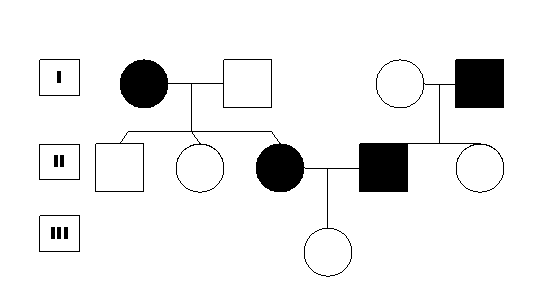
A pedigree is a special chart or family tree that uses a particular set of standardized symbols. Pedigrees are used to show the history of inherited traits through a family. In a pedigree, males are represented by squares and females by circles . An individual who exhibits the trait in question, for example, someone who suffers from hemophilia, is represented by a filled symbol or . A horizontal line between two symbols represents a mating . The offspring are connected to each other by a horizontal line above the symbols and to the parents by vertical lines. Roman numerals (I, II, III, etc.) symbolize generations. Arabic numerals (1,2,3, etc.) symbolize birth order within each generation. In this way, any individual within the pedigree can be identified by the combination of two numbers (i.e., individual II3).

Objective

Inherited traits can be traced through a family’s history by constructing a pedigree chart.

Materials

Large sheet of paper or poster board
Markers
Ruler
Protractor

Procedure
Part 1

1.      Examine Figure 1 that traces the ability to roll your tongue through three generations in a family. Remember: Blackened circles show the trait and circles are females and squares are male.

2.    Determine which parents and which offspring would be able to roll their tongue.  

FIGURE 1


Part 2

3.    Read the Passage 1 about the Smith family and their inherited trait of dimples.

4.    After reading the passage, construct a pedigree showing all family members in each generation that does and does NOT have dimples.

5.    Once the pedigree is constructed, write the correct genotype by each person in the family.


Passage 1

Grandfather and Grandmother Smith smiled a lot and showed off their dimples each time. They had a son named John, who had dimples, and daughter named Julie, who did not. Julie died at an early age, but her brother John Smith met and married Mary Jones because she had the most beautiful dimples when she smiled. They had 5 children, 2 boys and 3 girls. Only one of their sons, Tom, had dimples, but both girls, Judy and Kay, had dimpled smiles. Their sister June lacked dimples. After college, Tom met and married Jane Kennedy who also had dimples. They had 3 children, all girls, who shared their parent’s dimpled smile. Tom’s sister Kay married a lawyer named James who seldom smiled and didn’t have dimples. Their only son Matthew was like his mother when he smiled. Judy never married. Tom’s sister, June, married a doctor and had 5 children. Three of the children were boys, Jay, Fred, and Mike. Mike and Fred had dimples like dad, but Jay’s smile was like his mom’s lacking dimples. One sister, Susan, had dimples, but the other, Katherine, didn’t.


Questions

1.      What type of information does a pedigree contain?

2.    How do you show the presence of a trait in a pedigree?

3.    How do you denote males & females in a pedigree?

4.    From your pedigree, is the presence of dimples a dominant or recessive trait?

5.     How could examining a family pedigree be helpful to a couple wanting to have children?


Photosynthesis Worksheet Ch6 BI


Photosynthesis


Section 6-1 Capturing Light Energy

1. All organisms require ___________________ to carry out their life functions.

2. ___________________ is the ultimate energy for all life on earth.

3. During photosynthesis, the energy from the sun is stored within _____________________

compounds, mainly the sugar _______________________.

4. What organisms can carry on photosynthesis?

5. Name several autotrophic organisms.

6. What is a biochemical pathway and give an example?

7. What gas is used by autotrophs & what gas is produced?

8. What organisms release stored energy from organic compounds through cellular respiration?

9. Draw the diagram showing energy storage & transfer between autotrophs & heterotrophs. (Figure 6.1)

10. What are the light reactions of plants and in what organelle do they occur?

11. Draw & label the parts of a chloroplast. Tell the function of each labeled part.

12. Flattened sacs in chloroplasts are known as ____________________ and are

_______________________ to each other.

13. Thylakoid sacs in chloroplasts are called _____________________________.

14. What gel-like solution surrounds the thylakoids inside the chloroplast?

15. What is the visible spectrum?

16. Name the 7 colors that make up the visible spectrum.

17. What 3 things can happen to light that strikes an object?

18. What are pigments & what is their function in plants?

19. Is red light reflected or absorbed by an object if the object appears red to your eyes?

20. Name the most important chloroplast pigment & tell the 2 most important types of this pigment.

21. Only ________________________ is directly in capturing light energy.

22. Chlorophyll b is an example of an ______________________ pigment in plants.

23.Name another accessory pigment & tell what colors it includes. When could you see these colors?

24. Chlorophyll is most abundant in the _____________________ of a plant, while accessory
pigments appear more in the _________________________ and fruits.

25. The _________________________ and ________________________ pigments are grouped
into clusters in the thylakoid membrane.

26. What is a photosystem?

27. Name the 2 types of photosystems.

28. The light reactions start when __________________ pigments absorb ______________.

29. Absorbed light is passed to a pair of ________________________ pigment molecules in
photosystem ________.

30. When light energy is absorbed by chlorophyll a molecules, what happens to its electrons?

31. Once these electrons become “excited”, they have enough energy to do what?

32. What are the chemicals called that pick up these freed electrons & where are they located?

33. These electrons lose _________________ as they are passed through a series of molecules
called the ______________________________________ chain.

34. Photosystem I chlorophyll molecules also absorb ________________, and its electrons
eventually combine with ______________________ to form NADPH.

35. What would happen if the electrons lost from photosystem II weren’t replaced?

36. ________________________ provides the replacement electrons for photosystem II when
water is __________________________.

37. Write the equation for the splitting of a water molecule.

38. What important gas is released when water is split?

39. ______________ or energy for a cell is synthesized during the light reactions in a process
called ________________________________.

Section 6-2 Calvin Cycle

40. The _________________ cycle is the second set of photosynthetic reactions that uses energy
stored in ________________ and _____________________ to make __________________
compounds.

41. Carbon atoms from ______________ are “fixed” into organic compounds in the Calvin
cycle in a process called carbon _________________________.

42. In what part of the chloroplast does the Calvin cycle occur?

43. Carbon dioxide combines with _______________ to make two molecules of
_____________________________.

44. PGA is converted into ________________, ADP, _________________, and
phosphate.

45. Carbohydrates made from PGAL in the Calvin cycle include the monosaccharides
______________________ and ______________________, the disaccharide
_______________________, and polysaccharides such as _____________________,
________________________, and _______________________.

46. Write the balanced equation for photosynthesis. (See bottom of page 118.)

47. Plants that fix carbon through the Calvin cycle are called what type of plants?

48. What are stomata & where are they located?

49. When would plant cells need to close or partially close their stomata?

50. Name 2 alternate carbon-fixing pathways used by plants in hot climates.

51. Plants that close their stomata during the hottest part of the day thus fixing carbon into four
carbon compounds are called ______________________. Name three.

52. CAM plants open stomata at ______________ and close during the _________________.

53. Name 3 environmental factors that affect the rate of photosynthesis.

BACK


Photosynthesis

Photosynthesis
All Materials © Cmassengale

I. Capturing the Energy of Life

  1. All organisms require energy
  2. Some organisms (autotrophs) obtain energy directly from the sun and store it in organic compounds (glucose) during a process called photosynthesis

6CO2 + 6H2O + energy –>  6O2 + C6H12O6

II. Energy for Life Processes

  1. Energy is the ability to do work
  2. Work for a cell includes growth & repair, active transport across cell membranes, reproduction, synthesis of cellular products, etc.
  3. Work is the ability to change or move matter against other forces (W = F x D)
  4. Autotrophs or producers convert sunlight, CO2, and H2O into glucose (their food)
  5. Plants, algae, and blue-green bacteria, some prokaryotes, are producers or autotrophs
  6. Only 10% of the Earth’s 40 million species are autotrophs
  7. Other autotrophs use inorganic compounds instead of sunlight to make food; process known as chemosynthesis
  8. Producers make food for themselves and heterotrophs or consumers that cannot make food for themselves
  9. Heterotrophs include animals, fungi, & some bacteria, & protists

III.      Biochemical Pathways

  1. Photosynthesis and cellular respiration are biochemical pathways
  2. Biochemical pathways are a series of reactions where the product of one reaction is the reactant of the next
  3. Only autotrophs are capable of photosynthesis
  4. Both autotrophs & heterotrophs perform cellular respiration to release energy to do work
  5. In photosynthesis, CO2(carbon dioxide) and H2O (water) are combined to form C6H12O6 (glucose) & O2 (oxygen)
    6CO2 + 6H2O + energy –>  6O2 + C6H12O6
  6. In cellular respiration, O2 (oxygen) is used to burn C6H12O6 (glucose) & release CO2(carbon dioxide), H2O (water), and energy 
  7. Usable energy released in cellular respiration is called adenosine triphosphate or ATP


IV. Light Absorption in Chloroplasts

  1. Chloroplasts in plant & algal cells absorb light energy from the sun during the light dependent reactions
  2. Photosynthetic cells may have thousands of chloroplasts
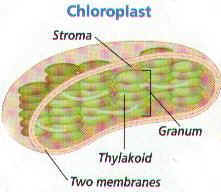
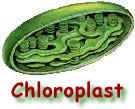
  3. Chloroplasts are double membrane organelles with the an inner membrane folded into disc-shaped sacs called thylakoids
  4. Thylakoids, containing chlorophyll and other accessory pigments, are in stacks called granum (grana, plural)
  5. Grana are connected to each other & surrounded by a gel-like material called stroma
  6. Light-capturing pigments in the grana are organized into photosystems

 V. Pigments

  1. Light travels as waves & packets called photons
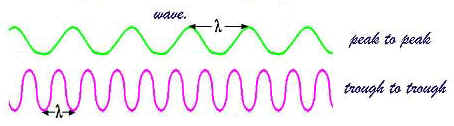
  2. Wavelength of light is the distance between 2 consecutive peaks or troughs

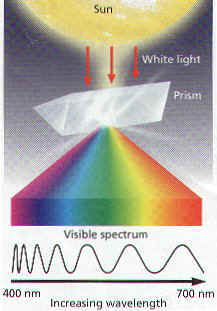
  1. Sunlight or white light is made of different wavelengths or colors carrying different amounts of energy
  2. A prism separates white light into 7 colors (red, orange, yellow, green, blue, indigo, & violet) ROY G. BIV
  3. These colors are called the visible spectrum

  1. When light strikes an object, it is absorbed, transmitted, or reflected
  2. When all colors are absorbed, the object appears black
  3. When all colors are reflected, the object appears white
  4. If only one color is reflected (green), the object appears that color (e.g. Chlorophyll)
VI. Pigments in the Chloroplasts


chlorophyll is found only in the chloroplasts
  1. Thylakoids contain a variety of pigments ( green red, orange, yellow…)
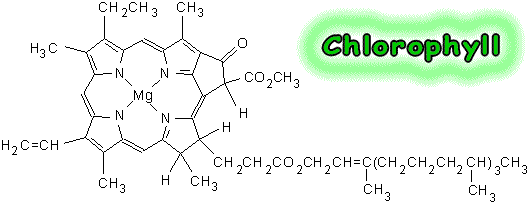
  2. Chlorophyll  (C55H70MgN4O6) is the most common pigment in plants & algae
  3. Chlorophyll a & chlorophyll b are the 2 most common types of chlorophyll in autotrophs
  4. Chlorophyll absorbs only red, blue, & violet light
  5. Chlorophyll b absorbs colors or light energy NOT absorbed by chlorophyll a
  6. The light energy absorbed by chlorophyll b is transferred to chlorophyll a in the light reactions

structural formula of chlorophyll

  1. Carotenoids are accessory pigments in the thylakoids & include yellow, orange, & red


VII. Overview of Photosynthesis        6CO2 + 6H2O C6H12O6 + 6O2

  1. Photosynthesis is not a simple one step reaction but a biochemical pathway involving many steps
  2. This complex reaction can be broken down into  two reaction systems — light dependent & light independent or dark reactions
  • Light Reaction:         H2O O2 + ATP + NADPH2
    • Water is split, giving off oxygen.
    • This system depends on sunlight for activation energy.
    • Light is absorbed by chlorophyll a which “excites” the electrons in the chlorophyll molecule.
    • Electrons are passed through a series of carriers and adenosine triphosphate or ATP (energy) is produced.
    • Takes place in the thylakoids.
  • Dark Reaction:         ATP + NADPH2 + CO2 C6H12O6
    • Carbon dioxide is split, providing carbon to make sugars.
    • The ultimate product is glucose.
    • While this system depends on the products from the light reactions, it does not directly require light energy.
    • Includes the Calvin Cycle.
    • Takes place in the stroma.

VIII. Calvin Cycle

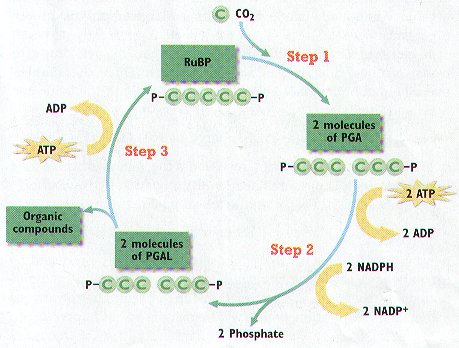
  1. Carbon atoms from CO2 are bonded or “fixed” into organic compounds during a process called carbon fixation
  2. The energy stored in ATP and NADPH during the Light Reactions is used in the Calvin cycle
  3. The Calvin cycle has 3 main steps occurring within the stroma of the Chloroplast

     STEP 1

  • CO2 diffuses into the stroma from surrounding cytosol
  • An enzyme combines a CO2 molecule with a five-carbon carbohydrate called RuBP
  • The six-carbon molecule produced then splits immediately into a pair of three-carbon molecules known as PGA

      STEP 2

  • Each PGA molecule receives a phosphate group from a molecule of ATP
  • This compound then receives a proton from NADPH and releases a phosphate group producing PGAL
  • These reactions produce ADP, NADP+, and phosphate which are used again in the Light Reactions.

   STEP 3

  • Most PGAL is converted back to RuBP to keep the Calvin cycle going
  • Some PGAL leaves the Calvin Cycle and is used to make other organic compounds including amino acids, lipids, and carbohydrates
  • PGAL serves as the starting material for the synthesis of glucose and fructose
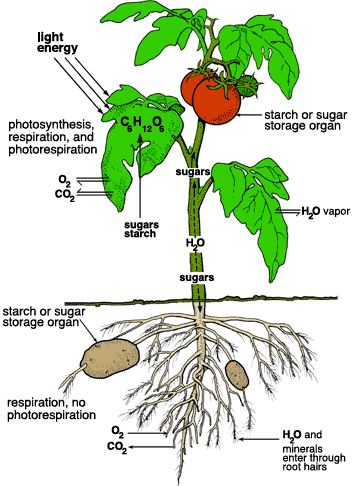
  • Glucose and fructose make the disaccharide sucrose, which travels in solution to other parts of the plant (e.g., fruit, roots)

movements within plants

  • Glucose is also the monomer used in the synthesis of the polysaccharides starch and cellulose

  1. Each turn of the Calvin cycle fixes One CO2 molecule so it takes six turns to make one molecule of glucose

IX. Photosystems & Electron Transport Chain

  1. Only 1 in 250 chlorophyll molecules (chlorophyll a) actually converts light energy into usable energy
  2. These molecules are called reaction-center chlorophyll
  3. The other molecules (chlorophyll b, c, & d and carotenoids) absorb light energy and deliver it to the reaction-center molecule
  4. These chlorophyll molecules are known as antenna pigments
  5. A unit of several hundred antenna pigment molecules plus a reaction center is called a photosynthetic unit or photosystem
  6. There are 2 types of photosystems — Photosystem I & Photosystem II
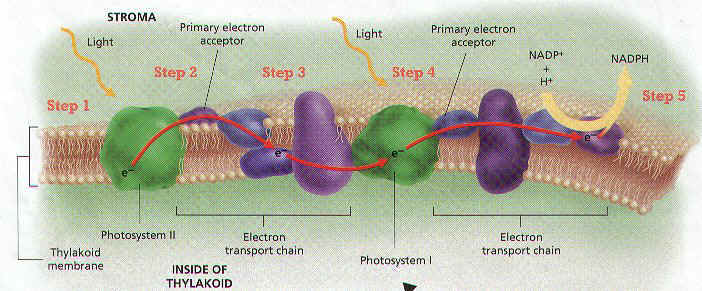
  7. Light is absorbed by the antenna pigments of photosystems II and I
  8. The absorbed energy is transferred to the reaction center pigment, P680 in photosystem II, P700 in photosystem I
  9. P680 in Photosystem II loses an electron and becomes positively charged so it can now split water & release electrons  (2H2O   4H+   +   4e-   +  O2)
  10. Electrons from water are transferred to the cytochrome complex of Photosystem I
  11. These excited electrons activate P700 in photosystem I which helps reduce NADP+ to NADPH
  12. NADPH is used in the Calvin cycle
  13. Electrons from Photosystem II replace the electrons that leave chlorophyll molecules in Photosystem I

X. Chemiosmosis (KEM-ee-ahz-MOH-suhs)

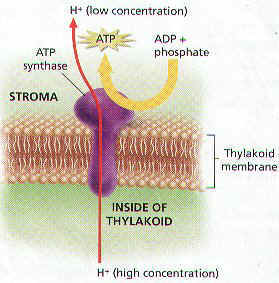
  1. Synthesis or making of ATP (energy)
  2. Depends on the concentration gradient of protons ( H+) across the thylakoid membrane
  3. Protons (H+) are produced from the splitting of water in Photosystem II
  4. Concentration of Protons is HIGHER in the thylakoid than in the stroma
  5. Enzyme, ATP synthetase in the thylakoid membrane, makes ATP by adding a phosphate group to ADP

XI. Alternate Pathways

  1. The Calvin cycle is the most common pathway used by autotrophs called C3 Plants
  2. Plants in hot, dry climates use alternate pathways to fix carbon & then transfer it to the Calvin cycle
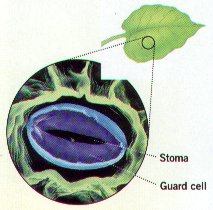
  3. Stomata are small openings on the underside of leaves for gas exchange (O2 & CO2)
  4. Guard cells on each side of the stoma help open & close the stomata
  5. Plants also lose H2O through stoma so they are closed during the hottest part of the day

  1. C4 plants  fix CO2 into 4-Carbon Compounds during the hottest part of the day when  their stomata are partially closed
  2. C4 plants include corn, sugar cane and crabgrass
  3. CAM plants include cactus & pineapples
  4. CAM plants open their stomata at night and close during the day so CO2 is fixed at night
  5. During the day, the CO2 is released from these compounds and enters the Calvin Cycle

XII. Factors Determining the Rate of Photosynthesis

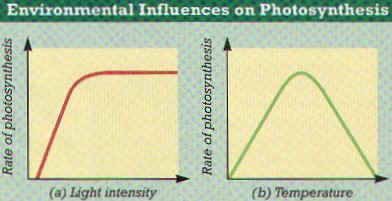
  1. Light intensity – As light intensity increases, the rate of photosynthesis initially increases and then levels off to a plateau
  2. Temperature – Only the dark, not the light reactions are temperature dependent because of the enzymes they use (25 oC to 37oC)
  3. Length of day
  4. Increasing the amount of carbon dioxide available improves the photosynthesis rate
  5. Level of air pollution


BACK