This presentation contains content that your browser may not be able to show properly. This presentation was optimized for more recent versions of Microsoft Internet Explorer.
If you would like to proceed anyway, click here.
This presentation contains content that your browser may not be able to show properly. This presentation was optimized for more recent versions of Microsoft Internet Explorer.
If you would like to proceed anyway, click here.
| Cellular Respiration Review |
1. Most eukaryotic cells produce only about ___________ ATP Molecules per Glucose Molecule.
2. What is the process by which glucose is converted to pyruvic acid? ________________________________________
3. At the beginning of aerobic respiration, pyruvic acid bonds to a molecule called ______________________________________ to form Acetyl CoA.
4. The breakdown of pyruvic acid in the presence of oxygen is called ______________________________ _______________________.
5. With every completion of the Krebs Cycle, how many ATP Molecules are made? ________________
6. What is the waste product of the Krebs Cycle? _____________________________________________.
7. The conversion of pyruvic acid to carbon dioxide and ethanol is called ___________________________________ _____________________________________________.
8. The release of energy from food molecules in the absence of oxygen is ______________________________________ _________________________________________________________.
9. What is the byproduct of the electron transport Chain?_______________________________________________.
10. How efficient is Anaerobic Respiration? __________% Aerobic Respiration? ____________%
11. What is the first pathway of cellular respiration called? ________________________________________________
12.What is the location of Glycolysis? _______________________________________________________
13. What is the scientific unit of Energy? ________________________________________________
14. What do you call cellular respiration in the presence of oxygen? _______________________________________ _________________________________________________________.
15. Yeast produces ______________________________ and _______________________________ in the process known as ____________________________________ ___________________________________________.
16. In cellular respiration, glycolysis proceeds the _______________________________ ___________________________.
17. In cellular respiration, more energy is transferred in the ___________________________ ________________________ _________________________________ than in any other step.
18. Glucose molecules are converted into _______________________________ _______________________ molecules in the process of glycolysis.
19. What is the location of the electron transport chain in prokaryotes? ________________ _______________________.
20. The processes of glycolysis and the anaerobic pathways is called ___________________________________.
21. What is the product of acetyl CoA and oxaloacetic acid? _________________ ___________________
22. What molecule is the electron acceptor of glycolysis? _________________________________________
23. The breakdown of organic compounds to produce ATP is known as ____________________________________ ________________________-_______________________________.
24. Glycolysis begins with glucose and produces ______________________________ _________________________.
25. An important molecule generated by both lactic acid and alcoholic fermentation is ______________________________.
26. In the first step of aerobic respiration, pyruvic acid from glycolysis produces CO2, NADH, H+, and _________________________________ _____________________________________.
27. The electron transport chain is driven by two products of the Krebs Cycle – ______________________ and ___________________________.
28. What happens to electrons as they are transported along the electron transport chain? _________________________________________________________________
29. The energy efficiency of aerobic respiration (including glycolysis) is approximately ______________ __________________________________________________.
30. Where in the mitochondria do the reactions of the Krebs cycle occur? _____________________________ ___________________________________________________________
31. Where in the mitochondria is the electron transport chain located? _____________________________ __________________________________________________
32. In alcoholic fermentation, ethyl alcohol is produced from _______________________________ ______________________________________.
33. ____________________________________, and _______________________________ supply electrons and protons to the electron transport chain.
34. Cellular respiration takes place in Two Stages: _______________________________________, then ________________________________________ ________________________________.
35. Water is an end product in the ________________________________________________________________
___________________________________________________________________.
36. In cellular respiration, a two-carbon molecule combines with a four-carbon molecule to form citric acid as part of the _____________________________________________________________________________________.
37. When glycolysis occurs, a molecule of glucose is ___________________________________________.
38. The name of the process that takes place when organic compounds are broken down in the absence of oxygen is _____________________________________________ or _______________________________________.
39. Energetic electrons that provide the energy for the production of most of a cell’s ATP are carried to the electron transport chain by _______________________________ and __________________________________________.
40. _______________________________________ is a biochemical pathway of cellular respiration that is anaerobic.
41. Glucose is split into smaller molecules during the biochemical pathway called __________________________________.
42. In the absence of oxygen, instead of oxidative respiration following glycolysis, glycolysis is followed by ______________________________________________________.
43. During fermentation, either ethyl alcohol and carbon dioxide or _______________________________________ is formed.
DIRECTIONS: Answer the questions below as completely and as thoroughly as possible. Answer the question in essay form (not outline form), using complete sentences. You may use diagrams to supplement your answers, but a diagram alone without appropriate discussion is inadequate.
1. How does aerobic respiration ultimately depend on photosynthesis?
2. Explain the role of oxaloacetic acid with respect to the cyclical nature of the Krebs cycle.
3. Glycolysis produces only 3.5% of the energy that would be produced if an equal quantity of glucose were completely oxidized. What has happened to the remaining energy in the glucose?
4. Why do most cells produce fewer than 38 ATP molecules for every glucose molecule that is oxidized through aerobic respiration?
5. What happens to electrons that accumulate at the end of the electron transport chain?
6. What role does chemiosmosis play in aerobic respiration?
7. What condition must exist in a cell for the cell to engage in fermentation?
8. How is the synthesis of ATP in the electron transport chain of mitochondria similar to the synthesis of ATP in chloroplasts?
9. The fourth step of glycolysis yields four ATP molecules, but the net yield is only two ATP molecules. Explain this discrepancy.
10. Under what conditions would cells in your body undergo lactic-acid fermentation?
11. What role does oxygen play in aerobic respiration? What molecule does oxygen become a part of as a result of aerobic respiration?
12. Where in the mitochondrion do protons accumulate, and what is the source of the protons?
| Potato Osmosis |
Introduction:
A shipwrecked sailor is stranded on a small desert island with no fresh water to drink. She knows she could last without food for up to a month, but if she didn’t have water to drink she would be dead within a week. Hoping to postpone the inevitable, her thirst drove her to drink the salty seawater. She was dead in two days. Why do you think drinking seawater killed the sailor faster than not drinking any water at all? Today we explore the cause of the sailor’s death. We’ll prepare solutions of salt water to represent the sea, and we’ll cut up slices of potato to represent the sailor. Potatoes are made of cells, as is the sailor!
Objective:
The concentration of solute in a solution will affect the movement of water across potato cell membranes.
Materials:
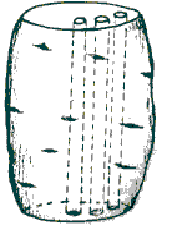
potato, corer, 3 plastic cups, marker, salt, sugar, distilled water, paper, pencil, electronic balance, clock with second hand or timer, metric ruler, small ziplock plastic bag, foil or plastic wrap
Procedure:
Day 1
Day 2
Data:
| Results of Osmosis in Potato Cells | |||||||||
| Solution | Initial length cm (day1) |
Final length cm (day2) |
Change in length cm |
Initial Mass g (day1) |
Final Mass g (day2) |
Change in mass g |
Initial Turgidity (flaccid or crisp) |
Final Turgidity (flaccid or crisp) |
Tonicity of Solution (iso-, hypo-, or hpertonic) |
| Distilled water | |||||||||
| Salt Solution | |||||||||
| Sugar Solution | |||||||||
Results & Conclusions:
1. Did any of the potato cylinders change in their turgidity (flexibility), and if so, which ones changed?
2. Explain why the flexibility of the potato slices changed.
3. Define isotonic, hypotonic, & hypertonic solutions.
4. If potato slices changed in length or turgidity, what process was responsible for this?
5. Make a sketch of your potato cylinder in the distilled water and use arrows to show the direction of water movement across the potato cell membranes.
6. What type of solutions were the salt & sugar solutions. Explain how you know this.
7. Which solution served as the control for this experiment & why?
8. In which solutions was their a greater solute concentration outside of the cells?
9. In which direction did water move through these cell membranes?
10. In what type of solution do plant cells do best & why?
11. Using the information you’ve discovered from this experiment, explain why the sailor died that drank saltwater.
| Cell Structure & Function Review |  |
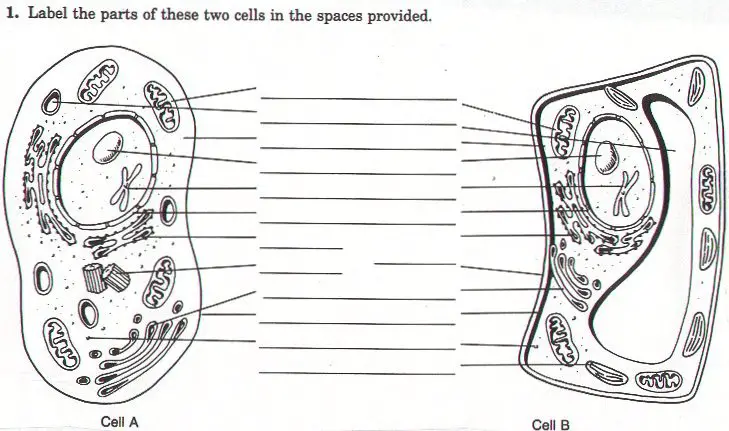
1. The first Person to describe microscopic organisms and living cells was
________________________________.
2. The maximum size to which a cell may grow is limited mainly by the cell’s ___________________________ ____________________________.
3. Short, hair-like organelles that can move and may cover a unicellular organism or line the respiratory tract are called ______________________________________.
4. Some Ribosomes are free in the cytoplasm, while others line the membrane of the
_________________ __________________ __________________________.
5. Everything between the cell membrane and the nucleus, is the cell’s
____________________________________.
6. All cells, from all organisms, are surrounded by a _______________ _____________________.
7. Membranes are _______________________ and have the consistency of vegetable oil.
8. The organelle that stores DNA and synthesizes RNA _________________________.
9. The organelle that processes and packages substances produced by the cell ______________________ _________________________.
10. The ____________________________ is the control center of the cell.
11. The DNA in the form of a long strand is called ______________________________.
12. Cytoplasm consists of two main components: ____________________________ and
______________________________.
13. The cell membrane functions like a ______________________, controlling what
__________________ and _______________________ the cell.
14. A lipid is a simple form of ________________________________.
15. There are many kinds of ______________________ in cell membranes; they help to move material into and out of the cell.
16. Scientist call the modern view of the cell membrane structure the
______________________________ ____________________ _________________.
17. The nucleus is surrounded by a double layer membrane called the
__________________________ _________________________________.
18. During cell division, _________________________ strands coil and condense into thick structures called _____________________________________.
19. The nucleoli make ___________________________. Which in turn build proteins.
20. Membranes are made mostly of ___________________ and ______________________.
21. The _________________ is the smallest unit that can carry out all of the processes of life. The basic unit of life.
22. The maximum size to which a cell may grow is limited mainly by the cell’s ___________________ ____________________.
23. The discovery of cells is linked most directly the development of the __________________________.
24. Organisms whose cells never contain a membrane bound nucleus are called _____________________________________.
24. Suspended in the cell’s cytosol are tiny ___________________________________.
25. Cell membranes consist of two phospholipid layers called a ___________________.
26. The chromosomes in the nucleus contain coded _____________________ that control all cellular activity.
27. When a cell prepares to reproduce the _______________________ disappears.
28. Cytosol is a jelylike mixture that consists mostly of _____________________.
29. The nucleus is one ______________________________.
30. In Eukaryotic cells, most organelles are surrounded by a _____________________.
31. Organisms whose cells always or usually contain a nucleus or nuclei are called
____________________________________.
32. ________________________ are structures that carry out specific functions in the cell.
33. Most cells have a single ______________________; some cells have more than one.
34. Unicellular organisms such as bacteria and their relatives are ___________________________.
35. The Fluid Mosaic Model presents the modern view of a
__________________ ___________________________.
36. The “Blueprints” in a Cell that controls all its activity are the ___________________.
37. Where are poisons and waste detoxified in a cell? _________________________ _________________________________.
38. A cell synthesizes protein by using organelles called _______________________________.
39. The Mitochondria of a cell contain an inner membrane called _____________________________.
40. What are the membrane-bound sacs that package and secrete cell products?
___________________________ ___________________________.
41. Unlike animal cells, plant cells have ______________ ________________.
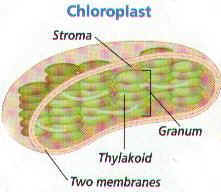
42. A Chloroplast can convert _________________, __________________________, and ____________________________ into ________________________.
43. What are Flagella? ___________________________________________________.
44. In animal cells, the Cytoskeleton maintains three-dimensional structure and helps the cell ___________________________.
45. The organelle that digest molecules, old organelles, and foreign substances in the cell _______________________________________.
46. A pigment that absorbs energy in sunlight ________________________________.
47. The organelle that prepares proteins for export and synthesizes steroids is ________________________ ________________________.
48. Ribosomes differ from most organelles because they have no ___________________________.
49. What type of cells would you expect to find large numbers of mitochondria? _______________________ _________________.
50. The “Powerhouse” of the cell _______________________________.
51. Short, hairlike organelles that can move and may cover a unicellular organism or line the respiratory tract are called _______________________________.
52. The first cells on Earth were likely _______________________ that did __________ make their own _________________.
53. Microfilaments and microtubules function in cell _______________________ and ____________________________.
54. What is the correct order of structures in living things, from simplest to the most complex? ______________________, __________________________, ______________________________, ______________________________.
55. The is the organelle that transfers energy in ATP _______________________________.
56. What word means “Water Fearing”? ____________________________.
57. What word means “Water Loving”? _____________________________.
58. What is cell specialization? Give an example.
59. Distinguish between the structure of rough ER and that of smooth ER.
60. Explain how ribosomes, endoplasmic reticulum, Golgi apparatus function together in protein synthesis.
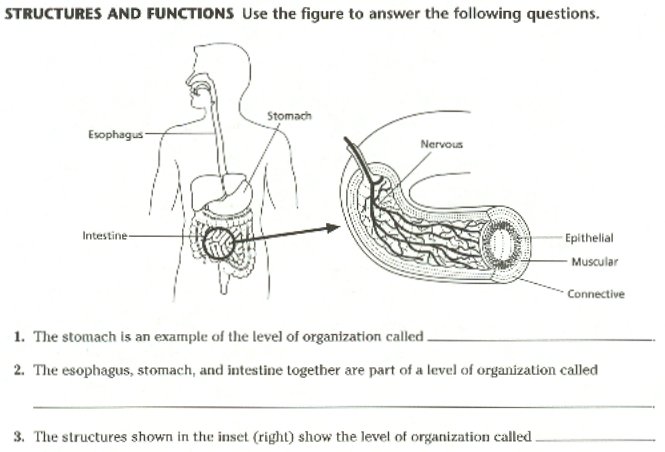
61. Explain the difference between a tissue and an organ.
62. Why is the cell membrane said to be selectively permeable?
63. If a cell has a high energy requirement, would you expect it to have many or few mitochondria? Explain your answer.
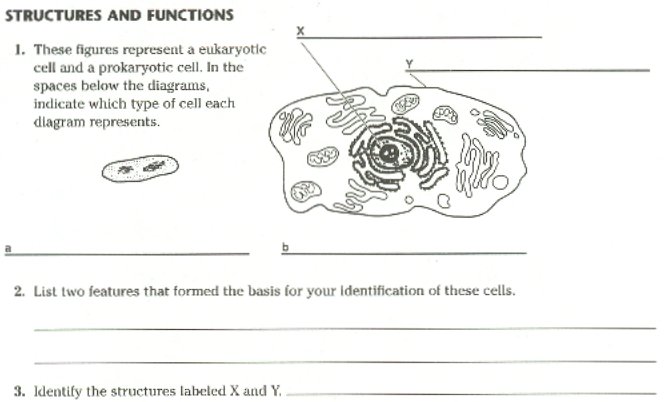
64. Describe TWO differences between prokaryotic cells and eukaryotic cells.
65. How can you determine whether a unicellular organism is a prokaryote or a eukaryote?
66. Plant cells have cell walls, but animal cells do not. Why do you think that is so?
67. What are the THREE Parts of the Cell Theory?
68. Describe three differences between plant and animal cells.
69. Name the TWO different kinds of animal cells, and describe how their shape is related to their function.
70. What is the difference between chromatin and chromosomes?
71. What are the major roles of the nucleus, and what parts of the nucleus carry out these roles?
72. What is a colonial organism, and what does it have in common with multicellular organisms?

Photosynthesis
All Materials © Cmassengale

I. Capturing the Energy of Life
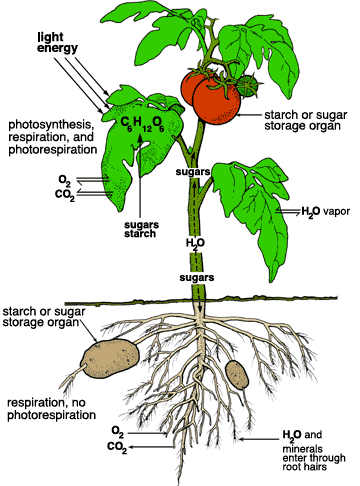
6CO2 + 6H2O + energy –> 6O2 + C6H12O6
II. Energy for Life Processes

III. Biochemical Pathways

IV. Light Absorption in Chloroplasts
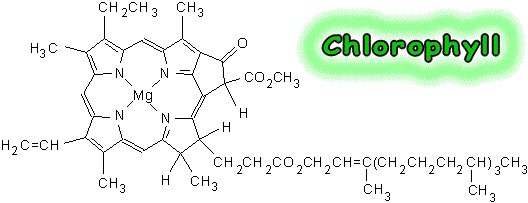
V. Pigments
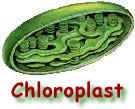
| VI. Pigments in the Chloroplasts
|
 |

VII. Overview of Photosynthesis 6CO2 + 6H2O C6H12O6 + 6O2

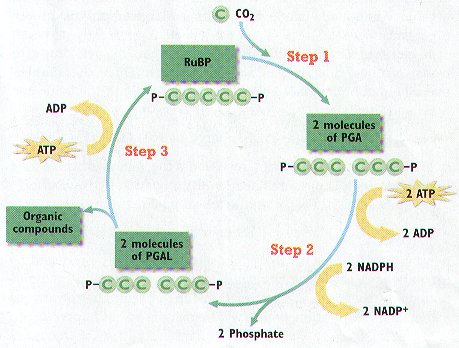
VIII. Calvin Cycle
STEP 1
STEP 2
STEP 3
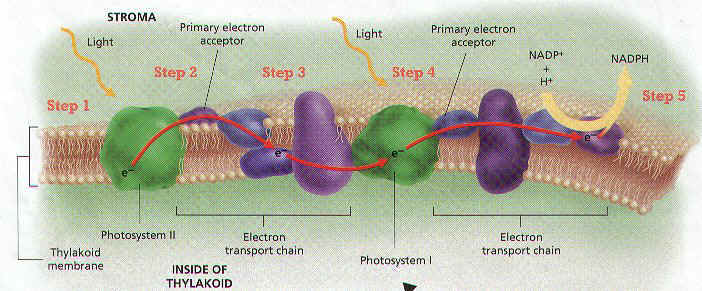
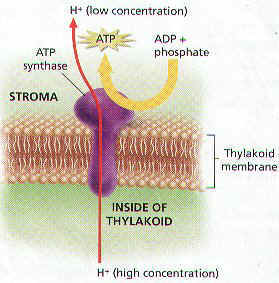
IX. Photosystems & Electron Transport Chain
XI. Alternate Pathways
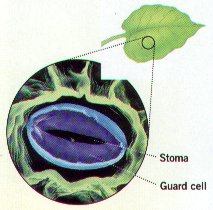
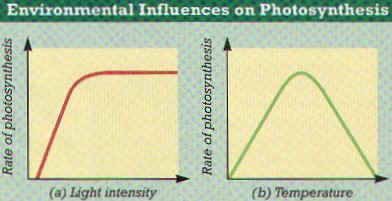
XII. Factors Determining the Rate of Photosynthesis