Origin of life PPT Qs

Origin Of Life
ppt Questions

Early Thoughts on Life

1. What was Aristotle’s idea about how life arose called?

2. What is another name for spontaneous generation?

3. Explain spontaneous generation of life.


4. How long did the idea of abiogenesis or spontaneous generation last?

5. The idea of abiogenesis lasted so long because, instead of testing their ideas, people based their beliefs on what?


6. Were their observations tested?

7. Did they use the scientific method for their observations?

Examples of Spontaneous Generation

8. What observation about new life did Egyptians make when the Nile River flooded each year?


9. What observation about new life did Medieval farmers make when they stored their grain each year?


10. The English people centuries ago, threw their garbage and sewage out on the streets. What observation about new life did these people make?


11. This practice led to a plague that killed many Europeans. What was this plague called and what carried the disease organism?


12.Before refrigerators, large slabs of meat were hung after being purchased. What observation about new life was made from this practice?


13. People believed so strongly in abiogenesis that they had recipes for making living things. Name two organisms that had accepted recipes.


Disproving Spontaneous Generation

14. Francesco ____________ was an early scientists who conducted experiments to try and disprove spontaneous generation.

15. What was Redi’s hypothesis?


16. Explain how Redi tried to prove this.


17. What were the results Redi found in the closed jars & why?


18. What were the results in the open jars?


19. How did maggots appear in the open jars?


20. Complete this table summarizing Redi’s experiment:


Evidence Against Spontaneous Generation
Unsealed Jar
Sealed Jar
Gauze Covered jar


21. Redi’s experiment disproved spontaneous generation for _____________ organisms.

Use of the Scientific Method

22. Did Francesco Redi use the scientific method in his experiment?

23. What served as the control in Redi’s experiment?


24. What jars served as the experimental groups?

25. What was Redi’s conclusion?


Disproving Spontaneous Generation of Microbes

26. Anton Van _______________ made one of the first simple microscopes.

27. Leeuwenhoek called the living things he saw in pond water ______________.

28. By the end of the 19th century, these organisms were known as ______________.

29. John _____________ did experiments with microorganisms growing in broths.

30. Needham believed there was a __________ __________ present in nonliving substances like air.

31. Why were bacteria able to grow in Needham’s soups?


32. What could have been done to the broths to kill the bacteria already present?

33. What scientists repeated this experiment but with boiled broth?

34. After boiling, what did Spallanzani do to the tops of the bottles? how did this help?


35. Critics of Spallanzani’s experiment said there was not enough _______ for the bacteria to survive and that boiling had destroyed the _________ __________.

The Theory Changes

36. What did the Paris Academy of Science do in 1860 to solve the problem?


37.Who won the prize? 

38. What was Pasteur’s experimental hypothesis?


39. What was the shape of Pasteur’s flasks? Include a sketch.


40. What was the special S-shaped neck intended to do?


41. Did Pasteur boil the broth in his flasks? Why?


42. The flasks were left at ___________ locations.

43. Did the broth change cloudy because microbes were growing in it?


44. What was visible in the neck of the flask after collecting there?

45. Once the S-shaped stem was broken off the top of the flasks, what happened to the broth and why?


46. Pasteur’s S-shaped flasks kept ___________ out but let ______ inside.

47. Pasteur’s experiment proved that living things only come from other _________ ___________.

48. What is the name of Pasteur’s theory?

Review

49. Where did the maggots come from in Redi’s experiment?

50. What was the purpose of the sealed jars?

51. Redi was trying to disprove – spontaneous generation or biogenesis?

52. Where did the microbes come from in Needham’s broth?

53. Needham & Spallanzani were trying to disprove – spontaneous generation or biogenesis?

54.Who proved biogenesis?


Pasteur Experiment

Recreation of Pasteur’s Experiment

Introduction:

Today, we take many things in science for granted. Many experiments have been performed and much knowledge has been accumulated that people didn’t always know. For centuries, people based their beliefs on their interpretations of what they saw going on in the world around them without testing their ideas to determine the validity of these theories — in other words, they didn’t use the scientific method to arrive at answers to their questions. Rather, their conclusions were based on untested observations.

Among these ideas, for centuries, since at least the time of Aristotle (4th Century BC), people (including scientists) believed that simple living organisms could come into being by spontaneous generation. This was the idea that non-living objects can give rise to living organisms. It was common “knowledge” that simple organisms like worms, beetles, frogs, and salamanders could come from dust, mud, etc., and food left out, quickly “swarmed” with life. For example:

Observation: Every year in the spring, the Nile River flooded areas of Egypt along the river, leaving behind nutrient-rich mud that enabled the people to grow that year’s crop of food. However, along with the muddy soil, large numbers of frogs appeared that weren’t around in drier times. Conclusion: It was perfectly obvious to people back then that muddy soil gave rise to the frogs.

Objective:

In this experiment, you will conduct an experiment similar to the one done by Pasteur whenever he disproved spontaneous generation.


Materials Needed:Experiment Set-Up

  • Low-salt broth (chicken or beef, home-made or purchased)
  • 2  250-mL Erlenmeyer flasks
  • 2  1-hole rubber stoppers with bent glass tubing inserted (see diagram)
  • Glycerine
  • Hot plate & pot holders
  • 50-ml Graduated Cylinder
  • Marker

Procedure:

  1. Students should work in teams of 2 to 3 people. Each team should perform the following steps.
  2. Use glycerine and a twisting motion to insert glass tubing into the stoppers. be sure to rinse off excess glycerine with water.
  3. Mark Erlenmeyer flasks accordingly:
    1. Flask 1 with stopper and glass tube going straight up
    2. Flask 2 with stopper and glass tube bent in S-curve
  4. Using a graduated cylinder, place about 50-mL of broth in each Erlenmeyer flask.
  5. Place appropriate lids on flasks.
  6. Use a hot plate to boil broth in flasks with appropriate lids on them for 30 min., then let cool.
  7. For the next ten days, observe the flasks and record any changes in color, turbidity, smell, etc. (Be careful to NOT remove the stoppers from the flasks.)

Data:

Microbial Growth Record
Record the appearance of the flask contents.

Day Flask 1 with Straight Tubing Day Flask 2 with S-shaped Tubing
1 1
2 2
3 3
4 4
5 5
6 6
7 7
8 8
9 9
10 10

Conclusion:

  1. What was the appearance on the broth in each flask on Day 1?
  2. Was their an observed appearance change in flask 1 over the 10 days? Describe the change, if any.
  3. Was their an observed appearance change in flask 2 over the 10 days? Describe the change, if any.
  4. Explain why there was or was not a change in the appearance of the broth in each flask.
  5. Why do you think the idea of spontaneous generation was believed to be true for so long (1000+ years)?
  6. Did your experiment support spontaneous generation of organisms? Explain why or why not?

Osmosis & Diffusion in Egg Lab


Osmosis & Diffusion in an Egg


Objective:
In this investigation, you will use a fresh hen’s egg to determine what happens during osmosis & diffusion across membranes.

Materials: (per lab group)
1-2 fresh hen eggs in their shells, masking tape & marker, distilled water, clear sugar syrup (Karo, for example), vinegar, clear jar with lid, tongs, electronic balance, paper towels, paper, pencil

Procedure:

Day 1   

  1. Label the jar with your lab group & the word “vinegar”.
  2. Mass the egg with the electronic balance & record in the data table.
  3. Carefully place the raw egg into the jar & cover the egg with vinegar.
  4. Loosely re-cap the jar & allow the jar to sit for 24 to 48 hours until the outer calcium shell is removed.

Day 2   

  1. Open the jar & pour off the vinegar.
  2. Use tongs to carefully remove the egg to a paper towel & pat it dry.
  3. Record the size & appearance of your egg in your data table.
  4. Mass the egg on an electronic balance & record.
  5. Clean and re-label the jar with your lab group & the word “distilled water”.
  6. Carefully place the egg into the jar & cover the egg with distilled water.
  7. Loosely re-cap the jar & allow it to sit for 24 hours.

Day 3   

  1. Open the jar & discard the distilled water.
  2. Use tongs to carefully remove the egg to a paper towel & pat it dry.
  3. Record the size & appearance of your egg in your data table.
  4. Mass the egg on an electronic balance & record.
  5. Clean and re-label the jar with your lab group & the word “syrup”.
  6. Carefully place the egg into the jar & cover the egg with clear syrup.
  7. Loosely re-cap the jar & allow it to sit for 24 hours.

Day 4   

  1. Open the jar & pour off the syrup.
  2. Use tongs to very carefully remove the egg & rinse off the excess syrup under slow running water.
  3. Pat the egg dry on a paper towel.
  4. Record the size & appearance of your egg in your data table.
  5. Mass the egg on an electronic balance & record.
  6. Clean up your work area & put away all lab equipment.

Data:


RESULTS OF DIFFUSION

Original Mass Final Mass Appearance of Egg
VINEGAR
WATER
SYRUP


Questions & Conclusion:

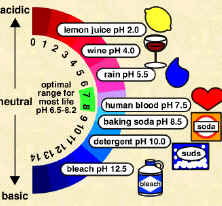
1. Vinegar is made of acetic acid & water. Explain how it was able to remove the calcium shell.


2. (a) What happened to the size of the egg after remaining in vinegar?

(b) Was there more or less liquid left in the jar?

   (c) Did water move into or out of the egg? Why?


3. (a) What happened to the size of the egg after remaining in distilled water?

(b) Was there more or less liquid left in the jar?

   (c) Did water move into or out of the egg? Why?


4. (a) What happened to the size of the egg after remaining in syrup?

(b) Was there more or less liquid left in the jar?

   (c) Did water move into or out of the egg? Why?


5. Was the egg larger after remaining in water or vinegar? Why?


6. Why are fresh vegetables sprinkled with water at markets?


7. Roads are sometimes salted to melt ice. What does this salting do to the plants along roadsides & why?


Mrs Nerg


      Seven Life Processes
Movement

Reproduction

Sensitivity

Nutrition

Excretion

Respiration

Growth

Mrs Nerg

MRS NERG


What one MAIN characteristic do ALL organisms have in common?

They’re all made of cells!

Nucleotide Model preap


Model of a Nucleotide


Introduction

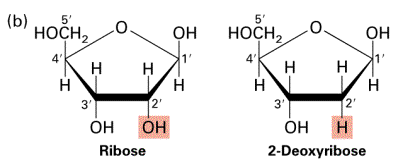
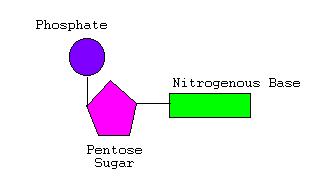
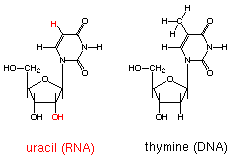
Nucleotides consist of three parts — a pentose sugar, a nitrogen-containing base, and a phosphate group. A pentose sugar is a five-sided sugar. There are 2 kinds of pentose sugars — deoxyribose and ribose. Deoxyribose has a hydrogen atom attached to its #2 carbon atom (designated 2′), and ribose has a hydroxyl group atom there. Deoxyribose-containing nucleotides are the monomers of DNA, while Ribose-containing nucleotides are the monomers of RNA.

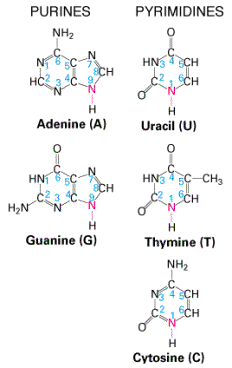
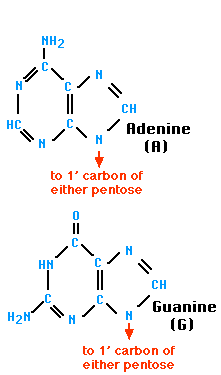
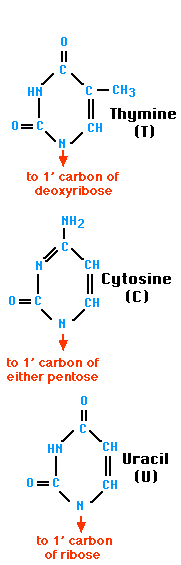
A nitrogen-containing ring structure is called a base. The base is attached to the 1′ carbon atom of the pentose. In DNA, four different bases are found — two purines, called adenine (A) and guanine (G) and two pyrimidines, called thymine (T) and cytosine (C). RNA contains The same purines, adenine (A) and guanine (G).  RNA also uses the pyrimidine cytosine (C), but instead of thymine, it uses the pyrimidine uracil (U).


The Purines The Pyrimidines

The combination of a base and a pentose is called a nucleoside.  A phosphate group is attached to the 5′ carbon of the pentose sugar.

Objective

Students will construct a 3-dimensional model of a single nucleotide, the monomer of which nucleic acids are composed.

Materials

Various materials may be used for the atoms that make up a nucleotide such as styrofoam balls, plastic coke bottle caps, beads, etc. Bonds between atoms may be made from toothpicks, plastic stirring sticks, popsicle sticks, etc. Single & double bonds must be represented by the correct number of “sticks”. The atoms and bonds may NOT be made of any food item. Your model should be glued together to make the model rigid for hanging. Attach string and a label with the nucleotide’s name to your model. Models must be sturdy, light weight, and small enough to hang from the ceiling.

Color Code for atoms:

CARBON – BLACK
HYDROGEN – YELLOW
OXYGEN – RED
NITROGEN – BLUE

Structural Formulas of Nucleotides:

Uracil Nucleotide (Ribose ) & Thymine Nucleotide (Deoxyribose)


Adenine Nucleotide (Deoxyribose)
Cytosine Nucleotide (Deoxyribose)
Guanine Nucleotide (Deoxyribose)