Chapter 13 – Meiosis and Sexual Life Cycles – Lecture Outline

Chapter 13    Meiosis and Sexual Life Cycles    Lecture Outline

Overview

·         Living organisms are distinguished by their ability to reproduce their own kind.

·         Offspring resemble their parents more than they do less closely related individuals of the same species.

·         The transmission of traits from one generation to the next is called heredity or inheritance.

·         However, offspring differ somewhat from parents and siblings, demonstrating variation.

·         Farmers have bred plants and animals for desired traits for thousands of years, but the mechanisms of heredity and variation eluded biologists until the development of genetics in the 20th century.

·         Genetics is the scientific study of heredity and variation.

A. The Basis of Heredity

1. Offspring acquire genes from parents by inheriting chromosomes.

·         Parents endow their offspring with coded information in the form of genes.

°         Your genome is comprosed of the tens of thousands of genes that you inherited from your mother and your father.

·         Genes program specific traits that emerge as we develop from fertilized eggs into adults.

·         Genes are segments of DNA. Genetic information is transmitted as specific sequences of the four deoxyribonucleotides in DNA.

°         This is analogous to the symbolic information of language in which words and sentences are translated into mental images.

°         Cells translate genetic “sentences” into freckles and other features with no resemblance to genes.

·         Most genes program cells to synthesize specific enzymes and other proteins whose cumulative action produces an organism’s inherited traits.

·         The transmission of hereditary traits has its molecular basis in the precise replication of DNA.

°         This produces copies of genes that can be passed from parents to offspring.

·         In plants and animals, sperm and ova (unfertilized eggs) transmit genes from one generation to the next.

·         After fertilization (fusion of a sperm cell and an ovum), genes from both parents are present in the nucleus of the fertilized egg, or zygote.

·         Almost all the DNA in a eukaryotic cell is subdivided into chromosomes in the nucleus.

°         Tiny amounts of DNA are also found in mitochondria and chloroplasts.

·         Every living species has a characteristic number of chromosomes.

°         Humans have 46 chromosomes in almost all of their cells.

·         Each chromosome consists of a single DNA molecule associated with various proteins.

·         Each chromosome has hundreds or thousands of genes, each at a specific location, its locus.

2. Like begets like, more or less: a comparison of asexual and sexual reproduction.

·         Only organisms that reproduce asexually can produce offspring that are exact copies of themselves.

·         In asexual reproduction, a single individual is the sole parent to donate genes to its offspring.

°         Single-celled eukaryotes can reproduce asexually by mitotic cell division to produce two genetically identical daughter cells.

°         Some multicellular eukaryotes, like Hydra, can reproduce by budding, producing a mass of cells by mitosis.

·         An individual that reproduces asexually gives rise to a clone, a group of genetically identical individuals.

°         Members of a clone may be genetically different as a result of mutation.

·         In sexual reproduction, two parents produce offspring that have unique combinations of genes inherited from the two parents.

·         Unlike a clone, offspring produced by sexual reproduction vary genetically from their siblings and their parents.

B. The Role of Meiosis in Sexual Life Cycles

·         A life cycle is the generation-to-generation sequence of stages in the reproductive history of an organism.

°         It starts at the conception of an organism and continues until the organism produces its own offspring.

1. Human cells contain sets of chromosomes.

·         In humans, each somatic cell (all cells other than sperm or ovum) has 46 chromosomes.

°         Each chromosome can be distinguished by size, position of the centromere, and pattern of staining with certain dyes.

·         Images of the 46 human chromosomes can be arranged in pairs in order of size to produce a karyotype display.

°         The two chromosomes comprising a pair have the same length, centromere position, and staining pattern.

°         These homologous chromosome pairs carry genes that control the same inherited characters.

·         Two distinct sex chromosomes, the X and the Y, are an exception to the general pattern of homologous chromosomes in human somatic cells.

·         The other 22 pairs are called autosomes.

·         The pattern of inheritance of the sex chromosomes determines an individual’s sex.

°         Human females have a homologous pair of X chromosomes (XX).

°         Human males have an X and a Y chromosome (XY).

·         Only small parts of the X and Y are homologous.

°         Most of the genes carried on the X chromosome do not have counterparts on the tiny Y.

°         The Y chromosome also has genes not present on the X.

·         The occurrence of homologous pairs of chromosomes is a consequence of sexual reproduction.

·         We inherit one chromosome of each homologous pair from each parent.

°         The 46 chromosomes in each somatic cell are two sets of 23, a maternal set (from your mother) and a paternal set (from your father).

·         The number of chromosomes in a single set is represented by n.

·         Any cell with two sets of chromosomes is called a diploid cell and has a diploid number of chromosomes, abbreviated as 2n.

·         Sperm cells or ova (gametes) have only one set of chromosomes—22 autosomes and an X (in an ovum) and 22 autosomes and an X or a Y (in a sperm cell).

·         A gamete with a single chromosome set is haploid, abbreviated as n.

·         Any sexually reproducing species has a characteristic haploid and diploid number of chromosomes.

°         For humans, the haploid number of chromosomes is 23 (n = 23), and the diploid number is 46 (2n = 46).

2. Let’s discuss the role of meiosis in the human life cycle.

·         The human life cycle begins when a haploid sperm cell fuses with a haploid ovum.

·         These cells fuse (syngamy), resulting in fertilization.

·         The fertilized egg (zygote) is diploid because it contains two haploid sets of chromosomes bearing genes from the maternal and paternal family lines.

·         As an organism develops from a zygote to a sexually mature adult, mitosis generates all the somatic cells of the body.

°         Each somatic cell contains a full diploid set of chromosomes.

·         Gametes, which develop in the gonads (testes or ovaries), are not produced by mitosis.

°         If gametes were produced by mitosis, the fusion of gametes would produce offspring with four sets of chromosomes after one generation, eight after a second, and so on.

·         Instead, gametes undergo the process of meiosis in which the chromosome number is halved.

°         Human sperm or ova have a haploid set of 23 different chromosomes, one from each homologous pair.

·         Fertilization restores the diploid condition by combining two haploid sets of chromosomes.

3. Organisms display a variety of sexual life cycles.

·         Fertilization and meiosis alternate in all sexual life cycles.

·         However, the timing of meiosis and fertilization does vary among species.

·         These variations can be grouped into three main types of life cycles.

·         In most animals, including humans, gametes are the only haploid cells.

°         Gametes do not divide but fuse to form a diploid zygote that divides by mitosis to produce a multicellular organism.

·         Plants and some algae have a second type of life cycle called alternation of generations.

°         This life cycle includes two multicellular stages, one haploid and one diploid.

°         The multicellular diploid stage is called the sporophyte.

°         Meiosis in the sporophyte produces haploid spores that develop by mitosis into the haploid gametophyte stage.

°         Gametes produced via mitosis by the gametophyte fuse to form the zygote, which grows into the sporophyte by mitosis.

·         Most fungi and some protists have a third type of life cycle.

°         Gametes fuse to form a zygote, which is the only diploid phase.

°         The zygote undergoes meiosis to produce haploid cells.

°         These haploid cells grow by mitosis to form the haploid multicellular adult organism.

°         The haploid adult produces gametes by mitosis.

·         Note that either haploid or diploid cells can divide by mitosis, depending on the type of life cycle. However, only diploid cells can undergo meiosis.

·         Although the three types of sexual life cycles differ in the timing of meiosis and fertilization, they share a fundamental feature: each cycle of chromosome halving and doubling contributes to genetic variation among offspring.

4. Meiosis reduces the chromosome number from diploid to haploid.

·         Many steps of meiosis resemble steps in mitosis.

°         Both are preceded by the replication of chromosomes.

·         However, in meiosis, there are two consecutive cell divisions, meiosis I and meiosis II, resulting in four daughter cells.

°         The first division, meiosis I, separates homologous chromosomes.

°         The second, meiosis II, separates sister chromatids.

·         The four daughter cells have only half as many chromosomes as the parent cell.

·         Meiosis I is preceded by interphase, in which the chromosomes are replicated to form sister chromatids.

°         These are genetically identical and joined at the centromere.

°         The single centrosome is replicated, forming two centrosomes.

·         Division in meiosis I occurs in four phases: prophase I, metaphase I, anaphase I, and telophase I.

Prophase I

·         Prophase I typically occupies more than 90% of the time required for meiosis.

·         During prophase I, the chromosomes begin to condense.

·         Homologous chromosomes loosely pair up along their length, precisely aligned gene for gene.

°         In crossing over, DNA molecules in nonsister chromatids break at corresponding places and then rejoin the other chromatid.

°         In synapsis, a protein structure called the synaptonemal complex forms between homologues, holding them tightly together along their length.

°         As the synaptonemal complex disassembles in late prophase, each chromosome pair becomes visible as a tetrad, or group of four chromatids.

°         Each tetrad has one or more chiasmata, sites where the chromatids of homologous chromosomes have crossed and segments of the chromatids have been traded.

°         Spindle microtubules form from the centrosomes, which have moved to the poles.

°         The breakdown of the nuclear envelope and nucleoli take place.

°         Kinetochores of each homologue attach to microtubules from one of the poles.

Metaphase I

·         At metaphase I, the tetrads are all arranged at the metaphase plate, with one chromosome facing each pole.

°         Microtubules from one pole are attached to the kinetochore of one chromosome of each tetrad, while those from the other pole are attached to the other.

Anaphase I

·         In anaphase I, the homologous chromosomes separate. One chromosome moves toward each pole, guided by the spindle apparatus.

·         Sister chromatids remain attached at the centromere and move as a single unit toward the pole.

Telophase I and cytokinesis

·         In telophase I, movement of homologous chromosomes continues until there is a haploid set at each pole.

°         Each chromosome consists of two sister chromatids.

·         Cytokinesis usually occurs simultaneously, by the same mechanisms as mitosis.

°         In animal cells, a cleavage furrow forms. In plant cells, a cell plate forms.

·         No chromosome replication occurs between the end of meiosis I and the beginning of meiosis II, as the chromosomes are already replicated.

Meiosis II

·         Meiosis II is very similar to mitosis.

°         During prophase II, a spindle apparatus forms and attaches to kinetochores of each sister chromatid.

§         Spindle fibers from one pole attach to the kinetochore of one sister chromatid, and those of the other pole attach to kinetochore of the other sister chromatid.

·         At metaphase II, the sister chromatids are arranged at the metaphase plate.

°         Because of crossing over in meiosis I, the two sister chromatids of each chromosome are no longer genetically identical.

°         The kinetochores of sister chromatids attach to microtubules extending from opposite poles.

·         At anaphase II, the centomeres of sister chromatids separate and two newly individual chromosomes travel toward opposite poles.

·         In telophase II, the chromosomes arrive at opposite poles.

°         Nuclei form around the chromosomes, which begin expanding, and cytokinesis separates the cytoplasm.

·         At the end of meiosis, there are four haploid daughter cells.

5. There are key differences between mitosis and meiosis.

·         Mitosis and meiosis have several key differences.

°         The chromosome number is reduced from diploid to haploid in meiosis but is conserved in mitosis.

°         Mitosis produces daughter cells that are genetically identical to the parent and to each other.

°         Meiosis produces cells that are genetically distinct from the parent cell and from each other.

·         Three events, unique to meiosis, occur during the first division cycle.

1.       During prophase I of meiosis, replicated homologous chromosomes line up and become physically connected along their lengths by a zipperlike protein complex, the synaptonemal complex, in a process called synapsis. Genetic rearrangement between nonsister chromatids called crossing over also occurs. Once the synaptonemal complex is disassembled, the joined homologous chromosomes are visible as a tetrad. X-shaped regions called chiasmata are visible as the physical manifestation of crossing over. Synapsis and crossing over do not occur in mitosis.

2.       At metaphase I of meiosis, homologous pairs of chromosomes align along the metaphase plate. In mitosis, individual replicated chromosomes line up along the metaphase plate.

3.       At anaphase I of meiosis, it is homologous chromosomes, not sister chromatids, that separate and are carried to opposite poles of the cell. Sister chromatids of each replicated chromosome remain attached. In mitosis, sister chromatids separate to become individual chromosomes.

·         Meiosis I is called the reductional division because it halves the number of chromosome sets per cell—a reduction from the diploid to the haploid state.

·         The sister chromatids separate during the second meiosis division, meiosis II.

C. Origins of Genetic Variation

·         What is the origin of genetic variation?

·         Mutations are the original source of genetic diversity.

·         Once different versions of genes arise through mutation, reshuffling during meiosis and fertilization produce offspring with their own unique set of traits.

1. Sexual life cycles produce genetic variation among offspring.

·         The behavior of chromosomes during meiosis and fertilization is responsible for most of the variation that arises in each generation.

·         Three mechanisms contribute to genetic variation:

1.       Independent assortment of chromosomes.

2.       Crossing over.

3.       Random fertilization.

·         Independent assortment of chromosomes contributes to genetic variability due to the random orientation of homologous pairs of chromosomes at the metaphase plate during meiosis I.

°         There is a fifty-fifty chance that a particular daughter cell of meiosis I will get the maternal chromosome of a certain homologous pair and a fifty-fifty chance that it will receive the paternal chromosome.

·         Each homologous pair of chromosomes segregates independently of the other homologous pairs during metaphase I.

·         Therefore, the first meiotic division results in independent assortment of maternal and paternal chromosomes into daughter cells.

·         The number of combinations possible when chromosomes assort independently into gametes is 2n, where n is the haploid number of the organism.

°         If n = 3, there are 23 = 8 possible combinations.

°         For humans with n = 23, there are 223, or more than 8 million possible combinations of chromosomes.

·         Crossing over produces recombinant chromosomes, which combine genes inherited from each parent.

·         Crossing over begins very early in prophase I as homologous chromosomes pair up gene by gene.

·         In crossing over, homologous portions of two nonsister chromatids trade places.

°         For humans, this occurs an average of one to three times per chromosome pair.

·         Recent research suggests that, in some organisms, crossing over may be essential for synapsis and the proper assortment of chromosomes in meiosis I.

·         Crossing over, by combining DNA inherited from two parents into a single chromosome, is an important source of genetic variation.

·         At metaphase II, nonidentical sister chromatids sort independently from one another, increasing by even more the number of genetic types of daughter cells that are formed by meiosis.

·         The random nature of fertilization adds to the genetic variation arising from meiosis.

·         Any sperm can fuse with any egg.

°         The ovum is one of more than 8 million possible chromosome combinations.

°         The successful sperm is one of more than 8 million possibilities.

°         The resulting zygote could contain any one of more than 70 trillion possible combinations of chromosomes.

°         Crossing over adds even more variation to this.

·         Each zygote has a unique genetic identity.

·         The three sources of genetic variability in a sexually reproducing organism are:

1.       Independent assortment of homologous chromosomes during meiosis I and of nonidentical sister chromatids during meiosis II.

2.       Crossing over between homologous chromosomes during prophase I.

3.       Random fertilization of an ovum by a sperm.

·         All three mechanisms reshuffle the various genes carried by individual members of a population.

2. Evolutionary adaptation depends on a population’s genetic variation.

·         Darwin recognized the importance of genetic variation in evolution.

°         A population evolves through the differential reproductive success of its variant members.

°         Those individuals best suited to the local environment leave the most offspring, transmitting their genes in the process.

·         This natural selection results in adaptation, the accumulation of favorable genetic variations.

·         If the environment changes or a population moves to a new environment, new genetic combinations that work best in the new conditions will produce more offspring, and these genes will increase.

°         The formerly favored genes will decrease.

·         Sex and mutation continually generate new genetic variability.

·         Although Darwin realized that heritable variation makes evolution possible, he did not have a theory of inheritance.

·         Gregor Mendel, a contemporary of Darwin ’s, published a theory of inheritance that supported Darwin ’s theory.

°         However, this work was largely unknown until 1900, after Darwin and Mendel had both been dead for more than 15 years.


Chapter 13 Meiosis Objectives


Chapter 13 Meiosis & Sexual Life Cycles
Objectives
The Basis of Heredity

1.  Explain in general terms how traits are transmitted from parents to offspring.

2.  Distinguish between asexual and sexual reproduction.

The Role of Meiosis in Sexual Life Cycles

3.  Distinguish between the following pairs of terms:

a. somatic cell and gamete

b. autosome and sex chromosome

4.  Explain how haploid and diploid cells differ from each other. State which cells in the human body are diploid and which are haploid.

5.  Explain why fertilization and meiosis must alternate in all sexual life cycles.

6.  Distinguish among the three life-cycle patterns characteristic of eukaryotes, and name one organism that displays each pattern.

7.  List the phases of meiosis I and meiosis II and describe the events characteristic of each phase.

8.  Recognize the phases of meiosis from diagrams or micrographs.

9.  Describe the process of synapsis during prophase I and explain how genetic recombination occurs.

10. Describe three events that occur during meiosis I but not during mitosis.

Origins of Genetic Variation

11. Explain how independent assortment, crossing over, and random fertilization contribute to genetic variation in sexually reproducing organisms.

12.       Explain why heritable variation is crucial to Darwin ’s theory of evolution by natural selection


BACK


Cell Respiration PPT Q-B1

ADP, ATP, & Cellular Respiration
PowerPoint Question Guide

1. _______ is the energy used by all cells.

2. ATP stands for ________________ ______________.

3. ATP is an ___________ molecule containing high-energy ____________ bonds.

4. The sugar in ATP is ____________, while the nitrogen base is ___________.

5. How many phosphate groups does ATP contain?

6. How do we get energy from ATP?


7. Make a simple sketch of ATP and show the high-energy bond that is broken.


8. To break the last phosphate bond in ATP, _________ must be added.

9. The process is called ___________.

10. What enzyme is used to help weaken & break the last phosphate bond in ATP?

11. Can ATP be remade?

12. When the last phosphate bond of ATP is broken, __________ and a free __________ form.

13. What enzyme can be used to rejoin ADP and a free phosphate to make more ATP?

14. Using ATP’s energy and then remaking it is called the ________________ cycle.

15. In the body, ATP is made during the process of _____________ ________________.

16. Cellular respiration takes place in both ____________ and ____________.

17. Cellular respiration requires the gas ____________.

18. In cellular respiration, _____________ is oxidized (loses electrons) and ___________ is reduced (gains electrons).

19. The breakdown of one glucose molecule results in ________ to _______ ATP molecules of energy.

20. Write the overall equation for cellular respiration.


21. Cellular respiration is an example of a ________ reaction.

22. REDOX stands for _____________-____________ reactions.

23. What are the products of cellular respiration?

24. What carries the energized electrons from glucose in cellular respiration?

25. NAD+_ is a _____________ that forms ____________ when it is reduced (picks up electrons).

26. What does NAD+ stand for?

27. Name a second coenzyme that acts as an energy carrier in cellular respiration.

28. What does FAD+ stand for?

29. FAD+ becomes __________ whenever it is reduced.

30. Cellular respiration like photosynthesis is a _______________ ____________ because it involves many reactions to make or break down carbohydrates.

31. Cellular respiration is an ______________ reaction because it releases energy from glucose.

32. Glucose is broken down into __________ and _________.

33. Is cellular respiration catabolic or anabolic? explain why.


34. Name the 3 stages of cellular respiration.


35. ____________ takes place in the cytoplasm of cells., while the __________ cycle and ETC take place in the _______________.

36. Sketch and label the parts of a mitochondrion.


37. Describe the outer surface of the mitochondria.

38. The inner membrane of the mitochondria is ___________.

39. The folds of the inner mitochondrial membrane are called ___________.

40. The innermost space of the mitochondria is known as the ___________.

41. Using the PowerPoint diagram, answer the following:

a. Glycolysis occurs where?

b. Glycolysis produces what energy molecule?

c. The products of glycolysis enter what other part of a cell?

d. What organic compound enters the Krebs cycle?

e. Electron carriers (NADH & FADH) carry electrons to what?

f. The ETC occurs across what?

g. What is the product at the end of the ETC?

h. What gas is added at the end of the ETC?

i. The Krebs cycle occurs where?

j. What gas is a product of the Krebs cycle?

k. Is ATP made in the Krebs cycle?

l. Is ATP in the ETC?

42. Is glycolysis aerobic or anaerobic? Explain why.


43. Glycolysis requires how much ATP to get started?

44. In glycolysis, glucose is split into two molecules of ______________ or pyruvic _________.

45. Is any CO2 produced during glycolysis?

46. Glycolysis uses 2 ATP and produces ______ ATP.

47. How much NADH (energy carrier) is made during glycolysis?

48. Glycolysis does ______ require oxygen but may occur if _________ is present.

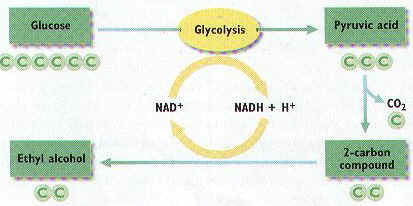
49. If oxygen is NOT present, the products of glycolysis enter a process called _______________.

50. Fermentation is an _____________ process because no ___________ is needed.

51. Name the 2 types of fermentation.


52. Which fermentation occurs in tired muscle cells?

53. _________ acid builds up and makes muscles feel tired.

54. ____________ fermentation in yeasts produces an alcohol called _____________.

55. Fermentation only nets ______ molecules of ATP.

56. Why did Hans Krebs receive the Nobel Prize in medicine in 1953?


57. Why did he have to leave Germany before WWII?

58. Does the Krebs cycle need oxygen?

59. Processes needing oxygen are said to be ____________.

60. How many turns of the Krebs cycle are needed to burn one molecule of glucose?

61. What gas is made during the Krebs Cycle?

62. Where does the Krebs cycle take place?

63. TWO TURNS of the Krebs cycle produces ______ CO2 molecules, ______ NADH, _____FADH, and ____ ATP molecules.

64. Label the parts of the Krebs Cycle.

65. The ETC occurs across the inner membrane of the ____________ and produces ________ as an end product.

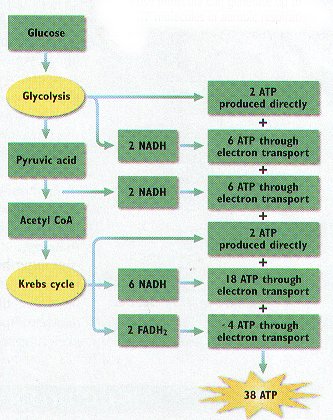
66. The ETC uses the energized electrons carried by the coenzymes __________ and ________ to make 34 ATP’s of energy.

67. Each NADH makes _______ ATP’s, while each FADH makes only ______ ATP’s.


CLICK HERE FOR PRINTABLE COPY


Chapter 1 Questions PPT


Introduction to Biology  

Science of Life

1. Approximately how long ago did life arise on earth?

2. Describe the first organisms.

3. Organisms change or __________ over long periods of time.

4. Today, millions of _________ of organisms exist on earth.

5. The ________ is the basis unit of life and makes up all _____________.

6. _____________ organisms are made of a single cell and are genetically ___________ to their parent cell.

7. Many-celled organisms are known are called _______________ and they may be made of ___________ types of cells.

8. What is true about the size of most cells?

9. Are cells organized?

10. Specialized structures in cells are called _____________.

11. What surrounds all cells?

12. All cells must contain a set of ______________ instructions or DNA.

13. Organisms maintain stable internal conditions called ______________.

14. Name 4 things that organisms must keep stable or balanced.


15. For a species to continue, some of its members must be able to _____________ and pass on their traits to their ______________.

16. What does DNA stand for?

17. DNA’s instructions are called __________ and code for the complex ____________ necessary for life.

18. ___________ cells or body cells each have a full set of _________ or hereditary material.

19. ____________ reproductions combines hereditary information from _____ parents.

20. When an sperm and egg join, a fertilized egg or __________ forms and contains DNA from ________ parents.

21. In ___________ reproduction, only a single parent cell reproduces and the new cells are genetically _____________ to each other and the original cell.

22. _____________, not individual organisms, change or evolve over many generations.

23. ____________ ___________ is the driving force for evolution.

24. According to natural selection, which individuals in a population are more likely to survive and be able to reproduce?


25. A change in population due to the survival & reproduction of organisms with favorable traits is known as what?

26. Define ecology.


27. Name 3 things that organisms need from their environment.

Matter, Energy, & Organization

28. Organisms require a constant supply of ____________.

29. The _________ directly or indirectly supplies the energy for living things.

30. ______________ is the process of capturing sunlight and changing it into stored ____________ energy for organisms.

31. __________ are organisms that can make their own food.

32. _____________ use _________ for photosynthesis converting _________ and _______ into sugar and __________.

33. ______________ use chemicals to get energy.

34. Organisms that can’t make their own food are known as _____________ and may be __________ eating autotrophs, ______________ eating other heterotrophs, or ______________eating both autotrophs and heterotrophs to get energy.

World of Biology

35. the size of an organisms depends on the ___________ of cells that make it up and not the _______ of the cells.

36. Organelles are cell structures that carry out different ___________ for the cell.

37. The sum of all the chemical processes in an organisms is called _____________.

38. _________ is needed for all metabolic processes including growth and reproduction.

39. Homeostasis is when a n organism maintains  ____________ internal conditions such as body temperature.

40. Name 2 processes that result in the growth of an organism.

41. All new cells develop from ______________ cells.

42. new cells ___________ as they mature.

43. The process of an organism become an adult is called ______________ and involves numerous cell ____________ and cell _______________.

44. Do all members of a species have to be able to reproduce for the species to continue?

45. Organisms respond to ____________ from their environment such as light, __________, heat, and touch.

Scientific Method

46. The scientific method begins with _____________ that involves using your senses to perceive objects or events in the natural world.

47. Based on their observations and questioning, scientists make a ________________ that can tested through experimentation.

48. Hypothesis may have to be ___________ after an experiment is done if it is NOT supported by the data.

49. Testing a hypothesis must be done in a ______________ experiment that includes a control group that can be compared to an ______________ group.

50. How many factors may be different between the control group & experimental group?

51. What is this one factor called?

52. The ___________ variable is measured in both groups.

53. Information collected in an experiment is called ___________.

54. When numerical data is collected, it is called _____________ data.

55. _____________ may be used when the population size is too large for the experiment.

56. Collected data must be organized into ___________, ____________, or graphs.

57. A ___________ may be formed from many related hypotheses that have been tested & support the evidence.

58. When scientists complete their experiments they must _________ their work with other scientists.

59. Scientific work may be printed in scientific ____________ or presented as papers as scientific ______________.

Microscopes

60. Microscopes produce an enlarged ____________ of an object due to ____________ of the microscope lenses.

61. The clearness of a microscope image is known as ____________.

62. Arrange these things in order from smallest to largest – fly, animal cell, atom, virus, organelle, bacterial cell.


63. Label the parts of this microscope.


64. Where is the specimen placed in order to view it through a microscope?

65. What lens do you look through at the top of a microscope and what is its magnification?

66. What are the lenses called on the revolving nosepiece?

67. How do you determine the total magnification for a microscope?

68. Which knob should be turned to focus on low power?

69. Which knob should be turned to focus on high power?

70. How should a microscope be carried?


71. What should be done when you are finished using a microscope?


72. The best light microscopes can magnify images up to how many times?

73. What type of microscope can used to view inside of cells that have been thinly sliced?

74. What is total magnification for the TEM?

75. What type of microscope produces a 3-D image of the surface of an object?

76. Can electron microscopes be used to view living specimens?

Measurements

77. Scientists use the _____________ system or _______.

78. The SI system is based on units of _______.

79.The basic metric unit of measure is __________ for mass, _________ for volume, __________ for temperature,  _____________ for length, and __________ for time.

80. What are the most common prefixes used for biology and what do they stand for?


Click HERE for Notebook Copy


Cell Model Instructions


 Cell Model 


    Construct a 3-dimensional eukaryotic plant or animal cell that includes the organelles listed in the table below. Your cell must show all of the cellular organelles listed on the table. These organelles should be LABELED with straight pin “flags” with the FUNCTION of each organelle written on the back  Make sure that your cell has a FLAT NOT round bottom so it will sit on a table or shelf. 

  •  NO FOOD ITEMS MAY BE USED IN THE CONSTRUCTION OF YOUR CELL MODEL! 
  •  DO NOT USE CLAY OR PLAY DOUGH AS THE CELL WILL BE TOO HEAVY OR NOT STAY TOGETHER!


Cellular Organelles
Cell Membrane Nucleus Nucleolus
Cell Wall (plants) Chromatin Rough ER
Smooth ER Attached Ribosomes Mitochondria
Chloroplast (plant) Lysosome Golgi Bodies
 Vacuole Free Ribosomes Centrioles (animal)


ANIMAL CELL

Copyright Pearson Education, Inc.

PLANT CELL

Copyright Pearson Education, Inc.