Cell Membrane PPT Qs BI


Transport Across Membranes
PowerPoint Questions

Membrane Structure

1. Cell membranes of unicellular organisms are ____________ so the organism can move.

2. What is meant by homeostasis?

3. Homeostasis is also called __________________.

4. How does the plasma membrane help maintain homeostasis?


5. Give 7 functions of the plasma membrane.

    a.

    b.

    c.

    d.

    e.

    f.

    g.

6. What is meant by the term selectively permeable?

7. What are cell junctions?

8. Fluid inside the cell is called _________________.

9. Label the plasma membrane (phospholipids, cholesterol, peripheral proteins, integral proteins, cytoskeleton, glcocalyx…)

10. A ________________ bilayer makes up most of the cell membrane.

11. Are phospholipids heads polar or nonpolar? the tails?

12. How many fatty acid chains are in a phospholipid?

13. Describe the heads of a phospholipid.

14. The __________ _____________ ___________ describes the appearance of the cell membrane.

15. Why is the cell membrane said to act like a fluid?


16. What causes the mosaic pattern of the cell membrane when viewed from above?

17. The phospholipid ____________ of the cell membrane allows ____________ molecules to pass through easily, but _________________ do NOT.

18. Materials soluble in __________ can pass easily through the cell membrane.

19. Because the cell membrane is ___________________, only ___________ molecules and larger _______________ molecules can move through easily.

20. List 3 substances that pass easily through the cell membrane.

21. _________, _____________ molecules larger than water, and large __________ molecules do NOT move easily through the phospholipids of the cell membrane.

Types of Membrane Transport

22. Simple ____________ requires NO energy to move things across the cell membrane.

23. With simple diffusion, molecules move from an area of ________ concentration to an area of ______ concentration.

24.Why is diffusion considered a passive process?

25. With diffusion, molecules move by their own natural __________ energy or energy of motion.

26.  Explain what happens to a drop of food coloring put into a beaker of water.


27. When solutes diffuse through a membrane, they move from __________ to _________ concentration.

28. __________ is the diffusion of _________ across a cell membrane.

29. If water potential is HIGH, solute concentration is __________.

30. If water potential is LOW, solute concentration is ___________.

31. Water moves from _________ water potential to ________ water potential.

32. Water diffuses through the pores called _____________ of the cell membrane.

33. Sketch a picture of a cell in an isotonic environment & show the direction of water movement?


34. What is meant by NO NET movement?

35. Sketch a picture of a cell in an Hypotonic environment & show the direction of water movement?


36. Sketch a picture of a cell in an hypertonic environment & show the direction of water movement?


37. Complete the following table:


Direction of Osmosis
Environmental Condition Net Movement of water What happens to cell
Hypotonic
Hypertonic
Isotonic


38. _____________ occurs whenever water moves out of a cell & the cell shrinks in size.

39. _____________ occurs whenever water moves into the cells causing them to swell and burst.

40. Explain what happens to a red blood cell placed in:

     a. distilled water

     b. a concentrated salt solution

41. Complete the following drawings.

42. Plants prefer ________________ environments, while animal cells do best in _____________ environments.

43. Describe these 3 types of movement across cell membranes.

     a. simple diffusion


     b. facilitated diffusion


    c. active transport


44. Passive transport does _______ require additional energy & moves materials from ________ to _________ concentration.

45. Give 2 examples of passive transport in cells.


46. ___________ diffusion is a type of __________ transport because energy is NOT required.

47. Facilitated diffusion uses _____________ proteins to help move materials from _________ to __________ concentrations.

48. Name 2 materials that move into or out of cells by facilitated diffusion.

49. name 2 types of transport proteins found in cell membranes.

50. Describe channel proteins.

51. How do carrier proteins help move materials across a cell membrane?

52. Channel proteins have an opening or ___________ through which molecules can passively move by _____________ diffusion.

53. Do all carrier proteins extend across the cell membrane?

54. Explain how these carrier proteins move materials across the membrane.


55. Some carrier proteins can change ________ to move materials across the cell membrane.

56. __________ transport requires additional energy to move materials.

57. Active transport uses cellular energy known as _________.

58. Active transport moves materials AGAINST the concentration gradient or from _________ to ___________ concentration.

59. The _______________ pump is an example of active transport.

60. The sodium-potassium pump moves _______ sodium ions out for every ______ potassium ions moved into the cell creating voltage across the cell called the ____________ potential.

61. Moving very large particles out of the cell is called _____________.

62. In exocytosis, wastes are moved out of the cell in ___________ that fuse with the cell membrane.

63. __________ involves moving large particles into the cell.

64. taking in large liquid droplets is called ____________ or “cell drinking”.

65. __________ ____________ endocytosis involves protein ____________ recognizing hormones to help move them into the cell.

66. How does cholesterol get into a cell?

67. “Cell eating” is known as ______________.

68. White blood cells engulfing bacteria is an example of _____________.

69. _____________ is the opposite of exocytosis.


Cell Respiration


Cellular Respiration
All Materials © Cmassengale


C6H12O6 + 6O2 —–> 6CO2 + 6H20 + energy (heat and ATP)

Energy

  • Capacity to move or change matter
  • Forms of energy are important to life include Chemical, radiant (heat & light), mechanical, and electrical
  • Energy can be transformed from one form to another
  • Chemical energy is the energy contained in the chemical bonds of molecules
  • Radiant energy travels in waves and is sometimes called electromagnetic energy. An example is visible light
  • Photosynthesis converts light energy to chemical energy
  • Energy that is stored is called potential energy

Laws of Thermodynamics

  • 1st law- Energy cannot be created or destroyed.

    Energy can be converted from one form to another. The sum of the energy before the conversion is equal to the sum of the energy after the conversion.

  • 2nd law- Some usable energy is lost during transformations.

    During changes from one form of energy to another, some usable energy is lost, usually as heat. The amount of usable energy therefore decreases.


Adenosine triphosphate (ATP)

  • Energy carrying molecule used by cells to fuel their cellular processes
  • ATP is composed of an adenine base, ribose sugar, & 3 phosphate (PO4) groups


  • The PO4 bonds are high-energy bonds that require energy to be made & release energy when broken


  • ATP is made & used continuously by cells
  • Every minute all of an organism’s ATP is recycled
  • Phosphorylation refers to the chemical reactions that make ATP by adding Pi to ADP ADP + Pi + energy «  ATP + H2O
  • Enzymes  (ATP synthetase& ATPase) help break & reform these high energy PO4 bonds in a process called substrate-level phosphorylation
  • When the high-energy phosphate bond is broken, it releases energy, a free phosphate group, & adenosine diphosphate (ADP)


Enzymes in Metabolic Pathways:

  • Biological catalysts
  • Speeds up chemical reactions
  • Lowers the amount of activation energy needed by weakening existing bonds in substrates

  • Highly specific protein molecules
  • Have an area called the active site where substrates temporarily join
  • Form an enzyme-substrate complex to stress bonds
  • Enzyme usable

enzyme substrate complex

 
Energy Carriers During Respiration:

NADH: A second energy carrying molecule in the mitochondria; produces 3 ATP


FADH2: A third energy carrying molecule in the mitochondria; produces 2 ATP


Mitochondria:

  • Has outer smooth, outer membrane & folded inner membrane
  • Folds are called cristae
  • Space inside cristae is called the matrix & contains DNA & ribosomes
  • Site of aerobic respiration
  • Krebs cycle takes place in matrix
  • Electron Transport Chain takes place in cristae 

Cellular Respiration Overview:

C6H12O6 + 6O2 —–> 6CO2 + 6H20 + energy (heat and ATP)

  • Controlled release of energy from organic molecules (most often glucose)
  • Glucose is oxidized (loses e-) & oxygen is reduced (gains e-)
  • The carbon atoms of glucose (C6H12O6) are released as CO2
  • Generates ATP (adenosine triphosphate)


  • The energy in one glucose molecule may be used to produce 36 ATP
  • Involves a series of 3 reactions — Glycolysis, Kreb’s Cycle, & Electron Transport Chain

Glycolysis:

  • Occurs in the cytoplasm
  • Summary of the steps of Glycolysis:

    a. 2 ATP added to glucose (6C) to energize it.

    b. Glucose split to 2 PGAL (3C). (PGAL = phosphoglyceraldehyde)

    c. H+ and e- (e- = electron) taken from each PGAL & given to make 2 NADH.

    d. NADH is energy and e- carrier.

    e. Each PGAL rearranged into pyruvate (3C), with energy transferred to make 4 ATP (substrate phosphorylation).

    f. Although glycolysis makes 4 ATP, the net ATP production by this step is 2 ATP (because 2 ATP were used to start glycolysis). The 2 net ATP are available for cell use.

    g. If oxygen is available to the cell, the pyruvate will move into the mitochondria & aerobic respiration will begin.


    Net Yield from Glycolysis
    4 NADH2
    2 CO2
    4 ATP ( 2 used to start reaction)


h. If no oxygen is available to the cell (anaerobic), the pyruvate will be fermented by addition of 2 H from the NADH (to alcohol + CO2 in yeast or lactic acid in muscle cells). This changes NADH back to NAD+ so it is available for step c above. This keeps glycolysis going!


Alcoholic Fermentation


Lactic Acid Fermentation


Aerobic Respiration:

  • Occurs in the mitochondria
  • Includes the Krebs Cycle & the Electron Transport Chain
  • Pyruvic acid from glycolysis diffuses into matrix of mitochondria & reacts with coenzyme A to for acetyl-CoA (2-carbon compound)
  • CO2 and NADH are also produced

Kreb’s Cycle:

  • Named for biochemist Hans Krebs
  • Metabolic pathway that indirectly requires O2 
  • Kreb’s Cycle is also known as the Citric acid Cycle
  • Requires 2 cycles to metabolize glucose
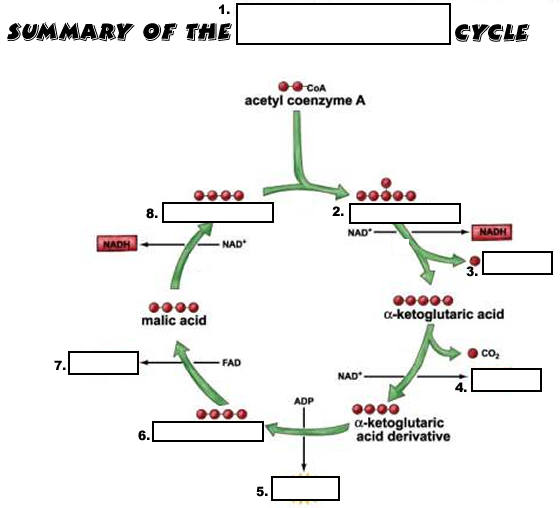
  • Acetyl Co-A (2C) enters the Kreb’s Cycle & joins with Oxaloacetic Acid (4C) to make Citric Acid (6C)
  • Citric acid is oxidized releasing CO2 , free H+, & e- and forming ketoglutaric acid (5C)
  • Free e- reduce the energy carriers NAD+ to NADH2 and FAD+ to FADH2
  • Ketoglutaric acid is also oxidized releasing more CO2 , free H+, & e-
  • The cycle continues oxidizing the carbon compounds formed (succinic acid, fumaric acid, malic acid, etc.) producing more CO2, NADH2, FADH2, & ATP
  • H2O is added to supply more H+
  • CO2 is a waste product that diffuses out of cells
  • Oxaloacetic acid is regenerated to start the cycle again
  • NADH2 and FADH2 produced migrate to the Electron Transport Chain (ETC)


Net Yield from Kreb’s Cycle (2 turns)
6 NADH2
2 FADH2
4 CO2
2 ATP


Electron Transport Chain:

  • Found in the inner mitochondrial membrane or cristae
  • Contains 4 protein-based complexes that work in sequence moving H+ from the matrix across the inner membrane (proton pumps)
  • A concentration gradient of H+ between the inner & outer mitochondrial membrane occurs
  • H+ concentration gradient causes the synthesis of ATP by chemiosmosis
  • Energized e- & H+ from the 10 NADH2 and 2 FADH2 (produced during glycolysis & Krebs cycle) are transferred to O2 to produce H2O (redox reaction)

O2  +  4e-  +  4H+  2H2O


Energy Yield from Aerobic Respiration
Glycolysis Kreb’s Cycle Total
4 NADH2 6 NADH2 10 NADH2 x 3 = 30 ATP
0 FADH2 2 FADH2 2 FADH2 x 2 = 4 ATP
2 ATP 2 ATP                          4 ATP
38 ATP


  • Most cells produce 36- 38 molecules of ATP per glucose (66% efficient)
  • Actual number of ATP’s produced by aerobic respiration varies among cells


Cell Reproduction Lecture Notes B1

Cell Reproduction Lecture Guide

SECTION 8-1    CHROMOSOMES

DNA stores?                        Estimated length?

Coiled DNA in eukaryote nucleus called?

Chromosome shape?                              Made of?

Can be seen inside nucleus by?

Histones?

Function of histones?

Function of nonhistone proteins?

Sister chromatids?

When form?

Centromere?

Function of centromere?

Sketch sister chromatids & label centromere.

Prokaryotic chromosomes?

Shape?                         Number?                     Location & attachment?

Number of chromosomes in human body cells?               Called what?

How abbreviated?

Are all diploid numbers in organisms the same?   Explain and give examples.

Human body cells called what?               Examples?

Reproductive cells are called?                        Name them.

Chromosome number of gametes?                              Abbreviation?

Haploid number also called?                                      Haploid number for humans?

Fertilization?

Chromosome number that fertilization restores?

Fertilized egg called?                          Sets of chromosomes in zygote?

Chromosomes in egg and sperm called?             Name them.

Sex chromosomes of female?                                 Male?

Other 22 pairs or 44  chromosomes called?

Karyotype?

Homologous pairs of chromosomes?

Example of information contained in homologs.

SECTION 8-2    CELL DIVISION

All cells come from?                          Process called?                     

Same in prokaryotes & eukaryotes?

Binary fission?

Used by?                               Number of steps or stages.

Stage 1 of binary fission?

Stage 2 of binary fisssion?

Stage 3 of binary fission?

Is binary fission sexual or asexual reproduction?

Original cell that forms eukaryotes is called?

How new cells compare to each other & the original cell after cell division? Why?

Phases cell goes through in its life cycle called?

Number of phases?                  Name them.

Two parts of cell division?

Mitosis?

Interphase?

Also called?                          Length in cell cycle?

What’s occurring to cells in interphase?

Number of phases in interphase?                   Name them.

G1 phase?

S phase?

G2 phase?

Replication?

Results in forming?                                            Occurs when?

Why all new cells must have exact copy of DNA?

Daughter cells?

How form?                                       Compare to each other?

Two steps of cell division called?

Another name for mitosis?                                    What’s dividing?

Division of the cytoplasm called?                          When occurs?

Parent cell?

How multicellular organisms grow?

Number of steps or phases in mitosis?            Name them in order.

What’s made during mitosis?

When did the chromosomes replicate (make copies of the DNA)?

Prophase?

Chromatin condenses into what?                                 Held together by?

Two structures that disappear in prophase?

Centrosomes located near?                                        Number of centrosomes?

Contain what cylindrical bodies?                                 Found in plant &/or animal cells?
Made of bundles of?                                                   Where centrosomes move?

Help form?

Function of mitotic spindle?

Two types of spindle fibers?

Attach to centromere of sister chromatids?                                          Function?

Metaphase?

             Where are chromosomes moved?

What moves the chromosomes?

Center of cell called?                                        Ends of cell called?

Anaphase?

What happens to sister chromatids?

Once chromatids separate, they’re now individual what?

Telophase?

What happens to spindle fibers?

Chromosomes again tightly coil becoming what?

What two structures reform?

Cytokinesis?

How occurs in animal cells?

How occurs in plant cells?

How many new cells formed?                                    Cells called?

Size of new cells to each other?                   Size of new cells & parent cell?

Daughter cells & parent cell genetically identical or different?

Is mitosis sexual or asexual reproduction?

SECTION 8-3    MEIOSIS

Meiosis?

What happens to chromosome number?

Cells produced by meiosis are called?              Their chromosome number?

Fusion of gametes?                                                      Effect on chromosome number?

Number of chromosomes in human egg?               Sperm?            Zygote?

Sexual reproduction?

Combines what 2 cells?                                                Forms what cell?

Eggs?

Sperm?

How sperm reaches nonmotile egg?

Gametes produced by what process?

Where occurs in females?                                            In males?

What called in females?                                               In males?

Diploid egg or sperm after meiosis have what chromosome number?

How do daughter cells made in meiosis compare to the original cell?

How many divisions do cells undergo during meiosis?

How many new cells are produced?

How many main stages are there in meiosis?                                   Name them.

What occurs in Meiosis I?

What occurs in Meiosis II?

Chromosome number at the beginning of Meiosis I?

Homolog?

Synapsis?

Pair of homologs after synapsis called?                                    Sketch a tetrad.

First step in Meiosis I called?

            Are chromosomes visible?

Chromosome number in meiosis I?

Genes?

Crossing over?

Genetic recombination?

What 2 structures disappear?

What structure appears & attaches to homologs?

Where are tetrads moved during Metaphase I?

What happens to homologs in Anaphase I?

            What separates the homologs?

Random separation of homologous chromosomes called?

What happens to cytoplasm during Telophase I?

Chromosome number of new cells?                             How many new cells formed?

Do chromosomes replicate before Meiosis II?

            Name the 4 steps in Meiosis II.

How many new cells form in males?                          In females?

Polar bodies?

What usually happens to polar bodies? Why?

New cells in females called?                                      Cells after maturing called?

New cells in males called?                                         Cells after maturing called?

Chromosome number of new cells?

Evolution?

Which type of reproduction causes change in organisms?

Reproduction involving one parent?                                               Give 3 examples.

Chromosome number of parent & new cells?

Reproduction involving two parents?

Chromosome number of parent cell?                           Chromosome number of new cells?

Are organisms in a sexually reproducing population genetically identical?

Variations?

“Survival of the fittest”?

How environmental changes affect asexually reproducing organisms?        Sexually reproducing organisms?

BACK

Chapter 2 – Chemistry Outline


Student Name
Date
Period
Chapter 2        Chemistry Outline
I. Composition of Matter
         A. Matter
  * 1.1  1. Makes up everything
             2. Occupies space & has mass
             3. Mass – quantity of matter making up an object
             4. Pull of gravity produces weight
             5. Chemical changes in matter necessary for life processes
   B. Elements and Atoms
           1. Pure substances that can’t be chemically broken down
           2. about 30 elements important to organisms
           3. Most common elements are C, H, O, N
           4. Symbols (1-2 letters) stand for elements
             5. May use Latin or Greek  e.g. Na – sodium (natrium)
*1.2 6. Simplest part of an element with the same properties
                                
 C. Nucleus
           1.  Most of the mass
           2. Central part of an atom
           3.

Cell Respiration Study Guide B1

Chapter 7        Study Guide        Cellular Respiration

1. Most eukaryotic cells produce only about ___________  ATP Molecules per Glucose Molecule.
2. What is the process by which glucose is converted to pyruvic acid?

3. At the begining of aerobic respiration, pyruvic acid bonds to a molecule called _______________________ to form Acetyl CoA.
4. The breakdown of pyruvic acid in the presence of oxygen is called ___________________  _______________________.

5. With every completion of the Krebs Cycle, how many ATP Molecules are made?
6. What is the waste product of the Krebs Cycle?

7. The conversion of pyruvic acid to carbon dioxide and ethanol is called _____________________   _______________________.

8. The release of energy from food molecules in the absence of oxygen is _______________________     _____________________________.

9. What is the byproduct of the electron transport Chain?

10. How efficient is Anaerobic Respiration? __________%  Aerobic Respiration?

11. What is the first pathway of cellular respiration called?

12.What is the location of Glycolysis?

13. What is the scientific unit of Energy?

14. What do you call cellular respiration in the presence of oxygen?

15. Yeast produces ___________________ and _________________ in the process known as _____________________  _______________________.

16. In cellular respiration, glycolysis proceeds the _________________.

17. In cellular respiration, more energy is transferred in the  ________________ than in any other step.

18. Glucose molecules are converted into ________________  ______________ molecules in the process of glycolysis.

19. What is the location of the electron transport chain in prokaryotes?

20. The processes of glycolysis and the anaerobic pathways is called _________________.

21. What is the product of acetyl CoA and oxaloacetic acid?

22. What molecule is the electron acceptor of glycolysis?

23. The breakdown of organic compounds to produce ATP is known as __________  __________.
24. Glycolysis begins with glucose and produces _____________  ______________.

25. An important molecule generated by both lactic acid and alcoholic fermentation is ____________.

26.  In the first step of aerobic respiration, pyruvic acid from glycolysis produces CO2, NADH, H+, and ____________  ______________.

27. The electron transport chain is driven by two products of the Krebs Cycle – ______________________  and  ___________________________.
28. What happens to electrons as they are transported along the electron transport chain?

29. The energy efficiency of aerobic respiration (including glycolysis) is approximately ______________  ____________________.

30. Where in the mitochondria do the reactions of the Krebs cycle occur?

31. Where in the mitochondria is the electron transport chain located?

32. In alcoholic fermentation, ethyl alcohol is produced from ____________________.

33.  _______________, and ________________ supply electrons and protons to the electron transport chain.

34. The fourth step of glycolysis yields four ATP molecules, but the net yield is only two ATP molecules.  Explain this discrepancy.

35. Under what conditions would cells in your body undergo lactic-acid fermentation?

36. Glycolysis produces only 3.5% of the energy that would be produced if an equal quantity of glucose were completely oxidized.  What has happened to the remaining energy in the glucose?

37. Explain the role of oxaloacetic acid with respect to the cyclical nature of the Krebs cycle.

38  What happens to electrons that accumulate at the end of the electron transport chain?

39. Where in the mitochondrion do protons accumulate, and what is the source of the protons?

Back