Campbell Problem 6

Molecular Genetics Problem 6
6. A space probe discovers a planet inhabited by creatures who reproduce with the same hereditary patterns as those in humans. Three phenotypic characters are height (T = tall, t = dwarf), hearing appendages (A = antennae, a = no antennae), and nose morphology (S = upturned snout, s = downturned snout). Since the creatures were not “intelligent” Earth scientists were able to do some controlled breeding experiments, using various heterozygotes in testcrosses. For a tall heterozygote with antennae, the offspring were tall-antennae, 46; dwarf-antennae 7; dwarf-no antennae 42; tall-no antennae 5. For a heterozygote with antennae and an upturned snout, the offspring were antennae-upturned snout 47; antennae-downturned snout, 2; no antennae-downturned snout, 48: no antennae-upturned snout 3. Calculate the recombination frequencies for both experiments.

Experiment 1 (Frequency/Distance between T and A).

Determine the recombination frequency for the genes controlling Tallness and Antennae:

46 tall-antennae = 46% expected
42 dwarf-no antennae = 42% expected
7 dwarf-antennae = 7% recombinant
5 tall-no antennae = 5% recombinant

Total = 100

Therefore this recombination frequency between genes T and A is 12%

Experiment 2. (Frequency/Distance between A and S)

Determine the recombination frequency for the genes controlling Antennae and Snout:

47 antennae-upturned snout = 47% expected
48 no antennae-downturned snout = 48% expected
2 antennae-downturned snout = 2% recombinant
3 no antennae-upturned snout = 3% recombinant

Total = 100

Therefore this recombination frequency between genes A and S is 5%

BACK 

Campbell Problem 8

Molecular Genetics Problem 8
8. Imagine that a geneticist has identified two disorders that appear to be caused by the same chromosomal defect and are affected by genomic imprinting: blindness and numbness of the limbs. A blind woman (whose mother suffered from numbness) has four children, two of whom, a son and daughter, have inherited the chromosomal defect. If this defect works like Prader-Willi and Angelman syndromes, what disorders do this son and daughter display? What disorders would be seen in their sons and daughters?

In Prader-Willi and Angelman syndromes the type of symptom exhibited in the offspring depends upon which parent contributes the defective chromosome.

In this case children receiving a defective chromosome from the father will suffer from numbness and children receiving a defective chromosome from the mother will be blind.

The pedigree below helps to sort out how the imprinting works.


BACK 

Biomes of the World Solution

Biomes of the World Solution
T + + + C D A R + R L + T + + + S + + E I E B E + A + U + + + + E S + M T T I + D E N + + + + E R U E A O + O I M D H + + R + S O W R + I + T O R E R T + N + H F C O + B R I A R E + O + S + + N A V + E B C B C C + E + + + + I R I T + + I U + R S A V A N N A N N + + V D F E N I R A M + + R I M + O O G R A S S L A N D + A V O R R S U O U D I C E D G + + O E P + + + + + + + + I + + + + R + + + + + + + + A + + + + + + E + + + + + + T + + + + + + + + (Over,Down,Direction) ABIOTIC(7,1,SE) BIOME(12,7,N) BIOTIC(10,6,NW) CARNIVORE(7,6,SE) CONSUMER(1,8,NE) DECIDUOUS(9,12,W) DESERT(6,1,SW) FRESHWATER(1,10,NE) GRASSLAND(1,11,E) HERBIVORE(14,4,S) INTERTIDAL(11,10,N) MARINE(7,10,W) OMNIVORE(13,11,NW) PRODUCER(15,12,N) RAINFOREST(10,10,NW) SAVANNA(3,9,E) TAIGA(7,15,NE) TUNDRA(13,1,S)


Biotechnology Notes Bi


DNA Technology
All Materials © Cmassengale

Introduction:

  • Biotechnology refers to technology used to manipulate DNA
  • The procedures are often referred to as genetic engineering
  • DNA is the genetic material of all living organisms
  • All organisms use the same genetic code
  • Genes from one kind of organism can be transcribed and translated when put into another kind of organism
  • For example, human and other genes are routinely put into bacteria in order to synthesize products for medical treatment and commercial use
  • Human insulin, human growth hormone, and vaccines are produced by bacteria
  • Recombinant DNA refers to DNA from two different source
  • Individuals that receive genes from other species are transgenic

Viruses & their Structure:

  • Viruses contain genetic material but are not living
  • Host cells are required for their reproduction
  • Viruses are composed of an inner nucleic acid core (genetic material) and an outer protein coat (capsid)
  • Viruses that infect animals have an outer envelope (membrane) that is derived from the cell membrane of the host cell may surround the capsid
  • The genetic material in some viruses is DNA; in others it is RNA


Viral Reproduction:

  • When viral genetic material enters a cell, it is replicated, transcribed (mRNA is produced) and translated (proteins are produced from the mRNA) by the host cell
  • By this process, the host cell uses the genetic instructions in the virus to make more viruses

Viral DNA ® mRNA ® protein

  • If the viral genetic material is RNA, a DNA copy must first be made before transcription and translation can occur
  • The DNA copy of the viral RNA is called cDNA.

viral RNA ® cDNA ® mRNA ® protein

Bacteriophages:

  • Bacteriophages are viruses that infect bacteria
  • Not surrounded by a membrane as the animal-infecting viruses
  • Virus attaches to the bacteria cell, a viral enzyme digests away a part of the wall, and its viral DNA enters the host cell
  • Inside the host cell, the viral DNA is transcribed, translated, and replicated
  • Translation produces protein coats and the enzymes needed in the construction of new virus particles
  • Viral DNA is replicated
  • The protein coats and DNA are assembled into new viral particles
  • The host cell wall to ruptures releasing the newly formed viruses

  • Upon entering the cell, the viral DNA may instead, become integrated into the bacterial DNA
  • It is replicated along with the host DNA when the host reproduces
  • Eventually, it will become transcribed and translated

Retroviruses:

  • Contain RNA & the enzyme reverse transcriptase
  • Reverse transcriptase can make a DNA copy of the viral RNA
  • The new DNA produced from the RNA template is called cDNA
  • DNA synthesis follows the production of cDNA to produce a double-helix
  • cDNA then becomes incorporated into the host DNA (called a prophage)
  • The new viruses escape the host cell by budding
  • The AIDS virus (HIV) is an example of a retrovirus


Vectors

  • Vectors are used to transfer genes into a host cell
  • Plasmids & viruses are the most commonly used vectors
  • A vector must be capable of self-replicating inside a cell
  • Viruses are the vectors of choice for animal cells
  • Marker genes can be used to determine if the gene has been taken up

Plasmids:

  • Small rings of DNA in bacterial cells
  • Used to transfer genes to other organisms
  • Host bacterium takes up the plasmid, which includes the foreign gene
  • When bacteria reproduce, plasmids with the new gene are also reproduced 
  • This clones (copies) the gene each time the bacteria reproduces

Viruses:

  • Can accept larger amounts of DNA than plasmids
  • Once the virus enters the host cell, it also reproduces the foreign gene it carries
  • The copied gene is “cloned”


Restriction enzymes:

  • Restriction enzymes were discovered in bacteria
  • Bacteria use them as a defense mechanism to cut up the DNA of viruses or other bacteria
  • Hundreds of different restriction enzymes have been isolated
  • Each restriction enzyme or RE cuts DNA at a specific base sequence
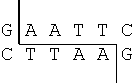
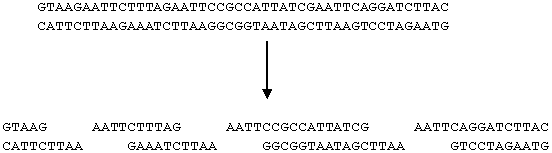
  • For example, EcoRI always cuts DNA at GAATTC as indicated below

  • The sequence GAATTC appears three times in the DNA strand below. As a result, the strand is cut into four pieces

  • Other restriction enzymes cut at different sites, some examples are listed below


Enzyme Cutting Site
Bam HI GGATCC
Hae III GGCC
Pst I CTGCAG
Hind I GANTC


Sticky Ends & Recombinant DNA:

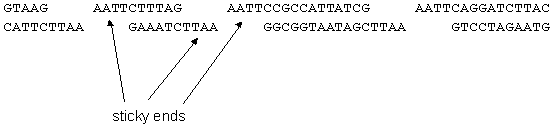
  • Fragments of DNA that has been cut with restriction enzymes have unpaired nucleotides at the ends called sticky ends

  • Sticky ends have complimentary bases, so they could rejoin
  • If the vector and the gene to be cloned are both cut with the same restriction enzyme, they will both have complimentary sticky ends
  • After cutting, the 2 DNA samples are mixed
  • Fragments with complementary sticky ends join together forming recombinant DNA (contains gene from vector & the gene to be cloned)
  • Enzyme DNA ligase seals the fragments together
  • Bacteria such as Escherichia coli are capable of taking up DNA from their environment
  • This process is called transformation
  • CaCl2 and a procedure called heat shock are used to make E. coli cells more permeable so that they take up the modified plasmids more readily

Genomic Libraries:

  • A genome is all of the genes in a particular organism
  • Bacteria or virus vectors can be used to store fragments of the DNA from another species
  • The DNA is cut up into fragments, and the different fragments are inserted into bacteria or viruses
  • The collection of bacteria or viruses is called a genomic library

Polymerase Chain Reaction (PCR):

  • Used to make many copies of small pieces of DNA
  • Procedure requires primers, DNA polymerase, and nucleotides
  • Primers are short chains of about 20 nucleotides that are complimentary to a region in the DNA to be amplified
  • DNA polymerase cannot continue the process unless it has already been started by primers
  • Nucleotides are needed because DNA is composed of nucleotide “building blocks”

  • The DNA is heated to approximately 95o C to separate the two strands of the double helix

  • After the strands are separated, the DNA is cooled to about 50o C, and the primers attach
  • The temperature is raised to approximately 70o C so the polymerase will attach to & copy the strand

  • The DNA replication process repeats itself as the solution is then heated and cooled at regular intervals


DNA Fingerprinting (RFLP Analysis):

  • In RFLP analysis, the DNA of an organism is cut up into fragments using restriction enzymes producing a large number of short fragments of DNA
  • Because no two individuals have identical DNA, no two individuals will have the same length fragments
  • Gel electrophoresis is a technique used to separate the DNA fragments according to their size
  • The fragments are placed in wells on a sheet of gelatin, and an electric current is applied to the sheet
  • DNA is negatively charged and will move in an electric field toward the positive pole

  • The smallest fragments will move the fastest because they are able to move through the pores in the gelatin faster
  • Bands will be produced on the gelatin where the fragments accumulate
  • Shortest fragments will accumulate near one end of the gelatin (furthest from the wells), and the longer, slower-moving ones will remain near the other end
  • DNA bands must be stained to make them visible


Gene Products & Uses of Genetic Engineering:

  • E. coli is used to produce proteins such as insulin by genetic engineering because it is easily grown
  • To recover the product, E. coli must be lysed or the gene must be linked to a gene that produces a naturally secreted protein
  • Yeasts can be genetically engineered and are likely to secrete the gene product continuously
  • Mammalian cells can be engineered to produce proteins such as hormones for medical use
  • Plant cells take up a plasmid from Agrobacterium
  • Plant cells can be engineered and used to produce plants with new properties such as Roundup Ready soybeans
  • Pseudomonas bacteria has been engineered to produce Bacillus thuringiensis or BT
  • BT bacteria make a toxin against insects, thus producing a natural insecticide   (example – B.T. cotton)
  • Animal viruses can be engineered to carry a gene for a pathogen’s surface protein so the virus can be used as a vaccine 
  • Genetic engineering techniques are being used to map the human genome through the Human Genome Project
  • Could provide tools for diagnosis and possible repair of genetic disease
  • Recombinant DNA techniques can be used for genetic fingerprinting
  • Gene therapy can be used to cure genetic diseases by replacing the defective or missing gene
  • Bovine growth hormone (BGH) increases milk production in cows by about 10%

Safety and Ethical Issues:

  • Harmful organisms may be accidentally produced
  • Organisms that are intended to be released in the environment may be engineered with genes that will eventually kill them
  • There is little legislation on the use of genetic screening and information produced by screening
  • The technology is increasing the ability to diagnose genetic diseases pre-natally, adding new complexity to the abortion controversy
  • Ethical questions have been raised over whether we should modify the genes of humans
  • Genetic screening and gene therapy are expensive and may be unavailable to the poor
  • Biological weapons could be created using biotechnology

Ap Unit 6 Heredity Study Guide


Unit 5    Molecular Genetics  Study Guide 


ü     Be able to describe & explain the experiments of the following scientists:
Frederick Griffith
Erwin Chargraff
Alfred Hershey
Martha Chase
Watson & Crick
Meselson & Stahl
Beadle & Tatum
“Dolly” experiment

ü     Know how DNA replicates including steps & the enzymes involved, energy required, nucleotides, leading & lagging strands, proofreading

ü     Be able to describe the ultrastructure of each component of the DNA & RNA molecules

ü     Know the steps of transcription, enzymes involved, etc

ü     Know the steps of translation, enzymes involved, etc.

ü     Be able to describe the structure & function of free and bound ribosomes

ü     Know the processing steps of newly made mRNA

ü     Know the types of mutations and their effects

ü     Know viral structure, reproduction, host recognition, viral genome, etc

ü     Be able to describe the prokaryotic genome, mechanisms for genetic recombination, & defenses against phages

ü     Differentiate between hetero- & euchromatin

ü     Know the function and use of restriction enzymes

ü     Be able to describe genomic differentiation

BACK